

ADHD medication management has no single standard cost in 2026: your total depends on the evaluation, follow-up care, prescription, and insurance benefits. The appointment charge usually does not include the medication you pick up at the pharmacy. To get a useful estimate, ask for the initial evaluation and ongoing follow-up charges separately, then verify your prescription coverage.
- How much does ADHD medication management cost? Compare evaluation, follow-up, and pharmacy expenses separately.
- Insurance coverage for psychiatric appointments does not establish coverage for an ADHD prescription.
- Attuned Psychiatry provides physician-led medication management in Decatur and Metro Atlanta.
- Ask about follow-up requirements before comparing providers by appointment charge alone.
How much does ADHD medication management cost?
The useful comparison is your complete care plan, not an advertised appointment charge. An initial evaluation, ongoing prescribing appointments, and pharmacy purchases serve different purposes. They can also fall under different insurance benefits.
Use this breakdown when requesting an estimate. For broader context on choosing a prescriber, see the guide to psychiatrists in Atlanta for medication management.
| Component | What it addresses | What to confirm before care |
|---|---|---|
| Initial evaluation | Symptoms, history, diagnostic assessment, and treatment planning | Whether the quoted charge covers the full evaluation |
| Follow-up appointments | Medication response, side effects, functioning, and prescribing decisions | Your responsibility per appointment and the expected follow-up plan |
| Prescription medication | The medication dispensed by the pharmacy | Coverage for the exact drug, formulation, and prescribed quantity |
| Additional assessment | Testing or medical assessment when clinically indicated | Whether it is needed and billed separately |
| Administrative services | Forms or other services outside an appointment | Whether a separate charge applies |
Not every patient needs every service in this table. Ask the clinician which services belong in your plan rather than assuming that a larger package is necessary.
An estimate should also distinguish the starting phase from ongoing treatment. A medication change can require closer follow-up than a stable treatment plan, so a recurring budget based only on the first appointment is incomplete.
Why this matters
An appointment and a prescription are not interchangeable purchases. Medication management includes deciding whether medication is appropriate, checking its effects, and responding when treatment is ineffective or causes problems.
The cheapest appointment is not automatically the least expensive care plan. You also need to understand follow-up requirements, insurance billing, and how the practice handles treatment questions between appointments.
Do not reduce or skip prescribed care to meet a budget without discussing the problem with your clinician. Tell the prescriber when appointment or pharmacy expenses make the plan difficult to follow. That information belongs in treatment planning.
Initial evaluation: clarify what the appointment includes
The initial evaluation establishes what needs treatment. Difficulty concentrating can occur with ADHD, but sleep problems, anxiety, depression, substance use, and other conditions can also affect attention.
Ask whether the appointment includes diagnostic assessment and treatment planning. An appointment described as an evaluation does not promise an ADHD diagnosis or a prescription, and a responsible assessment should not start with that promise.
Bring information that helps the clinician understand your symptoms:
- Previous ADHD assessments and psychiatric records.
- Current medications, supplements, and prior medication trials.
- Examples of difficulties at work, at home, or in school.
- Relevant medical history and sleep concerns.
- Insurance information and referral requirements, if applicable.
If another clinician diagnosed ADHD, ask whether the new practice needs those records before the appointment. Prior records provide context; they do not replace the receiving clinician's assessment.
Follow-up care: budget for monitoring, not just refills
Follow-up appointments assess whether treatment improves daily functioning and whether its benefits justify its risks. Your clinician can review attention, organization, sleep, appetite, mood, and other relevant effects.
The appropriate schedule depends on your clinical situation. Starting treatment, changing medication, and continuing an established plan are different stages; do not assume they have identical follow-up requirements.
Before committing to ongoing care, ask:
- What determines when the next appointment is needed?
- How are side effects or worsening symptoms handled between appointments?
- What is the process for requesting prescriptions?
- Which services require a separate appointment?
- What happens if insurance approval delays treatment?
A clear follow-up policy is part of a useful estimate. A low appointment charge tells you little if you do not know which appointments your treatment requires.
Prescription medication: check the exact formulation
The pharmacy expense is separate from the work of evaluating and prescribing. Your insurer's medical benefits and prescription benefits can apply different rules, even when both appear on the same insurance card.
Ask the pharmacy or prescription benefit administrator about the exact medication prescribed. Drug name alone is not enough: formulation, strength, quantity, and brand or generic status can affect coverage.
| Option | Best for | Potential advantage | Limitation to discuss |
|---|---|---|---|
| Generic medication | Patients whose prescribed treatment has an appropriate generic option | Creates an opportunity to compare covered alternatives | Generic status does not guarantee the lowest personal expense |
| Brand-name medication | Patients for whom the clinician identifies a reason for that product | Provides the specifically prescribed product | Plan restrictions can differ from generic alternatives |
| Immediate-release formulation | Patients whose clinician selects a shorter-acting approach | Supports a shorter-acting treatment plan | Some treatment plans require dosing during the day |
| Extended-release formulation | Patients whose clinician selects a longer-acting approach | Can reduce the need for dosing during the day | Coverage and clinical response differ by product |
These are overlapping categories, not competing treatment rankings. A medication can be both generic and extended-release, for example. Choose medication with your prescriber; use the coverage check to identify financial barriers, not to select treatment on your own.
Why ADHD medication management expenses vary
The main drivers are the services you need and how your plan covers them. For a 2026 estimate, confirm these factors directly rather than relying on another patient's bill:
- Evaluation needs: A new diagnostic assessment differs from continuing established treatment with usable records.
- Treatment stage: Starting or adjusting medication can change the monitoring plan.
- Network status: Your responsibility depends on the specific clinician, practice, service, and insurance plan.
- Benefit design: Deductibles, copayments, and coinsurance affect what you owe for covered care.
- Prescription coverage: Formulary placement and authorization requirements affect access to the prescribed medication.
- Additional services: Testing, forms, or other separately billed work can change the total.
An insurer's directory is a starting point, not a complete benefit verification. Confirm the clinician and service with both the practice and insurer, and ask whether a referral or authorization is required.
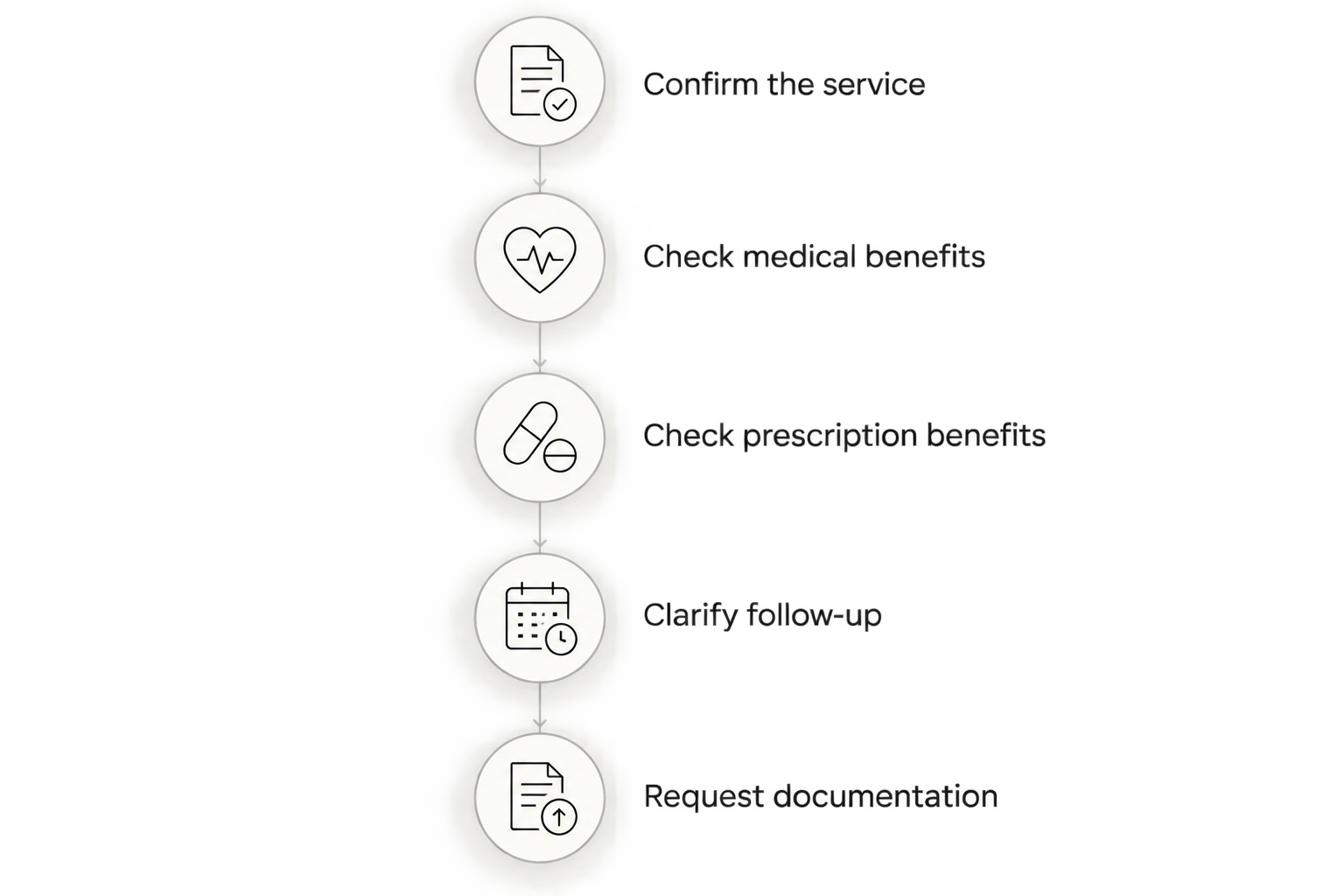
How do you get an estimate you can actually use?
Request separate information from the practice, insurer, and pharmacy. Each controls a different part of the answer; no single appointment quote establishes your complete treatment expense.
- Confirm the service. Ask whether you are booking an initial diagnostic evaluation, a transfer-of-care assessment, or a follow-up appointment.
- Check medical benefits. Verify network status, deductible responsibility, referral rules, and any applicable authorization requirements.
- Check prescription benefits. Once medication is prescribed, verify coverage for the exact formulation and quantity.
- Clarify follow-up. Ask the clinician what determines the appointment schedule and when the plan will be reassessed.
- Request documentation. Keep the written estimate, benefit information, and any authorization correspondence together.
When calling your insurer, explain that you are checking outpatient psychiatric evaluation and medication management benefits. Ask which details the insurer needs from the practice to estimate your responsibility accurately.
For 2026 coverage, use the current plan documents rather than a previous explanation of benefits. A past claim describes how a past service was processed; it does not establish coverage for a new clinician or a different service.
Does insurance cover ADHD medication management?
Insurance coverage depends on your plan, the provider, and the service. Coverage for a psychiatric appointment does not automatically mean the prescribed medication is covered under the same terms.
Ask about medical and prescription benefits separately. Also distinguish prior authorization from payment: authorization addresses a plan requirement, while your final responsibility still depends on the benefit terms and claim processing.
If a claim is denied, request the reason before deciding what to do next. A network issue, missing information, and an excluded benefit require different responses; the practice and insurer can explain which issue applies.
Is ongoing ADHD treatment less expensive than starting care?
Ongoing treatment can involve a different set of services than the initial assessment, but a stable prescription does not establish a fixed recurring total. Your follow-up schedule, medication, and insurance responsibility still matter.
Ask for separate estimates for starting care and continuing care. If the clinician changes treatment, revisit the estimate instead of assuming the previous pattern still applies.
Can transferring records prevent repeat assessment?
Transferring records gives the receiving clinician access to prior findings and treatment history. It does not guarantee that additional assessment will be unnecessary or that the clinician will continue the same prescription.
Request records early and confirm that the receiving practice has them. The psychiatric records transfer workflow explains how to organize that handoff.
For a transfer in 2026, include the current medication list and relevant prior treatment notes. Tell the receiving practice when you expect to need ongoing prescribing support; do not assume that sending records establishes care.
Where physician-led medication management fits
Attuned Psychiatry is a physician-led medication management option for patients in Decatur and Metro Atlanta. The practice also offers TMS and SPRAVATO® for patients with treatment-resistant depression and other psychiatric conditions; those services do not establish an ADHD treatment recommendation.
When considering Attuned Psychiatry medication management, ask whether the practice evaluates your specific concerns and what records it needs. Confirm the clinician, insurance arrangements, and follow-up expectations before booking.
The benefit of a clinical assessment is an individualized treatment decision. Its limitation is equally important: neither an evaluation nor an appointment estimate guarantees a diagnosis, a particular prescription, or a specific response.
FAQ
How much does ADHD medication management cost with insurance?
Your responsibility depends on your plan's deductible, copayment or coinsurance, network rules, and prescription benefits. Verify the evaluation, follow-up appointments, and medication separately rather than treating them as a single covered service.
Does an ADHD medication management appointment include the prescription expense?
The appointment charge usually does not include medication dispensed by a pharmacy. Ask the practice what its charge includes and ask the pharmacy about the exact prescription under your benefits.
Do I need a new ADHD evaluation if I already have a diagnosis?
The receiving clinician decides what assessment is needed before taking over treatment. Previous diagnostic records and medication history help inform that decision but do not guarantee continuation of a prescription.
Are generic ADHD medications always less expensive for me?
Generic status does not guarantee the lowest expense under your particular benefits. Ask your pharmacy to check the prescribed product and discuss clinically appropriate alternatives with your prescriber.
Can I schedule fewer appointments to reduce treatment expenses?
Discuss financial concerns with your prescriber rather than changing the follow-up plan yourself. The appropriate schedule depends on medication response, side effects, treatment changes, and clinical monitoring needs.
Does prior authorization mean my ADHD treatment is fully covered?
Prior authorization does not establish that you owe nothing for treatment. Your deductible, copayment, coinsurance, and other benefit terms can still apply.
What should I ask Attuned Psychiatry before starting medication management?
Ask Attuned Psychiatry whether the practice evaluates your specific concerns, which records it requires, and how follow-up care is arranged. Confirm insurance and billing details separately before the appointment.
One last thing
A stable medication does not mean a stable insurance bill. For 2026 treatment planning, check benefits again when your plan, pharmacy, prescriber, or prescribed formulation changes.
Bring financial barriers into the clinical conversation early. The useful question is not just what an appointment costs, but whether you can follow the proposed care plan consistently and safely.


