

There is no single fee for seeing a psychiatrist without insurance in 2026; you need a written estimate from the practice for the evaluation and expected follow-up care. The visit fee does not necessarily include prescriptions, laboratory testing, psychotherapy, or separately delivered treatments, so compare the care plan—not just the first appointment.
- How much does a psychiatrist cost without insurance? Request separate estimates for the evaluation, medication management, and other services.
- Attuned Psychiatry offers physician-led psychiatric care in Decatur/Metro Atlanta; ask about the proposed treatment before comparing fees.
- Ask for a Good Faith Estimate when you are uninsured or choosing not to use insurance.
- Include prescriptions, follow-up appointments, and necessary testing in your budget; confirm which charges are separate.
Why this matters
A first-visit quote answers a narrow question: what you will pay for that appointment. It does not tell you what ongoing treatment involves. You need to understand the recommended follow-up schedule, who prescribes your medication, and which services come from other providers.
For patients considering Attuned Psychiatry, the starting point is a clinical evaluation—not an assumption that every patient needs the same treatment. The physician-led practice offers medication management, TMS, and SPRAVATO® treatment in Decatur/Metro Atlanta. Those services should not be treated as interchangeable appointments.
A useful estimate connects each charge to a named service. Ask the practice to explain anything listed simply as psychiatric care, a treatment package, or ongoing support.
How much does a psychiatrist cost without insurance?
Your psychiatrist's office must provide the actual quote for your care. A national average cannot tell you what that practice charges, whether it includes medication management, or what additional services your clinician will recommend.
For a useful 2026 comparison, separate your expected care into these categories:
| Service | Best for | What to clarify | Limitation when budgeting |
|---|---|---|---|
| Initial psychiatric evaluation | Establishing a diagnosis and treatment plan | What the evaluation includes and whether records review is included | The first appointment does not establish the total cost of ongoing care |
| Medication-management follow-up | Reviewing benefits, side effects, and medication changes | How follow-up appointments are billed and when reassessment is expected | Visit frequency depends on clinical needs |
| Psychotherapy | Working on symptoms, behavior, and coping through structured treatment | Whether therapy is included or provided separately | A prescribing appointment is not automatically a therapy session |
| Additional testing | Answering a specific clinical question | Who orders, performs, and bills for the testing | Another organization may send a separate bill |
| TMS or SPRAVATO® evaluation and treatment | Assessing an advanced treatment for an appropriate condition | Which evaluation, treatment, and monitoring services are included | A routine medication-management quote does not describe these treatment costs |
These categories help you compare equivalent services. They are not a recommendation that you need every service listed, and they do not represent a package offered by any particular practice.
Before booking, ask for the initial appointment estimate and an explanation of how later appointments are billed. If the diagnosis or treatment plan changes, request an updated estimate rather than relying on the original quote.
Initial psychiatric evaluation: establish what is included
An initial evaluation gives the psychiatrist a basis for diagnosis and treatment recommendations. Expect questions about symptoms, medical history, previous treatment, medications, substance use, and safety concerns.
Ask what you are purchasing before you reserve the appointment. Confirm whether the quoted service includes review of outside records, discussion of treatment options, and a written treatment plan or visit summary. Do not assume every office includes the same administrative work.
An evaluation also does not guarantee a prescription. The psychiatrist needs to determine whether medication is appropriate, whether further information is necessary, and whether another level of care is indicated.
Bring your current medication list and relevant treatment history. Clear records support the assessment, but they do not replace the clinician's own evaluation or guarantee that the clinician will continue a previous prescription.
Medication-management follow-ups: budget beyond the first visit
Medication management involves checking symptoms, side effects, adherence, and whether treatment needs to change. The appropriate follow-up schedule depends on your condition and the decisions being made—not simply on your preference for fewer appointments.
Ask how the office handles prescription questions between visits. Clarify which requests require an appointment, what happens when you miss follow-up, and how to reach the practice with a medication concern.
The benefit of ongoing medication management is clinical reassessment rather than automatic refills. The budgeting limitation is that your future schedule cannot always be fixed at the first appointment. Ask for the current plan and the circumstances that would change it.
Do not stop, stretch, or change prescribed medication to make an appointment budget work. Tell your prescriber about financial barriers so you can discuss a clinically appropriate plan.
Prescriptions, therapy, and testing: check separate billing
A psychiatrist's appointment fee and a pharmacy's medication charge are different expenses. Ask the prescriber whether the proposed medication has a generic version and what alternatives are clinically appropriate; confirm the actual medication charge with the pharmacy.
Psychotherapy also needs a separate question. Some psychiatrists provide therapy, while other treatment plans involve an outside therapist. Ask whether your proposed appointments include psychotherapy or focus on medication management.
Testing should have a stated clinical purpose. If laboratory work or another assessment is recommended, ask what question it answers, where it will occur, and who will send the bill. Do not assume a practice's estimate includes an independent laboratory or another clinician.
For your 2026 budget, keep the prescribing office, pharmacy, therapist, and testing provider separate until each confirms its own billing. This prevents an appointment estimate from becoming an inaccurate estimate for all your care.
Why psychiatrist costs without insurance vary
Different quotes can describe different services. Use these factors to identify what actually differs before deciding that one practice is a better value:
- Appointment purpose: An initial diagnostic evaluation and a medication follow-up involve different work. Compare the same appointment type.
- Treatment scope: Medication management, psychotherapy, TMS, and SPRAVATO® are distinct services. Ask which service the estimate describes.
- Clinical needs: Diagnostic uncertainty, medication changes, and safety concerns affect the treatment plan and follow-up recommendations.
- Separate providers: A pharmacy, laboratory, therapist, or other clinician can bill independently of the psychiatrist.
- Included work: Records review, forms, care coordination, and between-visit requests need explicit clarification rather than assumptions.
A lower appointment quote does not establish a lower total treatment expense. Likewise, a higher quote does not establish better clinical care. Compare the clinician's qualifications, the service offered, and the explanation of the treatment plan alongside the estimate.
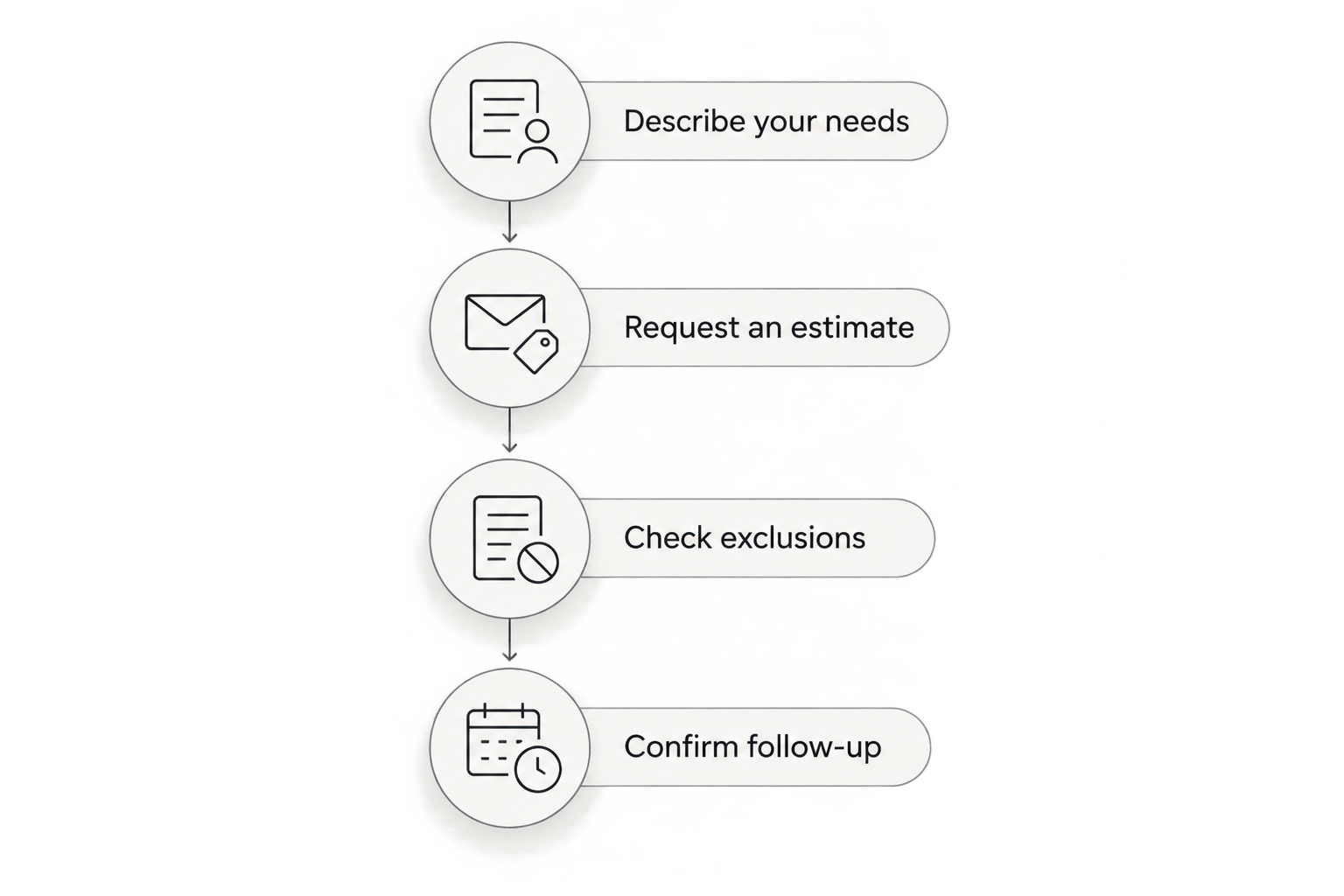
How do I get a usable estimate before booking?
Use a straightforward sequence. You do not need to disclose your entire medical history to an administrative team, but you should explain the general reason you are seeking care and whether you plan to use insurance.
- Describe your needs. Say whether you need an initial evaluation, ongoing medication management, or an assessment for a specific treatment. Ask whether the practice treats your concern.
- Request an estimate. Ask for a written estimate for the scheduled service and an explanation of expected related services. State that you are uninsured or choosing not to use insurance.
- Check exclusions. Ask about prescriptions, outside testing, psychotherapy, forms, and any separately billed services relevant to your plan.
- Confirm follow-up. Ask how the clinician determines follow-up frequency and how the office communicates changes to the estimated plan.
The objective is a clear agreement about what is scheduled and what remains undecided. You should be able to distinguish a confirmed appointment estimate from a possible future treatment expense.
Keep a copy of the estimate and the appointment confirmation. If a recommended service changes after the evaluation, ask the office to explain the change and provide updated information before you agree to nonurgent additional care.
Can I get a Good Faith Estimate without insurance?
Uninsured and self-pay patients generally have a right to a Good Faith Estimate under federal billing protections. This applies to people without insurance and people who are not using insurance to pay for the service, subject to the applicable rules.
The Centers for Medicare & Medicaid Services explains these protections through its No Surprises Act guidance for uninsured and self-pay patients. For care scheduled in 2026, request the estimate when arranging the appointment and ask which provider's services it covers.
A Good Faith Estimate is not a guarantee that the clinical plan will never change. It describes expected charges based on the information available. Keep it with your billing records, and ask the provider to explain any difference between the estimate and the bill.
Emergency care follows different rules; do not delay urgent treatment while trying to obtain a routine outpatient estimate.
Is an out-of-network psychiatrist the same as no insurance?
No. Being uninsured means you do not have health insurance coverage; seeing an out-of-network psychiatrist means you have a plan, but the clinician does not participate in its network. Whether your plan reimburses that care depends on your benefits.
Before assuming you must pay entirely yourself, ask your insurer about out-of-network outpatient mental health benefits, the deductible, claim requirements, and any authorization rules. A practice's willingness to provide billing documentation does not guarantee reimbursement.
If you decide not to use insurance, tell the office clearly. Ask how that decision affects billing and your eligibility to receive a Good Faith Estimate for the scheduled service.
When does advanced depression treatment need a separate estimate?
TMS and SPRAVATO® require treatment-specific assessment and planning. Do not use a general psychiatric visit quote to budget for either treatment, and do not assume either is appropriate solely because medication has been difficult to tolerate or has not helped.
Attuned Psychiatry is best suited to Decatur/Metro Atlanta patients seeking physician-led psychiatric care with medication management and advanced depression treatment options. The practice offers TMS and SPRAVATO®, but clinical suitability and the financial arrangements for a proposed treatment require individual confirmation.
The benefit of discussing these options is a treatment plan matched to your clinical history. The limitation is that a list of available services cannot establish eligibility, expected response, or your total expense.
For a 2026 consultation, bring prior medication names, treatment responses, and relevant records. Ask what the evaluation must establish before any advanced treatment is recommended.
Discuss your psychiatric care needs
Ask about an evaluation and request a written estimate for the services proposed.
FAQ
How much does a psychiatrist cost without insurance in 2026?
There is no single fee that applies to every psychiatrist or treatment plan. Request a written estimate for the initial evaluation, expected follow-ups, and any separately billed services before booking.
Does a psychiatrist's appointment fee include medication?
Do not assume the appointment fee includes medication. Confirm the prescribing office's charges separately from the pharmacy's charge for filling the prescription.
Is the first psychiatric appointment different from a follow-up?
Yes. An initial evaluation focuses on assessment and treatment planning, while follow-up appointments review progress and treatment decisions; ask the office for an estimate for each service.
Can I ask a psychiatrist for a Good Faith Estimate?
Yes. Uninsured patients and patients choosing not to use insurance generally have a right to a Good Faith Estimate under federal billing protections; ask when scheduling and confirm which services it covers.
Can I use insurance if a psychiatrist is out of network?
Your plan determines whether out-of-network psychiatric care is reimbursable. Ask your insurer about benefits, deductibles, documentation, and authorization requirements before relying on reimbursement.
Does Attuned Psychiatry offer more than medication management?
Yes. Attuned Psychiatry offers medication management, TMS, and SPRAVATO® treatment in Decatur/Metro Atlanta; an individual assessment determines which treatment options are appropriate.
Should I book fewer psychiatric visits to reduce expenses?
Discuss financial barriers with your prescriber rather than changing follow-up or medication on your own. Ask what appointment schedule is clinically appropriate and what alternatives you can consider safely.
One last thing
Ask what would make the estimate change. That question reveals more than asking only for the first appointment fee: it prompts a discussion about additional assessment, outside testing, medication changes, and follow-up needs.
Your next move is to request a written estimate tied to the service you are booking. Keep clinical decisions and billing questions connected, without letting an incomplete quote decide your treatment.


