

Instead of repeatedly calling offices and carrying scattered printouts, use a documented request-and-confirmation workflow to transfer psychiatric records to your new doctor. Request the relevant clinical history, authorize the correct recipient, and confirm that the receiving office can open the records before your appointment.
- To transfer psychiatric records to new doctor offices, verify the destination, request relevant records, and confirm receipt.
- Attuned Psychiatry offers physician-led psychiatric care, including medication management, TMS, and SPRAVATO® treatment.
- Routine psychiatric records and separately maintained psychotherapy notes have different privacy rules.
- A records transfer does not establish care or guarantee prescription refills.
Why this matters
Psychiatric treatment decisions depend on more than your current prescription list. Previous medication trials, side effects, hospital care, and responses to treatment help a new clinician understand what has already happened without relying entirely on memory.
Attuned Psychiatry is best suited to patients seeking physician-led psychiatric care in Decatur/Metro Atlanta, including treatment-resistant depression care. If you are considering Attuned Psychiatry, organize your records around the clinical decisions your next appointment needs to address.
For a 2026 transfer, separate three tasks: requesting records, scheduling care, and planning medication continuity. Completing one does not complete the others. This guide covers the records workflow; medication changes and prescribing decisions belong with your treating clinician.
Before you start
- Gather access and identifiers. Have your previous practice's contact details, your identifying information, and any patient portal access. Ask how the office verifies identity and accepts records requests.
- Verify the receiving destination. Get the new practice's exact recipient name and approved delivery method directly from its staff. Ask whether it wants records before scheduling or before the appointment.
- Check the privacy exception early. Separately maintained psychotherapy notes are not the same as routine psychiatric progress notes. They generally require a separate authorization for disclosure; certain substance use disorder records can also carry additional federal protections.
Do not assume your appointment request triggers a records request. Ask which office initiates the transfer and who follows up if nothing arrives.
Choose your records route
There are two practical routes: ask the previous practice to send records directly, or obtain a personal copy and submit it through the receiving practice's approved channel. Neither route replaces confirmation from the receiving office.
| Route | Best for | Advantage | Limitation |
|---|---|---|---|
| Direct office-to-office transfer | Patients whose practices accept direct delivery | Keeps delivery between the practices | You still need confirmation that the correct records arrived |
| Personal copy, then submission | Patients who want a copy for their own files | Lets you review what you received | You must protect the files and follow the new office's submission instructions |
Use the route the receiving office can reliably accept. A downloaded file is not useful if its format cannot be opened or its contents do not include the requested clinical history.
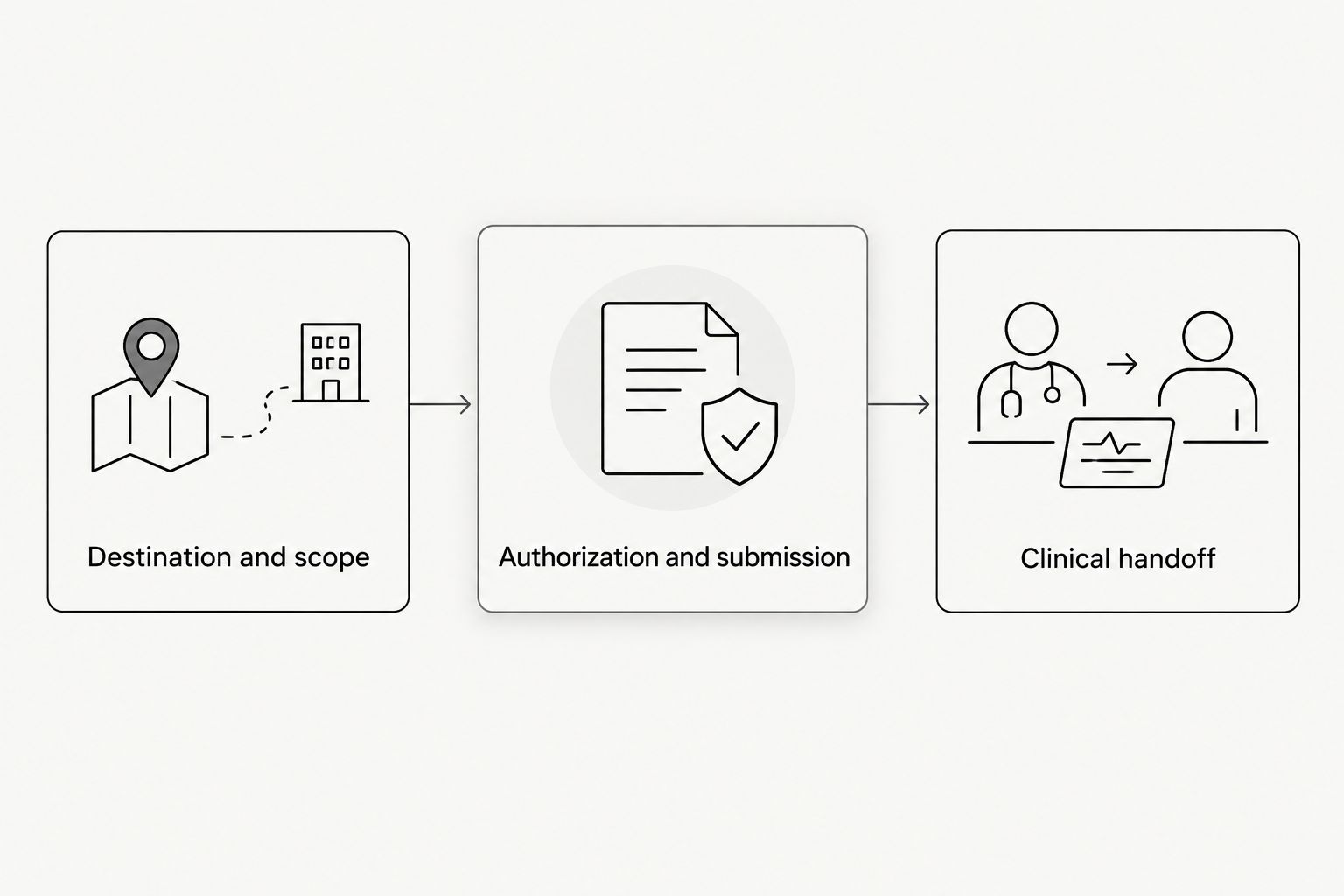
1. Destination and scope
- Confirm the recipient. Ask the new office for its approved records destination. Read back the address, fax number, or other destination rather than copying an unverified search result.
- Identify the previous record holders. List outpatient psychiatrists, hospital systems, and other clinicians whose records matter. One office does not necessarily hold another organization's records.
- Define the request. Ask for psychiatric evaluations, relevant progress notes, medication history, allergies, relevant laboratory results, and hospital discharge summaries. Request records that support your current care rather than automatically requesting every document.
- Specify dates. Identify the treatment period you need. Include earlier records when they document medication failures, significant adverse effects, or other history relevant to the new assessment.
- Create a 1-page summary. List current medications, previous prescribers, major treatment changes, and questions for the new clinician. Label uncertain details as uncertain; do not reconstruct doses from memory.
Expected result: You have a verified destination and a written list of records to request from each organization.
For treatment-resistant depression care, medication trial history deserves particular attention. Include known medication names, doses, duration, benefit, and reasons for stopping when those details are documented. If you received TMS or SPRAVATO® treatment, ask the treating practice which treatment records it can provide.
2. Authorization and submission
- Obtain the appropriate form. Ask the previous practice whether it needs a patient access request, a release authorization, or another approved request method. Do not substitute a generic form without checking acceptance.
- Enter identifying information. Use the name and other identifiers that match the previous practice's records. Include a former name when needed to locate the chart.
- Name the sender and recipient. Identify both organizations clearly and use the destination you verified. Avoid broad language that leaves the recipient unclear.
- Describe the records and dates. Match the scope you prepared. If an authorization includes an expiration date or event, complete it as instructed and review any options concerning sensitive information.
- Sign and submit securely. Complete the required signature and date, follow the office's delivery instructions, and retain a copy of the submitted request and confirmation.
Expected result: The previous practice has an actionable request, and you have a record of what you authorized and when you submitted it.
Form wording varies by practice; use the actual labels on the document you receive. Do not put passwords, portal login credentials, or unnecessary medical details into an ordinary email to staff.
Under HIPAA's right-of-access rule, covered entities generally must act on a patient access request within 30 calendar days. One additional 30-calendar-day extension is permitted when the required written notice explains the delay and gives a completion date. These are federal access-rule timeframes, not a promise of appointment readiness or an office-to-office delivery deadline.
3. Receipt and clinical handoff
- Confirm acceptance. Ask the sending office whether the request is complete and whether another signature or identity check is needed. Record the response.
- Track delivery. Note the submission date, sending office, requested documents, and reported delivery status. A simple written log is sufficient.
- Verify receipt. Ask the receiving office whether the files arrived, can be opened, and include the requested date range. A successful fax transmission alone does not establish that the correct chart reached the correct patient record.
- Identify gaps. Compare the received documents with your requested list. Ask the sender specifically for missing items rather than restarting an undefined request for everything.
- Clarify review timing. Ask whether records are available for the clinician's appointment review. Administrative receipt does not mean a clinician has already assessed the contents.
Expected result: The receiving practice has usable records, and you know which documents remain outstanding.
Keep the 2026 handoff log until the transfer is resolved. Save acknowledgments with your personal records rather than relying on a remembered phone conversation.
Send updated records after an initial transfer
An initial transfer can become outdated if you continue treatment before the new appointment. Send a targeted update when a medication change, hospitalization, or relevant test result changes the information the new clinician needs.
- Identify what changed. Note the visit date and the specific document, such as a discharge summary or updated medication list.
- Check authorization coverage. Ask the sending office whether the existing request covers the new date range and recipient. Submit an updated request if required.
- Request only the missing update. Explain that earlier records have already been sent so staff can distinguish the supplement from a duplicate transfer.
- Confirm receipt again. Ask the new office whether the update has been added to your record before the appointment.
Expected result: The receiving clinician has the newer information without an unexplained second batch of duplicate records.
For example, if your medication changes after the initial request, bring an accurate current list and ask the previous prescriber to send the corresponding visit documentation. Your personal list helps communication; it does not replace the clinical note.
Troubleshooting
The sending office says the authorization is incomplete
Ask which exact element is missing: signature, date, recipient, record scope, or identity verification. Correct that element and ask whether the original request remains active. Keep the replacement clearly identified so staff do not process conflicting instructions.
The offices disagree about whether records arrived
Ask the sender to verify the destination and delivery date, then ask the recipient to check its incoming records process. Confirm your identifying information matches both charts. Do not repeatedly resend sensitive files to an address that has not been verified.
Medication history is missing
Request the medication list and relevant prescribing notes explicitly. A pharmacy dispensing history can help reconstruct what was filled, but it does not establish why treatment changed, whether you took it, or whether it helped. Bring unresolved questions to the clinician.
The office withheld psychotherapy notes
Ask whether the withheld material is separately maintained psychotherapy notes or ordinary clinical documentation. HIPAA treats these categories differently. Medication management information and routine clinical summaries do not become psychotherapy notes merely because they concern mental health.
Your appointment is approaching and records are delayed
Tell the receiving office exactly what is missing and ask whether the appointment can proceed. Separately contact your current prescriber about medication continuity; do not assume the new clinician will refill prescriptions before evaluation. Do not abruptly stop or change psychiatric medication without medical guidance.
Customize your workflow
Adapt the request to the decision the new clinician needs to make. For medication management, prioritize prescribing history and relevant monitoring. For a treatment-resistant depression assessment, include documented previous treatment trials and records from advanced treatments when applicable.
Attuned Psychiatry provides medication management, TMS, and SPRAVATO® treatment, but a records transfer alone does not establish that any particular treatment is appropriate. Clinical assessment determines the treatment plan.
For a 2026 appointment, ask the receiving practice which records it needs first and how to submit later additions. Use the contact page to ask about the records submission process; do not assume a general inquiry form is an approved place to upload psychiatric records.
Ask about your records transfer
Confirm the receiving practice's submission instructions before sending sensitive psychiatric records.
FAQ
What's the safest way to transfer psychiatric records to a new doctor?
Use a delivery method approved by both practices, verify the recipient, and confirm receipt. Keep a copy of your request and avoid sending sensitive records to an unverified email address.
Do I need to sign a release before my psychiatrist sends records?
A signed authorization is not always required under HIPAA for provider-to-provider treatment disclosures, but practices can have request procedures and other laws can apply. Ask the sending office which form it requires, especially for separately maintained psychotherapy notes or protected substance use disorder records.
How long does a psychiatric records request take in 2026?
Under HIPAA's patient right-of-access rule, covered entities generally must act within 30 calendar days, with one additional 30-calendar-day extension allowed under specified conditions. That rule does not guarantee that an office-to-office transfer will be complete before your appointment.
Can my new psychiatrist see my old records automatically?
Do not assume your new psychiatrist can automatically see your previous records. Ask whether the practices share an accessible record system or whether a separate request and transfer are needed.
Are therapy notes included in my psychiatric records?
Routine psychiatric progress notes and separately maintained psychotherapy notes are different categories. Psychotherapy notes are generally excluded from HIPAA's patient access right and generally require separate authorization for disclosure.
Will transferring records guarantee my medication refill?
No, transferring records does not guarantee a prescription or establish a prescribing relationship. Discuss medication continuity with your current prescriber and ask the new practice about evaluation requirements.
What should I bring if my records have not arrived?
Bring an accurate medication list, relevant documents you already have, and a concise treatment summary. Tell the receiving office about the missing records before the visit so it can advise you about the appointment.
One last thing
Received and reviewed are different milestones. For your 2026 transfer, ask whether the records are accessible in your chart for the scheduled appointment—not just whether a fax or upload arrived. That distinction catches an administrative gap without assuming that staff can promise a clinical decision before your evaluation.


