The time needed for a psychiatric evaluation varies with your symptoms, treatment history, and the type of assessment you need. Confirm the reserved appointment time with the practice before arranging your day, and ask whether paperwork, records review, or additional testing happens separately.
- How long does a psychiatric evaluation take? Confirm your appointment time; assessment needs differ between patients.
- An initial psychiatric evaluation, medication follow-up, and psychological testing serve different purposes.
- Bring medication details and prior records so your psychiatrist can assess treatment history accurately.
- Attuned Psychiatry provides physician-led psychiatric care in Decatur/Metro Atlanta, including care for treatment-resistant depression.
How long does a psychiatric evaluation take?
Ask for the scheduled appointment time, not a generic estimate. A psychiatric evaluation needs enough clinical discussion to assess your concerns, review relevant history, consider safety, and explain the next steps. A complicated history does not automatically mean the practice extends the appointment; some questions require follow-up instead.
When planning a psychiatric evaluation in 2026, distinguish the clinical conversation from the rest of your visit. Registration, questionnaires, and checking your medication list are separate tasks, even when the practice completes them during the same appointment.
If you are considering Attuned Psychiatry, ask what to complete beforehand and whether records should arrive before the evaluation. Those questions give you a useful plan without assuming that every practice uses the same schedule.
| Appointment type | Best for | Main purpose | Important limitation |
|---|---|---|---|
| Initial psychiatric evaluation | Establishing psychiatric care | Review symptoms, history, safety, and treatment needs | Some diagnostic questions need further information |
| Medication follow-up | Reviewing ongoing medication treatment | Assess benefit, side effects, and changes in symptoms | It is not interchangeable with a new-patient evaluation |
| Psychological testing | Answering a defined question through formal testing | Assess specific cognitive, behavioral, or diagnostic concerns | It is not automatically part of a psychiatric evaluation |
Ask which appointment you are booking. The label matters because these services answer different questions and require different preparation.
Why this matters
An appointment slot tells you when to attend. It does not guarantee a final diagnosis, a prescription, or completion of every assessment you might need.
Plan around the appointment you have actually booked, not the result you hope to receive. If your main goal is a medication review, an ADHD assessment, or help after previous depression treatments have failed, say so before the visit. The practice can clarify whether the scheduled service addresses that concern.
For your 2026 calendar, also separate appointment duration from the wait to get an appointment. A practice's next opening does not tell you how long the clinical evaluation lasts.
What happens during a psychiatric evaluation?
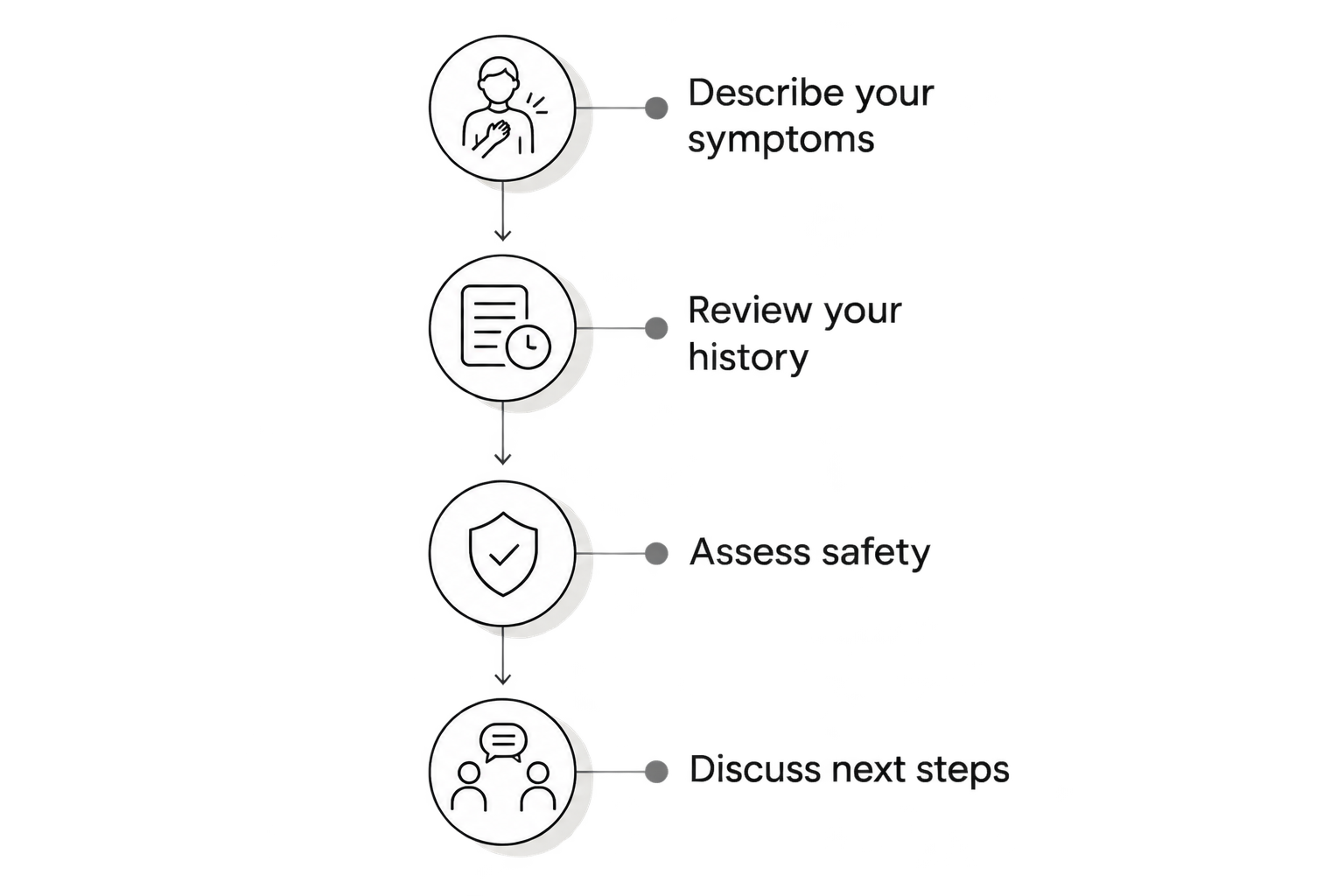
A psychiatric evaluation is a clinical conversation guided by your concerns and the psychiatrist's assessment. The order varies, and urgent safety concerns take priority over a routine history.
Describe your symptoms
Explain what brought you in, when the problem began, and how it affects daily life. Describe changes in sleep, mood, concentration, appetite, energy, relationships, or functioning when they apply.
Concrete examples help. Saying that you repeatedly miss work because you cannot get out of bed communicates something different from saying only that you feel depressed.
Review your history
Your psychiatrist asks about previous diagnoses, treatment, medication responses, relevant medical conditions, and substance use. Family psychiatric history and major life events can also inform the assessment.
An earlier diagnosis is useful information, not a substitute for a current evaluation. Explain what you were told, who assessed you, and whether treatment helped.
Assess safety
Questions about suicidal thoughts, self-harm, unusual experiences, or periods of markedly changed mood help determine the appropriate level of care. Answer directly, even if the question feels uncomfortable.
A safety discussion does not automatically mean hospitalization. The clinician considers the nature of the concern, your circumstances, and what support or intervention is needed.
Discuss next steps
The visit should leave you with an explanation of the clinician's assessment and recommended next steps. These can include treatment, records review, medical testing, coordination with another clinician, or further evaluation.
Before leaving, ask what is established and what remains uncertain. A working diagnosis guides care while the clinician gathers additional information.
Why psychiatric evaluation time varies
The depth of an evaluation depends on the questions your psychiatrist needs to answer. These factors affect what needs discussion, but they do not establish a specific appointment length:
- Symptom complexity: Overlapping mood, anxiety, attention, sleep, or substance-related concerns require careful clarification.
- Treatment history: Previous medication trials, side effects, hospitalizations, and other treatments add relevant information.
- Medical history: Physical health conditions and medications can affect psychiatric symptoms and treatment choices.
- Available records: Clear records help establish what was previously assessed or tried; incomplete records leave questions unresolved.
- Safety concerns: Immediate risk changes the priorities of the assessment and the recommended setting for care.
- Communication needs: An interpreter, accessibility accommodation, or involvement of a support person requires advance coordination.
Do not shorten or hide your history to fit an assumed schedule. Tell the practice about relevant needs before the appointment, then let the clinician prioritize the discussion.
For a 2026 visit, confirm the current process directly with the practice. Instructions from an earlier appointment elsewhere do not establish what your new clinician requires.
How should you prepare for a psychiatric evaluation?
Preparation helps you give an accurate history. You do not need to diagnose yourself or produce a polished account of your life.
Write down your main concerns
Start with what you most want help with and how it affects you. Include when symptoms started, whether they come and go, and any important changes from your usual functioning.
If speaking about symptoms is difficult, bring written notes. You can tell the psychiatrist that you need help organizing the discussion.
Make an accurate medication list
Include current prescriptions, nonprescription medicines, supplements, and relevant past psychiatric medications. Record the dose and what happened when you took each medication if you know those details.
Distinguish a medication that did not help from one you stopped because of side effects or difficulty obtaining it. Those experiences raise different clinical questions. Do not stop prescribed medication just to prepare for the evaluation unless your treating clinician instructs you to do so.
Arrange relevant records
Previous psychiatric notes, discharge summaries, testing reports, and treatment histories can help your clinician understand prior care. Ask the receiving practice which records it needs and how to authorize the transfer.
Use the psychiatric records transfer guide to organize that process. Do not assume records moved automatically because another clinician made the referral.
Confirm practical arrangements
Ask whether forms are due beforehand, whether the appointment is in person or by telehealth, and what identification or insurance information is required. For telehealth, confirm the practice's location requirements and arrange a private place to speak.
If you want a support person involved, ask how that works. The clinician also needs space to hear your account directly and discuss sensitive information privately.
Will you get a diagnosis at the first appointment?
A psychiatrist can establish a diagnosis during an initial evaluation when the available information supports it. Some concerns require records, observation over time, or additional assessment before the diagnosis is clear.
Depression, anxiety, attention difficulties, sleep disruption, and substance effects can overlap. A careful evaluation examines the pattern rather than assigning a diagnosis from a symptom checklist alone.
Ask what findings support the assessment and what else the clinician is considering. Diagnostic uncertainty should come with an explanation and a plan, not leave you guessing about the next step.
Will you get medication at the first appointment?
Medication can be prescribed at an initial evaluation when the clinician determines that it is appropriate. Booking an evaluation does not guarantee a prescription, a particular medication, or continuation of an existing prescription.
The psychiatrist considers your symptoms, previous response, medical history, potential interactions, and safety. Sometimes reviewing records or obtaining additional information comes first.
If you are close to running out of medication, tell both your current prescriber and the receiving practice before the appointment. Do not assume that a new-patient evaluation functions as an automatic refill visit.
Where does treatment-resistant depression fit?
When previous depression treatments have not provided enough relief, the evaluation needs a clear account of what you tried and what happened. Bring details about benefit, side effects, and why treatment changed rather than relying only on a list of medication names.
Attuned Psychiatry is for Decatur/Metro Atlanta patients seeking physician-led psychiatric care for treatment-resistant conditions. The practice offers medication management, TMS, and SPRAVATO® (esketamine); an evaluation determines which treatment discussion is appropriate for your circumstances.
The benefit of a psychiatric evaluation is a treatment recommendation grounded in your history. Its limitation is that an appointment alone does not establish eligibility for a specific treatment or guarantee a particular outcome.
When discussing care in 2026, ask which next steps are clinical and which involve separate administrative requirements. A treatment recommendation and permission to begin treatment are not always the same step.
Discuss your psychiatric care needs
Explore physician-led psychiatric care in Decatur/Metro Atlanta.
FAQ
How long does a psychiatric evaluation take for a new patient?
The time needed depends on the practice's appointment structure and your assessment needs. Confirm the reserved appointment time and ask whether paperwork, records review, or testing happens separately.
Does a longer psychiatric evaluation mean my condition is more serious?
Appointment length alone does not establish how serious a condition is. History, communication needs, records, and the purpose of the appointment all affect the discussion.
Is a psychiatric evaluation the same as psychological testing?
A psychiatric evaluation is not the same as psychological testing. A psychiatric evaluation assesses symptoms and treatment needs through clinical assessment, while formal testing addresses defined questions using selected assessment tools.
Can I get medication during my first psychiatric appointment?
A psychiatrist can prescribe medication at the first appointment when it is clinically appropriate. An evaluation does not guarantee a prescription or a specific medication.
What if I cannot remember all the medications I have tried?
Bring the information you have and clearly identify what you do not remember. Pharmacy records, prior notes, and information from previous prescribers can help clarify your treatment history.
Can someone come with me to my psychiatric evaluation?
Ask the practice whether a support person can participate and how consent works. The clinician can also request private discussion to hear your concerns directly.
What should I ask before booking with Attuned Psychiatry?
Ask Attuned Psychiatry about the evaluation process, required records, appointment format, and current scheduling arrangements. Describe your main concern so the practice can clarify the appropriate next step.
One last thing
Ask what happens if the evaluation leaves an important question unanswered. That tells you more about your care plan than appointment length alone.
Before your 2026 evaluation ends, make sure you understand the next action, who is responsible for it, and how to raise concerns before follow-up. If you cannot stay safe or face an immediate mental health emergency, seek emergency help rather than waiting for a routine evaluation.