

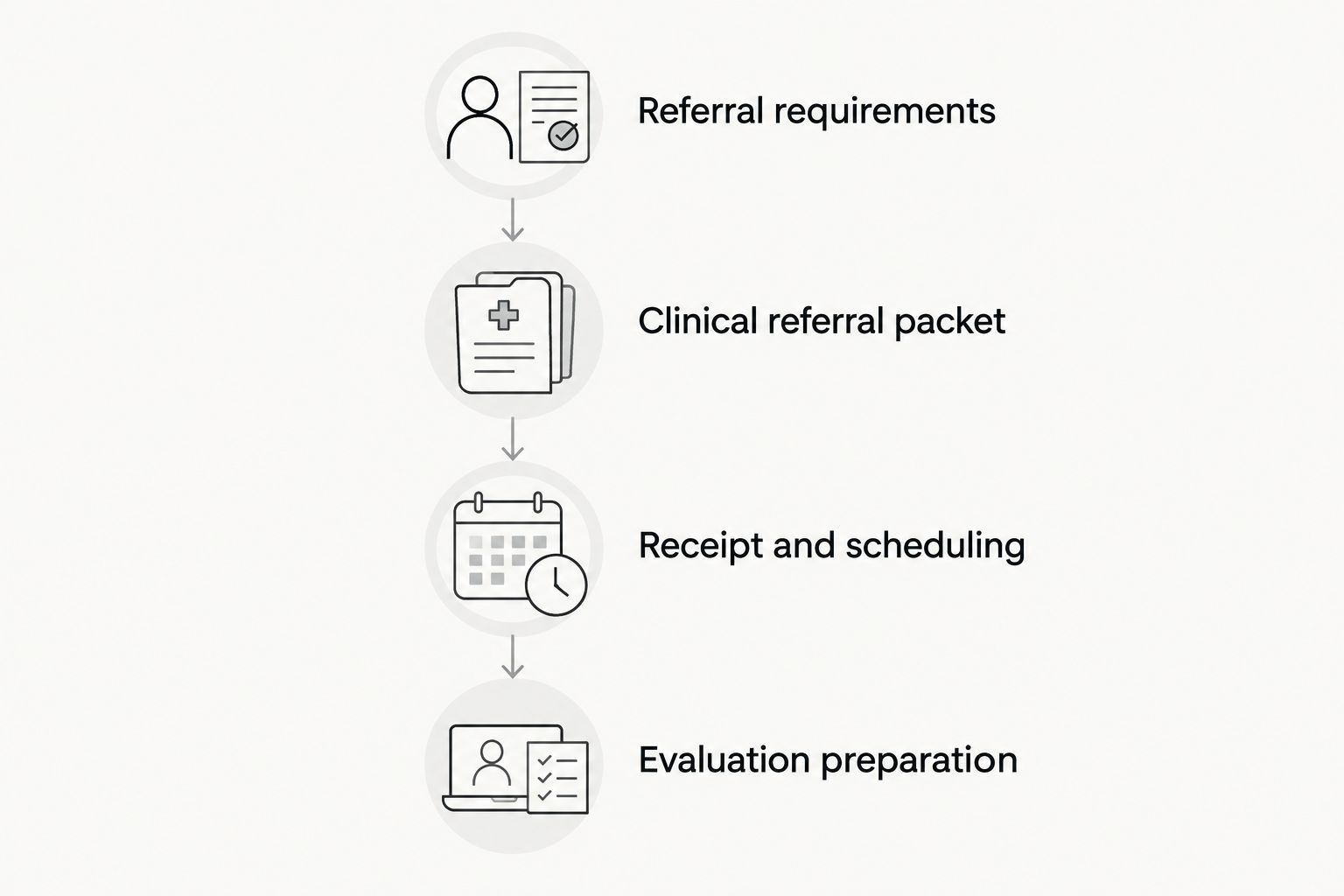
Instead of repeatedly calling your primary care office and a psychiatric practice to track a referral, use a documented handoff: confirm referral requirements, transfer the clinical summary, verify receipt, and arrange the evaluation. This 2026 guide to the psychiatrist referral process in Decatur explains what you and your PCP need to do, including when symptoms require a different route.
- For the psychiatrist referral process Decatur patients need, confirm practice requirements and insurance rules separately.
- Attuned Psychiatry offers physician-led psychiatric care in Decatur, including medication management, TMS, and SPRAVATO® treatment.
- A useful PCP referral includes the reason for evaluation, medication history, relevant records, and a clear follow-up owner.
- A referral does not establish treatment eligibility or replace urgent assessment when safety is at risk.
Why this matters
A referral order, insurance authorization, and a scheduled psychiatric evaluation are different things. Completing one does not automatically complete the others. Your next step is to identify which office owns each task rather than assuming the referral moves itself.
Attuned Psychiatry is a physician-led practice in Decatur/Metro Atlanta offering medication management, TMS, and SPRAVATO® treatment. Attuned Psychiatry is best suited to Decatur-area patients seeking physician-led psychiatric care, including evaluation of depression that has not responded to treatment. The evaluation determines which treatment, if any, fits your circumstances.
Use the workflow below for routine outpatient care. Immediate safety concerns require urgent assessment, not another referral-status call.
Before you start
- Gather your materials: Your insurance information, contact details, current medication list, PCP's contact information, and a concise description of why you want an evaluation. Include previous psychiatric treatment records when available.
- Confirm both sets of requirements: Ask the psychiatric practice whether it requires a PCP referral. Separately, ask your insurer whether your plan requires a referral, authorization, or a particular network arrangement for the requested service.
- Prevent the common handoff failure: Confirm where the PCP must send records and how the receiving office confirms receipt. A referral marked sent in one office is not proof that the other office received a usable referral.
For a 2026 referral, check your current coverage rather than relying on an earlier visit's rules. Also ask who will manage existing prescriptions while you wait; sending a referral does not transfer that responsibility.
Choose the right assessment route
Match the route to your current symptoms before starting routine paperwork. A routine referral supports planned care, but it is not a safety plan for someone whose condition is worsening rapidly.
| Route | Best for | Main benefit | Limitation or caution |
|---|---|---|---|
| Routine psychiatric referral | Symptoms that need specialist evaluation without an immediate safety concern | Creates a documented handoff and supports continuity | Does not provide immediate crisis assessment |
| Urgent clinical assessment | Worsening symptoms that need prompt review | Allows a clinician to assess urgency and direct care | Requires direct contact; a routine referral alone is insufficient |
| Emergency assessment | Immediate danger, suspected overdose, or a medical emergency | Prioritizes immediate safety and medical evaluation | Does not replace ongoing outpatient treatment |
If you are in immediate danger or have a medical emergency, call 911 or go to the nearest emergency department. In the United States, call or text 988 for suicide or mental health crisis support. Do not wait for referral approval when safety is at risk.
Referral requirements
Confirm the handoff rules
- Contact the psychiatric practice. Ask whether you can request an evaluation directly or whether the practice needs a PCP referral before scheduling. Ask what information is needed for the initial request.
- Check your insurance requirements separately. Ask whether the clinician and location are in network for your plan and whether the evaluation requires a referral or authorization. Do not treat a directory listing as confirmation of coverage.
- Confirm the submission method. Obtain the receiving office's current instructions for securely sending the referral and records. Give those instructions to your PCP rather than choosing a destination from an old document.
- Record the next action. Note who sends the referral, who checks receipt, and who contacts you about scheduling. Assign 1 named owner for your next follow-up so the task does not drift between offices.
For Attuned Psychiatry, use the care starting-point guide to ask about current evaluation and referral requirements. Confirm the instructions directly before sending medical records.
Expected result: You know whether a referral is required, where it must go, and which office acts next. You have not yet established treatment eligibility or guaranteed insurance payment.
Clinical referral packet
Prepare the information that supports evaluation
- Define the reason for referral. Ask your PCP to describe the symptoms, their effect on daily functioning, and the clinical question. A referral for persistent depression needs more context than a general request to see psychiatry.
- Document medication history. Include current prescriptions, doses, allergies, and previous psychiatric medications when known. Record how long you took each medication, whether it helped, and why it stopped; mark uncertain details as uncertain.
- Include relevant clinical context. Ask the PCP to share pertinent diagnoses, medical conditions, relevant test results, and previous treatment records. Report substance use and major sleep changes honestly because these affect assessment and medication decisions.
- Set the interim care plan. Confirm who handles refills, symptom changes, and clinical questions before the psychiatric evaluation. Do not stop or change prescribed medication simply because a referral is underway.
A 1-page summary is a practical starting point, not a clinical requirement. Put the reason for evaluation and current medications first, then attach relevant records. Keep your own copy so you can correct omissions during the appointment.
For a 2026 depression evaluation, describe previous treatment responses rather than deciding in advance that you qualify for a particular intervention. Inadequate improvement deserves assessment, but the clinician still needs to review diagnosis, treatment adequacy, tolerability, and safety.
Expected result: The receiving clinician gets a clear referral question and useful treatment history. The packet supports the evaluation without trying to predetermine its conclusion.
Receipt and scheduling
Close the referral loop
- Confirm transmission with the PCP. Ask when the referral was sent and whether the intended records accompanied it. Keep the date and the receiving destination in your notes.
- Confirm receipt with the psychiatric office. Ask whether the referral can be matched to your patient information and whether anything is missing. Distinguish received from ready for scheduling.
- Resolve the specific blocker. If the office needs a referral order, insurance information, or an authorization decision, identify exactly which item is outstanding. Send that task to the office responsible for it.
- Confirm the appointment instructions. Once an evaluation is arranged, verify the date, location or visit format, required paperwork, and what records to bring. Follow the practice's actual instructions rather than a generic checklist.
Keep a shared note covering the 2 offices involved in the handoff: your PCP and the psychiatric practice. Record the last completed action and the next responsible person. A short factual log is more useful than repeatedly asking whether someone has processed everything.
Expected result: You have either a confirmed evaluation or a specific unresolved task with an identified owner. A sent referral alone is not the endpoint.
Evaluation preparation
Turn your history into a useful clinical conversation
- Write your main concerns. Describe what has changed, what remains difficult, and how symptoms affect work, relationships, sleep, or self-care. Use concrete examples rather than trying to select the diagnosis yourself.
- Bring your medication information. Include prescriptions, nonprescription medicines, supplements, allergies, and previous adverse reactions. Bring bottles or an updated list if that helps you report accurately.
- Prepare treatment questions. Ask what the clinician is assessing, what options fit the findings, and what monitoring each option requires. Ask what happens if the initial plan does not help or causes side effects.
- Clarify follow-up ownership. Before the visit ends, confirm who manages psychiatric prescriptions, what your PCP should receive, and whom to contact about worsening symptoms. Ask how records will be shared and what permission is needed.
Attuned Psychiatry offers medication management, TMS, and SPRAVATO® treatment. These are services to discuss after clinical assessment, not interchangeable destinations selected by the referral wording. Each requires its own review of suitability, risks, and treatment requirements.
Expected result: You leave with an explanation of the assessment and a next step—or a clear account of what additional information is needed. Do not assume a first evaluation guarantees a particular prescription or procedure.
When symptoms change during the referral
A referral is a snapshot, not a permanent description of your condition. If symptoms change, contact the clinician managing your care instead of assuming the original referral still communicates the current situation.
- Report the change directly. Describe new or worsening symptoms, medication changes, side effects, and any new safety concerns. Ask whether you need urgent assessment.
- Update the receiving practice. Explain that the clinical situation has changed and ask how updated information should be sent. Do not assume the two offices share records automatically.
- Replace the interim plan when instructed. Follow the treating clinician's updated directions and record who is responsible for the next action.
For your 2026 referral record, keep the original submission date and add the date of the update. Do not silently replace the older information; the sequence helps clinicians understand what changed while you were waiting.
Troubleshooting
The PCP says the referral was sent, but the practice cannot find it
Verify the destination, transmission date, and patient identifiers with both offices. Ask the PCP to resend through the receiving practice's confirmed method, then check receipt rather than restarting the entire process.
Insurance approval and scheduling are being treated as the same task
Ask which item is actually missing: a clinical referral, an insurance referral, authorization, or appointment paperwork. Confirm requirements with the insurer and practice separately; one office's approval does not establish the other's requirements.
Your previous medication history is incomplete
Request records from previous prescribers and ask your pharmacy for available dispensing history. Dispensing records help reconstruct prescriptions, but they do not establish whether you took a medicine consistently or whether it helped. Add that context yourself.
You are running low on medication before the evaluation
Contact your current prescriber promptly. Ask about the interim plan and avoid assuming that an unscheduled psychiatric practice has taken over prescribing. Do not ration, stop, or change medication without clinical guidance.
You expected a specific treatment from the referral
Ask the evaluating clinician what information determines suitability. A request to consider TMS or SPRAVATO® does not establish eligibility; the evaluation must address clinical appropriateness and safety before a treatment plan is selected.
Customize your workflow
Adapt the referral summary to the question you want answered. For persistent depression, emphasize previous treatment attempts and their outcomes. For medication side effects, emphasize the symptom timeline and medication changes. For diagnostic uncertainty, describe episodes and functioning rather than presenting an unconfirmed diagnosis as settled.
Keep your 2026 handoff record focused on decisions: who manages medication, who sends updates, and what should trigger earlier clinical contact. The benefit of this workflow is accountability; its limitation is that paperwork cannot resolve clinical uncertainty or replace assessment.
FAQ
Do I need a PCP referral to see a psychiatrist in Decatur?
Confirm referral requirements with the psychiatric practice and your insurer separately. Practice scheduling rules and your insurance plan's requirements are different, so one answer does not settle both.
What should my PCP include in a psychiatric referral?
A useful psychiatric referral includes the reason for evaluation, current medications, relevant history, and previous treatment responses. The receiving practice can specify which additional records it needs.
Can I request an evaluation without waiting for my PCP?
Ask the psychiatric practice whether it accepts direct requests for evaluation. Even when it does, your insurance plan can have separate referral requirements.
Does a referral mean I qualify for TMS or SPRAVATO®?
No, a referral does not establish eligibility for TMS or SPRAVATO®. The clinician must assess your history, treatment response, and safety considerations before recommending treatment.
How long does the psychiatrist referral process take?
Ask the receiving practice for the status of your specific referral and the next required action. Timing depends on receipt of records, clinical review, insurance requirements, and scheduling; there is no single timeline for every referral.
Who manages my medication while I wait for psychiatry?
Confirm interim prescribing responsibility with your current prescriber. A referral alone does not transfer medication management to the psychiatric practice.
What should I do if symptoms worsen before my evaluation?
Contact the clinician managing your care promptly and describe the change. For immediate danger or a medical emergency, call 911; in the United States, call or text 988 for suicide or mental health crisis support.
One last thing
The most useful referral question is not whether it was sent, but what happens next and who owns that action. Write down the answer before ending the call. That detail separates a documented referral from a completed handoff.
Related guides
Discuss your referral and next appointment
Request an evaluation and ask what the next step after your referral looks like.


