

Yes, an online psychiatrist can prescribe ADHD medication when the evaluation supports treatment and the psychiatrist meets the licensing and prescribing requirements that apply to your location. Stimulant prescriptions also require compliance with controlled-substance rules; an online appointment does not guarantee a prescription or remove an in-person evaluation requirement when one applies. For care in 2026, confirm the practice’s current requirements before booking.
- Online ADHD prescribing requires a clinical evaluation, appropriate licensing, and compliance with current prescribing rules.
- Searching for adhd medication management near me? Ask about stimulant policies, monitoring, and local follow-up.
- Attuned Psychiatry offers physician-led psychiatric medication management in Decatur and Metro Atlanta.
- ADHD screening questionnaires support an assessment; they do not establish a diagnosis alone.
Why this matters
Being able to attend an appointment online is not the same as being eligible for an online prescription. Your diagnosis, medication choice, physical location, and the clinician’s practice policies all affect the next step.
If you are comparing ADHD psychiatrists near Decatur, GA, start with the evaluation and follow-up process rather than a promise of medication. A workable plan must cover what happens after the first appointment, including side effects, prescription requests, and any required physical measurements.
Can an online psychiatrist prescribe ADHD medication?
Yes. A psychiatrist can prescribe ADHD medication through telehealth when clinically appropriate and legally permitted. The distinction is between evaluating ADHD remotely and meeting the additional requirements for the particular prescription.
For a 2026 appointment, ask the practice to confirm the rules that apply to you rather than relying on an older telehealth policy. Federal requirements, state requirements, and practice policies are separate checks.
| Option | Best for | Main benefit | Limitation |
|---|---|---|---|
| Online evaluation | Patients who can complete an appropriate assessment remotely | Allows a psychiatric interview without traveling to the office | Physical assessment or an in-person visit can still be necessary |
| In-person evaluation | Patients who need an office-based assessment or cannot meet remote-care requirements | Allows direct assessment and office-based measurements | Requires travel and does not guarantee medication |
| Hybrid follow-up | Patients whose treatment requires both remote contact and office-based checks | Combines remote follow-up with necessary in-person care | Requires coordination across appointment types |
These are care formats, not different standards of diagnosis. Choose the format that supports a complete assessment and reliable follow-up, not the format that promises a particular prescription.
Stimulant medication: additional prescribing requirements
Stimulants used for ADHD include methylphenidate and amphetamine medications. These are Schedule II controlled substances under federal law, so prescribing involves requirements beyond those for a noncontrolled medication.
A psychiatrist must assess whether a stimulant is appropriate, including your medical history, other medications, substance use, and risk of misuse. A past prescription is relevant evidence, but it does not require a new psychiatrist to continue the same medication or dose.
Ask these questions before booking:
- Does the clinician evaluate ADHD through telehealth for patients physically located in my state?
- Does the practice prescribe stimulant medication when clinically appropriate?
- Is an in-person evaluation required for my situation?
- How does the practice handle prescription requests and pharmacy problems?
- What monitoring must happen outside the video appointment?
Do not interpret a clinic’s telehealth service as a promise that it prescribes every controlled medication. In 2026, confirm the policy directly with the prescribing practice.
Nonstimulant medication: a different prescribing pathway
Nonstimulant ADHD medications include atomoxetine, guanfacine, clonidine, and viloxazine. Approval by age and formulation differs, and a psychiatrist must select an appropriate option for the individual patient.
These medications are not controlled substances, but that does not make them suitable for everyone. They have their own side effects, interactions, and monitoring requirements.
A psychiatrist considers nonstimulants when they fit your clinical history and treatment goals. The decision should address the expected benefit and the reason for choosing that medication—not simply whether it is easier to prescribe remotely.
A nonstimulant is a treatment choice, not a substitute for a diagnostic evaluation. Ask what improvement to watch for, which adverse effects need a call, and when the response will be reviewed.
Why online ADHD prescribing varies
Online prescribing depends on several separate factors. A practice can offer psychiatric telehealth while requiring office visits for certain evaluations or prescriptions.
- Your physical location: The psychiatrist must have the legal authority to treat you where you are during the appointment.
- Medication category: Controlled and noncontrolled medications have different prescribing requirements.
- Diagnostic evidence: Prior records, symptom history, and competing explanations affect the treatment decision.
- Medical safety: Blood pressure, pulse, cardiac history, sleep, and other medications can change the plan.
- Practice policies: A clinic can set prescribing and monitoring requirements beyond the legal minimum.
- Continuity of care: Travel, relocation, pharmacy coordination, and missed follow-ups can interrupt treatment.
Your home address alone does not settle the location question. Tell the office if you will join an appointment while traveling, including travel outside Georgia.
What happens during an online ADHD evaluation?
An ADHD evaluation examines whether your symptoms fit ADHD, began during development, affect daily functioning, and have another explanation. It is more than a checklist of current concentration problems.
For adults, established diagnostic criteria include symptoms lasting at least 6 months, several symptoms present before age 12, and several symptoms occurring in 2 or more settings. These criteria help distinguish a persistent pattern from a recent change associated with sleep loss, mood symptoms, stress, or another condition.
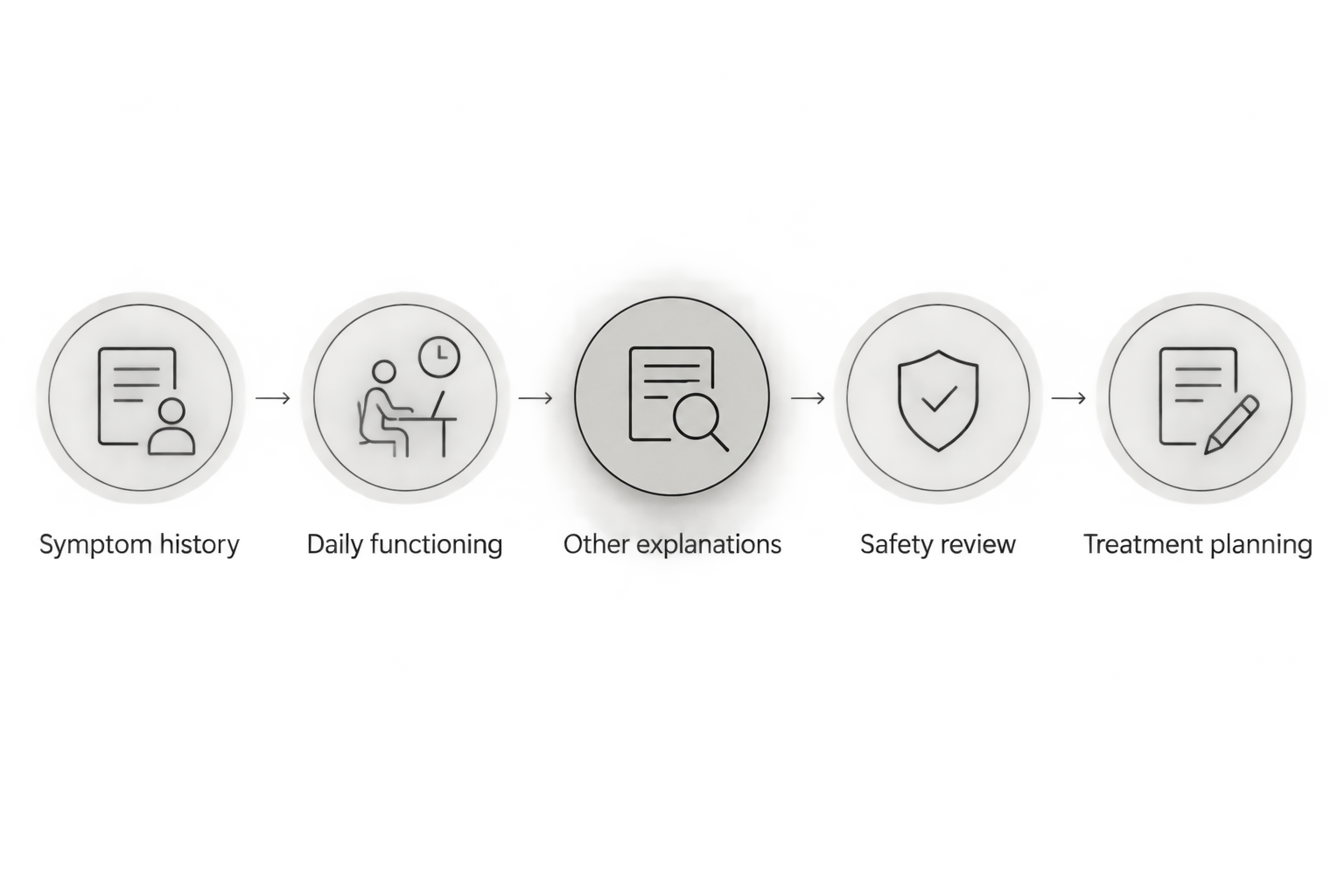
A typical evaluation addresses these steps:
- Symptom history: Describe attention, organization, impulsivity, and restlessness across your life—not only this week.
- Daily functioning: Explain specific effects at work, school, home, or in relationships.
- Other explanations: Review sleep, anxiety, depression, substance use, medical conditions, and medication effects.
- Safety review: Discuss medical history and the information needed before prescribing.
- Treatment planning: Agree on goals, monitoring, follow-up, and the next decision point.
You do not need to arrive with perfect childhood documentation. Bring what you have, describe what you remember, and let the psychiatrist determine what additional evidence is needed.
What should I prepare before the appointment?
Prepare a clear medication history rather than relying on memory during the visit. Include prescription medications, over-the-counter products, supplements, and substances that affect sleep or alertness.
For previous psychiatric medications, record what you took, why it was prescribed, whether it helped, and why it stopped. Mention appetite changes, sleep problems, anxiety, palpitations, or other adverse effects, even if you did not tell the previous prescriber.
Bring concrete examples of impairment. Missing deadlines despite using reminders tells the clinician more than saying that you feel distracted.
Useful records include:
- Previous ADHD evaluations and relevant psychological testing.
- Psychiatric notes and medication history.
- Relevant primary care records and available vital signs.
- School reports or other developmental information, when available.
- Pharmacy details and the name of your current prescriber.
If you are changing practices, arrange transfer of psychiatric records before the evaluation when possible. Records support continuity; they do not guarantee that the new clinician will adopt the previous treatment plan.
Can I diagnose ADHD myself before seeing a psychiatrist?
You can recognize symptoms and document their impact, but a self-assessment does not establish an ADHD diagnosis. Difficulty concentrating also occurs with sleep disorders, anxiety, depression, substance use, and other conditions.
Online questionnaires can organize your concerns. Their limits matter: the accuracy of ADHD self-diagnosis depends on distinguishing a lifelong pattern of impairment from symptoms with another cause, which requires more than matching yourself to a symptom list.
Use self-observations to improve the interview, not to predetermine its result. Write down when difficulties started, where they occur, and what practical consequences they create.
This approach also helps if ADHD is not the final diagnosis. The goal is treatment for the problem affecting your life, not confirmation of a label selected before the evaluation.
What does ADHD medication management include after diagnosis?
Medication management means reviewing benefits, adverse effects, adherence, and safety over time. It is not simply issuing the next prescription.
Before treatment starts, agree on observable goals. Examples include completing necessary paperwork, following conversations, or finishing assigned work without repeated disruption. Symptom improvement matters most when it translates into better functioning without unacceptable adverse effects.
At follow-up, discuss:
- Whether the medication helps the specific problems identified during evaluation.
- Changes in sleep, appetite, mood, anxiety, or irritability.
- Blood pressure, pulse, weight, or other measurements requested by the clinician.
- Missed doses, medication interactions, and changes in substance use.
- Whether the treatment plan still fits your daily responsibilities.
Do not change the dose, combine prescriptions, or use someone else’s medication to bridge a gap. Contact the prescriber when treatment is not working or you cannot obtain the prescribed medication.
How do I choose ADHD medication management near me?
Choose a clinician who can explain the assessment, prescribing limits, and follow-up plan before you commit to care. A nearby office is helpful when an examination or office-based monitoring becomes necessary, even if some appointments happen online.
For a 2026 search, verify the individual clinician’s licensing and ask who handles clinical questions between appointments. Also confirm whether your insurance covers the clinician and the planned visit format; an appointment listing does not establish coverage.
Attuned Psychiatry is best suited to patients seeking physician-led psychiatric medication management in Decatur or Metro Atlanta. For an ADHD-specific appointment, confirm the practice’s current evaluation scope, telehealth arrangements, and prescribing policies before booking.
The practice’s physician-led model does not establish that every patient is eligible for a particular medication or remote appointment. A prescribing decision must follow the individual evaluation.
FAQ
Can an online psychiatrist prescribe ADHD medication at the first appointment?
An online psychiatrist can prescribe after an appropriate evaluation when clinical findings and applicable rules support it. Additional records, measurements, or an in-person assessment can be necessary before a prescribing decision.
Can I get stimulant medication through telehealth in Georgia?
Telehealth stimulant prescribing depends on the clinician’s authority to treat you, applicable federal and Georgia requirements, and the practice’s policies. Confirm the requirements for your circumstances directly with the practice before booking.
Do I need an ADHD diagnosis before booking an appointment?
You do not need to diagnose yourself before requesting an ADHD evaluation. Bring your concerns, symptom history, and previous records so the psychiatrist can assess the cause of your difficulties.
Is an online ADHD questionnaire enough for a prescription?
An online questionnaire alone is not enough to establish an ADHD diagnosis or justify a prescription. The clinician must assess your history, impairment, other possible causes, and treatment safety.
Can a new psychiatrist continue my existing ADHD prescription?
A new psychiatrist can consider continuing an existing prescription after reviewing your history and assessing whether it remains appropriate. Previous treatment does not guarantee continuation of the same medication or dose.
What should I ask Attuned Psychiatry about ADHD care?
Ask Attuned Psychiatry whether its current services include the ADHD evaluation or follow-up you need. Confirm appointment format, prescribing policies, required records, and monitoring before booking.
Can I attend an online psychiatry visit while traveling?
Travel can affect whether your psychiatrist is authorized to treat you during an online appointment. Tell the practice where you will physically be before the visit, especially when crossing state lines.
One last thing
A medication can improve concentration while creating sleep, appetite, or mood problems that undermine daily functioning. Judge treatment by the overall result, not focus alone.
Before your next appointment in 2026, write down what improved, what worsened, and what remains difficult. That record gives your psychiatrist a clearer basis for a treatment decision than a general statement that the medication works—or does not.


