

Getting a psychiatrist appointment depends on the practice’s scheduling calendar, the care you need, and any referral or insurance requirements; there is no single wait time that applies to everyone. The first evaluation also does not guarantee a prescription or the start of a particular treatment that day.
- How long to get a psychiatrist appointment depends on scheduling, clinical fit, referrals, and insurance requirements.
- Ask for the earliest evaluation date and clarify whether treatment requires a separate appointment.
- Attuned Psychiatry offers physician-led psychiatric care in Decatur/Metro Atlanta, including medication management, TMS, and SPRAVATO®.
- If you cannot stay safe while waiting, seek emergency help rather than waiting for an outpatient appointment.
How long does it take to get a psychiatrist appointment?
The scheduling office must confirm your appointment date; a general wait-time estimate cannot tell you when you will be seen. Ask when the practice can evaluate your specific concern, not simply when it can return your call or complete an intake form.
For a 2026 appointment search, separate these steps:
- Initial contact: You submit a request or speak with the office. This is not necessarily a confirmed appointment.
- Intake review: The practice checks whether your needs match its services and identifies required paperwork.
- Psychiatric evaluation: You meet with the clinician to discuss symptoms, history, safety, and treatment options.
- Treatment planning: The clinician recommends next steps, which can require additional appointments or insurance review.
Review the practice’s psychiatric services before requesting care. A date only helps if the clinician treats your concern and provides the type of evaluation you need.
When you call, ask for the appointment date, any conditions that must be met before that date, and what the appointment covers. An intake request and a booked evaluation are not the same thing.
Why this matters
A psychiatric evaluation is a clinical assessment, not an automatic approval for a particular medication or procedure. Treating every step as one appointment creates confusion about when care actually begins.
If you are seeking help for depression that has not improved with treatment, your medication history matters as much as the calendar. Attuned Psychiatry provides physician-led psychiatric care for patients with treatment-resistant depression and other psychiatric conditions in Decatur/Metro Atlanta.
Your immediate goal is to confirm an appropriate evaluation. Your next goal is to understand the plan for care between that evaluation and any recommended treatment.
Why psychiatrist appointment timing varies
The scheduling question becomes easier to answer when you identify what must happen before your evaluation. These factors affect the path to an appointment without establishing a universal waiting period:
- Clinical fit: Ask whether the clinician evaluates your symptoms, age group, and treatment needs before completing intake paperwork.
- Referral requirements: Your insurance plan or the receiving practice can require a referral. Confirm both requirements rather than assuming they match.
- Insurance verification: Confirm the individual clinician’s participation in your specific plan and any authorization requirements.
- Records review: Previous evaluations, medication history, and discharge instructions help explain your needs. Ask which records are required before scheduling.
- Appointment format: Ask whether the practice offers an appropriate in-person or telehealth evaluation for your circumstances.
- Treatment requested: An evaluation for medication management is different from clearance and preparation for a procedure.
For a 2026 insurance plan, verify the exact plan name rather than relying on the carrier’s name alone. A carrier can administer different networks, and a general statement about accepting insurance does not establish your individual benefits.
Which appointment route fits your situation?
Choose the route that matches your clinical need, not just the earliest date you find. The table below compares care pathways, not promised waiting times.
| Care pathway | Best for | Main advantage | Main limitation |
|---|---|---|---|
| New psychiatric evaluation | A first assessment or a new diagnostic question | Creates space to review symptoms and treatment history | Does not guarantee a specific diagnosis, prescription, or procedure |
| Transfer of psychiatric care | Continuing treatment with a different clinician | Brings an existing treatment history into the assessment | The new clinician must make an independent prescribing decision |
| Specialty treatment evaluation | Assessing whether a particular treatment is appropriate | Focuses on treatment eligibility and clinical fit | Evaluation and treatment start are separate decisions |
| Emergency assessment | Immediate danger or inability to stay safe | Addresses urgent safety needs | Is not a substitute for ongoing outpatient care |
If you already receive psychiatric care, tell the new practice that you are transferring. Explain whether you need ongoing medication management, a second opinion, or assessment for a different treatment.
If you are requesting a specialty treatment, describe the symptoms and prior treatments behind that request. Asking only for a procedure leaves out the clinical information needed to assess fit.
How can you make the scheduling process clearer?
Use a short sequence rather than sending the same incomplete request repeatedly. The goal is to give the office enough information to identify the right next step, without putting sensitive details into an unsecured message.
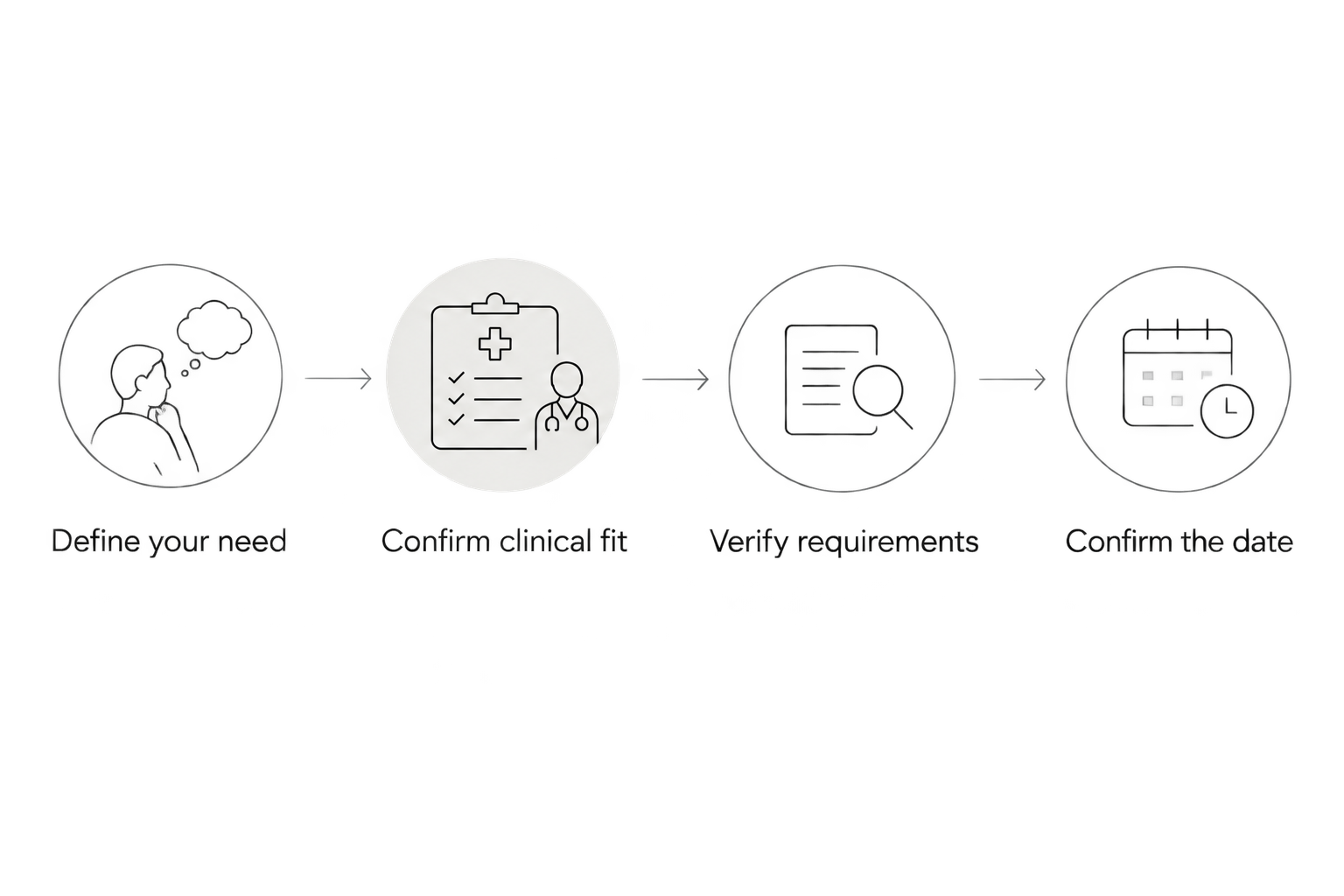
Define your need
State the main concern in plain language: worsening depression, medication follow-up, a transfer of care, or an evaluation after a hospital stay. Explain whether you already have a prescriber and whether there is a time-sensitive medication concern.
You do not need to diagnose yourself. Describe what is happening and what kind of help you are seeking.
Confirm clinical fit
Ask whether the practice treats your concern and whether the requested appointment is with a psychiatrist. If you need a particular service, confirm that the evaluation addresses that service rather than assuming every appointment does.
Ask about age restrictions, location requirements, and appointment format when they apply. These questions prevent you from pursuing an appointment that does not meet your needs.
Verify requirements
Ask which forms, referrals, and records must arrive before the evaluation. Also ask whether the office needs those items before it can schedule you or simply before the appointment itself.
Keep confirmation messages and the names of any documents requested. Send medical records through the method the practice specifies.
Confirm the date
Get the appointment date, location or connection instructions, clinician’s name, and next steps in writing. Check that the appointment is an evaluation rather than an administrative intake call.
For your 2026 appointment, use the instructions attached to your actual booking. General website information does not replace appointment-specific directions.
What should you prepare before the evaluation?
Prepare a clear treatment history, not a polished personal statement. The clinician needs to understand your symptoms, what you have tried, and what happened with each treatment.
Bring or submit the following through the practice’s approved process:
- Your current prescription medications, doses, and prescribing clinicians.
- Previous psychiatric medications, including benefits, side effects, and reasons for stopping.
- Relevant diagnoses, evaluations, and hospital discharge instructions.
- Medical conditions, allergies, and other medications or supplements.
- Your main concerns about sleep, mood, anxiety, attention, or daily functioning.
- The treatment questions you want answered.
If you cannot remember a medication name or dose, request the information from your pharmacy or prior prescriber. Mark uncertain details as uncertain rather than filling gaps from memory.
Preparation supports an informed evaluation; it does not guarantee faster scheduling. Ask the office which documents are essential so you do not postpone contacting the practice while gathering every record you have.
Does insurance change how you arrange the appointment?
Insurance can add requirements to the booking process, but your plan determines which requirements apply. Ask whether you need a referral, whether the clinician participates in your network, and whether the evaluation requires authorization.
For 2026 benefits, confirm the plan attached to your current member identification information. If your coverage recently changed, do not assume a previous verification still applies.
Separate these questions when speaking with the insurer:
- Is this individual clinician in my plan’s network?
- Does my plan require a referral for outpatient psychiatry?
- Does the evaluation require prior authorization?
- Are telehealth benefits different from in-person benefits?
- Is the treatment I am asking about subject to a separate review?
A provider’s receipt for an out-of-network visit is not a coverage guarantee. Questions about out-of-network therapy reimbursement also require a distinction between obtaining documentation and meeting the insurer’s benefit rules; verify psychiatric evaluation benefits separately from therapy benefits.
Ask the practice how it handles insurance verification, then confirm your responsibilities with your insurer. Keep any reference number from the insurer’s response with your appointment records.
Will the first appointment start treatment?
The first appointment begins the assessment process. It does not establish in advance which treatment the clinician will recommend or whether additional information is necessary.
Medication decisions depend on the evaluation, your medical history, safety considerations, and the clinician’s judgment. A previous prescription or diagnosis is relevant information, not a guarantee that the new clinician will continue the same plan.
Attuned Psychiatry is best suited to patients seeking physician-led psychiatric care in Decatur/Metro Atlanta, including evaluation for treatment-resistant depression. Its services include medication management, TMS, and SPRAVATO®; the appointment date alone does not establish eligibility for those treatments or a treatment-start date.
That range of services is relevant when depression has not responded to previous treatment. The limitation is equally important: only an individualized assessment can establish which option fits your needs.
Request a psychiatric consultation
Discuss psychiatric care and treatment-resistant depression services in Decatur/Metro Atlanta.
What should you do while waiting for the appointment?
Keep your existing care team informed about changes in symptoms and medication needs. If you have a current prescriber, contact that clinician before you run out of medication rather than assuming a new practice will issue a prescription before evaluating you.
Do not stop or change prescribed psychiatric medication without clinical guidance. Ask your current clinician what to do if symptoms worsen before the scheduled evaluation.
If you are leaving a hospital, follow the discharge plan and contact the discharge team when outpatient arrangements are unclear. Tell the receiving practice about the discharge and provide the recommended follow-up instructions.
In the United States, call or text 988 for a mental health or suicide crisis. Call 911 or go to the nearest emergency department if there is immediate danger or a medical emergency; do not wait for a routine outpatient appointment.
FAQ
How long will I have to wait to see a psychiatrist?
Your appointment date depends on the practice’s schedule, clinical fit, and intake requirements. Ask for the earliest appropriate evaluation date and confirm whether paperwork or referrals must arrive first.
Can I book a psychiatrist without a referral?
You can contact a psychiatric practice directly, but your insurance plan or the practice can require a referral. Confirm both requirements before treating the appointment as ready to proceed.
Will a psychiatrist prescribe medication at my first appointment?
A first appointment does not guarantee a prescription. The psychiatrist must assess your symptoms, medical history, current medications, and safety before making treatment recommendations.
Is a telehealth psychiatry appointment always faster?
Telehealth does not guarantee an earlier appointment. Ask whether the practice offers telehealth for your circumstances and whether the clinician can evaluate you from your location.
What should I do if I run out of medication before my appointment?
Contact your current prescriber before your medication runs out. Do not assume a new psychiatrist can prescribe before an evaluation, and seek urgent clinical guidance if a medication interruption is affecting your health.
Can I schedule TMS or SPRAVATO® without an evaluation?
TMS and SPRAVATO® require assessment of whether treatment is appropriate. An appointment request does not establish eligibility, insurance approval, or a treatment-start date.
Does Attuned Psychiatry provide care for treatment-resistant depression?
Attuned Psychiatry provides physician-led psychiatric care for treatment-resistant depression and other psychiatric conditions in Decatur/Metro Atlanta. Services include medication management, TMS, and SPRAVATO®; an evaluation determines the recommended next step.
One last thing
Before ending a scheduling call, ask: What exactly will happen at this appointment, and what must I complete beforehand? That question separates a confirmed clinical evaluation from a preliminary intake step.
For any 2026 booking, write down the answer alongside the date. You need a clear care pathway, not just a place on a calendar.


