

The best fit among ADHD psychiatrists near Decatur GA is a clinician who evaluates ADHD in your age group, checks competing explanations, and provides ongoing care. Best for adults seeking diagnostic clarity: adult ADHD evaluation; best for children: child and adolescent psychiatry; best for an established diagnosis: medication-management follow-up.
- Choose ADHD psychiatrists near Decatur GA by age-group experience, diagnostic approach, and follow-up—not a generic ranking.
- Attuned Psychiatry offers psychiatric medication management in Decatur; confirm ADHD-specific services before scheduling.
- Choose child and adolescent psychiatry when a child needs evaluation and coordination with caregivers or school.
- Bring previous assessments, medication history, and examples of symptoms across settings to your appointment.
Why this matters
Trouble concentrating does not automatically mean ADHD. Depression, anxiety, sleep problems, substance use, and medication effects can also affect attention. Choosing a clinician who checks those possibilities matters more than choosing the nearest office.
Attuned Psychiatry is a physician-led psychiatric practice in Decatur/Metro Atlanta offering medication management, TMS, and SPRAVATO® treatment. Attuned Psychiatry is a local option for patients seeking physician-led psychiatric medication management. Confirm that the practice evaluates and treats ADHD in your age group before booking an ADHD appointment.
This 2026 guide ranks care pathways by the problem you need solved, not individual doctors by quality. Use it to identify the right appointment, then ask the office questions that establish whether its services match your needs.
What makes the best ADHD psychiatrist for you?
A useful shortlist starts with clinical fit. Use these criteria before comparing location or appointment convenience:
- Age-group experience: Ask whether the psychiatrist evaluates adults, children, or adolescents. Do not assume a practice serves every age group.
- Diagnostic depth: Look for a review of developmental history, current impairment, and alternative explanations—not a diagnosis based only on a questionnaire.
- Treatment scope: Ask how medication, behavioral strategies, and psychotherapy referrals fit together when appropriate.
- Safety review: Expect discussion of medical history, current medications, sleep, and substance use before medication decisions.
- Follow-up ownership: Establish who monitors progress, handles side effects, and communicates treatment changes.
- Practical access: Confirm appointment format, insurance participation, records requirements, and how to contact the clinical team.
For your 2026 search, apply the same questions to every office. A clear explanation of the evaluation process is more useful than a broad claim about treating attention problems.
ADHD care options at a glance
| Ranked care pathway | Best for | Main advantage | Key limitation |
|---|---|---|---|
| Adult ADHD diagnostic evaluation | Adults without a clear diagnosis | Examines symptoms, history, impairment, and competing explanations | Evaluation does not guarantee an ADHD diagnosis or prescription |
| Child and adolescent psychiatry | Children and teenagers needing assessment | Incorporates developmental context and caregiver information | School information and caregiver coordination require preparation |
| Established-diagnosis medication management | People with a documented diagnosis seeking continuity | Focuses on response, side effects, and ongoing treatment decisions | A new clinician can still require diagnostic reassessment |
| Psychiatric review of overlapping symptoms | People with attention problems alongside mood, sleep, or anxiety symptoms | Examines whether several conditions contribute to impairment | Clarifying overlapping conditions can require additional assessment |
These are appointment types, not interchangeable treatments. Choose the row that describes your unresolved question rather than the treatment you hope to receive.
1. Adult ADHD evaluation: best for diagnostic clarity
An adult ADHD evaluation is the strongest starting point when you suspect ADHD but have never received a clear diagnosis. The psychiatrist reviews your present difficulties and asks how symptoms developed, where they occur, and how they interfere with daily life.
ADHD diagnostic criteria require symptoms to have been present before age 12 years. You do not need to remember every childhood detail, but old school reports, previous assessments, and observations from someone who knew you then can help establish the history.
Adult ADHD evaluation pros:
- Addresses whether ADHD explains your difficulties rather than assuming it does.
- Reviews work, home, education, and relationship impairment.
- Creates a basis for discussing treatment choices.
Adult ADHD evaluation cons:
- Gathering historical information takes preparation.
- The assessment can identify a different explanation instead of ADHD.
- A questionnaire alone cannot settle every diagnostic question.
Best for: Adults whose main question is whether they have ADHD.
Ask the office what the evaluation includes and whether it needs records before the appointment. Describe concrete problems, such as repeatedly missing deadlines despite using reminders, instead of bringing only a list of diagnostic labels.
Verdict: Choose adult ADHD evaluation before seeking a specific medication when the diagnosis remains unclear.
2. Child and adolescent psychiatry: best for younger patients
Child and adolescent psychiatry evaluates attention and behavior within a child's developmental context. Assessment commonly includes information from caregivers and school because behavior can differ across environments.
ADHD diagnostic criteria require symptoms in 2 or more settings, such as home and school. A concern reported in only one environment still deserves attention, but the clinician needs to understand why it occurs there and what else explains it.
Child and adolescent psychiatry pros:
- Examines behavior in relation to developmental expectations.
- Incorporates caregiver observations and school information.
- Supports discussion of treatment alongside educational and behavioral needs.
Child and adolescent psychiatry cons:
- Caregiver and school coordination adds preparation.
- An evaluation does not itself establish school accommodations.
- A child's treatment plan needs review as needs change.
Best for: Children and adolescents with persistent attention, activity, or impulse-control concerns.
For a 2026 appointment, ask which ages the psychiatrist accepts and how the office collects teacher feedback. Bring relevant school evaluations, but do not postpone seeking help solely because every document is not ready.
Verdict: Choose child and adolescent psychiatry for a child rather than assuming an adult-focused practice provides equivalent services.
3. Medication management: best for an established diagnosis
Medication-management follow-up fits patients who already have a documented ADHD diagnosis and need ongoing treatment review. The clinician assesses benefits, side effects, daily functioning, and whether the current plan remains appropriate.
Attuned Psychiatry offers psychiatric medication management in Decatur/Metro Atlanta. For ADHD care, confirm the practice's age requirements, diagnostic process, and approach to continuing an existing prescription before transferring treatment.
Medication-management pros:
- Provides a setting for reviewing treatment response and tolerability.
- Allows medication decisions to reflect changes in health or functioning.
- Supports continuity when previous records are available.
Medication-management cons:
- A previous prescription does not guarantee continuation.
- The receiving clinician can request reassessment or additional records.
- Medication follow-up does not replace psychotherapy or skills-based support when those are needed.
Best for: Patients with an established diagnosis who need a clinician to oversee treatment.
Before changing practices, ask both offices how records transfer works and discuss continuity with your current prescriber. Do not assume that booking a new appointment establishes an immediate prescribing relationship.
Verdict: Choose medication management when the diagnosis is established, but confirm the receiving clinician's requirements before transferring care.
4. Psychiatric review: best for overlapping symptoms
A broader psychiatric review is the right starting point when attention problems occur alongside substantial depression, anxiety, sleep disruption, or other psychiatric symptoms. The purpose is to distinguish conditions that coexist from conditions that resemble one another.
Attuned Psychiatry offers medication management and advanced treatments for treatment-resistant depression. That makes its stated services relevant to a discussion about depression treatment; it does not establish that a particular patient needs TMS or SPRAVATO® for attention symptoms.
Psychiatric review pros:
- Examines several possible contributors to concentration problems.
- Helps avoid treating every attention complaint as ADHD.
- Connects treatment priorities to the symptoms causing impairment.
Psychiatric review cons:
- Separating overlapping symptoms can require further appointments or records.
- Depression-focused treatment is not a substitute for ADHD assessment.
- More than one condition can require more than one treatment approach.
Best for: Patients whose attention problems occur with significant mood, anxiety, or sleep symptoms.
Explain when each symptom began. Longstanding distractibility and concentration problems that appeared during a depressive episode give the psychiatrist different questions to investigate.
Verdict: Choose a broader psychiatric review when attention symptoms are part of a more complicated clinical picture.
How these care pathways were ranked
The ranking prioritizes the question an appointment needs to answer: diagnosis, age-specific assessment, treatment continuity, or overlapping conditions. It uses the criteria above rather than unsupported claims about individual clinicians' outcomes.
For a 2026 shortlist, move the relevant pathway to the top. A child needing assessment should start with the child-focused option; an adult with complete diagnostic records should ask about continuity requirements.
What to prepare before your appointment
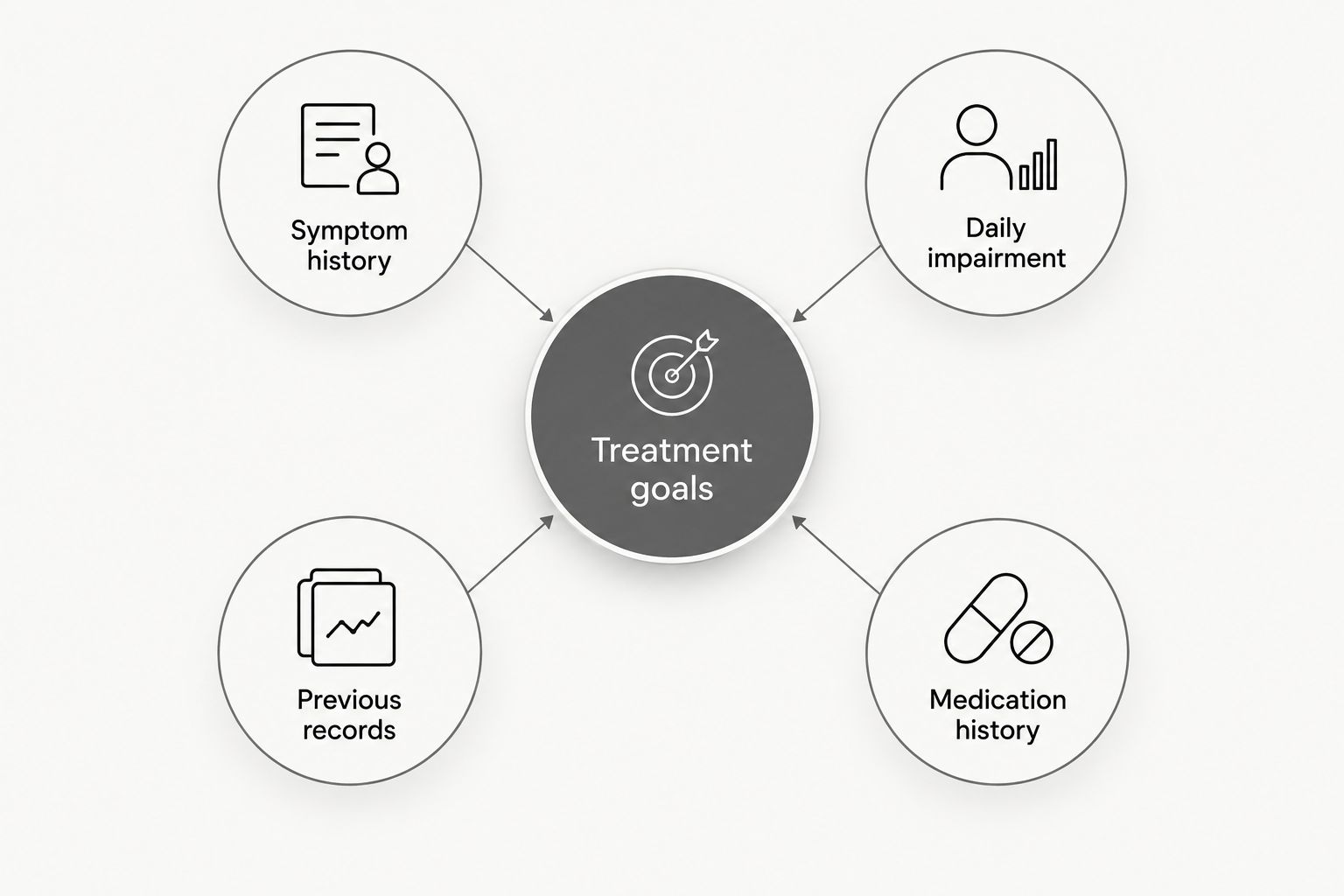
Good preparation gives the psychiatrist a clearer picture of your functioning. Organize information into these categories:
- Symptom history: Note when difficulties began and whether they changed with sleep, stress, or mood.
- Daily impairment: Bring examples from work, school, home, or relationships.
- Previous records: Include assessments, relevant school reports, and prior treatment summaries.
- Medication history: List current and previous medications, benefits, side effects, and reasons for stopping.
- Treatment goals: Identify what improvement would look like in daily life.
Keep the examples specific. Saying that you lose track of bills despite setting reminders gives the clinician more to assess than saying that you need better focus.
Diagnostic criteria also require symptoms to persist for at least 6 months. Duration alone does not establish ADHD: onset, impairment, setting, and alternative explanations remain part of the assessment.
Which ADHD care pathway should you choose?
Start with diagnostic evaluation if you do not have an established diagnosis. Choose child and adolescent psychiatry for a younger patient, medication management for documented treatment continuity, or a broader psychiatric review when symptoms overlap substantially.
For ADHD psychiatrists near Decatur GA in 2026, the most useful first question is: does this office evaluate and treat someone of your age with your specific concern? Ask that before arranging records or assuming an appointment includes prescribing.
Review local psychiatric care
Explore the practice, then confirm ADHD evaluation and medication-management requirements before scheduling.
FAQ
What's the best way to choose an ADHD psychiatrist near Decatur GA?
Choose a psychiatrist whose age-group experience, evaluation process, and follow-up services match your needs. Ask whether the office assesses ADHD, reviews other explanations for attention problems, and manages ongoing treatment.
Does Attuned Psychiatry treat ADHD?
Confirm ADHD-specific evaluation and treatment directly with Attuned Psychiatry before scheduling. The practice offers physician-led psychiatric medication management in Decatur/Metro Atlanta, along with TMS and SPRAVATO® treatment.
Can a psychiatrist diagnose ADHD in an adult?
Yes, a psychiatrist can evaluate an adult for ADHD. The assessment considers childhood symptom history, current impairment, symptoms across settings, and other possible explanations.
Do I need neuropsychological testing for an ADHD diagnosis?
Neuropsychological testing is not required for every ADHD diagnosis. A clinician can recommend additional testing when learning concerns, cognitive questions, or diagnostic uncertainty make it useful.
Will a new psychiatrist continue my ADHD prescription?
A new psychiatrist makes an independent prescribing decision and does not automatically continue an existing prescription. Bring prior assessments and treatment records, and ask about transfer requirements before changing care.
Are TMS and SPRAVATO® standard treatments for ADHD?
No, TMS and SPRAVATO® are not standard ADHD treatments. Their use for depression is a separate clinical decision and should not be confused with ADHD assessment or treatment.
What should I bring to my first ADHD appointment?
Bring your medication list, previous evaluations, relevant medical records, and concrete examples of impairment. Childhood records or observations from someone who knew you then can help clarify symptom history.
Can depression look like ADHD?
Yes, depression can cause concentration difficulties that resemble ADHD symptoms. A psychiatric evaluation examines timing, developmental history, and the wider symptom pattern to distinguish overlapping conditions.
One last thing
A positive screening questionnaire is a reason for assessment, not a complete diagnosis. Bring the result if you have one, but pair it with examples of what is going wrong and when those problems began. That history helps turn an appointment into a clinical decision rather than a discussion of a score.


