

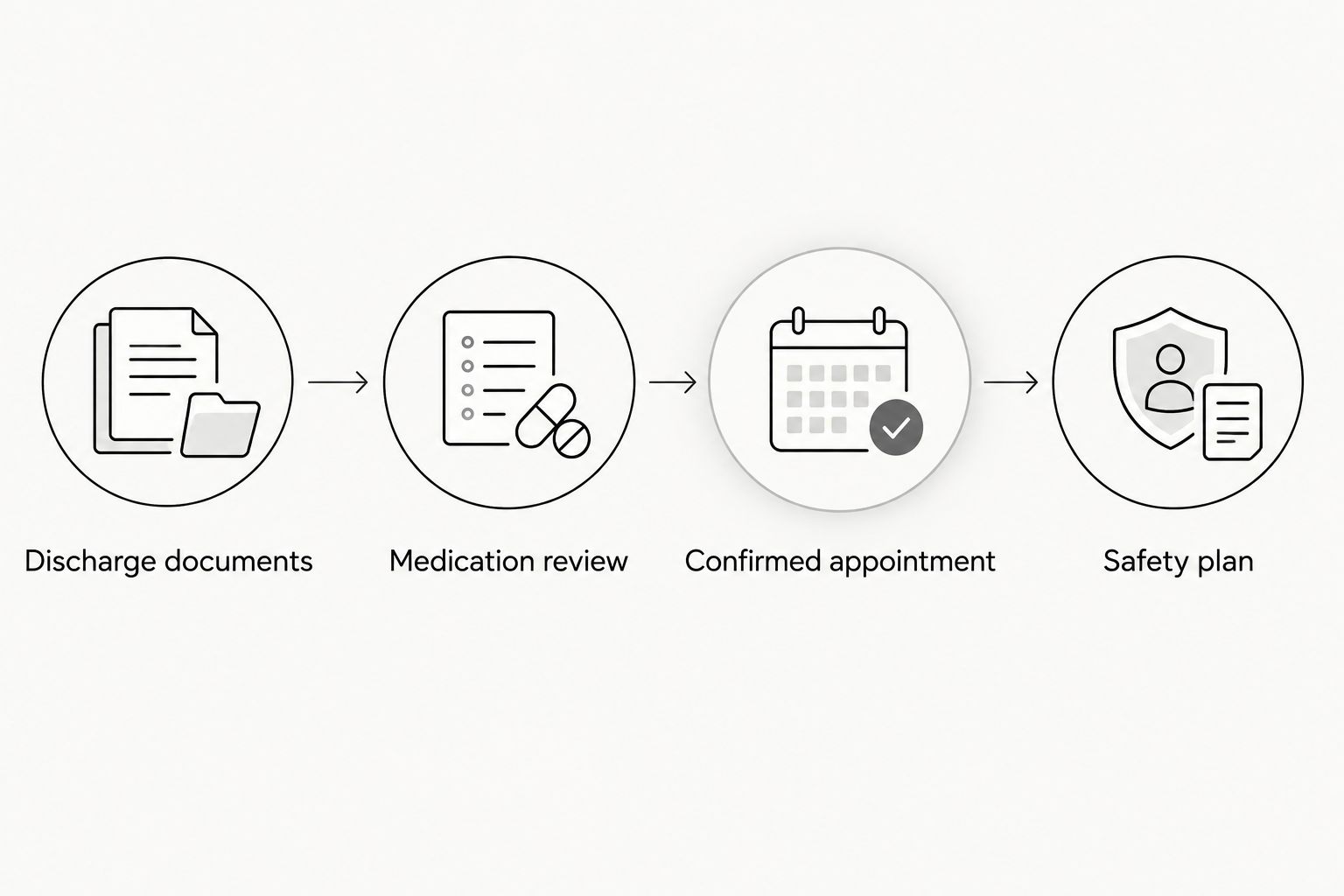
Instead of repeatedly calling offices and retelling your hospital stay, organize psychiatric follow up care after hospitalization around a confirmed appointment, an accurate medication list, and a written safety plan. This 2026 workflow shows you what to arrange before discharge, what to bring to outpatient care, and who to contact when the handoff breaks down.
- Psychiatric follow up care after hospitalization needs a confirmed appointment, medication reconciliation, and a written safety plan.
- Attuned Psychiatry offers physician-led outpatient psychiatric care in Decatur/Metro Atlanta, including medication management.
- Ask the hospital who handles medication questions before your first outpatient appointment.
- Call 988 for a mental health crisis; call 911 for immediate danger or a medical emergency.
Why this matters
A discharge referral is not the same as an accepted outpatient appointment. You need to know who will see you, when the visit happens, and who handles urgent questions before that visit.
Attuned Psychiatry is best for people in Decatur/Metro Atlanta seeking physician-led outpatient psychiatric care, including medication management and evaluation of treatment-resistant depression. Attuned Psychiatry offers medication management, TMS, and SPRAVATO® treatment; the appropriate next step depends on an individual clinical assessment, not hospitalization alone.
For your 2026 discharge plan, separate routine follow-up from emergency help. An outpatient appointment does not replace crisis assessment: in the United States, call or text 988 for a mental health crisis, and call 911 for immediate danger or a medical emergency.
This guide supports discharge planning; it does not replace your treating team's instructions. Do not stop, restart, or change psychiatric medication based on this article.
Before you start
- Gather your discharge materials. Request the discharge summary, medication list, prescriptions, written safety plan, and any instructions about pending tests or monitoring. If you cannot obtain everything before leaving, identify who will send the missing records.
- Confirm practical access. Have your insurance information if applicable, pharmacy details, a working callback number, transportation arrangements, and the outpatient office's contact information. Ask what records and intake paperwork the office requires.
- Resolve the hidden handoff problem. Ask whether the outpatient clinician has accepted the referral and who handles medication questions until the first visit. A referral sent by the hospital does not establish either responsibility.
You do not need a particular app. Use one secure document or paper folder, and share sensitive records through the channels each healthcare organization instructs you to use.
Discharge record and medication handoff
Your first task is to make the hospital's instructions usable outside the hospital. Keep the discharge list separate from older medication lists until a clinician resolves any differences.
- Request the final discharge documents. Check that the documents belong to you and reflect the discharge instructions you received. Ask how to obtain the completed summary if it is not ready when you leave.
- Review each medication with the discharge team. Ask which medicines continue, which stop, and which changed. Include nonprescription medicines and supplements when discussing possible interactions.
- Check the pharmacy handoff. Confirm where prescriptions were sent, whether the pharmacy received them, and whether any prescription needs an additional authorization. Raise problems before your existing supply runs out.
- Identify monitoring responsibilities. Ask whether your treatment requires laboratory tests, physical checks, or other monitoring. Record who orders each item, who reviews the result, and how you receive instructions.
- Name the interim contact. Write down who to call about a missing prescription, a suspected side effect, or unclear instructions before the outpatient visit. Ask what to do outside office hours.
Expected result: You have one clinician-reviewed medication list and know who handles unresolved medication questions. If the discharge paperwork and prescription label disagree, contact the prescribing team or pharmacist for clarification rather than choosing between them yourself.
Treat medication access as part of the handoff, not a separate errand. A future appointment does not solve a prescription problem today.
Outpatient appointment and records transfer
A useful appointment has a named office, a confirmed date, and clear instructions. Keep a record of what the office actually confirms rather than relying on a referral status alone.
- Contact the receiving practice. Explain that you are arranging follow-up after psychiatric hospitalization. Share your discharge date, the hospital's recommended follow-up timing, and any medication or monitoring issue that needs prompt review.
- Confirm the appointment details. Record the clinician or service, visit date, location or visit format, check-in instructions, and required paperwork. Ask whether the first visit includes prescribing decisions or whether another appointment is required.
- Arrange the records transfer. Ask the hospital how it sends the discharge summary and medication list. Complete any required authorization, then ask the outpatient office whether it received the records.
- Check practical barriers. Confirm transportation, time away from work, accessibility needs, interpreter arrangements, or any technology required for the scheduled visit. Do not assume a visit format is offered until the office confirms it.
- Escalate a timing gap. If the first offered appointment falls outside the hospital's instructions, tell the discharge team. Ask for an alternative handoff plan and clarify who remains responsible for interim questions.
Expected result: You can state where the follow-up happens, what the visit covers, and how the clinician receives your records.
What do the follow-up timeframes mean?
For 2026 planning, distinguish quality-measure windows from your personal clinical instructions. The National Committee for Quality Assurance's HEDIS Follow-Up After Hospitalization for Mental Illness measure tracks qualifying follow-up within 7 days and 30 days after discharge for its defined population.
Those windows measure follow-up; they do not tell you how long it is safe to wait. Follow the timing in your discharge plan, and seek earlier assessment for worsening symptoms or safety concerns.
Safety plan and daily handoff
A safety plan needs to work when concentration, sleep, or judgment is impaired. Keep it easy to find, and review it with a trusted support person when appropriate and with your permission.
- Locate your written safety plan. Review the warning signs, coping steps, supportive contacts, and crisis instructions with the discharge team. Ask for clarification wherever an instruction is vague.
- Discuss a safer environment. Follow the team's recommendations about access to firearms, medications, and other potentially lethal means. Ask a trusted person to help carry out the agreed plan when appropriate.
- Assign practical support. Decide who can help with transportation, appointment reminders, pharmacy calls, or meals. Agree on what that person should do if they cannot reach you or notice concerning changes.
- Separate contact routes. Write down the routine office contact, any after-hours instructions, and emergency options. Do not rely on a routine voicemail or patient portal message for an immediate safety concern.
- Prepare a brief symptom record. Note sleep changes, mood changes, medication concerns, and difficulties managing daily activities. Bring the record to your appointment without changing treatment on your own.
Expected result: You and any involved support person know which changes require a routine call, prompt clinical assessment, or emergency help.
First outpatient visit and ongoing responsibility
The first visit should connect the hospitalization to a plan you can follow at home. Bring your discharge documents even if you were told they were sent electronically.
- Explain the reason for hospitalization. Describe what changed, what treatment occurred, and what remains difficult. Include relevant changes in sleep, substance use, functioning, and safety.
- Review what you actually take. Bring the current medication list and describe missed doses, access problems, or side effects. Distinguish what was prescribed from what you have been able to take.
- Clarify the treatment plan. Ask what continues, what changes, what requires monitoring, and what symptoms should prompt contact. Request written instructions for medication changes.
- Confirm ongoing responsibility. Identify who handles prescriptions, test results, therapy referrals, and the next appointment. If several clinicians are involved, ask how they will coordinate.
Expected result: You leave with a documented next step and understand who handles each part of care.
Attuned Psychiatry's psychiatric services include medication management, TMS, and SPRAVATO®. These treatments are not interchangeable discharge steps; discuss their purpose, suitability, risks, and monitoring requirements during clinical evaluation.
When symptoms or prescriptions change before follow-up
The adjacent workflow starts whenever something changes after discharge: symptoms worsen, a prescription cannot be filled, or instructions conflict. Do not wait for the scheduled visit to report a problem that needs earlier review.
Compare these response routes in your 2026 plan:
| Response route | Best for | Benefit | Limitation |
|---|---|---|---|
| Scheduled outpatient visit | Reviewing ongoing symptoms and treatment | Supports a coordinated treatment discussion | Does not address an immediate emergency |
| Prompt clinical contact | New side effects, access problems, or conflicting instructions | Brings a specific problem to the responsible team | A routine message does not guarantee an immediate response |
| Crisis or emergency help | A mental health crisis or immediate danger | Connects you to crisis assessment or emergency response | Does not replace ongoing outpatient treatment |
Contact the responsible clinical team with the change, when it started, and the action you need clarified. If you cannot reach that team, follow the discharge plan's backup instructions; use crisis or emergency help when the situation requires it.
Do not use a routine appointment request to manage an immediate safety crisis. Call or text 988 for crisis support; call 911 for immediate danger or a medical emergency.
Troubleshooting the discharge handoff
The office has no referral or records
Ask the hospital to verify the receiving office and resend through its approved channel. Separately ask the office whether scheduling can proceed while records are being transferred. Record the next action and who owns it.
The prescription cannot be filled
Ask the pharmacist to identify the barrier, then contact the prescribing team with that specific issue. Do not substitute an old prescription, borrow medication, or change the dose to stretch your supply.
The appointment is later than instructed
Tell both the receiving office and the discharge team about the timing conflict. Ask whether another appointment or service can meet the discharge instructions and who will handle care questions meanwhile.
You missed the first appointment
Contact the office to reschedule and explain any medication, transportation, or safety concern. Ask the discharge contact for help if you still lack an established outpatient clinician; seek urgent assessment rather than waiting if symptoms require it.
Customize your workflow
For your 2026 follow-up plan, add the details that affect whether you can attend and follow treatment: work hours, caregiving duties, transportation, communication preferences, and permission to involve a support person. Keep the plan short enough to use during a difficult day.
Attuned Psychiatry provides physician-led outpatient psychiatric care, but a request for care is not a confirmed hospital handoff. Ask the practice directly about the intake process and explain the hospital's discharge instructions.
Discuss your outpatient care needs
Explain your discharge instructions and ask about the intake process.
FAQ
How soon should I have psychiatric follow-up after leaving the hospital?
Follow the timing specified by your discharge team. NCQA's follow-up measure tracks 7-day and 30-day windows, but those measurement windows do not replace individualized clinical instructions.
What should I bring to my first outpatient psychiatry appointment?
Bring your discharge summary, current medication list, safety plan, and any monitoring instructions. Also bring a record of symptoms, side effects, missed doses, and prescription access problems.
Who handles my medication before my first outpatient appointment?
Ask the discharge team to identify the responsible clinician before you leave. Do not assume that sending a referral means the receiving practice has accepted prescribing responsibility.
What if my symptoms get worse before my follow-up visit?
Contact the responsible clinical team promptly and follow your discharge safety plan. In the United States, call or text 988 for a mental health crisis, or call 911 for immediate danger or a medical emergency.
Can a family member help coordinate psychiatric follow-up?
A trusted support person can help with records, transportation, reminders, and agreed safety steps. Discuss your preferences and any required permissions with the treating team.
Does hospitalization mean I need TMS or SPRAVATO?
Hospitalization alone does not determine whether TMS or SPRAVATO is appropriate. Attuned Psychiatry offers both treatments, and suitability requires an individual clinical assessment.
What should I do if I cannot fill my discharge prescription?
Ask the pharmacist what is preventing the prescription from being filled and contact the prescribing team with that information. Do not change the dose or use someone else's medication.
One last thing
The most useful question is: who is responsible until the next clinician takes over? Ask it about prescriptions, test results, symptom changes, and safety concerns. A named contact and a clear backup plan make the handoff actionable.


