

Yes. A psychiatrist in Georgia can prescribe benzodiazepines when appropriately licensed and authorized to prescribe controlled substances, but a prescription requires an individual medical assessment. Searching for benzodiazepine friendly doctors near me does not establish whether a medication is appropriate, and an existing prescription does not guarantee that a new psychiatrist will continue it.
- Benzodiazepine friendly doctors near me should mean careful evaluation, not a guaranteed prescription.
- Georgia psychiatrists can prescribe benzodiazepines when authorized and clinically appropriate; individual practice policies differ.
- Attuned Psychiatry offers physician-led psychiatric medication management in Decatur/Metro Atlanta, not a stated benzodiazepine prescribing guarantee.
- Do not abruptly stop a regularly taken benzodiazepine; withdrawal can cause seizures and other serious complications.
Can a psychiatrist in Georgia prescribe benzodiazepines?
Yes, but prescribing authority and the decision to prescribe are separate issues. Benzodiazepines are Schedule IV controlled substances under federal law. A Georgia psychiatrist must meet applicable licensing and controlled-substance requirements, and each prescription must serve a legitimate medical purpose.
For patients seeking psychiatric medication management, the useful question is whether the clinician will assess the symptoms, treatment history, and medication risks—not whether the clinician promises a particular drug.
A prescribing assessment generally addresses these steps:
- Clarify the problem. Describe panic episodes, persistent anxiety, sleep symptoms, or another concern, including how symptoms affect daily functioning.
- Review previous treatment. Bring medication names, doses, benefits, adverse effects, and reasons treatments ended.
- Check safety. Disclose alcohol use, opioid prescriptions, other sedating medicines, breathing problems, and any history of withdrawal.
- Agree on a plan. Discuss treatment goals, follow-up, alternatives, and what happens if the medication does not help.
A clinician can recommend a different treatment after completing this assessment. That decision does not mean your symptoms are being dismissed.
Why this matters
The phrase benzodiazepine friendly doctors near me mixes several different needs: finding someone who listens, transferring an existing prescription, and seeking relief after other treatments have failed. Those situations require different conversations.
For your 2026 search, focus on continuity, clear prescribing policies, and a documented treatment plan. A promise to prescribe before reviewing your history is not a substitute for an evaluation. Neither is a blanket assumption that everyone taking a benzodiazepine has a substance use disorder.
If you already take a benzodiazepine regularly, tell the prospective practice before the appointment. Explain when your current supply ends and who currently prescribes it. Do not wait until you have run out to discuss continuity.
What does a psychiatrist review before prescribing?
A psychiatrist needs enough information to judge whether the expected benefit outweighs the risks. Your diagnosis matters, but so do your health conditions, other medications, daily responsibilities, and response to previous treatment.
Your symptoms and diagnosis
Describe what happens during an episode rather than relying only on the word anxiety. Include physical symptoms, triggers, avoidance, sleep changes, and effects on work or relationships.
Anxiety can occur alongside depression, trauma-related conditions, substance effects, or medical illness. A medication request alone does not establish the diagnosis or the best treatment.
Your medication and substance history
List prescription drugs, nonprescription sleep aids, supplements, alcohol, and other substances. Include medications from other clinicians, even if you take them only occasionally.
Combining benzodiazepines with opioids, alcohol, or other central nervous system depressants can cause dangerous sedation and breathing problems. Accurate disclosure helps the psychiatrist identify interactions; it is not a reason to hide part of your history.
Your current functioning and safety
Tell the clinician if your work involves driving, machinery, climbing, or other tasks where impaired alertness creates danger. Mention falls, memory concerns, sleep apnea, pregnancy, or plans for pregnancy.
These details affect the benefit-risk discussion. They do not produce the same prescribing decision for every patient.
How do benzodiazepines compare with other anxiety treatments?
Benzodiazepines, antidepressant medications, and cognitive behavioral therapy have different roles. The right comparison is symptom relief plus long-term safety—not simply which treatment acts fastest.
The table below summarizes established treatment characteristics for a 2026 discussion with your clinician. It is not an individualized recommendation.
| Treatment approach | Best for discussion when | Potential benefit | Important limitation |
|---|---|---|---|
| Benzodiazepines | Selected patients need relief of severe anxiety or panic symptoms | Can reduce symptoms relatively quickly | Sedation, physical dependence, withdrawal, and dangerous interactions require careful assessment |
| SSRIs or SNRIs | Persistent anxiety or panic symptoms need ongoing medication treatment | Can support sustained symptom control without benzodiazepine-type dependence | Benefit is not immediate, and adverse effects require monitoring |
| Cognitive behavioral therapy | Anxiety involves avoidance, panic-related fear, or recurring thought and behavior patterns | Builds skills without medication sedation or drug interactions | Requires active participation and access to an appropriately trained therapist |
These approaches are not always mutually exclusive. A psychiatrist can discuss whether medication, psychotherapy, or a combination fits your diagnosis and treatment history.
Failure of one treatment also needs context. The clinician will want to know what you took, how consistently you took it, what changed, and why it stopped. Bring that history rather than assuming every unsuccessful trial rules out an entire treatment category.
Why benzodiazepine prescribing decisions vary
There is no single prescribing answer for every patient with anxiety. These factors explain why psychiatrists reach different decisions:
- Diagnosis and treatment goal: Managing a discrete episode of severe symptoms differs from planning ongoing care for persistent anxiety.
- Previous response: Meaningful benefit, adverse effects, unsuccessful alternatives, and prior withdrawal all matter.
- Other medications and alcohol: Sedating combinations change the safety assessment, particularly when opioids are involved.
- Medical circumstances: Breathing disorders, falls, cognitive concerns, pregnancy, and other health conditions affect risk.
- Current medication use: Starting treatment differs from safely assessing someone already taking a benzodiazepine regularly.
- Practice policy and follow-up: A practice's controlled-substance policies and ability to monitor treatment affect what it offers.
Ask about practice policy before booking. You can confirm whether the office evaluates patients taking benzodiazepines without asking the office to guarantee a prescription.
How do you find a psychiatrist without seeking a prescription guarantee?
Use your 2026 provider search to identify a clinician who explains decisions, reviews records, and addresses what happens next. Location matters, but a nearby office is not useful if its services do not match your needs.
Ask prospective practices:
- Do you evaluate adults who currently take prescribed benzodiazepines?
- What records should my current prescriber send?
- Does the practice have a policy about starting or continuing these medications?
- If a medication change is recommended, how is the transition addressed?
- What should I do if my current prescription ends before an evaluation?
An office can explain its policies without deciding your treatment over the phone. A receptionist's answer about appointments is not a medical commitment from the psychiatrist.
Attuned Psychiatry is a physician-led practice offering psychiatric medication management in Decatur/Metro Atlanta. Attuned Psychiatry fits patients seeking physician-led psychiatric medication management in Decatur/Metro Atlanta. Its stated services do not establish whether a particular benzodiazepine will be started, continued, or tapered; confirm that question directly before booking.
Discuss your medication management needs
Ask about evaluation, current medications, and records needed before booking.
What should you bring to a benzodiazepine evaluation?
Prepare a clear medication history for your 2026 appointment. Bring records that explain the treatment—not just the name of the prescription you want continued.
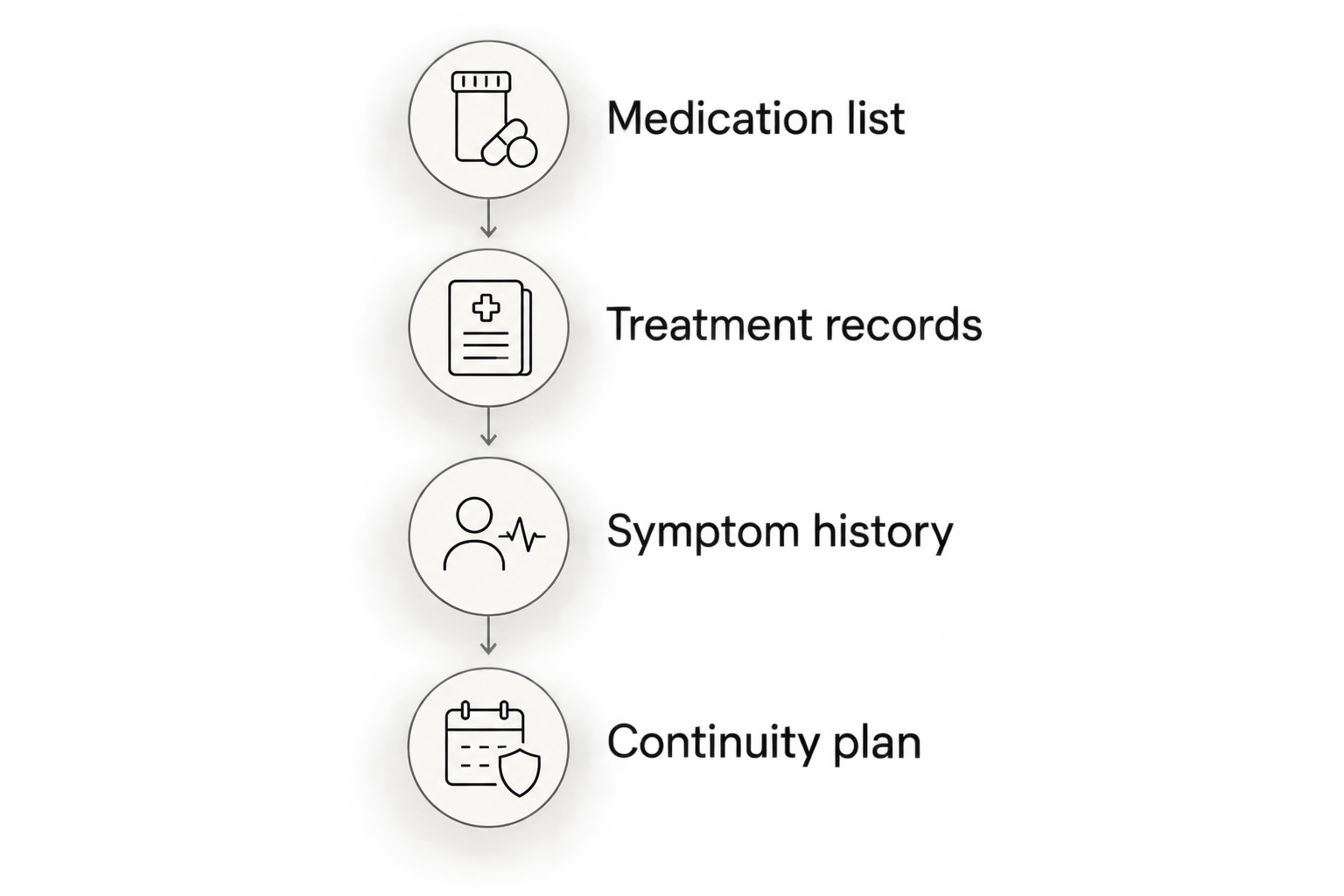
Use this sequence:
- Medication list: Include exact names, prescribed doses, actual use, and all other medicines or substances.
- Treatment records: Request relevant notes, prior diagnoses, medication trials, and hospital discharge information when applicable.
- Symptom history: Describe what improves with treatment, what remains difficult, and any sedation, memory changes, or falls.
- Continuity plan: Identify your current prescriber, the remaining supply, and whom to contact if care is delayed.
These steps help organize the visit; they do not guarantee prescribing. Do not change your dose to prepare for an appointment unless your treating clinician directs you to do so.
If records are delayed, tell the receiving practice rather than assuming the appointment can resolve everything without them. Keep your current prescriber informed about the transfer and any uncertainty about follow-up.
Will a new psychiatrist continue my existing prescription?
An existing prescription does not guarantee continuation. A new psychiatrist must make an independent prescribing decision based on the evaluation, available records, and safety considerations.
If the clinician recommends a change, ask what the plan addresses: the underlying condition, withdrawal risk, symptom monitoring, and responsibility for follow-up. Do not interpret a recommendation to change treatment as instructions to stop immediately.
Physical dependence and substance use disorder are not the same diagnosis. Dependence can develop during prescribed use, and the distinction matters when planning a safe transition.
How many times can a benzodiazepine prescription be refilled?
Federal rules allow no more than 5 refills within 6 months for a Schedule IV prescription when refills are authorized. Those are legal limits, not an entitlement to refills or a recommendation for treatment duration; a prescriber can authorize fewer or none.
The federal reference is 21 CFR §1306.22, covering refills of Schedule III and IV controlled-substance prescriptions. For your 2026 care plan, confirm the prescription instructions, applicable state requirements, pharmacy requirements, and follow-up expectations with your clinician and pharmacist.
Do not treat unused refill authorization as permission to change how you take the medication. Follow the prescribed directions and raise concerns before making changes.
Is it safe to stop a benzodiazepine while switching doctors?
Abruptly stopping a regularly taken benzodiazepine can be dangerous. Withdrawal can include severe anxiety, insomnia, tremor, confusion, and seizures; a clinician should assess whether a supervised taper is needed.
Contact your current prescriber promptly if you expect to run out during a transfer. Do not borrow medication, combine it with alcohol, or create your own taper schedule.
Call 911 for a seizure, severely slowed breathing, inability to wake someone, or another medical emergency. Routine appointment messaging is not an emergency service.
The clinical safety points in this 2026 guide reflect FDA benzodiazepine class boxed-warning information on misuse, addiction, physical dependence, and withdrawal, plus FDA warnings about combining opioids and benzodiazepines. Individual prescribing still requires a medical evaluation.
FAQ
Can a psychiatrist in Georgia prescribe benzodiazepines at the first appointment?
A first appointment does not guarantee a benzodiazepine prescription. The psychiatrist must assess clinical appropriateness, applicable prescribing requirements, available records, and practice policy.
What should benzodiazepine friendly doctors near me mean when I search?
Look for a clinician who evaluates your symptoms and medication history without promising a specific prescription. Ask about controlled-substance policies, continuity of care, and how treatment changes are managed.
Does Attuned Psychiatry prescribe benzodiazepines?
Attuned Psychiatry offers psychiatric medication management, but its stated services do not establish a benzodiazepine prescribing policy. Ask the practice directly whether it evaluates your situation before booking.
Can I get a benzodiazepine prescription through telehealth in Georgia?
Telehealth prescribing depends on applicable federal and Georgia requirements, the clinician's authorization, and practice policy. Confirm current requirements with the practice before booking; an online appointment does not guarantee a controlled-substance prescription.
Will my psychiatrist think I have an addiction if I take a benzodiazepine?
Taking a prescribed benzodiazepine does not by itself establish a substance use disorder. A psychiatrist assesses use patterns, benefits, harms, and physical dependence separately.
What should I do if I am about to run out before seeing a new psychiatrist?
Contact your current prescriber promptly and explain the timing of your transfer. Do not abruptly stop a regularly taken benzodiazepine or assume a new clinician will provide an immediate refill.
Are benzodiazepines the only option if anxiety is severe?
Benzodiazepines are not the only treatment for severe anxiety. Depending on the diagnosis, a clinician can discuss psychotherapy, other medications, or combined treatment, including the benefits and limitations of each.
One last thing
A refill decision and a withdrawal-safety plan are different clinical questions. Even when a psychiatrist does not recommend continuing a medication, you still need clear instructions about the transition. Ask who is managing the current prescription, what symptoms require urgent help, and when follow-up should occur.


