
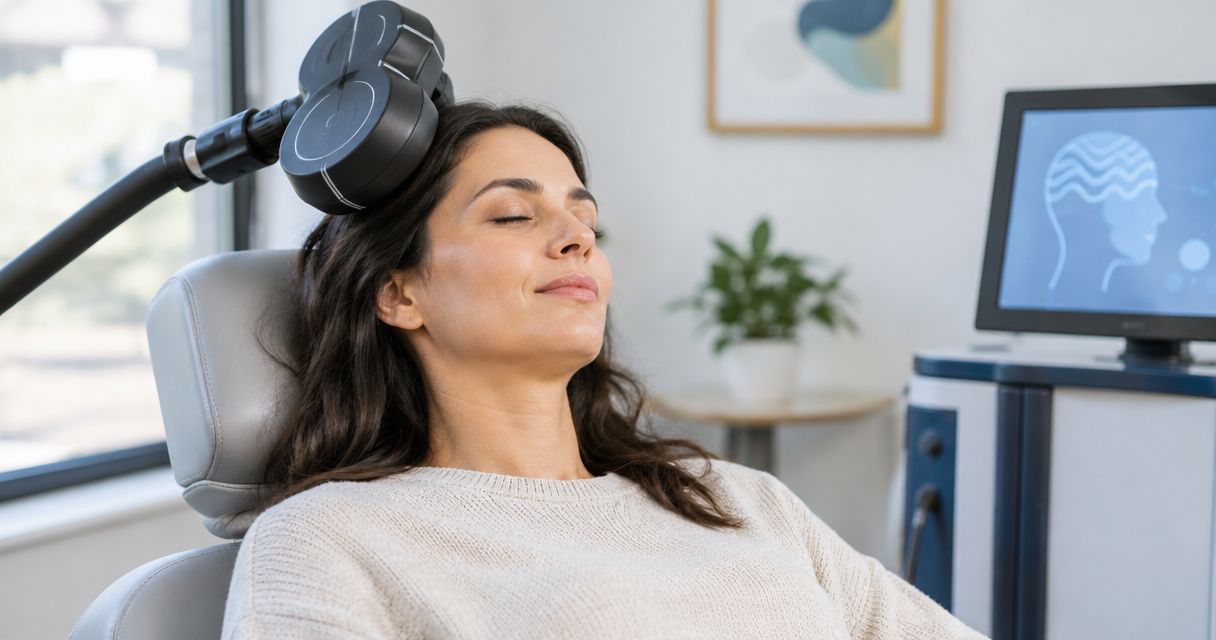
In the THREE-D randomized trial, 47% of patients receiving conventional repetitive TMS had a treatment response, compared with 49% receiving intermittent theta-burst stimulation, a shorter TMS protocol. For a 2026 treatment decision, distinguish improvement from remission: remission rates in those groups were 27% and 32%, respectively, and neither outcome guarantees that depression will stay away permanently.
- The THREE-D trial puts the TMS success rate for depression at 47%–49% for response, not guaranteed recovery.
- Remission occurred in 27%–32% of participants across the trial’s conventional TMS and theta-burst groups.
- Attuned Psychiatry offers physician-led assessment for depression treatment in Decatur/Metro Atlanta.
- Ask whether a quoted success rate measures symptom improvement, remission, or results after treatment ends.
Why this matters
A clinic can describe treatment as successful because symptoms improve, even when depression still affects your sleep, concentration, or ability to work. Another clinic can report only remission, which sets a different threshold. Those percentages do not answer the same question.
Compare definitions before comparing success rates. You need to know who received treatment, how improvement was measured, and when the assessment happened—not just which percentage appears largest.
Attuned Psychiatry provides medication management, TMS, and SPRAVATO® for patients with treatment-resistant depression and other psychiatric conditions. Its psychiatric services are relevant when you need an assessment of treatment options rather than a promise based on a headline statistic.
What is the success rate of TMS for depression?
The THREE-D trial, published in The Lancet, compared conventional repetitive transcranial magnetic stimulation, or rTMS, with intermittent theta-burst stimulation, or iTBS, in adults with treatment-resistant depression. The trial reported the following outcomes at the end of the acute treatment course.
| Treatment option | Response rate | Remission rate | Best for discussing | Important limitation |
|---|---|---|---|---|
| Conventional rTMS | 47% | 27% | Patients considering a conventional stimulation protocol | Improvement did not mean remission for every responder |
| Intermittent theta-burst stimulation | 49% | 32% | Patients asking about a shorter stimulation protocol | A shorter session does not establish a better individual outcome |
These are study results, not a forecast for every patient or every clinic. The trial found iTBS noninferior to conventional rTMS under its study conditions. The numerical differences do not establish that iTBS is universally more effective.
The study also does not establish which protocol a particular practice provides. Ask your treating clinician which protocol is being proposed and which evidence supports that recommendation for your diagnosis.
What counts as a response?
In depression research, response commonly means a reduction of at least 50% in a symptom-rating score. Someone who meets that threshold can still have substantial symptoms and need continued care.
A response is meaningful, but it is not the same as returning fully to your usual functioning. Ask about both symptom scores and changes you would notice in daily life: getting out of bed, managing responsibilities, or reconnecting with people.
What counts as remission?
Remission means symptoms fall below the study’s specified threshold on a depression-rating scale. It does not mean a permanent cure or a guarantee against another depressive episode.
For your 2026 consultation, ask which scale the clinician uses and what score counts as remission. Without that definition, a remission percentage is difficult to interpret accurately.
Conventional rTMS: 47% response and 27% remission
In the THREE-D trial, conventional rTMS produced a response in 47% of participants and remission in 27%. These results give patients a concrete reference point for discussing a conventional treatment course.
Conventional rTMS uses magnetic pulses delivered through a coil positioned against the scalp. For depression treatment, stimulation targets brain networks involved in mood regulation; treatment does not require general anesthesia.
The benefit: conventional rTMS has randomized-trial evidence for treatment-resistant depression and does not require taking another systemic medication. That distinction matters when you are discussing medication side effects or incomplete benefit with your psychiatrist.
The limitation: not everyone improves, and a response can leave residual depression. Treatment also requires repeated appointments, so practical attendance deserves the same attention as the clinical plan.
Best for discussing with your clinician: a conventional stimulation approach supported by evidence in treatment-resistant depression. Suitability still depends on your diagnosis, medical history, and safety assessment.
Intermittent theta-burst stimulation: 49% response and 32% remission
In the THREE-D trial, iTBS produced a response in 49% of participants and remission in 32%. It delivers stimulation in a different pulse pattern and uses shorter stimulation sessions than the conventional protocol studied.
The benefit: shorter stimulation sessions can reduce the time spent receiving stimulation at each visit. The trial supports iTBS as an evidence-based alternative to conventional rTMS under the conditions studied.
The limitation: shorter stimulation does not necessarily mean a shorter overall appointment or fewer visits. Screening, preparation, scheduling, and the prescribed course still matter.
Best for discussing with your clinician: whether a shorter stimulation protocol fits your clinical needs and treatment schedule. Do not choose it solely because its response percentage was numerically higher in one trial.
Why the reported TMS success rate varies
TMS studies and clinic reports do not always measure the same patients, treatment, or endpoint. These differences explain why you should not treat a single percentage as the answer for everyone.
- Outcome definition. Response measures substantial improvement; remission requires symptoms to fall below a specified threshold. Combining these outcomes makes a result sound better without making it clearer.
- Patient population. Research involving treatment-resistant depression addresses a different clinical population from research involving patients earlier in treatment. Check that the evidence resembles your situation.
- Treatment protocol. Conventional rTMS, iTBS, and other stimulation approaches differ in their delivery. A result for one protocol should not automatically be assigned to another.
- Measurement timing. Results at the end of an acute course do not answer how patients feel months later. Lasting benefit requires separate follow-up evidence.
- Who gets counted. A report limited to people who finish treatment answers a different question from a report that includes everyone who started. Ask how incomplete courses were handled.
- Other treatment. Medication use and other care during a study affect how its findings apply to your proposed plan. Ask whether TMS is being added to existing treatment or used within a different arrangement.
For a 2026 comparison, request the original study or a clear explanation of the clinic’s calculation. A percentage without a defined population and endpoint is not enough to make a treatment decision.
How should you assess your own chance of benefit?
You cannot calculate your personal probability of remission from a study average alone. A useful consultation connects the evidence to your treatment history and identifies how the clinician will recognize progress.
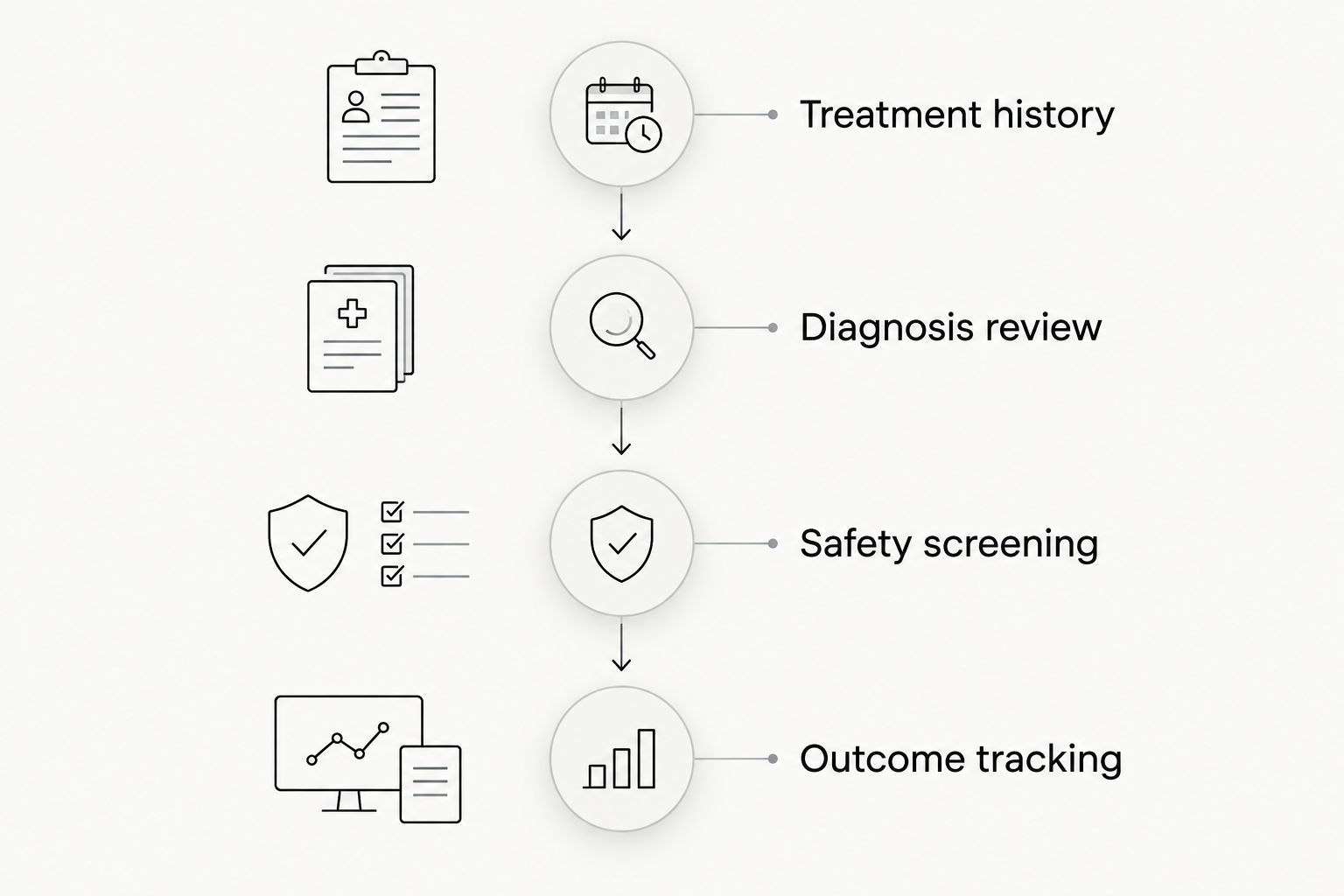
- Treatment history. Bring the names of previous medications, the doses you remember, how long you took them, and what happened. Include side effects and reasons for stopping; an incomplete trial and an adequate trial are not interchangeable.
- Diagnosis review. Discuss depressive episodes, any history of unusually elevated mood, psychotic symptoms, substance use, and relevant medical conditions. The treatment plan needs to match the diagnosis rather than the search term you used.
- Safety screening. Tell the clinician about seizures, implanted devices, metal near the head, and all medications or supplements. These details require individualized review before treatment.
- Outcome tracking. Agree on a symptom scale and practical goals before treatment starts. Decide when progress will be reviewed and what happens if symptoms do not improve.
Attuned Psychiatry is best suited to Decatur/Metro Atlanta patients seeking physician-led evaluation of TMS and other depression treatments. The practice offers medication management, TMS, and SPRAVATO®; the appropriate choice requires an individual assessment, not a ranking based on unrelated success percentages.
How long does improvement from TMS last?
The 47% response rate for conventional rTMS in the THREE-D trial describes the end of acute treatment, not a permanent outcome. Some patients need continued depression care after improvement, and symptoms can return.
Ask about the follow-up plan before beginning treatment. That discussion should cover ongoing medication or psychotherapy when appropriate, symptom monitoring, and how the clinician would assess a recurrence.
A useful 2026 treatment plan separates two questions: whether you improve during the course and how that improvement will be supported afterward. Neither question replaces the other.
Does TMS work when antidepressants have not helped?
The 47% conventional rTMS response rate came from adults with treatment-resistant depression in the THREE-D trial. That makes the evidence relevant to people whose depression has not responded adequately to previous treatment, but it does not guarantee the same result for you.
Bring a treatment history rather than simply reporting that you have tried several medications. Your clinician needs to assess whether prior treatments were appropriate, tolerated, and taken long enough to evaluate.
Do not stop prescribed medication to prepare for TMS unless your treating clinician directs you to do so. Changes to medication belong in the treatment and safety plan.
Is TMS worth considering if remission is not guaranteed?
The 27% remission rate for conventional rTMS in the THREE-D trial shows that remission is possible without making it the expected outcome for every patient. Whether treatment is appropriate depends on the potential benefit, risks, appointment burden, and your previous treatment experience.
TMS commonly causes scalp discomfort or headache, and seizures are a rare but serious risk. Your clinician should explain the relevant risks and screen for factors that affect safety before treatment begins.
The decision is not whether a success rate sounds impressive; it is whether the evidence and treatment demands fit your situation. Ask what would count as enough improvement to continue and what the next discussion would be if treatment falls short.
Questions to bring to a TMS consultation
Use these questions to turn a general success-rate discussion into a specific treatment plan:
- Which TMS protocol are you recommending, and why does it fit my diagnosis?
- Does the success rate you are quoting mean response or remission?
- Does that percentage include everyone who started treatment or only those who completed it?
- How will you measure symptoms and daily functioning during treatment?
- Which side effects or safety concerns apply to my history?
- What is the plan if I improve only partly or symptoms return?
You do not need a promise of success. You need clear definitions, an appropriate safety review, and a clinician who can explain the next decision if the first plan does not deliver enough benefit.
FAQ
What is the TMS success rate for depression in 2026?
The THREE-D randomized trial reported response rates of 47% for conventional rTMS and 49% for intermittent theta-burst stimulation. These are end-of-course study results in adults with treatment-resistant depression, not universal or individual success probabilities.
What percentage of people achieve remission with TMS?
Remission occurred in 27% of the conventional rTMS group and 32% of the intermittent theta-burst group in the THREE-D trial. Remission means symptoms met the study’s low-symptom threshold, not that depression was permanently cured.
Does a TMS response mean my depression is gone?
No. Response commonly means at least a 50% reduction in a depression symptom score, so substantial symptoms can remain. Remission is a separate outcome with a different threshold.
Is theta-burst stimulation better than conventional TMS?
The THREE-D trial found intermittent theta-burst stimulation noninferior to conventional rTMS under its study conditions. Its numerically higher response and remission rates do not establish that it is better for every patient.
Can depression return after successful TMS?
Yes, depression can return after successful TMS. End-of-treatment response and remission rates do not measure permanent recovery, so follow-up and a plan for recurring symptoms matter.
What should I ask at a TMS consultation in 2026?
Ask which protocol is proposed, what response and remission mean, and how progress will be measured. Also discuss safety screening, appointment requirements, continued treatment, and the plan if improvement is incomplete.
Does Attuned Psychiatry offer TMS for depression?
Yes. Attuned Psychiatry is a physician-led practice in Decatur/Metro Atlanta offering TMS, medication management, and SPRAVATO® for patients with treatment-resistant depression and other psychiatric conditions. An individual assessment determines which treatment is appropriate.
One last thing
Ask for the baseline symptom score to be documented before treatment begins. Without a starting measurement, judging improvement becomes less precise, especially when changes arrive gradually rather than all at once.
Pair that score with a personal goal, such as resuming a daily responsibility that depression has disrupted. A rating scale tracks symptoms; your treatment discussion should also address whether daily life is getting better.
If you are in immediate danger or thinking about acting on suicidal thoughts, seek urgent help rather than waiting for a TMS consultation. In the United States, call or text 988 for the Suicide & Crisis Lifeline, or call 911 for an immediate emergency.
Related guides
Discuss TMS for treatment-resistant depression
Request a physician-led evaluation to review your treatment history and depression care options.


