

Wellstar offers psychiatric care within a broader health system, which suits patients who want their mental health care connected to other medical services. When you need a focused evaluation of depression that has not responded to treatment, compare the clinician’s approach and treatment options rather than the organization’s size. Among Wellstar psychiatry alternatives in 2026, Attuned Psychiatry is a strong fit for patients in Decatur or Metro Atlanta seeking medication management, TMS, or SPRAVATO® evaluation; staying with Wellstar makes sense when your current care meets your needs.
- For wellstar psychiatry alternatives, Attuned Psychiatry offers physician-led care, medication management, TMS, and SPRAVATO® in Decatur/Metro Atlanta.
- Compare depression treatment options and continuity of care, not just practice size.
- TMS and SPRAVATO® require clinical evaluation; neither is automatically the next step after an unsuccessful medication.
- Stay with Wellstar when treatment is helping and your clinician has a clear plan for persistent symptoms.
Why this matters
Changing psychiatric practices is a treatment decision, not just an appointment search. You need to know what the new clinician will reassess, how existing prescriptions will be handled, and whether the proposed treatment addresses your diagnosis.
For persistent depression, the useful distinction is not large system versus small practice. It is whether your care includes a careful review of previous treatment and a clear next step. Start with the practice’s psychiatric services, then ask how those services apply to your history.
Treatment-resistant depression commonly refers to depression that has not responded adequately to at least 2 antidepressant trials of adequate dose and duration. That definition is a starting point for assessment, not a diagnosis you should make from a medication count alone.
Wellstar psychiatry alternatives at a glance
This 2026 comparison separates the confirmed treatment options at the Decatur practice from the broader organizational choice. It does not rank individual clinicians or promise that switching will improve your symptoms.
| Option | Best for | Standout feature | How it differs from Wellstar |
|---|---|---|---|
| Attuned Psychiatry | Patients seeking a physician-led evaluation of persistent depression in Decatur/Metro Atlanta | Medication management, TMS, and SPRAVATO® within a psychiatric practice | A focused psychiatric practice rather than a broader health system |
| Wellstar psychiatry | Patients whose current psychiatric care and health-system relationships meet their needs | Psychiatric care within a broader medical organization | The benchmark: compare your actual clinician, treatment plan, and referral pathway |
The best fit depends on the treatment plan you need, not the number of services an organization lists. A practice offering an advanced treatment still needs to establish whether that treatment is appropriate for you.
1. Attuned Psychiatry: best for evaluating persistent depression
Attuned Psychiatry is a physician-led psychiatric practice serving Decatur and Metro Atlanta. Its stated services include medication management, transcranial magnetic stimulation, and SPRAVATO® treatment for patients with treatment-resistant depression and other psychiatric conditions.
That combination gives you 3 treatment paths to discuss: medication management, TMS, and SPRAVATO®. These are options for clinical assessment, not interchangeable treatments or a sequence every patient should follow.
Where the practice shines
- A defined treatment focus. Persistent depression and advanced psychiatric treatment are part of the practice’s stated work.
- Medication management remains an option. Seeking an evaluation does not mean committing to a procedure or changing every medication.
- Different treatment approaches are represented. TMS uses magnetic stimulation; SPRAVATO® is an esketamine nasal spray administered under medical supervision.
- A local setting. The practice serves Decatur and Metro Atlanta, making location a concrete part of your comparison.
Where the practice falls short
- A service list does not establish eligibility. Your diagnosis, medical history, previous treatment, and safety considerations determine whether TMS or SPRAVATO® fits.
- Advanced treatment adds practical demands. TMS requires treatment visits, while SPRAVATO® involves supervised administration, monitoring, and transportation planning.
- Switching interrupts an established relationship. You will need to transfer treatment history and coordinate prescriptions rather than assume the new practice will continue everything unchanged.
- The practice name alone cannot establish fit. You still need to assess the clinician’s explanation, follow-up plan, and response to your concerns.
Head-to-head: focused practice versus health system
| Dimension | Decatur psychiatric practice | Wellstar psychiatry |
|---|---|---|
| Organizational setting | Physician-led psychiatric practice | Psychiatry within a broader health system |
| Treatment discussion | Medication management, TMS, and SPRAVATO® are stated services | Compare the options and referrals available through your treating team |
| Continuity question | How will records, prescriptions, and follow-up transfer? | Does staying preserve a treatment relationship that is working? |
| Decision standard | Does the proposed evaluation address unresolved symptoms? | Does the current plan address unresolved symptoms? |
Best for: Patients who want a physician-led review of persistent depression and a discussion of medication management, TMS, or SPRAVATO® in Decatur/Metro Atlanta.
Verdict: Hold off on transferring care until the evaluation, prescription handoff, and follow-up arrangements are clear.
Match the treatment to the problem
When comparing Wellstar psychiatry alternatives in 2026, ask why a treatment fits your history before asking which treatment is newest. A useful recommendation explains the diagnosis, the remaining symptoms, the expected burdens, and how progress will be assessed.
Medication management
Medication management involves evaluating prescriptions, response, side effects, and the overall treatment plan. It can include continuing a helpful medication, adjusting treatment, or reconsidering the diagnosis when the response does not match expectations.
- Best for: Patients who need a structured review of current or previous psychiatric medication treatment.
- Advantage: The discussion can address both persistent symptoms and medication tolerability.
- Limitation: Another prescription change is not a substitute for reviewing whether previous trials were adequate or whether the diagnosis needs reassessment.
TMS
Transcranial magnetic stimulation uses magnetic pulses to stimulate targeted areas of the brain. It is a noninvasive treatment used for depression, with eligibility and the specific treatment protocol determined through clinical evaluation.
- Best for: Patients whose clinician identifies TMS as an appropriate depression treatment after reviewing their history.
- Advantage: TMS provides a treatment approach that does not depend on taking another antidepressant medication.
- Limitation: Repeated treatment visits create a scheduling burden, and treatment does not guarantee symptom remission.
SPRAVATO®
SPRAVATO® is an esketamine nasal spray administered under supervision in a certified healthcare setting. FDA prescribing information requires monitoring for at least 2 hours after administration, with discharge determined by the healthcare professional’s assessment.
- Best for: Adults whose clinical assessment establishes an appropriate indication and acceptable safety profile.
- Advantage: It offers a distinct medication approach for eligible patients with treatment-resistant depression.
- Limitation: Monitoring, sedation and dissociation risks, and transportation requirements make it different from a prescription you take independently at home.
Patients should not drive after SPRAVATO® until the next day following a restful sleep. Discuss the full prescribing information and your individual risks with the treating clinician.
What to check before switching practices
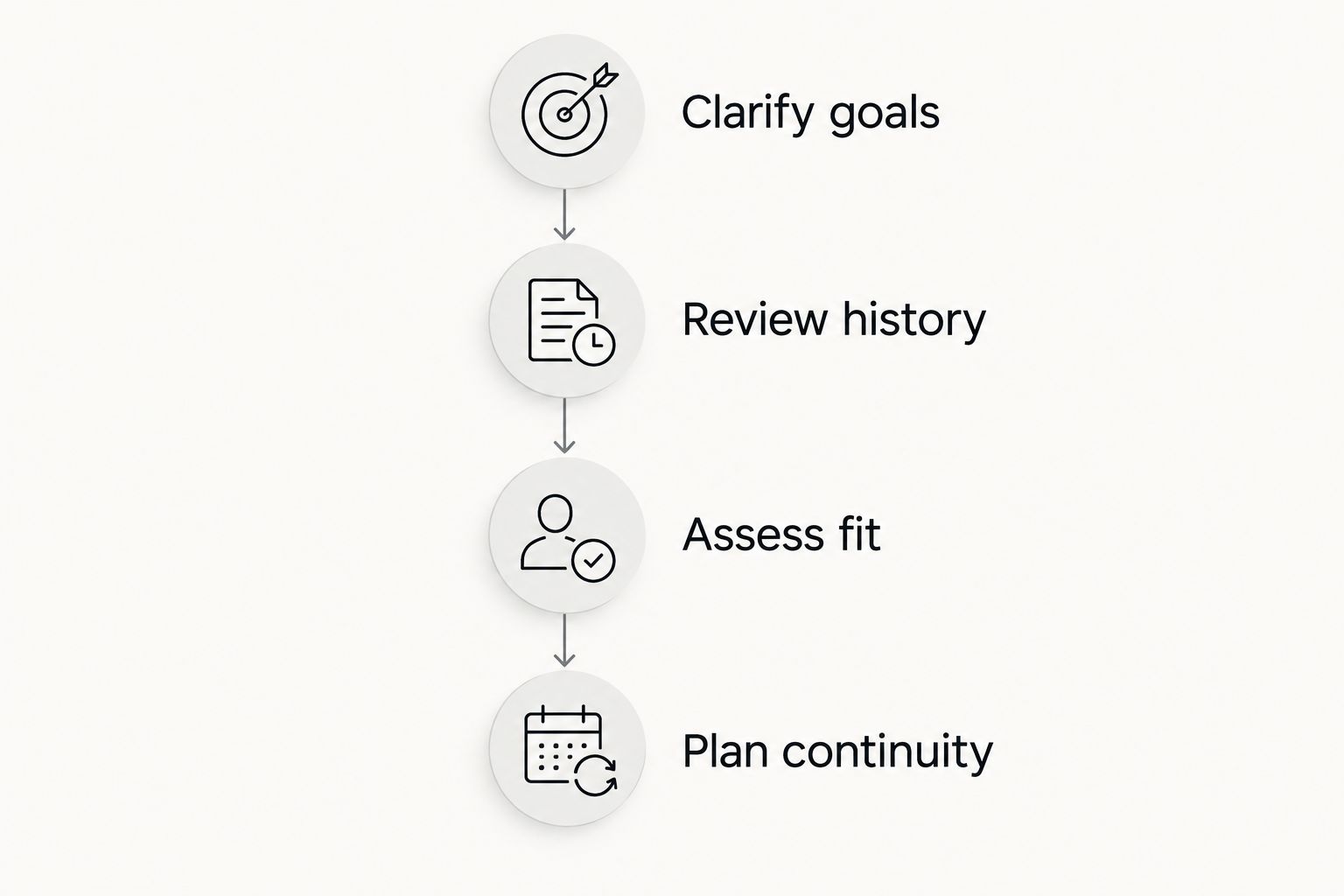
Use this sequence for a 2026 comparison. It keeps the decision centered on continuity and clinical reasoning rather than a treatment name.
Clarify goals
Describe what remains difficult: mood, interest, sleep, concentration, daily functioning, or medication side effects. Tell the clinician which changes would make the biggest difference in your daily life.
A goal such as returning to regular work attendance gives the treatment conversation more direction than asking for the strongest treatment. Goals should inform the plan without replacing clinical assessment.
Review history
Prepare medication names, doses, approximate treatment periods, benefits, and reasons for stopping. Include previous psychotherapy, hospitalizations, relevant medical conditions, and any history of unusually elevated mood or reduced need for sleep.
Bring records when possible. A medication that caused intolerable side effects raises a different question from one taken consistently without meaningful improvement.
Assess fit
Ask why the clinician recommends medication management, TMS, SPRAVATO®, or another approach. Request an explanation of the main risks, reasonable alternatives, and what would prompt a change in the plan.
Do not treat eligibility as proof that a treatment is the right choice. Your preferences and ability to attend treatment matter alongside the clinical assessment.
Plan continuity
Confirm who will manage prescriptions during the transition and when the new clinician assumes responsibility. Ask how records will be transferred and what to do if symptoms worsen before the next appointment.
Do not stop psychiatric medication or change the dose simply because you are switching practices. Coordinate changes with the prescribing clinician.
You can use the care starting-point guide to ask about the evaluation process and what information to prepare. Keep the request specific: describe the unresolved problem and the treatment discussion you want to have.
Why people consider switching from Wellstar
A reasonable switch starts with an unmet need in your own care. The following are decision criteria, not claims that Wellstar lacks a particular service or that its clinicians provide inadequate treatment.
- You want a focused review of persistent depression. Previous treatment has not produced enough improvement, and you want the diagnosis and treatment history reassessed.
- You want to discuss TMS or SPRAVATO®. Ask your current clinician whether either is appropriate and how an evaluation would be arranged.
- You need a clearer plan. You should understand the current treatment goal, what happens next, and how the clinician will judge progress.
- You want a second opinion. A second evaluation can address a specific clinical question without requiring an immediate transfer of all care.
Before leaving, ask your current team what it can address directly and what requires referral. A referral within an existing care relationship can resolve the problem without a full transfer.
When staying with Wellstar is the right call
Stay with Wellstar when treatment is helping, you trust your clinician, and the plan addresses your remaining symptoms. Access to a different treatment does not, by itself, make changing practices necessary.
Continuity has practical value: your clinician already knows your treatment history, previous side effects, and symptom patterns. If the main problem is an unanswered question, start by asking it directly.
For a 2026 decision, compare the proposed next steps on both sides. A clear, individualized plan at your current practice is more useful than an advanced-treatment label without a clinical explanation.
FAQ
What's a Wellstar psychiatry alternative in Decatur for treatment-resistant depression?
Attuned Psychiatry is a physician-led option in Decatur/Metro Atlanta offering medication management, TMS, and SPRAVATO®. The appropriate service depends on your diagnosis, previous treatment, medical history, and clinical evaluation.
Is a smaller psychiatric practice better than Wellstar?
A smaller psychiatric practice is not automatically better than Wellstar. Compare the clinician's treatment plan, continuity arrangements, communication, and ability to address your specific needs.
Do I have treatment-resistant depression if antidepressants haven't helped?
Unsuccessful antidepressant treatment warrants reassessment, but it does not establish treatment-resistant depression by itself. Clinicians review diagnosis, dose, duration, adherence, tolerability, and other factors before recommending the next treatment.
Is TMS the same as SPRAVATO®?
TMS and SPRAVATO® are different treatments. TMS uses magnetic stimulation, while SPRAVATO® is an esketamine nasal spray administered under supervision with required monitoring.
Can I drive home after SPRAVATO® treatment?
You should not drive home after SPRAVATO® treatment. Arrange transportation and do not drive until the next day after a restful sleep, following your treatment team's instructions.
Do I need to leave Wellstar to get a second opinion?
A second opinion does not require you to transfer all psychiatric care immediately. Clarify the purpose of the consultation and who remains responsible for prescribing and follow-up.
What should I bring to a new psychiatry appointment?
Bring your medication history, current prescriptions, previous treatment records, and the symptoms you want addressed. Include benefits, side effects, and reasons previous treatments ended.
Should I wait for a new appointment if I feel unsafe?
Do not wait for a routine appointment if you are in immediate danger or cannot stay safe. Call 911 or go to the nearest emergency department; in the United States, call or text 988 for crisis support.
One last thing
Ask each clinician the same question: What would make you change this treatment plan? The answer should connect your symptoms, side effects, functioning, and safety to a specific reassessment process.
That question reveals more than a list of available treatments. You are choosing a clinical relationship that can respond when the first plan is not enough.
Related guides
Discuss Wellstar psychiatry alternatives in Decatur
Request an evaluation and ask what would make your clinician change the proposed treatment plan.


