
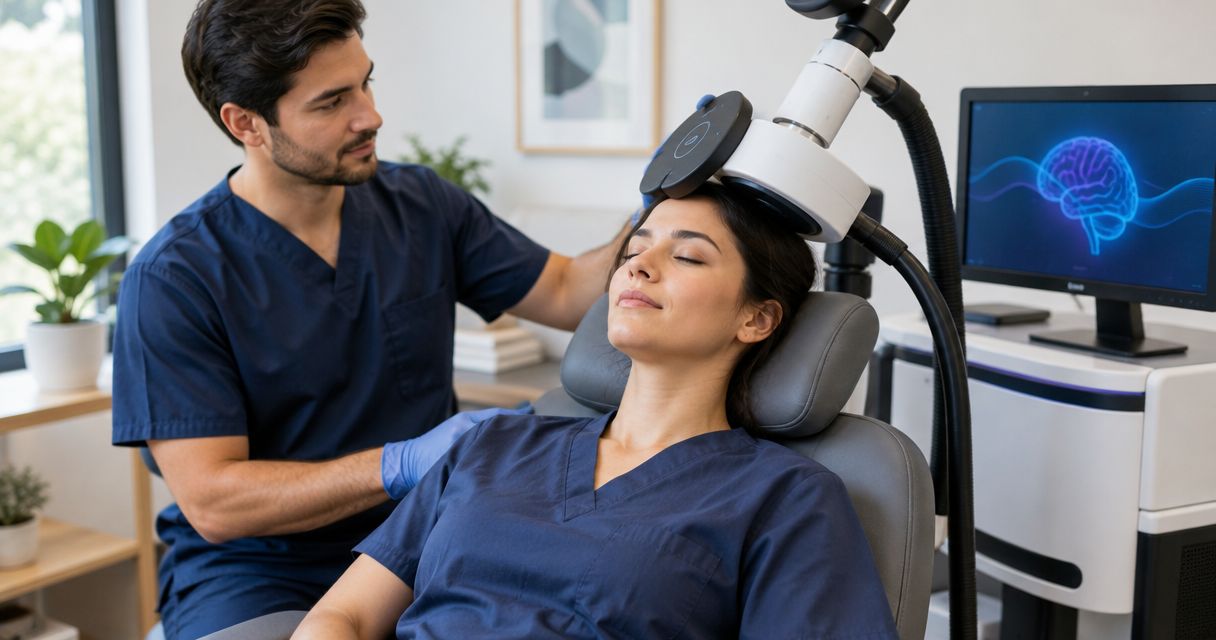
Healthcare workers’ TMS therapy is noninvasive brain stimulation aimed at treating depression, not workplace burnout alone. This 2026 guide explains how to assess eligibility, compare treatments, and plan care around shifts without assuming you can work immediately after every session.
- TMS therapy for healthcare workers treats depression; it is not a stand-alone solution for burnout or unsafe staffing.
- Attuned Psychiatry offers physician-led psychiatric care, including TMS, in Decatur/Metro Atlanta.
- Compare TMS, medication management, and SPRAVATO® by clinical fit, treatment burden, and safety requirements.
- Build a shift-compatible treatment plan before scheduling; appointment frequency depends on the prescribed protocol.
Why TMS therapy matters for healthcare workers
Depression affects the person providing care, not just their performance at work. If you are a nurse, physician, therapist, technician, or another healthcare professional, seek an assessment when persistent symptoms interfere with sleep, relationships, concentration, or daily functioning.
Shift work complicates that decision. Sleep disruption, occupational stress, and depression can overlap, but they do not establish the same diagnosis or require the same treatment. Knowing the clinical vocabulary does not replace having your own clinician.
Attuned Psychiatry is best for Decatur/Metro Atlanta patients seeking physician-led psychiatric care with TMS, medication management, and SPRAVATO® options. Start with Attuned Psychiatry if you want to explore those services locally; an assessment determines which treatment fits.
For your 2026 treatment plan, separate two questions: what condition needs treatment, and what schedule can you realistically sustain? Neither question should be answered by your job title alone.
How to plan TMS treatment around healthcare work
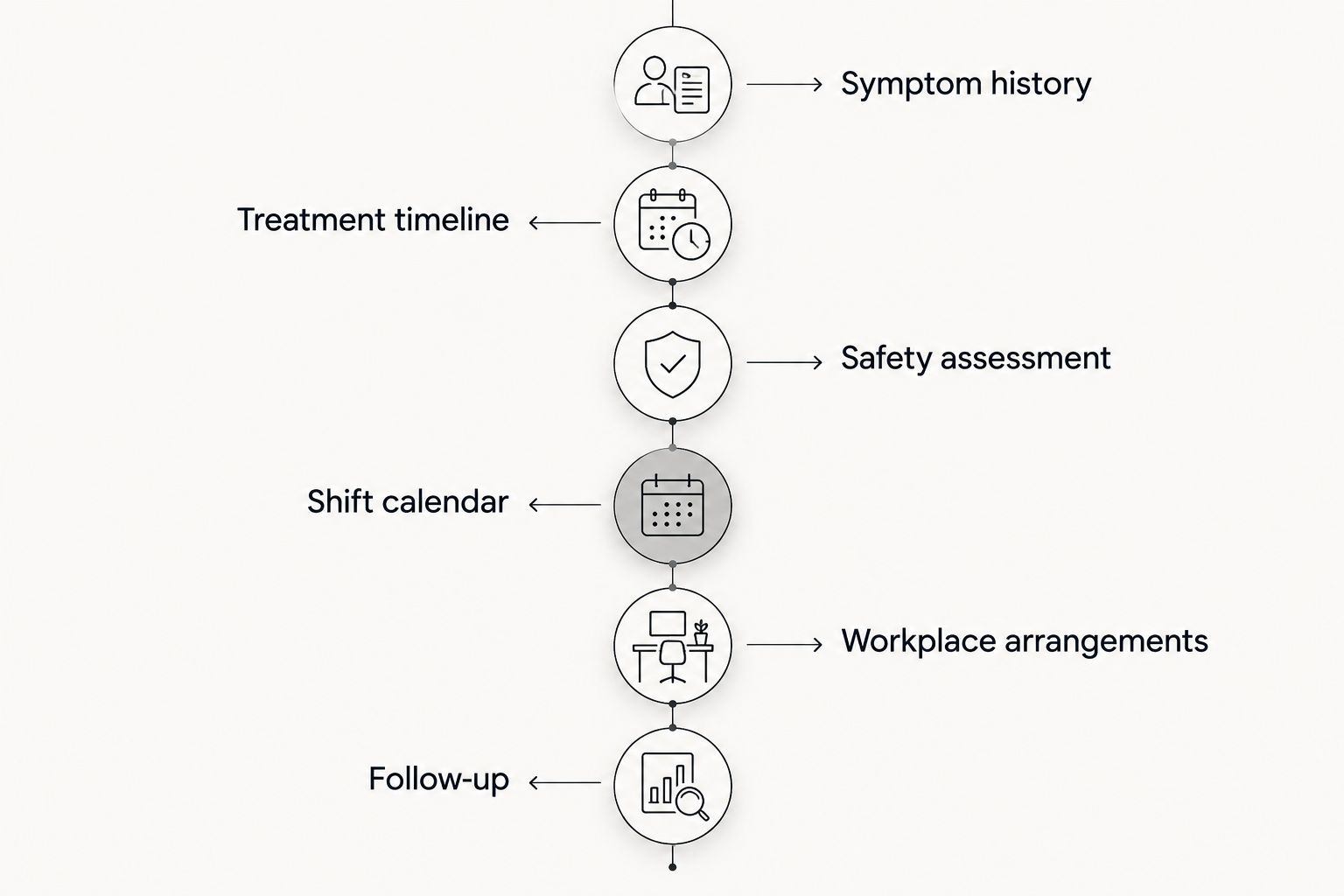
1. Separate depression symptoms from occupational strain
Start with a written symptom history before your appointment. Record low mood, loss of interest, changes in appetite, difficulty concentrating, and thoughts of worthlessness, including whether they continue away from work. This gives the evaluation more substance than saying you feel exhausted.
Bring a 7-day sleep-and-shift log. It is a practical record, not a diagnostic test, and helps your clinician distinguish your work pattern from your usual sleep needs. A psychiatric evaluation can also consider other explanations for symptoms, including bipolar disorder, substance effects, and medical conditions.
- Record symptoms on workdays and days off.
- Note recent shift changes and overnight work.
- Describe effects on home life, not only clinical duties.
- Identify any periods of unusually elevated mood or reduced need for sleep.
- Tell the clinician directly about thoughts of self-harm.
2. Reconstruct your previous depression treatment
Use your medication list, pharmacy history, and prior records to build a treatment timeline. A medication name alone does not show whether you completed an adequate trial. Your clinician needs the dose, duration, response, side effects, and reason it ended.
TMS is an established treatment option for certain patients with depression, including patients whose symptoms have not improved adequately with antidepressant treatment. Eligibility depends on the clinical assessment, the device and protocol, and any applicable coverage requirements. Do not stop medication to make yourself eligible.
For a 2026 consultation, bring the most current list rather than relying on an old medication reconciliation.
- List prescription medicines, supplements, and substance use.
- Record doses and approximate treatment dates.
- Separate lack of benefit from intolerable side effects.
- Include psychotherapy and other psychiatric treatments.
- Request relevant records from previous clinicians.
3. Ask for a TMS-specific safety assessment
Review your medical history with the treating clinician before committing to treatment. TMS uses magnetic pulses delivered through a coil positioned near the scalp; it does not require general anesthesia. You remain awake during standard treatment, but that does not make the safety assessment optional.
Disclose implanted devices, metal in or near the head, previous seizures, neurological conditions, and medication changes. Not all implants have the same implications, so provide the device details rather than assuming that any metal either permits or rules out treatment. Seizure is a rare but serious risk; headache and scalp discomfort are recognized side effects.
Attuned Psychiatry’s psychiatric services include TMS, medication management, and SPRAVATO®. Discuss the clinical differences before selecting a treatment.
- Bring implant identification information when applicable.
- Report seizures, head injuries, and neurological diagnoses.
- Discuss alcohol use, withdrawal, and major sleep disruption.
- Ask about hearing protection during treatment.
- Confirm whom to contact about side effects or medication changes.
4. Match the treatment schedule to your actual rota
Write out your shifts, commute, and recovery time before asking for appointment times. Standard TMS courses commonly involve repeated visits across several weeks, but the exact schedule depends on the protocol. Do not assume a schedule described elsewhere is available at your chosen practice.
Ask the clinic to specify treatment days, visit length, the expected course, and what happens after a missed session. Then compare that plan with handoffs, on-call duties, and changes between day and night shifts. A technically available appointment is not useful if you repeatedly cannot attend it.
In 2026, build your plan around the protocol you are actually prescribed—not around a general description of TMS.
- Map appointment travel alongside your shift calendar.
- Identify conflicts with rounds, handoffs, and call coverage.
- Ask how scheduling changes affect the treatment plan.
- Discuss whether leave or workplace adjustments are necessary.
- Confirm follow-up arrangements before the course begins.
5. Plan work, transport, and confidentiality separately
Ask your clinician about your own work and transport restrictions rather than treating the absence of anesthesia as clearance for every task. Depression symptoms, medication effects, sleep deprivation, or treatment side effects can still affect your ability to drive or perform safety-sensitive work.
For workplace arrangements, begin with the minimum information needed to request an appointment adjustment or leave. Employment, occupational-health, credentialing, and licensing questions involve different processes. Read the actual forms and obtain appropriate advice rather than assuming either automatic disclosure or complete confidentiality in every context.
A useful planning exercise is to answer 3 questions: Can you attend consistently? Can you travel safely? What information does your workplace actually require?
- Confirm individual driving and work advice with your clinician.
- Arrange a backup plan if you feel unwell after treatment.
- Ask the practice how records and communications are handled.
- Review workplace forms before providing medical details.
- Seek qualified advice for licensing or credentialing questions.
6. Measure response and agree on the next decision
Track symptoms and functioning during treatment instead of judging success by whether you completed a difficult shift. Your clinician can use a structured scale alongside clinical assessment. The PHQ-9, for example, contains 9 items addressing symptoms over the preceding 2 weeks; it supports monitoring but does not replace diagnosis.
Agree on meaningful goals before treatment begins. These might include renewed interest in activities, improved concentration, or less difficulty completing daily tasks. Discuss what happens if symptoms improve only partly, remain unchanged, or worsen.
Keep your 2026 follow-up plan explicit. Completing a course and deciding how to maintain improvement are separate clinical decisions.
- Choose a symptom measure with your clinician.
- Record changes in functioning outside work.
- Report side effects without waiting for a scheduled review.
- Ask when the treatment plan will be reassessed.
- Establish follow-up and a plan for returning symptoms.
Compare depression treatment options for healthcare workers
Choose by diagnosis, treatment history, safety, and practical requirements—not by which option sounds most advanced. These treatments are not interchangeable, and none guarantees remission. Your clinician should explain the reason for recommending one approach over another.
The table summarizes established treatment distinctions, not a statement that every option fits every patient. Appointment schedules and prescribing decisions require individual confirmation.
| Option | Best for | Main advantage | Key limitation |
|---|---|---|---|
| Medication management | Patients who need medication selection, adjustment, or monitoring | Allows treatment to be adjusted according to response and tolerability | Side effects and inadequate response can require changes; follow-up remains necessary |
| TMS | Patients with depression for whom a clinician recommends brain stimulation | Noninvasive treatment without general anesthesia | Repeated attendance, scalp discomfort, headache, and device-specific safety restrictions require planning |
| SPRAVATO® | Adults meeting its prescribing criteria after clinical assessment | Provides an additional treatment approach for eligible patients | Requires supervised administration and monitoring; driving restrictions complicate shift planning |
| Psychotherapy | Patients who need structured psychological treatment, alone or alongside other care | Addresses patterns of thought, behavior, and coping | Requires ongoing participation and is not a substitute for urgent assessment when safety is at risk |
Attuned Psychiatry offers TMS, medication management, and SPRAVATO®; confirm the proposed treatment pathway during your assessment. Psychotherapy appears here as a comparison option, not as a statement about the practice’s services.
Ask specifically about SPRAVATO® transport requirements if comparing it with TMS. Under its prescribing information, patients must not drive or operate machinery until the next day after a restful sleep. Do not transfer those instructions to TMS or assume the treatments share the same restrictions.
Discuss your depression treatment options
Ask about psychiatric assessment, TMS, medication management, and SPRAVATO® in Decatur/Metro Atlanta.
Common mistakes healthcare workers make
Treating burnout as proof of treatment-resistant depression
Occupational exhaustion does not establish treatment-resistant depression. Describe the full symptom pattern and previous treatment history so your clinician can assess depression and other possible causes. Workplace changes can matter without replacing psychiatric care.
Minimizing symptoms because clinical duties are still getting done
Being able to finish a shift does not establish recovery. Include what happens afterward: withdrawal from relationships, lost interest, persistent distress, or difficulty managing daily responsibilities. Your assessment needs the whole week, not just your functioning in uniform.
Booking around an idealized work schedule
A plan that ignores night shifts, mandatory coverage, or travel creates avoidable conflicts. Bring the rota you actually work and discuss foreseeable changes. Do not assume that missed appointments can simply be compressed into the remaining course.
Assuming medical knowledge replaces disclosure
Your treating clinician still needs your full history, including supplements, alcohol use, previous elevated mood, and medication changes. Do not filter out information because you think you already know whether it matters. Safety decisions depend on accurate details.
Expecting TMS to correct the workplace
TMS treats a clinical condition; it does not resolve unsafe staffing, harassment, or an unsustainable rota. Address those problems through appropriate workplace channels while pursuing treatment. Symptom improvement and occupational problem-solving serve different purposes.
FAQ
Is TMS therapy for healthcare workers different from regular TMS?
The clinical assessment and prescribed protocol determine TMS treatment, not your occupation. Healthcare workers need additional practical planning around shifts, sleep disruption, and safety-sensitive duties.
Can I work after a TMS appointment?
Your clinician should give individualized advice about working after TMS. Standard TMS does not require general anesthesia, but symptoms, sleep deprivation, and side effects still matter for driving and clinical duties.
Does TMS treat burnout?
TMS is not a stand-alone treatment for workplace burnout. If depression is also present, a clinician can assess whether TMS is appropriate while you separately address occupational stressors.
Do I need to stop antidepressants before TMS?
Do not stop antidepressants or other prescribed medication on your own before TMS. The treating clinician should review your medicines and explain any necessary changes.
Is TMS better than SPRAVATO® for someone working shifts?
Neither treatment is automatically better for shift workers. TMS involves repeated attendance, while SPRAVATO® requires supervised treatment, monitoring, and specific driving restrictions; clinical eligibility comes first.
Will getting TMS affect my medical or nursing license?
Licensing implications depend on your jurisdiction, the questions asked, and your individual circumstances—not simply the treatment name. Review current requirements and obtain qualified advice rather than relying on general assurances.
What should I do if depression feels unsafe while I wait for treatment?
Seek immediate help rather than waiting for a routine TMS appointment. In the United States, call or text 988 for crisis support; call 911 or go to an emergency department for immediate danger or a medical emergency.
One last thing
Bring a recovery goal that has nothing to do with productivity. Being able to enjoy dinner, reconnect with someone, or take interest in a day off tells your clinician something that completing documentation cannot.
For your 2026 assessment, write that goal beside your treatment history and shift calendar. The purpose of depression treatment is your health—not simply keeping you available for another shift.


