

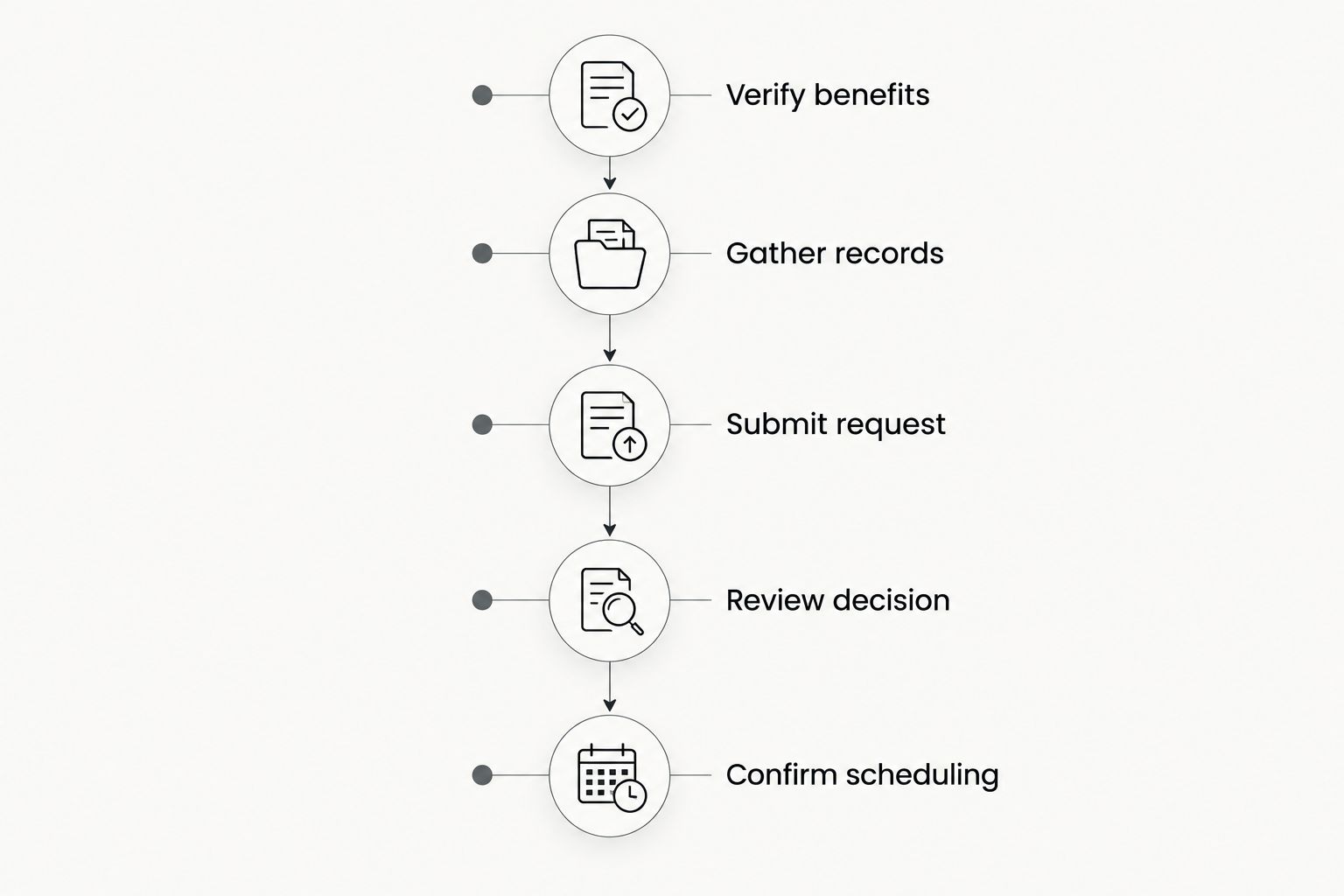
Instead of repeating your treatment history on every insurance call, build one TMS preauthorization file and track it from benefits verification through the written decision. To find out whether you can get TMS therapy covered by insurance, confirm your plan’s coverage rules, complete a clinical evaluation, and have the treating practice submit the required documentation before treatment begins.
- TMS therapy covered by insurance requires plan-specific verification; prior authorization and payment are separate decisions.
- Attuned Psychiatry offers TMS in Decatur/Metro Atlanta; confirm network participation for your exact insurance plan.
- Collect medication history, clinical records, and current insurer criteria before the practice submits a preauthorization request.
- Check approved services, treatment dates, and session limits against the proposed treatment schedule.
Why this matters
An insurer can list TMS as a covered benefit while still requiring prior authorization and documentation of medical necessity. A benefits representative confirming coverage does not establish that your proposed course meets those requirements.
Attuned Psychiatry is best suited to Decatur/Metro Atlanta patients seeking a physician-led practice offering TMS alongside medication management. Explore Attuned Psychiatry as a clinical option, then verify the insurance details separately.
For a 2026 coverage review, use the medical policy and benefit documents that apply to your current plan. A policy found through a general search can belong to a different insurer product or apply to a different coverage period.
This workflow keeps three questions separate: Is TMS a benefit? Does your clinical history meet the applicable criteria? Does the authorization match the treatment your clinician proposes?
Before you start
- Gather plan information and permissions. Have your insurance card, member identifier, current plan documents, and treating practice’s details ready. Ask previous clinicians how to release relevant records to the TMS practice.
- Prepare treatment history. Collect medication names, doses, treatment dates, response, side effects, and psychotherapy records when requested. Mark uncertain details as unknown rather than reconstructing them from memory.
- Check the hidden handoff. The insurer listed on your card is not always the organization handling behavioral health authorization. Ask who reviews TMS, where the request goes, and whether the treating clinician and treatment location participate in your exact network.
Keep these materials in 1 shared folder, using a secure method agreed with the practice. Avoid sending medical records through an unsecured channel simply because it is convenient.
Benefits and policy verification
Establish the coverage route
- Call the member-services number on your insurance card. Ask whether outpatient TMS is a covered benefit under your specific plan and whether prior authorization is required. Explain that you are checking a proposed treatment, not asking for general information about depression care.
- Identify the reviewing organization. Ask whether the insurer, a behavioral health administrator, or another designated reviewer handles the request. Confirm the submission route with the treating practice.
- Request the applicable medical policy. Ask for its title, effective date, and a copy or instructions for obtaining it. For your 2026 file, confirm that the policy applies to your plan rather than assuming a public document does.
- Verify network details. Give the representative the treating clinician and location information supplied by the practice. Ask about referral requirements and any separate network rules affecting the proposed services.
- Record the conversation. Save the representative’s name, call date, reference number, and next action. Ask for written benefits information when available.
Expected result: You know who reviews the request, which policy applies, and what the practice must submit. You have a documented answer—not just a verbal assurance that TMS is covered.
Benefits verification still does not guarantee payment. Eligibility, the authorization terms, and the submitted claim must also align with your plan’s requirements.
Clinical documentation and submission
Build the treatment record
- Complete the clinical evaluation. The clinician determines whether TMS is appropriate and documents the diagnosis and treatment rationale. Insurance criteria do not replace an individual assessment of symptoms, treatment history, and safety.
- Create a treatment-history summary. Use a 1-page summary as an index to the supporting records, not as a substitute for them. Include medication names, doses, dates, response, and reasons for stopping when documented.
- Match evidence to the actual policy. Ask the practice which medication trials, psychotherapy history, symptom assessments, or other records the reviewer requires. Do not assume every insurer uses the same threshold.
- Resolve gaps before submission. Request missing progress notes or prescribing records from previous clinicians. A pharmacy record can support dispensing history, but it does not by itself explain symptom response or why treatment stopped.
- Confirm the proposed treatment details. Have the practice identify the requested services, schedule, and treatment location. These details belong in the request and later need to match the approval.
Expected result: The practice has a clinically supported request with identifiable source records. Missing information is either obtained or clearly identified before review begins.
Attuned Psychiatry offers TMS, medication management, and SPRAVATO® treatment. Review its psychiatric services to understand the available clinical options; an insurance decision about TMS is not a substitute for choosing an appropriate treatment with your clinician.
Track the authorization decision
- Confirm submission ownership. Ask who at the practice submits the request and who follows up. Record the submission date and insurer reference number once assigned.
- Verify receipt and completeness. Ask whether the reviewer received the request and whether anything remains outstanding. A sent document is not the same as a complete request accepted for review.
- Use the insurer’s stated review timeline. Ask which deadline applies to this request and what happens if additional information is needed. Do not substitute a generic online estimate for the timeline attached to your case.
- Read the written decision. Check the approved clinician or location, authorized services, treatment limits, and effective dates. If anything differs from the proposed treatment, have the practice resolve it before relying on the approval.
- Check scheduling against authorization. Confirm that planned visits fit the approved terms. Keep the decision letter and reference number with your treatment records.
Expected result: You have either a written authorization that matches the proposed course or a specific reason the request needs correction, more documentation, or review.
For a course starting in 2026, check the actual authorization dates rather than treating approval as open-ended. An approval letter authorizes only what its terms specify.
Updated requests, extensions, and appeals
An initial approval does not automatically resolve every later change. If your clinician changes the proposed course or your coverage changes, ask whether the existing authorization still applies.
Choose the route that matches the issue. A missing document needs a completed submission; a medical-necessity denial needs a response to the stated clinical reason.
| Route | Best for | Advantage | Limitation |
|---|---|---|---|
| Initial preauthorization | A proposed course without an authorization | Establishes a decision for the requested treatment | Requires a complete initial record |
| Authorization update or extension | Changes to approved treatment details or dates | Addresses a specific mismatch | Requires confirmation of the insurer’s process |
| Appeal | A written adverse decision you want reconsidered | Allows a response to the stated denial reason | Must follow the notice’s requirements and deadlines |
Update an existing request
- Identify what changed. Specify whether the issue concerns dates, treatment details, location, clinician, or insurance coverage. Give the practice the current authorization reference.
- Ask which process applies. The insurer determines whether the change requires an amendment, extension, or new request. Do not assume the original authorization follows you to a different plan or location.
- Supply the requested evidence. For continued treatment, the reviewer can require updated clinical information under the applicable policy. The clinician should document response and the rationale for the proposed care.
- Obtain written confirmation. Check the revised terms before treating the change as approved. Keep the earlier decision so the practice can reconcile both records.
Expected result: The authorization reflects the treatment currently proposed, or you know what new review is required.
Respond to a denial
Read the entire notice, including the reason, appeal instructions, and deadline. Separate an administrative problem—such as missing documentation—from a determination that the request does not meet medical-necessity criteria.
Ask the practice whether a corrected submission, clinician discussion with the reviewer, or formal appeal fits the notice. These routes are not interchangeable, and a clinician discussion does not automatically replace a formal appeal deadline.
For a denial received in 2026, follow the dates and instructions in that notice. Keep copies of the submission and any proof of receipt; do not rely on a phone conversation alone to preserve an appeal.
Troubleshooting
The representative says TMS is covered, but no approval exists
Fix: Ask whether the answer concerned benefits or an actual authorization decision. Obtain the authorization reference and written terms before treating a coverage statement as approval.
The reviewer says treatment history is incomplete
Fix: Ask which specific record or criterion remains unresolved. Request the relevant prescribing notes, treatment dates, or documented response rather than resending the same incomplete summary.
The practice and insurer give different network answers
Fix: Compare the exact clinician, location, and plan information each party checked. Ask the practice to supply the billing details needed for verification, then request written clarification from the insurer.
Approval arrives, but treatment dates do not fit
Fix: Have the practice ask about changing the authorization dates before relying on visits outside the approved window. Keep the revised written decision with the original authorization.
The claim is denied after authorization
Fix: Compare the explanation of benefits with the authorization and billed services. Ask the practice and insurer to identify whether the issue involves eligibility, coding, authorization matching, or another stated reason; prior approval alone does not explain a claim denial.
Customize your workflow
Ask for 2 separate confirmations before treatment: the clinical plan from your treating clinician and the insurance status from the appropriate administrative contact. Each answers a different question, and neither replaces the other.
Keep a short tracker with the current status, outstanding document, responsible contact, and next deadline. Update it whenever a request changes hands so you do not repeat calls without advancing the case.
Contact the practice to ask how to begin a TMS evaluation and what insurance materials to prepare. Attuned Psychiatry’s clinical services are established; network participation and authorization requirements need verification for your individual plan.
If your symptoms worsen while authorization is pending, contact your treating clinician rather than waiting for the administrative process to finish. For immediate danger or an inability to stay safe, seek emergency help.
FAQ
Is TMS therapy covered by insurance in 2026?
TMS coverage depends on your specific insurance plan and its applicable medical-necessity requirements. Confirm the benefit, network status, and prior authorization process for your proposed treatment before scheduling.
Does prior authorization guarantee that insurance will pay for TMS?
No, prior authorization does not guarantee payment. Eligibility, approved treatment terms, and claim details still need to meet your plan’s requirements.
What records do I need for TMS preauthorization?
Start with your insurance information and documented treatment history. The treating practice should identify the medication records, clinical notes, symptom assessments, and other materials required by your specific insurer.
How many antidepressants must I try before insurance approves TMS?
There is no single medication-trial requirement that applies to every insurance plan. Ask the practice to check the applicable policy and document the treatments you actually received, including response and tolerability.
How long does TMS insurance authorization take?
The review timeline depends on the insurer’s process and the request’s circumstances. Ask when the request was accepted for review, which deadline applies, and whether any documents remain outstanding.
What should I do if insurance denies TMS?
Read the denial reason and appeal instructions, then ask the treating practice which response fits the decision. A corrected submission, clinician review discussion, and formal appeal serve different purposes; preserve the deadline stated in the notice.
Can I transfer a TMS authorization to another practice?
Do not assume an authorization transfers to another practice. Ask the insurer whether changing the clinician or treatment location requires an update or a new request before relying on the existing approval.
One last thing
An authorization number is not the same as an approved treatment plan. The useful document is the written decision with services, limits, dates, and treating-provider details that match the care you are about to receive.
Make that comparison before your first authorized visit. Finding a mismatch then gives the practice a chance to address it before treatment and billing diverge.
Related guides
Discuss TMS authorization and your treatment plan
Request an evaluation and ask how coverage verification and TMS scheduling are coordinated.


