

Instead of piecing together ride arrangements, medication questions, and discharge instructions on treatment day, organize SPRAVATO treatment day monitoring around a supervised dose, at least 2 hours of observation, and a clinician’s discharge assessment. This 2026 guide explains what to prepare, what staff monitor, and how to plan the rest of your day.
- SPRAVATO treatment day monitoring requires supervised administration and at least 2 hours of observation, including respiratory monitoring with pulse oximetry.
- Attuned Psychiatry offers physician-led SPRAVATO care for treatment-resistant depression in Decatur/Metro Atlanta.
- Blood pressure is checked before dosing and again approximately 40 minutes afterward, with further checks as clinically needed.
- Arrange transportation home; do not drive until the next day after a restful sleep.
Why this matters
SPRAVATO® is esketamine nasal spray administered under healthcare supervision. It can cause sedation, dissociation, increased blood pressure, and respiratory depression. Feeling ready to leave does not establish that those risks have passed.
Two hours is the minimum monitoring period, not a guaranteed discharge time. A healthcare professional assesses whether you are clinically stable before you leave. Keep the rest of your schedule flexible rather than treating the appointment as a fixed-length errand.
Attuned Psychiatry is best for patients seeking physician-led evaluation for treatment-resistant depression in Decatur/Metro Atlanta. The practice offers SPRAVATO treatment; its services are the starting point for discussing whether this treatment fits your clinical situation.
For appointments in 2026, the safety references are the current FDA-approved SPRAVATO Prescribing Information and the SPRAVATO Risk Evaluation and Mitigation Strategy, or REMS. The prescribing information covers administration and monitoring; the REMS governs supervised treatment requirements. Your treating team applies those requirements to your medical history and response.
Before you start
- Confirm the clinical plan and location. Complete the clinic’s required assessment and paperwork, and confirm where supervised treatment will occur. Bring your medication list, allergies, relevant medical history, and any instructions from your prescribing clinician.
- Arrange transportation and protect the afternoon. Have a ride home and a plan that does not require driving, operating machinery, or other hazardous activity until the next day after a restful sleep. Tell the clinic beforehand if transportation is unresolved.
- Separate the fasting rules from medication instructions. Avoid food for at least 2 hours before administration and liquids for at least 30 minutes beforehand. If you use a nasal corticosteroid or nasal decongestant, take it at least 1 hour before SPRAVATO. Do not independently skip prescribed medicines to meet these instructions; ask the team how to handle them.
The easily missed issue is the ride home. A driver arriving at the minimum observation mark does not make you ready for discharge. Tell your driver that the departure time depends on your assessment, and establish how you will reach them if monitoring continues longer.
Your arrival and baseline assessment
Confirm your readiness
- Report changes since your last assessment. Tell staff about new illnesses, medication changes, alcohol or substance use, pregnancy or possible pregnancy, and symptoms that affect treatment safety. Include nonprescription products and supplements in the medication review.
- Describe how you feel before treatment. Report dizziness, nausea, unusual sleepiness, chest discomfort, breathing difficulties, or a severe headache before dosing. Establishing what is already present helps staff interpret changes afterward.
- Have your blood pressure checked. The healthcare professional checks blood pressure before administration and assesses whether treatment should proceed. An elevated reading requires a clinical decision, not an attempt to rush through the visit.
- Confirm the day’s instructions. Ask what you should do if you feel unwell, how to summon staff, and what monitoring will involve. Tell staff about nasal congestion or difficulty using a nasal spray before administration starts.
Expected result: The team has assessed your condition, reviewed relevant changes, and determined whether to proceed. If treatment is delayed, ask what needs to happen before another attempt rather than assuming you should change medication yourself.
A baseline blood-pressure check is not a general medical clearance. Specifically report any history of aneurysmal vascular disease, arteriovenous malformation, or bleeding within the brain; these are relevant to SPRAVATO’s contraindications. Your clinician must review the full contraindication and precaution list, not just the examples on this page.
Your supervised administration
Follow the prescribed dose sequence
- Use only the dose prepared for your visit. A healthcare professional supervises self-administration. SPRAVATO is not a take-home nasal spray that you use independently between appointments.
- Follow the device instructions demonstrated by staff. Blow your nose before administration if instructed, position yourself as directed, and use the nasal spray device according to the approved instructions. Do not test or prime the device yourself.
- Wait between devices when instructed. The approved administration instructions specify a 5-minute rest between devices when the prescribed dose requires more than one device. Staff direct the sequence; do not shorten the interval to finish sooner.
- Tell staff about an administration problem immediately. Report a suspected missed spray, device difficulty, or uncertainty about whether you used it correctly. Do not repeat a spray or add medication on your own.
Expected result: You have completed the prescribed administration under supervision, and staff know about any device or dosing concern. Monitoring then continues according to the treatment plan and your response.
The benefit of supervised administration is that help is present when symptoms or questions arise. The trade-off is practical: treatment requires time at the facility, transportation planning, and restrictions afterward. Those requirements remain part of treatment even when an earlier visit felt straightforward.
Your observation and safety checks
Stay for clinical monitoring
- Remain under observation for at least 2 hours after administration. Staff monitor for sedation, dissociation, respiratory depression, and other adverse effects. Respiratory monitoring includes pulse oximetry, which measures blood oxygen saturation.
- Complete the follow-up blood-pressure assessment. Blood pressure is reassessed approximately 40 minutes after administration and subsequently as clinically warranted. Tell staff about symptoms between checks; do not wait for the next scheduled reading.
- Report symptoms in plain language. Say whether you feel unusually sleepy, disconnected from your surroundings, dizzy, nauseated, anxious, or physically unwell. Ask for assistance before standing if you feel unsteady.
- Alert staff immediately to urgent symptoms. Chest pain, shortness of breath, a sudden severe headache, vision changes, or seizure symptoms need prompt assessment. Do not dismiss them as an expected part of the experience.
Expected result: The team has monitored your response through the required observation period and assessed any symptoms or abnormal readings. Observation continues if your condition requires it.
For your 2026 treatment plan, keep three checkpoints distinct: the baseline assessment, the post-dose observation period, and the discharge assessment. Passing one does not replace the next.
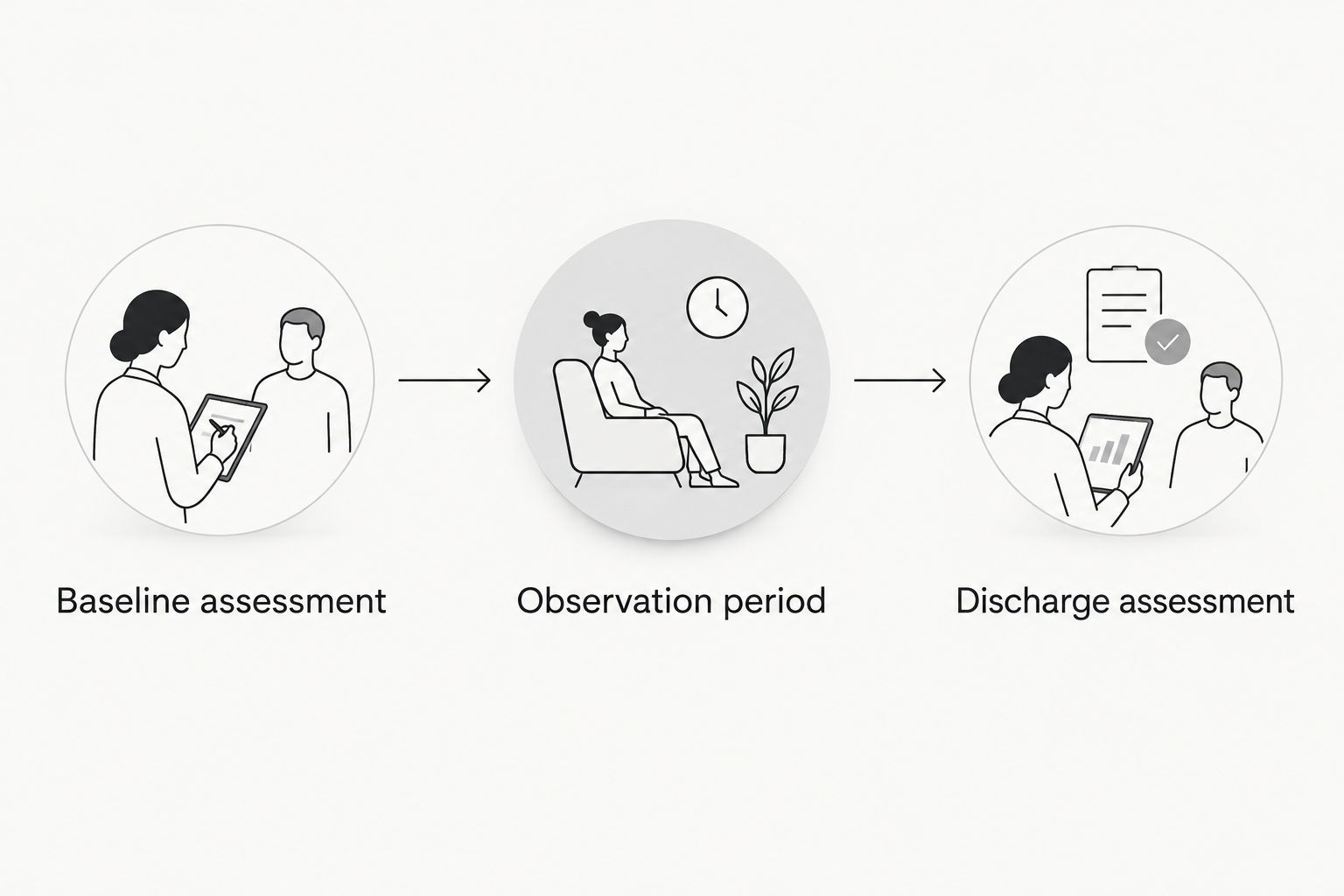
A quiet experience is not proof that monitoring is unnecessary. Pulse oximetry and blood-pressure measurements provide information beyond how you feel, while your symptom reports give staff information that a monitor cannot supply. Both belong in the same workflow.
Your discharge and ride home
Complete the handoff
- Wait for the clinician’s discharge decision. Before you leave, a healthcare professional assesses whether you are clinically stable. Do not leave simply because your driver has arrived or the minimum observation period has elapsed.
- Review symptoms and instructions. Ask which effects still need attention, whom to contact about nonemergency concerns, and what requires emergency care. Request clarification before leaving if you feel too sleepy or distracted to follow the explanation.
- Confirm your transportation. Use the transportation arrangement approved with your treatment team. Do not drive yourself home, including a short trip that feels manageable.
- Keep the driving restriction separate from discharge. Leaving the clinic does not clear you to drive. Avoid driving, operating machinery, and hazardous activities until the next day after a restful sleep.
Expected result: You leave after clinical assessment, with transportation arranged and clear instructions for the remainder of the day. Your next treatment and follow-up questions should also be settled before departure.
If severe symptoms develop after discharge, seek emergency care rather than waiting for a routine clinic response. Call 911 for trouble breathing, chest pain, seizure, or other signs of a medical emergency.
Repeat visits: keep the checks, update the details
For repeat appointments in 2026, reuse your preparation checklist rather than assuming the last visit’s experience predicts the next one. A new medicine, a different blood-pressure reading, or a change in your health belongs in the pre-dose review.
| Visit workflow | Best for | Practical advantage | Limitation |
|---|---|---|---|
| First treatment visit | Patients learning the supervised treatment process | Establishes device technique, symptom reporting, and transportation expectations | Requires unfamiliar instructions alongside the treatment experience |
| Repeat treatment visit | Patients continuing a prescribed treatment course | Lets you reuse preparation notes and report patterns from earlier visits | Still requires assessment, monitoring, and a discharge decision each time |
Bring a brief record of effects that continued after you left, problems with the ride home, and questions about recovery. Describe what happened rather than labeling every symptom a side effect; your clinician assesses the cause.
Do not independently change the dose, visit schedule, or other psychiatric medications because one session felt different. A repeat visit is a new safety assessment, not an automatic clearance.
Troubleshooting treatment-day problems
You ate or drank inside the preparation window
Tell the clinic what you consumed and when before administration. Food and liquid restrictions help address nausea and vomiting risk; staff decide whether timing needs to change. Do not hide the issue to avoid disrupting the appointment.
Your blood pressure is higher than expected
Let staff repeat or assess the measurement as appropriate and review relevant symptoms and medicines. Do not take an extra blood-pressure dose unless your treating clinician directs it. Whether to proceed depends on the clinical assessment, not your transportation schedule.
You feel too dizzy or disconnected to explain yourself
Use a short description such as feeling unsteady, unusually sleepy, or detached from your surroundings. Stay seated and request help before moving. Staff need to know about worsening symptoms even when dissociation or dizziness was discussed before treatment.
Your driver cannot arrive when expected
Tell staff as soon as the problem appears and work out an acceptable transportation plan. Do not substitute driving yourself or leave before discharge clearance. Resolving transportation before dosing prevents this problem from becoming a rushed decision afterward.
You still feel impaired when observation ends
Tell staff exactly what remains difficult, including walking, staying awake, or following instructions. The minimum monitoring duration does not require the clinic to discharge you at that point. Continued symptoms need assessment before the next step is decided.
Customize your workflow
Ask Attuned Psychiatry how to adapt treatment-day preparation to your medication schedule, transportation needs, and responsibilities at home. The goal is a plan you can repeat without changing clinical instructions yourself.
For a 2026 appointment, prepare one concise note with your medication list, relevant health changes, transportation contact, and questions from the previous visit. Keep scheduling questions separate from symptoms requiring medical attention. That distinction helps you communicate clearly before and after treatment.
Discuss your treatment-day plan
Ask about SPRAVATO evaluation, preparation, and supervised treatment requirements.
FAQ
How long does SPRAVATO treatment day monitoring last?
SPRAVATO requires at least 2 hours of monitoring after administration. A healthcare professional then assesses whether you are clinically stable; symptoms or abnormal findings can require longer observation.
What do staff monitor after SPRAVATO?
Staff monitor for sedation, dissociation, respiratory depression, blood-pressure changes, and other adverse effects. Respiratory monitoring includes pulse oximetry, and blood pressure is reassessed approximately 40 minutes after administration and afterward as clinically warranted.
Can I drive home if I feel normal after SPRAVATO?
No. Do not drive, operate machinery, or perform hazardous activities until the next day after a restful sleep, even if you feel normal before discharge.
Can I eat or drink before my SPRAVATO appointment?
Avoid food for at least 2 hours and liquids for at least 30 minutes before administration. Ask your treating team how to handle prescribed medications rather than skipping them yourself.
Does every SPRAVATO visit require monitoring?
Yes, supervised administration and post-dose monitoring apply to each treatment visit. Having tolerated an earlier dose does not remove the monitoring or discharge requirements.
What happens if my blood pressure is high before treatment?
A healthcare professional assesses the reading and decides whether treatment should proceed. Report associated symptoms and do not take extra medication without clinical instructions.
Does Attuned Psychiatry offer SPRAVATO treatment?
Yes. Attuned Psychiatry is a physician-led psychiatric practice offering SPRAVATO treatment in Decatur/Metro Atlanta; an individual clinical evaluation determines whether it is appropriate for you.
One last thing
Discharge clearance and driving clearance are different decisions. Being stable enough to leave with your arranged transportation does not mean you can drive later that evening. Put the next-day-after-restful-sleep restriction in your calendar alongside the appointment, not just in the instructions you read afterward.


