

Instead of repeatedly calling about forms, coverage, and scheduling, organize the SPRAVATO REMS enrollment process into separate checkpoints: clinical evaluation, patient enrollment, medication coordination, and a supervised first treatment. This 2026 outpatient guide explains what you handle, what the treatment team handles, and what must be settled before you arrive.
- The SPRAVATO REMS enrollment process requires patient enrollment before outpatient treatment at a certified healthcare setting.
- REMS enrollment and insurance authorization are separate checkpoints; completing one does not complete the other.
- SPRAVATO requires supervised administration and monitoring for at least two hours after each treatment.
- Attuned Psychiatry offers physician-led evaluation for treatment-resistant depression in Decatur/Metro Atlanta.
Why this matters
SPRAVATO is prescription esketamine nasal spray administered under healthcare supervision. Its Risk Evaluation and Mitigation Strategy, or REMS, addresses serious risks, including sedation, dissociation, respiratory depression, and abuse and misuse. REMS enrollment is a safety requirement, not a treatment approval or an insurance decision.
Attuned Psychiatry is best for Decatur/Metro Atlanta patients seeking physician-led evaluation for treatment-resistant depression. You can start with Attuned Psychiatry when you need an assessment of whether this treatment belongs in your care plan.
For your 2026 preparation, distinguish the national safety requirements from the clinic’s scheduling instructions. The clinical references for this U.S. outpatient workflow are the FDA-approved SPRAVATO Prescribing Information and official SPRAVATO REMS program materials; your treatment team supplies the forms and instructions that apply to your visit.
Before you start
- Gather your treatment history. Bring your current medication list, previous depression treatments, responses, side effects, allergies, relevant medical history, and insurance information if you plan to use coverage. Include nonprescription medicines, supplements, alcohol use, and other substances.
- Identify the treatment setting and responsible clinician. Outpatient SPRAVATO treatment requires a REMS-certified healthcare setting. Ask who coordinates enrollment, who handles coverage questions, and how the medication reaches the treatment setting. You do not need to create an independent software account to begin discussing treatment.
- Arrange transportation before booking. You must not drive or operate machinery until the next day after a restful sleep. Monitoring lasts at least two hours after administration, and discharge depends on clinical assessment—not simply the clock. Do not plan to drive yourself home.
The setup trap: completing an enrollment form does not mean your medication, coverage, and appointment are ready. Ask the team to confirm each checkpoint separately.
Clinical evaluation and treatment clearance
Establish whether SPRAVATO fits your care
- Request a clinical evaluation. Describe your current symptoms, how they affect daily functioning, and which treatments you have already tried. Bring records when possible rather than relying on medication names from memory.
- Review your diagnosis and treatment history. Let the prescriber determine whether SPRAVATO fits an FDA-approved indication and your individual situation. A diagnosis of depression alone does not establish eligibility.
- Disclose medical and safety concerns. Tell the clinician about high blood pressure, vascular conditions, previous bleeding in the brain, breathing problems, substance-use history, pregnancy, breastfeeding, and medicines that cause sedation. Some conditions rule out treatment; others require additional assessment.
- Agree on the treatment plan. Ask what treatment is intended to address, how progress will be assessed, and which existing medicines you should continue. Do not stop antidepressants, sedatives, or other prescriptions on your own.
Expected result: you understand whether the clinician recommends SPRAVATO, what further assessment is required, and who is responsible for the next step. This is clinical clearance, not confirmation that every administrative task is finished.
Your 2026 checklist should also identify whom to contact if symptoms worsen while arrangements are underway. SPRAVATO scheduling is not a substitute for urgent assessment. If you are in immediate danger, call 911; in the United States, call or text 988 for suicide and crisis support.
Patient enrollment and coverage coordination
Complete the REMS enrollment paperwork
- Ask the certified treatment setting for the current patient enrollment form. Use the official SPRAVATO® REMS Patient Enrollment Form, not a general intake questionnaire or insurance consent form. These documents serve different purposes.
- Review the counseling with the treatment team. Discuss sedation, dissociation, breathing-related risks, the supervised treatment requirement, and the restriction on driving afterward. Ask questions before signing.
- Complete your required information and signature. Follow the form’s instructions and let the healthcare team complete the sections assigned to the setting or clinician. Do not guess at clinical or certification information.
- Ask the team to confirm enrollment is complete. The treatment setting handles the program’s enrollment process. Obtain a clear answer that the enrollment requirement has been satisfied before the first outpatient dose.
Expected result: the treatment team confirms your patient enrollment status and explains your safety responsibilities. A signed copy in your own files is useful, but your signature alone does not confirm that the process is complete.
Keep coverage separate from enrollment
Ask which records your insurer requires and whether a coverage decision is still pending. Clinical records, prior treatment documentation, and authorization requirements depend on the plan. Do not interpret an insurance approval as proof of REMS enrollment—or the reverse.
| Checkpoint | Best for answering | What it establishes | What it does not establish |
|---|---|---|---|
| Clinical evaluation | Whether treatment fits your condition | The clinician’s recommendation and safety assessment | Insurance authorization or a scheduled dose |
| REMS enrollment | Whether outpatient program enrollment is complete | Completion of the patient enrollment requirement | Insurance coverage or clinical suitability by itself |
| Coverage review | Whether your plan authorizes treatment | The insurer’s decision under your benefits | REMS completion or medical clearance |
| Scheduling confirmation | Whether you should attend a specific visit | The clinic’s instructions for your appointment | Guaranteed administration if new safety concerns arise |
This separation is useful because it identifies the actual blocker. Its limitation is that no single checkpoint replaces the others; you still need the team to confirm the whole sequence.
Medication coordination and first-visit preparation
Confirm the appointment is ready
- Confirm medication coordination. Ask whether the treatment setting has completed the arrangements needed for your scheduled dose. SPRAVATO is not dispensed to you for unsupervised home use.
- Confirm visit instructions. Ask about arrival time, expected time at the clinic, identification, paperwork, and whom to call if your transportation changes. Follow the clinic’s instructions rather than assuming a standard appointment length.
- Follow eating and drinking instructions. The prescribing information advises avoiding food for at least two hours before administration and avoiding liquids for at least 30 minutes beforehand because nausea and vomiting can occur.
- Check nasal medicines and other prescriptions. If you use a nasal corticosteroid or nasal decongestant, the prescribing information directs administration at least one hour before SPRAVATO. Ask your clinician how to handle your usual medicines that day; do not independently skip them.
- Reconfirm your ride home. Arrange transportation that does not require you to drive. Discuss the clinic’s transportation and discharge requirements before the treatment day.
Expected result: you have an appointment, confirmed medication coordination, clear preparation instructions, and a transportation plan. If any item remains unresolved, call before leaving home.
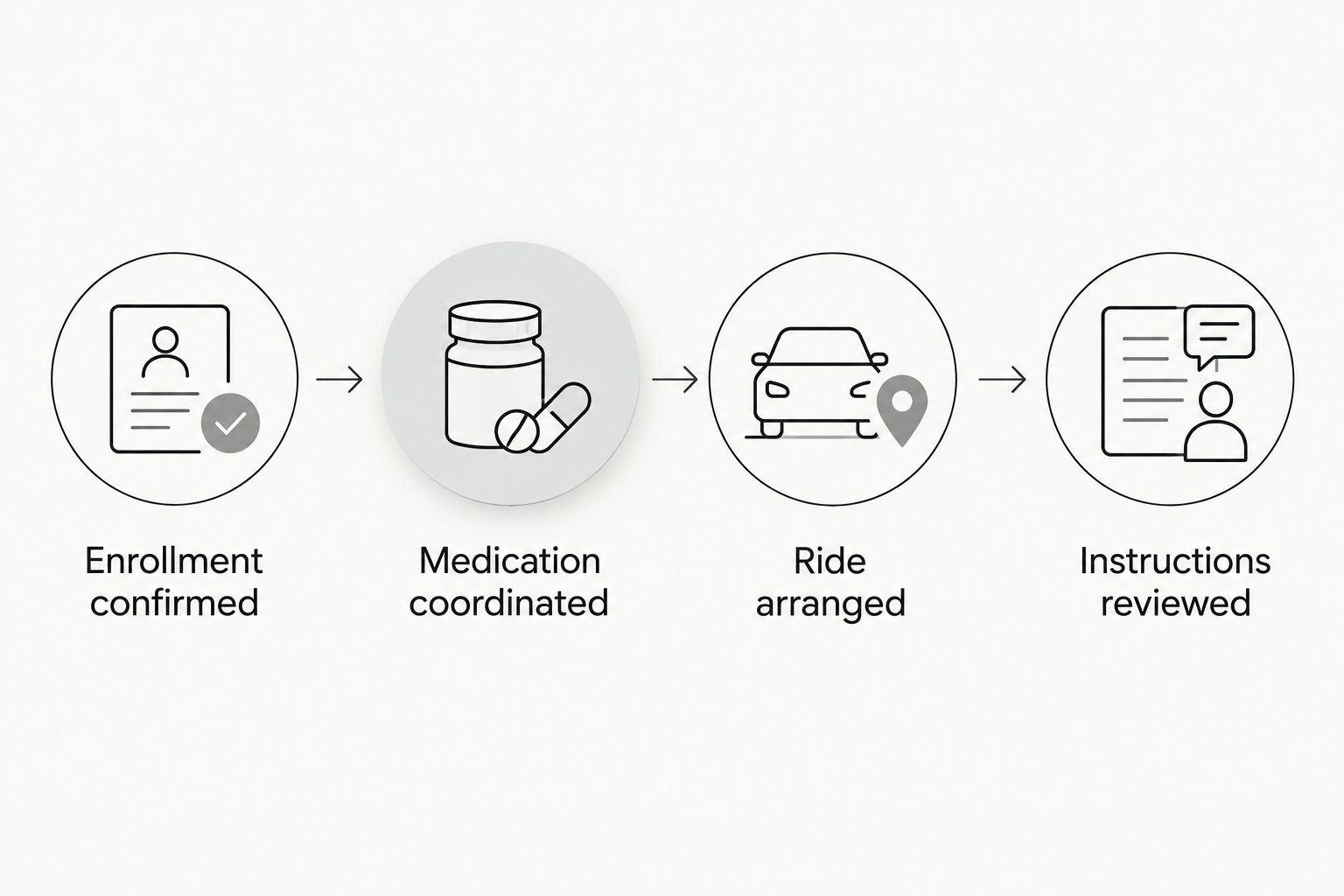
For a practical 2026 handoff, keep these preparation labels together: Enrollment confirmed, Medication coordinated, Ride arranged, and Instructions reviewed. They make a useful personal checklist without replacing the clinic’s clearance process.
Supervised administration and discharge
Know what happens during the first visit
- Report changes before treatment. Tell the team about new medicines, illness, substance use, pregnancy concerns, or a change in symptoms. The clinician must assess whether treatment should proceed that day.
- Complete the pre-dose assessment. The healthcare team checks blood pressure before administration and evaluates relevant safety concerns. An elevated reading requires a clinical decision; enrollment does not override that assessment.
- Use the nasal spray under direct supervision. You administer SPRAVATO yourself while a healthcare professional supervises and gives instructions. Do not treat the nasal device as a take-home prescription.
- Remain for monitoring. Monitoring lasts at least two hours after administration. The team reassesses blood pressure around 40 minutes after dosing and subsequently as clinically warranted, monitors breathing—including pulse oximetry—and assesses your condition before discharge.
- Leave only after clinical clearance. Follow the team’s discharge instructions and use your arranged transportation. Continue to avoid driving and machinery until the next day after a restful sleep.
Expected result: the team documents the treatment and monitoring, determines when you are ready to leave, and explains your next appointment or follow-up instructions. Two hours is the minimum monitoring period, not a promised discharge time.
SPRAVATO’s advantage for an appropriate patient is access to an additional depression treatment under supervision. Its practical limitations include repeated clinic attendance, transportation needs, monitoring time, and treatment risks. Discuss both sides before committing to the schedule.
Returning to treatment after a gap
A return visit is not automatically a new enrollment. If you previously received SPRAVATO, ask the treatment setting to verify your existing REMS status rather than assuming you must start over.
For a 2026 restart, use this shorter workflow:
- Identify your previous treatment setting. Share when and where you received treatment and provide records if requested.
- Request a clinical reassessment. Report medication changes, health changes, your previous response, and why treatment stopped. A past course does not establish that the same plan remains appropriate.
- Verify administrative requirements. Ask whether enrollment status, coverage, medication coordination, or transfer arrangements need attention.
- Obtain a new appointment plan. Let the prescriber determine the treatment schedule. Do not assume you should resume the previous dose or frequency.
Best for returning patients: verify existing records before repeating paperwork. The benefit is avoiding unnecessary duplication; the limitation is that existing enrollment does not remove the need for a fresh clinical and scheduling review.
Troubleshooting the handoffs
- You signed the form, but enrollment is unconfirmed. Contact the treatment setting’s enrollment coordinator. Ask whether all required sections were completed and whether the program enrollment step is finished. Do not submit multiple new forms without instructions.
- Enrollment is complete, but treatment is not scheduled. Ask whether the unresolved item is clinical clearance, coverage, medication coordination, or scheduling. Request a named next action rather than another general status update.
- Your ride cancels. Call before traveling. Do not substitute driving yourself home or assume that feeling alert removes the driving restriction.
- Your blood pressure is elevated on treatment day. Let the clinician assess the reading and decide whether to proceed, reassess, or postpone. Do not take extra blood-pressure medicine unless your prescriber directs it.
- You still feel unwell when the minimum monitoring time ends. Tell the team exactly what you are experiencing. Discharge requires clinical assessment; the observation period can extend beyond the minimum.
Customize your workflow
Create one written list with the coordinator’s contact details, your open questions, preparation instructions, and transportation arrangements. Keep sensitive medical records in the communication channel the practice directs you to use, rather than sending them through an unfamiliar form.
For Attuned Psychiatry patients, use the contact page to ask how to begin an evaluation and which records to prepare. Keep the request specific: ask about assessment, enrollment coordination, and first-visit preparation without assuming treatment has already been approved.
FAQ
How do I start the SPRAVATO REMS enrollment process?
Start with a clinical evaluation and a REMS-certified outpatient treatment setting. The treatment team provides the official patient enrollment form, reviews safety requirements, and coordinates enrollment before outpatient administration.
Can I enroll in SPRAVATO REMS without a treatment clinic?
Patient enrollment is coordinated through the certified treatment setting. Completing paperwork on your own does not replace clinical evaluation, the setting’s enrollment process, or supervised treatment.
Does SPRAVATO REMS enrollment mean my insurance approved treatment?
No. REMS enrollment addresses program safety requirements, while insurance authorization addresses coverage under your plan. Ask the coordinator to confirm both separately.
How long does SPRAVATO REMS enrollment take?
There is no single completion time for the entire path from evaluation to first treatment. Enrollment paperwork, clinical review, coverage decisions, medication coordination, and scheduling are separate tasks; ask which task remains open in your case.
How long do I stay after a SPRAVATO dose?
You remain under observation for at least two hours after administration. A healthcare professional must assess whether you are clinically ready to leave, so monitoring can last longer.
Can I drive home if I feel normal after SPRAVATO?
No. Do not drive or operate machinery until the next day after a restful sleep, even if you feel alert when monitoring ends. Arrange transportation before treatment.
Do I need to enroll again if I restart SPRAVATO?
Ask the treatment setting to verify your existing enrollment status before completing another enrollment form. Restarting still requires clinical reassessment and confirmation of coverage, medication arrangements, and scheduling as applicable.
One last thing
The most useful question is not whether your paperwork is done. It is whether anything still prevents your first dose. Before your 2026 appointment, ask the coordinator to name any unresolved checkpoint and who owns the next action. That answer is more useful than a general assurance that your request is being processed.
Related guides
Start the SPRAVATO REMS enrollment discussion
Request an evaluation and ask how enrollment, coverage verification, and your first supervised treatment are coordinated.


