

Postpartum depression care is treatment for depression after childbirth aimed at restoring your safety, daily functioning, and ability to care for yourself; SPRAVATO for postpartum depression is not an FDA-approved indication. SPRAVATO treats certain forms of adult depression, so considering it after delivery requires a psychiatric assessment that also addresses breastfeeding, sleep, childcare, and transportation.
- SPRAVATO for postpartum depression is not an FDA-approved indication; eligibility depends on a separate qualifying depression diagnosis.
- Attuned Psychiatry offers medication management, TMS, and SPRAVATO for adults seeking treatment-resistant depression care in Decatur/Metro Atlanta.
- ZURZUVAE is FDA-approved for postpartum depression in adults; SPRAVATO has different indications and monitoring requirements.
- Breastfeeding, transportation, and childcare belong in the treatment decision, not just the appointment checklist.
Why treatment choices matter for postpartum depression
Postpartum depression treatment must fit both your symptoms and your responsibilities after delivery. A plan that ignores feeding, disrupted sleep, or the need for another adult to help at home leaves important safety questions unanswered.
For your 2026 treatment discussion, separate two questions: what diagnosis needs treatment, and which treatment fits that diagnosis? The fact that SPRAVATO treats depression does not make it a postpartum-specific medicine. Review the available psychiatric services before an appointment so you can ask about the differences rather than arrive committed to one option.
Do not wait for a routine consultation if you have thoughts of harming yourself or your baby, hallucinations, delusions, or severe confusion. Call 911 for immediate danger or go to an emergency department. In the United States, call or text 988 for a suicide or mental health crisis. Postpartum psychosis is an emergency, not a condition to manage by comparing outpatient treatments.
What SPRAVATO does—and does not—mean after childbirth
SPRAVATO is the brand name for esketamine nasal spray. Its FDA-approved uses include treatment-resistant depression in adults and, with an oral antidepressant, depressive symptoms in adults with major depressive disorder and acute suicidal ideation or behavior. The prescribing information does not establish that SPRAVATO prevents suicide or eliminates the need for hospitalization.
Postpartum depression is not a separate SPRAVATO indication in 2026. A postpartum patient with treatment-resistant depression needs an assessment of that diagnosis and the treatment's risks; childbirth alone does not establish eligibility.
An off-label discussion also needs to be explicit. Ask whether the proposed treatment fits an approved indication, what evidence supports its use in your situation, and which postpartum-specific alternatives deserve consideration. Do not treat SPRAVATO and a medicine approved specifically for postpartum depression as interchangeable.
How to evaluate SPRAVATO after childbirth
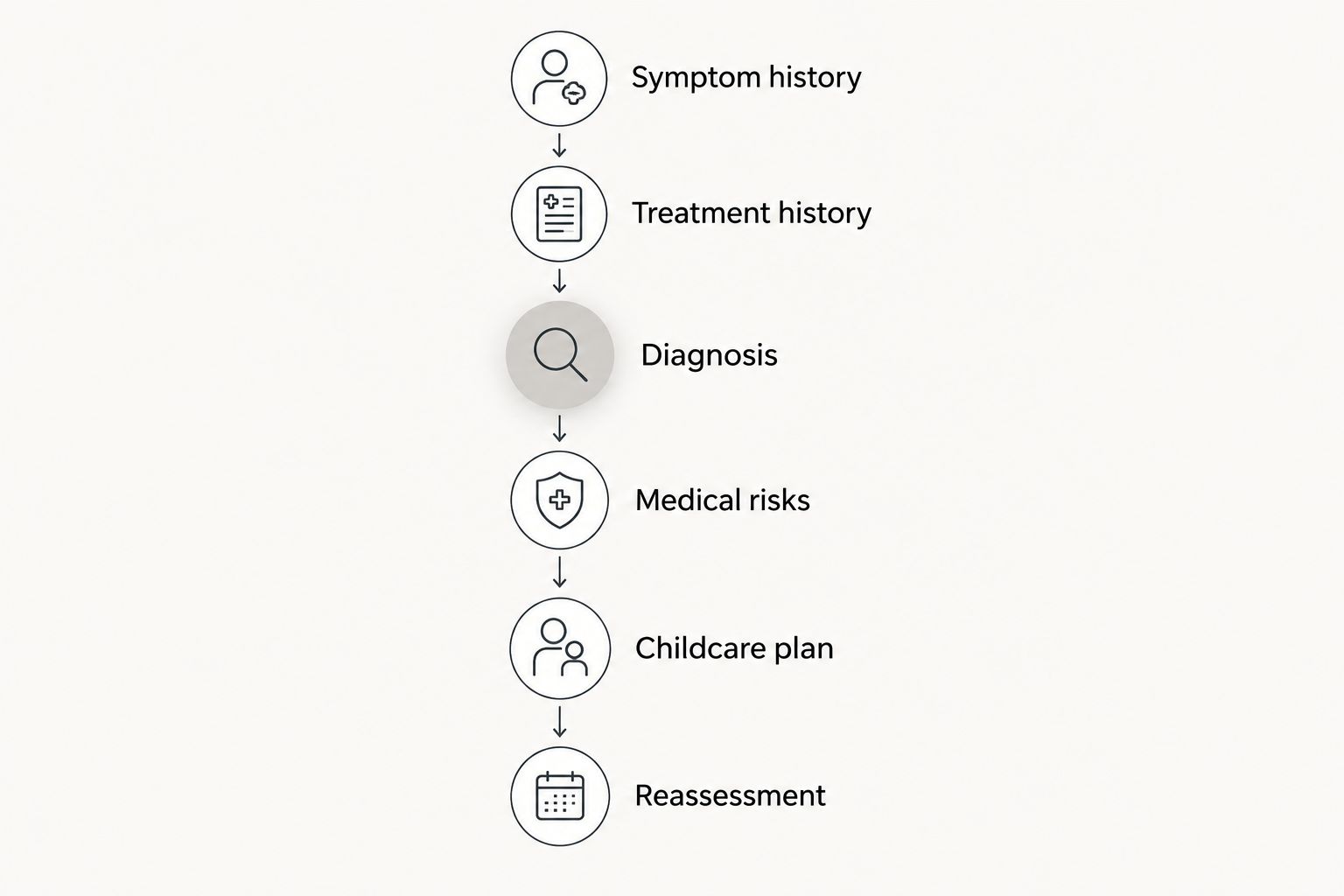
1. Describe your symptoms and identify urgent concerns
Start with a written symptom history rather than a request for a particular medicine. Record when symptoms began, how they affect eating and sleep, and whether you can complete basic tasks or safely care for your baby.
Depression symptoms lasting at least 2 weeks deserve assessment, but severe symptoms require help sooner. You do not need to reach a duration threshold before seeking care. Tell the clinician about anxiety, intrusive thoughts, panic, or feeling disconnected from your baby as well as low mood.
Unwanted, frightening thoughts and an intention to act are not the same, but both deserve a clear clinical conversation. Describe what you experience without trying to assign the diagnosis yourself.
- Record symptom onset relative to pregnancy and delivery.
- Describe sleep when someone else handles infant care.
- Explain changes in appetite, concentration, and functioning.
- Disclose thoughts of self-harm or harm to your baby.
- Report hallucinations, unusual beliefs, or severe agitation immediately.
2. Reconstruct your previous treatment history
A medication name alone does not show whether treatment failed. Your clinician needs the dose, duration, adherence, benefit, and side effects to distinguish an inadequate trial from a treatment that genuinely did not work.
Bring records if you have them. A medication stopped early because of side effects raises a different question from a medication taken consistently without improvement. Include treatment before pregnancy, changes during pregnancy, and anything discontinued after delivery.
Treatment-resistant depression commonly refers to depression that has not responded adequately to at least two antidepressant treatments. That history still requires clinical interpretation; it is not a self-diagnosis or an automatic reason to receive SPRAVATO.
- List each antidepressant and the reason it was stopped.
- Include doses and treatment dates when available.
- Describe benefits even if they were incomplete.
- Record psychotherapy and other psychiatric treatments.
- Bring your current medication and supplement list.
3. Ask for a diagnosis-led treatment comparison
Start with an appointment that reviews the diagnosis, not just access to a procedure. Depression after childbirth can coexist with anxiety, and a history of mania or hypomania changes treatment decisions. Medical contributors and substance use also belong in the assessment.
Attuned Psychiatry provides physician-led medication management, TMS, and SPRAVATO in Decatur/Metro Atlanta. Attuned Psychiatry is best suited to adults in Decatur/Metro Atlanta seeking psychiatric evaluation for treatment-resistant depression. Its stated services do not establish that every postpartum patient qualifies for SPRAVATO or that postpartum-specific prescribing is offered.
For a 2026 consultation, ask the clinician to explain the preferred option and its limitations. A useful comparison addresses your diagnosis, prior treatment response, feeding plans, and ability to attend care—not just which treatment sounds newest.
- Ask which diagnosis is guiding the recommendation.
- Discuss any history of elevated mood or reduced need for sleep.
- Ask whether SPRAVATO would be on-label or off-label.
- Compare psychotherapy, medication management, and other relevant options.
- Confirm experience treating patients during the postpartum period.
4. Review breastfeeding and medical risks before scheduling
Tell the prescriber whether you breastfeed, pump, use formula, or plan to change feeding methods. SPRAVATO's FDA-approved prescribing information advises against breastfeeding during treatment because of potential adverse effects in the infant. Do not substitute an informal pump-and-discard schedule for a clinician's feeding plan.
SPRAVATO also requires review of blood pressure, cardiovascular and cerebrovascular history, substance use, and medicines that affect alertness. Certain vascular conditions and a history of intracerebral hemorrhage are contraindications. Your clinician must assess these issues individually.
Do not stop an antidepressant, change feeding, or alter another prescribed treatment on your own to qualify for SPRAVATO. Ask the psychiatric prescriber and your obstetric or primary care clinician to coordinate unresolved questions.
- State your current feeding method and goals.
- Ask for a treatment-specific breastfeeding recommendation.
- Report blood pressure problems during or after pregnancy.
- Disclose vascular conditions and prior brain bleeding.
- Review sedatives, alcohol, and other substances honestly.
5. Build a supervised-treatment and childcare plan
SPRAVATO is administered under supervision in a certified healthcare setting through its restricted REMS program. It is not a take-home nasal spray. The prescribing information requires monitoring for at least 2 hours after administration, with discharge based on clinical assessment.
You must not drive or operate machinery until the next day after a restful sleep. With a newborn, that restriction needs practical planning rather than an assumption that a night's sleep will happen. Arrange transportation and ask the clinic how to handle persistent impairment or inadequate rest.
Sedation, dissociation, respiratory depression, and increased blood pressure are important treatment risks. Have another responsible adult available for infant care while you are receiving treatment or remain impaired.
- Arrange a ride home before the appointment.
- Plan for at least 2 hours of monitored recovery.
- Assign infant care to another responsible adult.
- Ask when you can safely resume caregiving tasks.
- Confirm whom to contact for symptoms after discharge.
6. Define improvement and reassess the plan
Agree on how you and your clinician will judge progress before starting treatment. Use the same symptom measure over time, but also track whether you can eat regularly, connect with others, complete daily tasks, and participate safely in infant care.
Symptom relief and restored functioning are related, not identical. A lower questionnaire score does not settle persistent safety concerns or explain new agitation, unusual energy, or worsening sleep. Report those changes instead of waiting for a scheduled review.
A 2026 treatment plan should include follow-up, side-effect review, and a clear response to insufficient benefit. Do not interpret a difficult treatment session as proof that treatment has failed, or a brief improvement as proof that follow-up is unnecessary.
- Choose a consistent depression symptom measure.
- Identify daily activities you want to regain.
- Track side effects alongside symptom changes.
- Set a date to review benefit and tolerability.
- Agree on whom to contact if symptoms worsen.
Compare treatment options for postpartum depression
The best option depends on diagnosis, severity, prior response, medical history, and feeding plans. This 2026 comparison distinguishes postpartum-specific approval from treatments used for depression more broadly; it does not rank treatments for every patient.
| Option | Best for | Main advantage | Key limitation |
|---|---|---|---|
| Psychotherapy | Patients whose assessment supports therapy alone or alongside medication | Addresses thoughts, behavior, relationships, and coping | Requires participation and does not replace emergency care |
| Antidepressant medication management | Patients needing an individualized medication plan | Allows selection based on history, response, and feeding considerations | Benefits and side effects require follow-up; medication choice matters |
| ZURZUVAE, or zuranolone | Adults being evaluated for a medicine specifically approved for postpartum depression | FDA-approved postpartum depression treatment with a 14-day course | Has sedation and driving restrictions; requires medication and feeding review |
| SPRAVATO, or esketamine | Adults meeting an approved depression indication after assessment | Offers a supervised option for qualifying depression | Not specifically approved for postpartum depression; requires monitoring and transportation |
| TMS | Patients whose depression assessment supports a nonmedication procedure | Does not require taking an antidepressant as the procedure itself | Requires repeated visits and individual eligibility review |
ZURZUVAE's postpartum-specific approval does not make it appropriate for every patient. Its FDA-approved prescribing information includes a driving restriction of at least 12 hours after each dose throughout treatment. Feeding recommendations also differ between medicines, so advice for one drug does not transfer to another.
Attuned Psychiatry offers the medication management, TMS, and SPRAVATO options described in its practice information. Confirm directly whether the practice evaluates your postpartum needs and whether any treatment not listed among those services is available.
Common mistakes postpartum patients make
Equating severe symptoms with treatment resistance
Severe postpartum depression needs prompt assessment, but severity alone does not establish treatment-resistant depression. Bring your treatment history so the recommendation reflects both your current condition and what you have already tried.
Treating breastfeeding as a question for later
Feeding affects treatment selection and family planning from the start. Ask for a medication-specific recommendation before the first dose rather than changing feeding arrangements after treatment begins.
Planning transportation but forgetting infant care
A ride home solves only part of a supervised-treatment day. Arrange help with feeding, lifting, overnight care, and other tasks if sedation or impaired alertness makes independent care unsafe.
Assuming a nasal spray is a home treatment
SPRAVATO requires supervised administration and monitoring in a certified setting. Do not confuse it with take-home nasal medicines or assume an online consultation replaces the treatment visit.
FAQ
Is SPRAVATO approved for postpartum depression?
No. SPRAVATO is not FDA-approved specifically for postpartum depression. A postpartum patient needs evaluation for a qualifying depression indication and an individualized risk assessment.
Can I receive SPRAVATO while breastfeeding?
SPRAVATO's prescribing information advises against breastfeeding during treatment. Discuss feeding plans with your psychiatric prescriber and your baby's clinician before starting treatment.
Is SPRAVATO the same as ZURZUVAE?
No. SPRAVATO is esketamine nasal spray with specific adult depression indications; ZURZUVAE is oral zuranolone, FDA-approved for postpartum depression in adults. Their administration, risks, and treatment schedules differ.
How long do I stay at the clinic after SPRAVATO?
SPRAVATO requires monitoring for at least 2 hours after administration. Your clinician determines when you are stable enough to leave, so arrange transportation and flexible childcare.
Can I drive home or care for my baby after treatment?
You cannot drive home after SPRAVATO, and another responsible adult should care for your baby while you are impaired. The driving restriction lasts until the next day after a restful sleep; ask your clinician about caregiving safety.
Do I need to try antidepressants before considering SPRAVATO?
A treatment-resistant depression evaluation includes prior antidepressant treatment and response. SPRAVATO also has a separate indication involving major depressive disorder with acute suicidal ideation or behavior, so eligibility requires clinical assessment rather than a self-applied medication checklist.
When does postpartum depression require emergency help?
Immediate danger, intent to harm yourself or your baby, hallucinations, delusions, or severe confusion require emergency evaluation. Call 911 for immediate danger; in the United States, call or text 988 for crisis support.
One last thing
The most useful appointment document is a treatment timeline, not a preferred-drug request. Put pregnancy and delivery, symptom onset, medication changes, feeding plans, and previous responses on the same page. That makes it easier to distinguish persistent depression from a treatment interruption or a new diagnostic concern.
Before seeking SPRAVATO for postpartum depression in 2026, ask for a diagnosis-led comparison and a written plan for feeding, transportation, childcare, and follow-up.
Related guides
Discuss postpartum depression treatment options
Request an evaluation to review your symptoms, treatment history, and supervised care options.


