

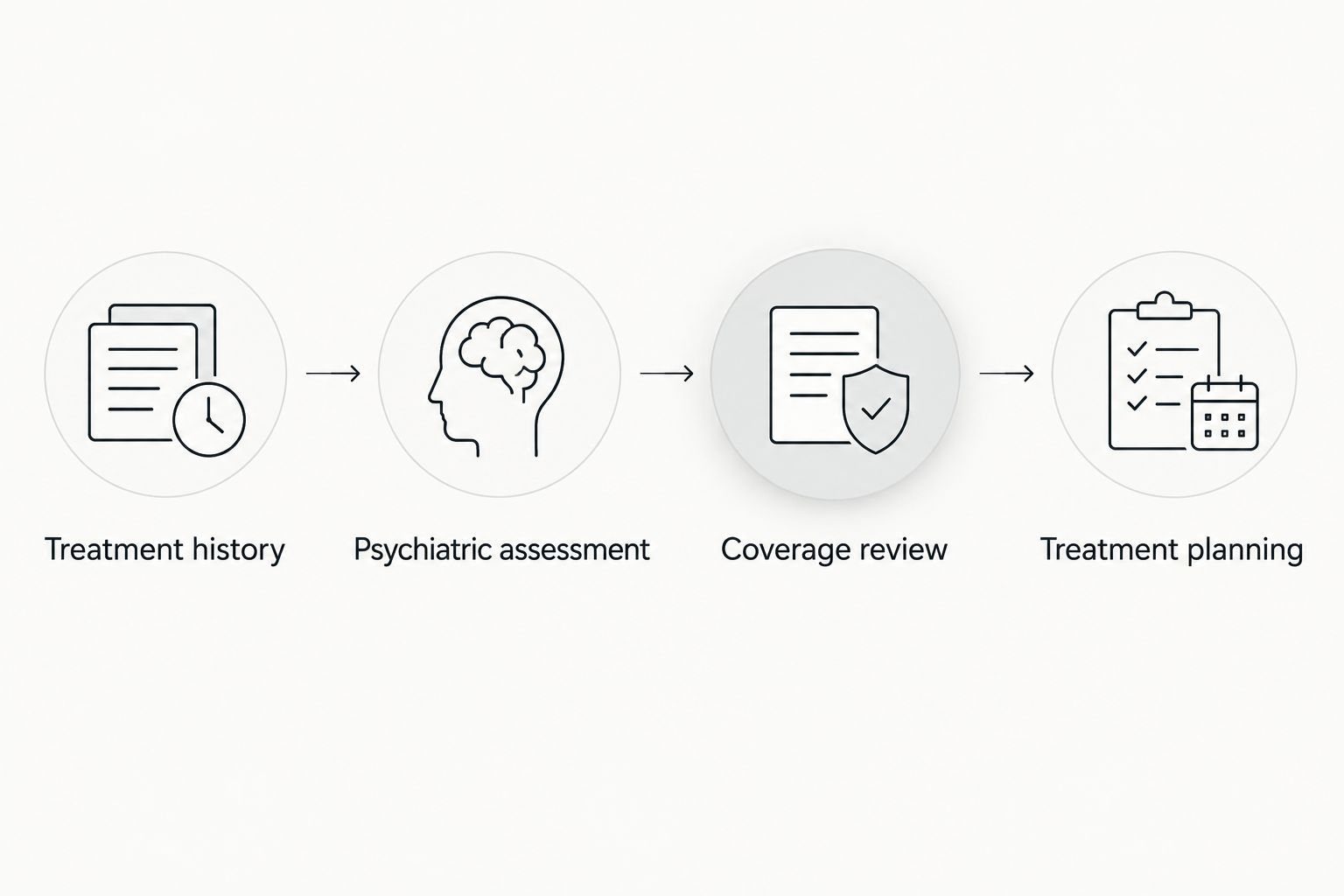
Instead of repeatedly retelling your depression history, organize your records for the TMS evaluation process, then work through psychiatric assessment, safety screening, coverage review, and treatment planning before your first session. This 2026 guide explains what to prepare, what your clinician decides, and what must happen before treatment starts.
- The TMS evaluation process establishes diagnosis, treatment history, safety, and a treatment plan before scheduling.
- Attuned Psychiatry offers physician-led psychiatric care and TMS for patients in Decatur and Metro Atlanta.
- Bring medication records, prior treatment results, and implant information to your psychiatric evaluation.
- Clinical eligibility and insurance authorization are separate decisions; neither guarantees the other.
Why this matters
A TMS consultation is not just a scheduling appointment. Transcranial magnetic stimulation uses magnetic pulses to stimulate targeted brain regions; your clinician first needs to establish whether the treatment fits your diagnosis and medical history.
Attuned Psychiatry is a fit for Decatur and Metro Atlanta patients seeking physician-led psychiatric evaluation and TMS care. The practice offers medication management as well, so the discussion can address your broader treatment plan rather than treating TMS as an isolated decision. Learn about Attuned Psychiatry before preparing your consultation questions.
The useful outcome of an evaluation is a clear next step—not necessarily an immediate treatment start. Your clinician might recommend proceeding, obtaining missing records, clarifying the diagnosis, or addressing another clinical issue first.
Before you start
Prepare these materials for your 2026 evaluation:
- Treatment history and records: Bring medication names, doses, treatment dates, benefits, side effects, psychotherapy history, and any previous TMS records. Request relevant notes from previous clinicians through their approved records-release process.
- Medical and scheduling information: List current prescriptions, nonprescription products, seizure history, head injuries, implanted devices, and metal near your head. Have your insurance information and a realistic picture of your recurring appointment commitments ready.
- The easily missed hurdle: A clinician's recommendation does not establish insurance coverage. Ask what documentation your plan requires, whether authorization is needed, and who confirms that clearance before treatment begins.
Do not stop medication to prepare for the appointment unless your prescriber instructs you to do so. An accurate account of your current treatment is more useful than an unplanned medication change.
Treatment history preparation
Build a usable medication record
- Create a medication timeline. For each antidepressant, record the name, dose, approximate dates, and reason you stopped or changed it. Mark uncertain details as uncertain rather than guessing.
- Separate benefit from tolerability. Describe whether your mood improved, whether the benefit lasted, and whether side effects limited treatment. A medicine stopped because of side effects tells a different story from one taken adequately without improvement.
- Request supporting records. Ask previous prescribers for relevant treatment summaries. Bring pharmacy records if they help reconstruct medication names, while recognizing that dispensing records do not establish how consistently you took a medication.
Treatment-resistant depression commonly refers to depression that has not responded adequately to at least 2 adequate antidepressant trials. That clinical description does not automatically establish TMS eligibility or satisfy an insurer's requirements. Dose, duration, adherence, diagnosis, and the particular coverage policy still matter.
Include psychotherapy and previous procedures without treating every intervention as interchangeable. If you previously received TMS, bring the treatment course, response, adverse effects, and available treatment-setting records.
Expected result: Your clinician can review what you tried, what happened, and which details still need confirmation.
Psychiatric assessment and safety screening
Establish the clinical picture
- Describe your current symptoms and functioning. Explain changes in mood, interest, sleep, concentration, appetite, work, relationships, and daily care. Include thoughts of self-harm directly rather than waiting for a particular question.
- Review the broader psychiatric history. Discuss past episodes, periods of unusually elevated or irritable mood, psychotic symptoms, substance use, and previous hospitalizations. The evaluation must establish the diagnosis before selecting a treatment.
- Complete the requested assessment. Your clinician can use a depression questionnaire alongside the interview to document baseline symptoms. A questionnaire supports clinical assessment; it does not replace it or determine eligibility by itself.
A TMS discussion should also identify who manages your existing medications. Keep one current medication list and make sure each treating clinician knows about changes made elsewhere.
Identify safety issues before scheduling
- Disclose implants and relevant medical history. Report implanted electronic devices, metal in or near your head, prior brain surgery, seizures, significant head injuries, and hearing concerns. Bring device identification information when available.
- Discuss factors that affect treatment planning. Report medication changes, alcohol or substance use, and disrupted sleep. Your clinician needs this information to assess risk and decide whether additional review is necessary.
Not every implant or piece of dental work creates the same concern. Device type, material, location, and the TMS system's safety instructions matter; do not decide compatibility from a general internet checklist.
Expected result: You understand the working diagnosis, whether TMS is appropriate to consider, and whether any safety question remains unresolved.
Coverage review and treatment planning
Separate clinical clearance from coverage clearance
- Ask what supports the recommendation. Have your clinician explain why TMS fits—or does not fit—your diagnosis, previous treatment response, and medical history. Ask what other treatment decisions still need attention.
- Confirm the coverage pathway. If you plan to use insurance, ask whether authorization is required and which records support the request. Confirm who handles submission, who receives the decision, and how you will learn about missing documentation.
- Review consent and practical commitments. Discuss expected benefits, limitations, common discomforts, and serious risks, including seizures. Ask about the proposed schedule, symptom monitoring, and what happens if you miss sessions.
TMS requires a clinical decision and a workable attendance plan. Many conventional outpatient depression protocols involve appointments 5 days per week over approximately 4–6 weeks, but schedules differ by protocol. Your prescribed course—not a general example—determines your actual commitment.
Use this 2026 planning comparison to distinguish the tasks rather than assuming one completed appointment clears everything:
| Workflow component | Best for | What it establishes | Limitation |
|---|---|---|---|
| Psychiatric evaluation | Establishing diagnosis and treatment fit | Clinical history, symptoms, and treatment recommendation | Does not guarantee coverage |
| Insurance authorization review | Clarifying plan requirements | Whether the requested care meets the plan's authorization criteria | Does not replace medical judgment or guarantee payment |
| Treatment planning | Preparing for a prescribed course | Consent, schedule, monitoring, and coordination | Cannot guarantee symptom improvement |
Ask for a clear status statement: recommended and awaiting authorization, awaiting records, awaiting safety review, or ready for treatment scheduling. A specific status is more useful than being told that everything is being processed.
Expected result: You know which requirements are complete, which remain open, and who owns the next action.
Treatment setup and first-session preparation
Confirm the treatment-day plan
- Ask whether setup and treatment share an appointment. Before attending, confirm what the visit includes and which preparation instructions apply. Do not assume a consultation automatically includes stimulation treatment.
- Review treatment mapping. TMS setup generally includes identifying the treatment location and determining the motor threshold, a measurement used to help set stimulation intensity. Your clinician explains the method used for the prescribed protocol.
- Confirm comfort and monitoring arrangements. Ask how hearing protection is provided, how to report scalp discomfort, and whom to contact about symptoms between visits. Tell the treatment team about any new medical issue or medication change before stimulation begins.
- Set a baseline and follow-up plan. Confirm how symptoms and side effects will be tracked and when your clinician will review progress. Ask how the team handles worsening symptoms or a treatment course that is not helping.
TMS does not guarantee remission. Scalp discomfort and headache are recognized side effects, and seizures are a rare but serious risk; the consent discussion should explain risks in relation to your circumstances.
For your 2026 treatment start, leave with the prescribed schedule and contact instructions, not just an appointment reminder. The practical details help you follow the plan and report changes promptly.
Expected result: You understand the setup visit, the prescribed treatment course, and how to communicate concerns.
Discuss your next treatment step
Contact Attuned Psychiatry about psychiatric evaluation and TMS care in Decatur and Metro Atlanta.
When symptoms return after previous TMS
A return evaluation after prior TMS is different from a first-time evaluation. Your clinician needs to understand your earlier response and what changed before deciding whether another course is appropriate.
- Document the previous benefit. Describe which symptoms improved, how daily functioning changed, and when symptoms returned. Bring prior rating-scale results if you have them.
- Update the safety review. Report new diagnoses, devices, medications, seizures, or significant changes in substance use and sleep.
- Recheck coverage requirements. Previous authorization does not establish authorization for a new course. Ask what documentation supports retreatment under your current plan.
The advantage is that previous treatment records can inform the next decision. The limitation is that an earlier response does not guarantee the same outcome or remove the need for reassessment.
Best for: Patients seeking reassessment after a prior TMS course, rather than treating recurring symptoms as permission to restart automatically.
Troubleshooting delays and uncertainty
Your medication history has gaps
Request records from previous prescribers and pharmacies, then identify what remains unknown. Do not reconstruct doses or dates as facts when you cannot confirm them; your clinician can decide whether the available history is sufficient.
Your insurance request needs more information
Ask for the specific missing requirement and the relevant decision notice. Clinical notes, medication histories, or other documentation must address the actual request; repeatedly sending an unchanged packet does not resolve a documentation gap.
You have an implant but no device details
Contact the implanting clinician or obtain your device identification information. Let the TMS clinician review compatibility before treatment scheduling rather than assuming that all implants are safe or all are disqualifying.
The proposed schedule conflicts with work or caregiving
Discuss the conflict before accepting the treatment calendar. Ask what schedules are clinically appropriate and what the practice can support; do not plan around an unconfirmed alternative protocol.
Your symptoms worsen while you wait
Contact your treating clinician promptly instead of waiting for an authorization decision. If you are in immediate danger or cannot stay safe, call 911 or go to the nearest emergency department; in the United States, call or text 988 for suicide and crisis support.
Customize your workflow
Build your 2026 preparation around the barrier that actually applies to you: incomplete records, diagnostic uncertainty, a device question, coverage documentation, or attendance constraints. Completing unrelated paperwork first does not resolve the issue holding up treatment.
For Attuned Psychiatry TMS care, ask which clinical and administrative requirements apply to your individual plan. Keep a single record of pending tasks and the person responsible for each one. Update that record whenever a clinician, insurer, or previous practice supplies new information.
Include your existing prescriber in coordination when appropriate. Medication management and TMS planning need a consistent account of what you take and how you are doing.
FAQ
What happens during the TMS evaluation process?
The TMS evaluation process reviews your diagnosis, depression symptoms, treatment history, and safety factors before a clinician recommends a next step. Coverage review, consent, and treatment setup are separate parts of preparation.
Do I need to have tried antidepressants before a TMS evaluation?
Bring your antidepressant history to the evaluation because prior treatment response helps determine whether TMS fits your situation. Clinical criteria and insurance requirements are not identical, so ask which requirements apply to you.
Can I start TMS on the day of my psychiatric evaluation?
Do not assume that TMS starts on the evaluation day. Clinical review, safety questions, authorization requirements, consent, and treatment setup must be addressed before treatment begins.
Should I stop taking medication before my TMS consultation?
Do not stop or change medication unless your prescriber instructs you to do so. Bring an accurate medication list and report changes to the treatment team before sessions.
Can I have TMS if I have dental work or an implanted device?
Your clinician must assess the specific material, device, and location before deciding whether TMS is appropriate. Bring device information and disclose metal or electronic implants rather than assuming compatibility.
Does insurance approval mean TMS will work?
Insurance approval does not predict treatment response. It addresses coverage requirements, while your clinician assesses treatment suitability and monitors benefits and side effects.
What should I bring to an Attuned Psychiatry TMS evaluation?
Prepare your medication history, current medication list, relevant psychiatric records, medical and implant information, and insurance details. Ask the practice which forms and records it needs before your appointment.
One last thing
Keep authorization, clinical clearance, and appointment scheduling as separate checklist items. Each answers a different question. Knowing exactly which one remains unfinished gives you a concrete next action instead of another round of calls asking when treatment can start.


