

Medication management for first responders is psychiatric care that selects, monitors, and adjusts medication to improve mental health while accounting for safety-sensitive work. This 2026 guide explains how to prepare for care, assess side effects around shifts, and coordinate treatment without treating a prescription as automatic clearance for duty.
- Medication management for first responders should address symptoms, shift work, side effects, and duty-related safety together.
- Attuned Psychiatry offers physician-led psychiatric medication management in Decatur/Metro Atlanta.
- Report impaired alertness promptly; do not change medication doses or timing without your prescriber's instructions.
- Clinical treatment and fitness-for-duty decisions serve different purposes; clarify who handles each.
Why medication management matters for first responders
First responders need treatment decisions that account for driving, operating equipment, interrupted sleep, and unpredictable calls. A medication discussion is incomplete if it covers mood but ignores alertness during an overnight shift.
The goal is symptom improvement with a workable safety plan—not simply a new prescription. Depression, anxiety, trauma-related symptoms, and sleep problems deserve assessment rather than an assumption that every difficult shift reflects the same condition. Sleep loss, physical illness, substance use, and medication effects can complicate that assessment.
Your 2026 care plan should distinguish psychiatric treatment from occupational clearance. A treating clinician manages health; an employer or designated occupational evaluator may have separate responsibilities for work restrictions and return-to-duty decisions.
Attuned Psychiatry is best for Decatur/Metro Atlanta patients seeking physician-led psychiatric medication management. The practice also offers TMS and SPRAVATO® for appropriate patients, but the starting point is an individual assessment—not choosing an advanced treatment before establishing the diagnosis.
How to build a medication plan around first-response work
1. Document symptoms alongside your actual shifts
Start with a simple paper log or phone note. Record when symptoms occur, how they affect functioning, and whether they follow workdays, overnight shifts, or days off. You do not need a paid tracking app to bring useful information to an appointment.
As a preparation exercise, keep notes for 7 days if your appointment timing allows. That is an organizational suggestion, not a diagnostic test or a reason to delay urgent care. Include difficult days and better days so your clinician sees more than a snapshot.
Describe work demands without recording identifying details about patients, coworkers, or incidents. Your clinician needs the effect on you, not confidential operational records.
- Write down shift start and end times, including overtime.
- Note sleep periods, awakenings, and difficulty becoming alert.
- Identify 3 symptoms you most want treatment to address.
- Record caffeine, alcohol, cannabis, supplements, and other medication use.
- Describe concrete effects, such as losing concentration during documentation or withdrawing from family.
2. Request an assessment before choosing a medication
Bring your notes to a qualified prescriber and describe both symptoms and job responsibilities. Medication selection depends on the condition being treated, previous responses, medical history, interactions, and your preferences—not your job title alone.
For your 2026 appointment, prepare a complete medication list, including over-the-counter sleep aids and medications prescribed elsewhere. Tell the clinician about periods of unusually elevated or irritable mood, markedly reduced need for sleep, or impulsive behavior. Those details can change the diagnostic assessment and treatment plan.
Ask what diagnosis is being considered and what remains uncertain. A careful assessment can identify when psychotherapy, sleep evaluation, substance-use treatment, or another medical assessment belongs alongside psychiatric care.
- List previous medications, benefits, side effects, and reasons for stopping.
- Include medical conditions, allergies, and relevant family psychiatric history.
- Describe trauma-related symptoms without forcing yourself into unnecessary detail.
- Disclose alcohol or drug use accurately so the clinician can assess interactions.
- Prepare 2 questions about treatment goals and work-related safety.
3. Agree on a treatment plan that fits your duties
Before starting or changing medication, discuss the tasks you must perform safely. Emergency driving, carrying a firearm, climbing, operating machinery, and making time-critical decisions are relevant clinical details. Do not assume a prescriber already knows your role's demands.
Ask how to handle medication timing when shifts rotate. A plan tied to a fixed clock time is not automatically suitable for someone whose sleep period changes. Get individualized instructions rather than moving doses yourself or following a colleague's schedule.
Attuned Psychiatry's psychiatric services include medication management, TMS, and SPRAVATO®. Medication management provides a setting to discuss treatment choices; choosing an option still requires assessment of symptoms, history, risks, and suitability. Psychiatric treatment does not itself establish fitness for duty.
- Agree on the symptom or functional change each treatment should address.
- Ask whether the medication can affect alertness, coordination, or judgment.
- Get instructions for missed doses and rotating sleep schedules.
- Clarify when side effects require a call, urgent assessment, or emergency care.
- Identify who handles occupational restrictions or formal duty clearance.
4. Monitor early changes without adjusting treatment yourself
Use the same simple log after treatment begins or changes. Record benefits and unwanted effects separately. Feeling less anxious is useful information; feeling too slowed to drive safely is equally important and needs prompt attention.
Do not perform safety-sensitive duties while impaired. If you develop drowsiness, dizziness, confusion, or another effect that compromises safe work, contact your clinician promptly and follow your workplace's safety procedures. Do not test whether you can push through impairment on an emergency call.
Do not abruptly stop, increase, skip, or reschedule medication without instructions. Some psychiatric medications cause discontinuation symptoms when stopped suddenly, and an inconsistent schedule can make treatment harder to assess.
- Track changes in mood, anxiety, sleep, concentration, and functioning.
- Note when side effects occur relative to a dose and your sleep period.
- Report new agitation, unusual mood elevation, or worsening suicidal thoughts promptly.
- Ask a trusted person to flag concerning changes you might overlook.
- Keep the follow-up plan accessible rather than relying on memory after a shift.
5. Coordinate care and clarify confidentiality
Create a short list of everyone involved in your treatment and occupational decisions. This can include a psychiatric prescriber, therapist, primary care clinician, and occupational health professional. They do not automatically have the same role or access to the same information.
Ask the practice how records, releases, billing communications, and employer paperwork are handled. Do not assume that seeking psychiatric care automatically notifies an employer—or that confidentiality has no exceptions. Rules depend on the circumstances, applicable law, and the type of evaluation.
A treatment visit and an employer-requested fitness-for-duty evaluation can have different purposes and reporting arrangements. Clarify those differences before signing releases or expecting a treating clinician to provide occupational clearance.
- Ask who can access your records and how information is shared.
- Read any release of information before signing it.
- Identify the recipient and purpose of requested workplace documentation.
- Tell each prescriber about medications managed by other clinicians.
- Confirm whom to contact between visits and during an urgent problem.
6. Review progress and address persistent symptoms
At follow-up, compare your current functioning with the goals you set before treatment. Better sleep alone does not answer whether depression, panic, or trauma-related symptoms have improved. Equally, a symptom score does not replace discussion of how you function at work and home.
If symptoms persist, ask the clinician to review the diagnosis, medication use, tolerability, sleep, substance use, and other contributing conditions. Treatment changes should follow that review rather than an assumption that every unsuccessful medication calls for a higher dose.
For treatment-resistant depression, a psychiatric assessment can address whether options such as TMS or SPRAVATO® are appropriate. Neither is a universal next step, and treatment schedules, safety requirements, and transportation needs require discussion before committing.
- Compare progress against the original symptom and functional goals.
- Discuss side effects even when a medication is helping.
- Review missed doses without minimizing them or treating them as a moral failure.
- Ask whether psychotherapy or another evaluation should be added.
- Leave with clear next steps and a follow-up plan.
Compare care options for first responders
Use this 2026 comparison to match the type of support to the problem you need addressed. These options are not interchangeable, and several can form part of the same care plan.
| Option | Best for | Main benefit | Key limitation |
|---|---|---|---|
| Psychiatric medication management | Symptoms needing diagnostic assessment and prescription treatment | Connects medication decisions with symptom and side-effect monitoring | Requires follow-up; it does not replace psychotherapy or occupational clearance |
| Psychotherapy | Trauma-related distress, coping patterns, and behavioral treatment goals | Addresses experiences and behaviors that medication alone does not resolve | Does not provide prescription management unless the clinician separately holds prescribing credentials |
| Primary care | Initial assessment and coordination of physical and mental health concerns | Helps assess medical contributors and coordinate referrals | Complex diagnostic questions can require psychiatric evaluation |
| Occupational health | Questions about work restrictions and fitness for duty | Connects health findings with job requirements | Its evaluation purpose can differ from ongoing psychiatric treatment |
| Advanced depression treatment | Depression needing specialist review after previous treatment | Adds options such as TMS or SPRAVATO® when clinically appropriate | Eligibility, treatment logistics, and safety requirements need individual review |
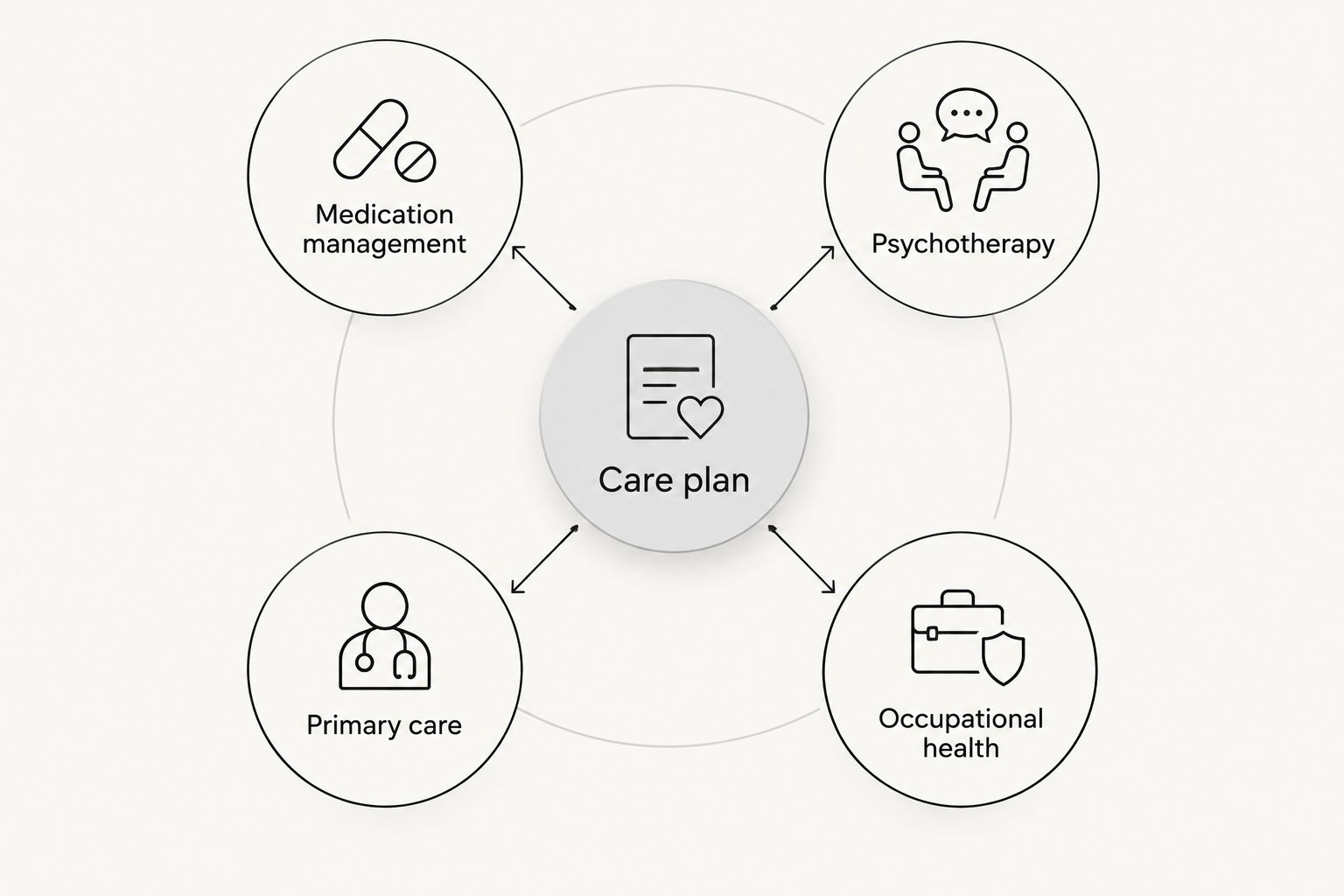
The right combination depends on your clinical needs and work responsibilities. Ask each clinician to explain what they manage and what requires another professional; unclear ownership creates gaps in follow-up and safety planning.
Common mistakes first responders make
Treating a colleague's prescription as a recommendation
Shared work does not mean shared diagnoses, medication responses, or interaction risks. Describe what you want treatment to improve, but do not take someone else's medication or treat their experience as a prescribing plan.
Using days off as proof of duty readiness
Feeling comfortable at home does not establish that you can safely drive an emergency vehicle or perform another high-risk task. Discuss actual job demands and any required occupational assessment before assuming treatment tolerability equals clearance.
Leaving shift changes out of the appointment
A medication schedule cannot account for information the prescriber does not have. Report overtime, rotating shifts, disrupted sleep, and changes in caffeine or sleep-aid use rather than presenting your schedule as more predictable than it is.
Hiding side effects to protect a treatment plan
Reporting impairment is part of treatment, not evidence that care has failed. Tell your clinician about slowed thinking, dizziness, sexual side effects, or other concerns so decisions reflect your actual experience.
Discuss your psychiatric care needs
Contact Attuned Psychiatry about medication management and assessment in Decatur/Metro Atlanta.
FAQ
What's medication management for first responders?
Medication management for first responders is psychiatric assessment, prescribing, and follow-up that accounts for symptoms and safety-sensitive duties. The plan should address shift patterns, side effects, interactions, and coordination with other care.
Can I work while taking psychiatric medication?
Taking psychiatric medication does not by itself establish whether you can safely perform your duties. Your symptoms, medication effects, job requirements, and applicable occupational rules need individual review; do not perform safety-sensitive tasks while impaired.
What's the best medication for a first responder with anxiety?
There is no single best medication based on being a first responder. A prescriber must assess the diagnosis, previous treatment, medical history, interactions, and duties before recommending an option.
How should I take medication when my shifts rotate?
Ask your prescriber for a schedule tailored to your medication and changing sleep periods. Do not independently move doses, double doses, or skip medication to fit a shift.
Will my employer find out that I see a psychiatrist?
Psychiatric treatment does not automatically mean your employer receives your clinical records. Ask about confidentiality, its exceptions, insurance communications, and any employer-requested evaluation before assuming what will remain private.
Is medication management better than therapy for first responders?
Neither is universally better because medication management and psychotherapy address different treatment needs. An assessment can identify whether either approach or a combination fits your symptoms and goals.
What should I do if my medication makes me too sleepy to work?
Do not perform safety-sensitive duties while impaired, and contact your prescriber promptly for instructions. Follow workplace safety procedures and do not drive yourself if you cannot do so safely.
What should I do if I am in a mental health crisis?
In the United States, call or text 988 for suicide and crisis support; call 911 for immediate danger or a medical emergency. If you cannot stay safe, seek emergency help rather than waiting for a routine appointment.
One last thing
Before your next 2026 treatment visit, write down the task you most need to perform safely—not just the symptom you most want to reduce. Saying that you need reliable alertness for emergency driving gives your clinician a concrete requirement to assess alongside symptom relief.
A useful medication plan explains both what improvement looks like and what to do if safety changes. Leave with those instructions clear.


