

College student medication management is coordinated psychiatric care that reviews prescriptions, benefits, side effects, and daily routines to support mental health and functioning at school. College adds specific challenges: changing schedules, moves between home and campus, independent healthcare decisions, and gaps between semesters.
- Medication management for college students should connect symptom tracking, prescription planning, and regular clinical review.
- Attuned Psychiatry offers physician-led psychiatric medication management in Decatur/Metro Atlanta.
- Use a medication list and symptom log before asking your prescriber about treatment changes.
- Plan semester transitions early; never share prescriptions or change doses without clinical guidance.
Why medication management matters for college students
Medication management is more than getting another prescription. Your prescriber needs to know whether treatment improves daily functioning, creates side effects, or becomes difficult to follow when your schedule changes.
College makes continuity especially important. Moving between campus and home can separate you from your usual clinician and pharmacy, while exams and late nights can disrupt established routines. Your treatment plan needs to account for those changes rather than assuming every week looks the same.
For students reviewing local care in 2026, Attuned Psychiatry offers physician-led psychiatric medication management in Decatur/Metro Atlanta. Attuned Psychiatry is best suited to Decatur/Metro Atlanta readers seeking physician-led psychiatric medication management. Confirm student eligibility, appointment arrangements, and fit directly before transferring care.
This guide provides general education, not an individualized treatment plan. Your clinician should make prescribing decisions using your history, current symptoms, examination, and treatment response.
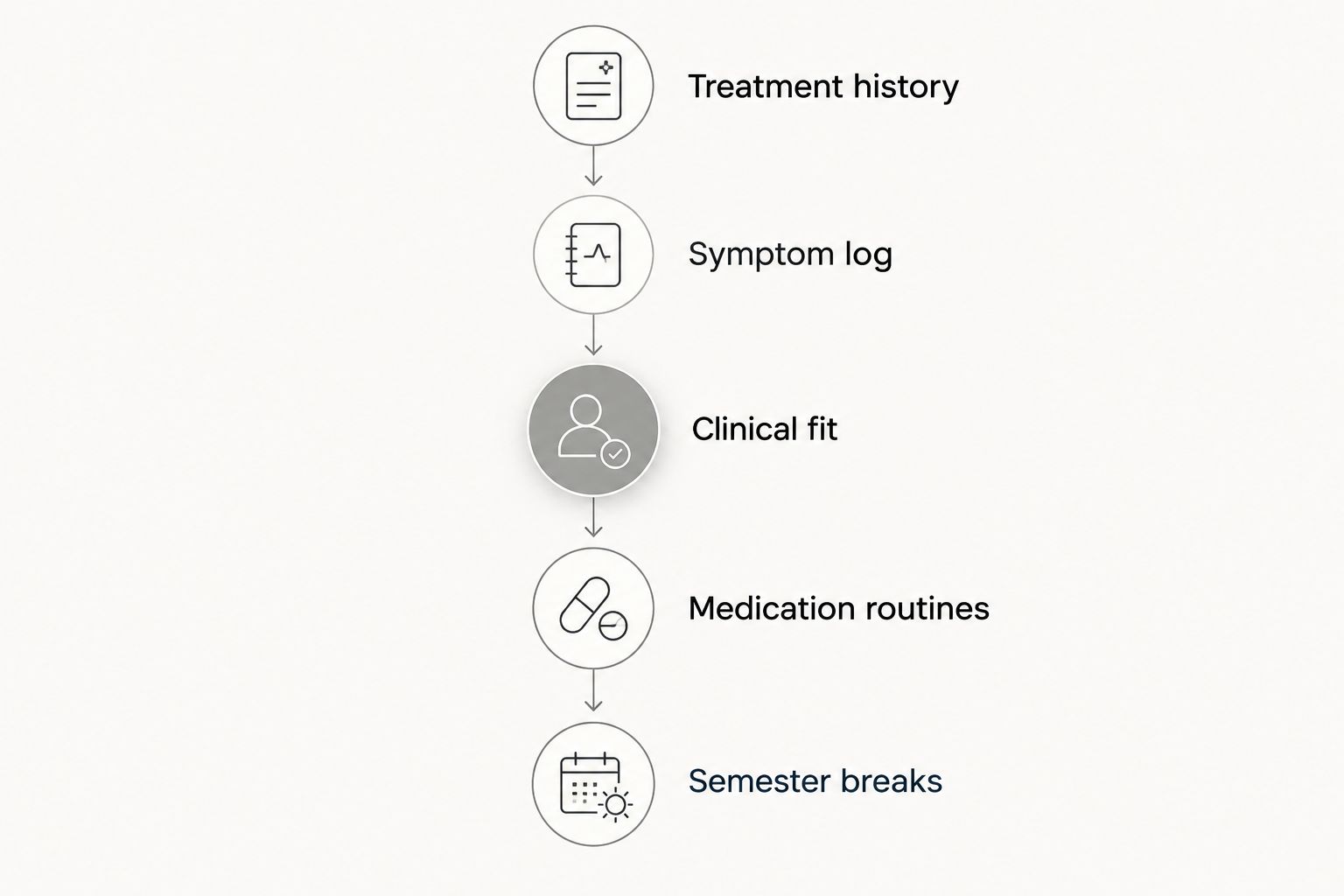
How to organize medication management around college
Gather your treatment history
Start with a 1-page medication list you can update yourself. Include prescription medicines, nonprescription products, supplements, allergies, and the pharmacy you use. Record what you actually take, not just what remains on an old patient portal list.
Previous treatment matters even when you no longer remember every detail. Bring available records and identify which information needs confirmation. A medication that did not help, caused side effects, or was stopped early gives your next clinician a different kind of information.
Keep the list accessible during appointments without leaving sensitive records on a shared computer. If several clinicians prescribe for you, make sure each receives the current version.
- List each medicine's name, prescribed dose, and instructions.
- Record benefits, side effects, and reasons for previous changes.
- Add your prescriber's and pharmacy's contact information.
- Request relevant records before a transfer appointment.
Track symptoms alongside daily functioning
Begin with a 7-day symptom log before a routine appointment, unless your clinician recommends a different approach. Keep entries short enough to maintain during a busy week. The purpose is to give your clinician useful observations, not to grade your performance.
Record sleep, mood, anxiety, concentration, and problems you think relate to medication. Add practical examples: missing morning lectures, avoiding meals, or struggling to start assignments. A symptom score alone does not explain how you are functioning.
For a 2026 semester review, bring dated observations rather than relying on how you feel on appointment day. Do not delay contacting your clinician about concerning changes just to finish the log.
- Note when you take medication and when symptoms occur.
- Describe effects on classes, relationships, and basic self-care.
- Record missed doses without changing the record to look better.
- Flag new symptoms or side effects for clinical review.
Choose a clinician who can coordinate your care
First, ask your current prescriber how care will continue while you attend college. Then check what your campus health service provides. Do not assume a campus clinic offers ongoing psychiatric prescribing, accepts outside treatment plans, or manages every medication.
If you need community care, review the practice's stated psychiatric services and confirm whether the clinician treats your condition. Attuned Psychiatry offers medication management, TMS, and SPRAVATO® treatment; those services are not interchangeable, and advanced treatments require an individual assessment.
Choose clinical fit and continuity before convenience alone. A community practice does not replace your college's process for academic accommodations, and campus counseling does not automatically include prescribing. Clarify who handles each part of care.
- Confirm which clinician will manage each prescription.
- Ask how records move between existing and new clinicians.
- Explain where you live during semesters and breaks.
- Ask how to report side effects between appointments.
Build medication routines around your actual schedule
Use tools you already have: a calendar, a private reminder, or a written checklist. Ask your pharmacist or prescriber how to fit the prescribed instructions around classes, meals, and sleep. Do not change medication timing simply because a different schedule looks easier.
Set 2 calendar reminders for care logistics: one to check your remaining medication and another for your next appointment. Ask your care team when those reminders should occur. Refill requirements differ, so a reminder is not a guarantee that a prescription can be renewed immediately.
Keep medication secure in shared housing. Avoid leaving it in communal bathrooms, unlocked common areas, or places where visitors can access it.
- Follow the prescribed timing and storage instructions.
- Use a private reminder rather than a public dorm-room note.
- Ask what to do after a missed dose; do not improvise.
- Never lend, borrow, sell, or share prescription medication.
Discuss side effects and substance use directly
Tell your prescriber what makes treatment difficult, including effects on sleep, appetite, energy, concentration, or sexual functioning. You do not need to decide whether a symptom is definitely medication-related before raising it. Your clinician can review timing, other explanations, and treatment options.
Be direct about alcohol, cannabis, nicotine, caffeine, supplements, and nonprescribed substances. These details affect safety and interpretation of symptoms. Giving an accurate account is more useful than describing the routine you think a clinician wants to hear.
Do not stop, double, or otherwise change a psychiatric medication without clinical instructions. If you develop a severe reaction or feel unsafe, seek urgent help rather than waiting for a routine visit.
- Describe when a side effect started and how it affects you.
- Bring supplement labels or a written ingredient list.
- Ask about interactions relevant to your actual habits.
- Request clear instructions for urgent and nonurgent concerns.
Plan semester breaks and travel before departure
Build your 2026 academic calendar into your care plan. Tell your clinician about moves, study abroad, internships, and trips before they happen. An appointment arrangement that works while you are on campus does not automatically work from another state or country.
For telehealth, your physical location matters because clinicians must follow applicable licensing and prescribing requirements. For international travel, medication rules differ by destination. Check official requirements rather than assuming a prescription allows unrestricted travel with a medicine.
A written transition plan helps you identify who is responsible for follow-up. Do not wait until medication runs out to discover that records, an appointment, or a new clinician are needed.
- Share your departure, return, and relocation dates.
- Confirm whether appointments can occur from your destination.
- Ask how refill requests work during academic breaks.
- Identify a local source of urgent care while away.
Review outcomes and agree on the next decision
Use follow-up appointments to compare symptoms and functioning with your treatment goals. Explain what has improved, what remains difficult, and what you cannot tolerate. Better concentration does not tell the whole story if sleep or appetite has become difficult to manage.
A useful 2026 medication review ends with a clear next step: continue the plan, make a clinician-directed adjustment, investigate another concern, or consider a different treatment approach. Do not interpret persistent symptoms as proof that you need a particular procedure or medicine.
For depression that has not responded to treatment, ask for a structured review of prior care. Treatment history, diagnosis, tolerability, and clinical eligibility guide the discussion of further options.
- Bring your medication list and recent symptom notes.
- Identify the daily activities you want treatment to improve.
- Ask what benefits and side effects to watch for next.
- Leave knowing when and how follow-up will happen.
Compare care options for college students
These options describe roles, not a ranking of treatment quality. Confirm the scope of each service before relying on it. The best arrangement gives you a named prescriber, a follow-up plan, and clear instructions for problems between visits.
| Option | Best for | Main advantage | Key limitation |
|---|---|---|---|
| Existing prescriber | Students whose current care can continue across college transitions | Preserves an established treatment relationship | Location and prescribing requirements can interrupt continuity |
| Campus health service | Students seeking care connected to campus resources | Provides a starting point for understanding campus support | Psychiatric prescribing and treatment scope vary by institution |
| Community psychiatric practice | Students needing psychiatric assessment and ongoing medication review | Focuses care on psychiatric symptoms and treatment response | Requires coordination with campus services and other clinicians |
| Primary care clinician | Students whose clinician confirms the condition fits their scope | Can connect mental health concerns with general medical care | Complex or persistent symptoms can require psychiatric referral |
| Emergency care | Students facing immediate danger or a severe acute reaction | Addresses urgent safety and medical needs | Does not replace ongoing outpatient medication management |
Before choosing, ask who answers medication questions, how follow-up works during breaks, and what happens if symptoms worsen. A convenient location is useful; an unclear prescribing relationship is not.
Common mistakes college students make
Waiting until medication runs out
A refill request can require clinical review or an appointment. Ask about the process while you still have medication, particularly before leaving campus. Do not assume an old prescription or a previous pharmacy arrangement remains usable after a move.
Treating an exam week as a reason to change doses
Academic pressure does not make self-directed dose changes safe. Taking extra medication, skipping doses to stay awake, or borrowing a roommate's prescription creates risks outside your treatment plan. Tell your clinician when your current plan does not support everyday functioning.
Assuming all campus support includes prescribing
Counseling, disability services, student health, and psychiatric care serve different roles. Ask each office what it provides and what documentation it needs. A counseling appointment does not necessarily establish responsibility for your medication.
Leaving privacy arrangements unspoken
Explain whom you want involved in care and ask how consent, records access, and communication work. Insurance paperwork can also affect privacy. If a parent helps arrange appointments, clarify whether that person is also authorized to discuss clinical information.
Measuring success only by grades
Grades reflect more than mental health, and a strong transcript does not prove that treatment is working well. Report changes in sleep, relationships, appetite, distress, and self-care. Your clinician needs the parts of college life that never appear on a transcript.
FAQ
What does medication management for college students include?
Medication management for college students includes reviewing symptoms, prescriptions, treatment benefits, side effects, and follow-up needs. It should also address semester transitions, missed-dose instructions, and coordination between clinicians.
Can I keep my psychiatrist when I move to college?
Keeping your psychiatrist depends on your clinician's arrangements and the requirements where you are physically located. Confirm this before moving, especially if you expect to use telehealth across state lines.
Is campus counseling the same as medication management?
Campus counseling is not the same as medication management. Ask whether your college provides psychiatric prescribing, refers students elsewhere, or coordinates with outside clinicians.
What should I do if I miss a dose before class?
Follow the medication-specific missed-dose instructions from your prescriber or pharmacist. Do not double a dose or improvise a replacement schedule without instructions.
Can I stop taking medication when the semester ends?
Do not stop psychiatric medication because the semester ends without discussing it with your prescriber. A break from classes is a reason to review your plan, not an automatic reason to stop treatment.
What should I bring to my first medication appointment?
Bring your current medication list, relevant treatment records, allergies, and notes about symptoms and side effects. Include nonprescription medicines, supplements, and the practical problems you want treatment to address.
When should a college student seek urgent mental health help?
Seek urgent help for immediate danger, suicidal intent, or a severe medication reaction. In the United States, call 911 for an immediate emergency or call or text 988 for suicide and crisis support; do not wait for a routine appointment.
One last thing
Put your next location on your treatment checklist, not just your next appointment. For your next 2026 semester transition, ask whether your clinician can continue care where you will actually be. That question can expose a gap before it interrupts treatment.
To discuss psychiatric care in Decatur/Metro Atlanta, find the right starting point for care. Bring your treatment history and ask whether the practice fits your clinical needs and college schedule.
Related guides
Plan medication care across semesters
Request an evaluation and ask how psychiatric care continues through campus moves and breaks.


