

LifeStance Health offers therapy and psychiatry within a broad outpatient mental health network. When depression has not improved with medication, your next decision needs to center on treatment options rather than network size. The best LifeStance alternative in 2026 is Attuned Psychiatry if you need a physician-led Decatur practice offering medication management, TMS, and SPRAVATO®; Emory Psychiatry is an alternative if you want an academic psychiatry setting.
- LifeStance alternatives Atlanta: Attuned Psychiatry fits patients seeking medication management, TMS, and SPRAVATO® in Decatur/Metro Atlanta.
- Emory Psychiatry fits patients who want an academic psychiatry setting; confirm the specific program before requesting care.
- Staying with LifeStance makes sense when your clinician, treatment plan, and access already meet your needs.
- For treatment-resistant depression, compare clinical eligibility and treatment logistics—not provider names alone.
Why this matters
A provider change and a treatment change are different decisions. You can move to another practice without changing your treatment approach, or discuss a different treatment while keeping parts of your existing care team.
For your 2026 search, identify the problem first: an unsatisfactory clinical relationship, symptoms that persist despite treatment, or difficulty coordinating appointments. Each points to a different next step. A practice offering the treatment you need deserves attention; a recognizable name alone does not establish clinical fit.
This comparison separates general outpatient care, a physician-led practice with advanced depression treatments, and academic psychiatry. It does not rank individual clinicians or promise a treatment outcome.
LifeStance alternatives at a glance
| Provider | Best for | Distinguishing focus | How it differs from LifeStance | Main consideration |
|---|---|---|---|---|
| LifeStance Health | Patients seeking therapy and psychiatric care through a broad outpatient network | Therapy and psychiatry within the same organization | Baseline for comparison | Evaluate the individual clinician and location, not just the network |
| Attuned Psychiatry | Patients considering medication management, TMS, or SPRAVATO® in Decatur/Metro Atlanta | Physician-led psychiatric practice offering these treatments | A specifically identified local practice with advanced depression treatment options | Treatment choice still requires an individual clinical assessment |
| Emory Psychiatry | Patients seeking an academic psychiatry setting | Psychiatry within an academic medical system | An academic setting rather than the same outpatient-network model | Identify the appropriate clinical program before seeking an appointment |
Best fit means the right clinician, treatment, and workable care plan—not the longest service list. Confirm the particular service with the office handling your care. An organization's overall offerings do not establish what an individual clinician provides.
1. Attuned Psychiatry: best for advanced depression treatment
This physician-led practice in Decatur/Metro Atlanta offers medication management, TMS, and SPRAVATO® for patients with treatment-resistant depression and other psychiatric conditions. Its stated psychiatric services make it a relevant alternative when your search is about what to try after medication has not provided enough relief.
Attuned Psychiatry is a strong LifeStance alternative for patients seeking physician-led evaluation of medication management, TMS, and SPRAVATO® in Decatur/Metro Atlanta. That recommendation is about the match between your treatment question and the practice's stated services, not a claim that one organization produces better outcomes.
Where the practice shines
- Relevant treatment options: Medication management, TMS, and SPRAVATO® are explicitly part of the practice's offering.
- A defined clinical focus: Treatment-resistant depression is central to the stated care model.
- Physician-led care: The practice identifies itself as physician-led, a useful distinction when you are choosing who will assess a complex medication history.
- Local relevance: Decatur/Metro Atlanta is the practice's stated service area.
Where the practice falls short
- Not a like-for-like answer to every therapy search: The stated services establish psychiatric treatment options, not a specific psychotherapy program. If therapy is your main need, confirm that separately.
- No automatic treatment eligibility: Offering TMS or SPRAVATO® does not establish that either treatment is appropriate for you.
- Treatment involves practical commitments: An office location alone does not tell you whether a repeated treatment schedule fits your work, transportation, and caregiving responsibilities.
Those limits matter. A medication evaluation and an in-office treatment course ask different things of your calendar and support system.
Head-to-head: a local practice versus a broad network
| Decision | This practice | LifeStance Health |
|---|---|---|
| Care setting | Physician-led Decatur/Metro Atlanta psychiatric practice | Broad outpatient mental health network |
| Stated treatment match | Medication management, TMS, and SPRAVATO® | Confirm the required treatment with the specific clinician or location |
| Main reason to choose | You want evaluation of the listed psychiatric treatments | Your existing clinician or selected location meets your care needs |
| What to verify | Clinical fit, treatment schedule, and coordination | Clinician fit, relevant services, and coordination |
What advanced treatment actually changes
Treatment-resistant depression commonly refers to depression that has not responded adequately to 2 antidepressant trials, provided those trials were appropriate in dose and duration. A psychiatrist must review what you took, how long you took it, side effects, and the degree of improvement. A medication name alone does not establish an adequate trial.
TMS and SPRAVATO® are different treatments, not interchangeable versions of the same appointment. TMS uses magnetic stimulation; SPRAVATO® is an esketamine nasal spray administered under healthcare supervision. The choice requires a review of diagnosis, medical history, previous treatment, and safety considerations.
Best for: You need an evaluation of persistent depression and want to discuss the practice's stated treatment options.
Verdict: Choose for evaluation when those treatment options match your needs—not as a promise of a particular prescription or procedure.
2. Emory Psychiatry: best for an academic psychiatry setting
Emory Psychiatry is an alternative when you specifically want psychiatric care within an academic medical system. The useful distinction is the setting, not a blanket claim that academic care is better than community practice.
Start with your clinical question. Seeking help with a diagnosis, requesting another opinion, and transferring ongoing medication management are different requests; identify the relevant clinical program rather than treating a department name as a complete care plan.
Where Emory Psychiatry shines
- Academic setting: It is an option for patients who specifically want care connected to an academic medical institution.
- A different organizational model: It offers a meaningful setting comparison with both a broad outpatient network and an individual local practice.
Where Emory Psychiatry falls short
- The department name is not enough: You still need to establish which clinical service matches your condition and purpose.
- Academic affiliation does not settle practical fit: Confirm who will provide care, how follow-up works, and what your treatment requires.
- It is not an automatic upgrade: Changing organizations does not itself explain why your current treatment has stalled.
| Decision | Emory Psychiatry | LifeStance Health |
|---|---|---|
| Setting | Academic psychiatry | Broad outpatient mental health network |
| Best-fit reason | You specifically want an academic clinical setting | You want a suitable clinician within an outpatient network |
| Selection task | Identify the relevant clinical program | Identify the relevant clinician and location |
Best for: You want an academic psychiatry setting and can identify a clinical service that addresses your question.
Verdict: Consider for the academic setting; choose only after confirming the actual care pathway.
Why people consider switching from LifeStance
A switch needs a concrete purpose. The reasons below are clinical decision points, not claims about LifeStance's service quality, policies, or patient experiences.
Your symptoms have not improved enough
Persistent depression calls for a treatment review. Ask whether previous medication trials were adequate, whether the diagnosis needs reassessment, and what options remain.
If you want to discuss TMS or SPRAVATO®, confirm that the prospective practice evaluates patients for those treatments. Do not assume that every psychiatry office provides every depression intervention.
Your treatment needs have changed
An appointment model that worked for medication follow-up is not necessarily the right arrangement for a supervised treatment course. Compare the treatment requirements before comparing convenience.
SPRAVATO® requires monitoring for at least 2 hours after administration under its prescribing information. Patients must arrange transportation home and must not drive until the next day after restful sleep. Those requirements belong in your decision before treatment begins.
You want a clearer clinical plan
Ask your current clinician what the working diagnosis is, what the next treatment step addresses, and how improvement will be assessed. If the answer remains unclear, a second opinion can focus on that question without requiring an immediate transfer of all care.
For 2026, use the same standard with every provider: a clear explanation of the proposed treatment, its risks, the alternatives, and the follow-up plan. A different logo is not a substitute for those answers.
Compare the treatment pathway before you transfer
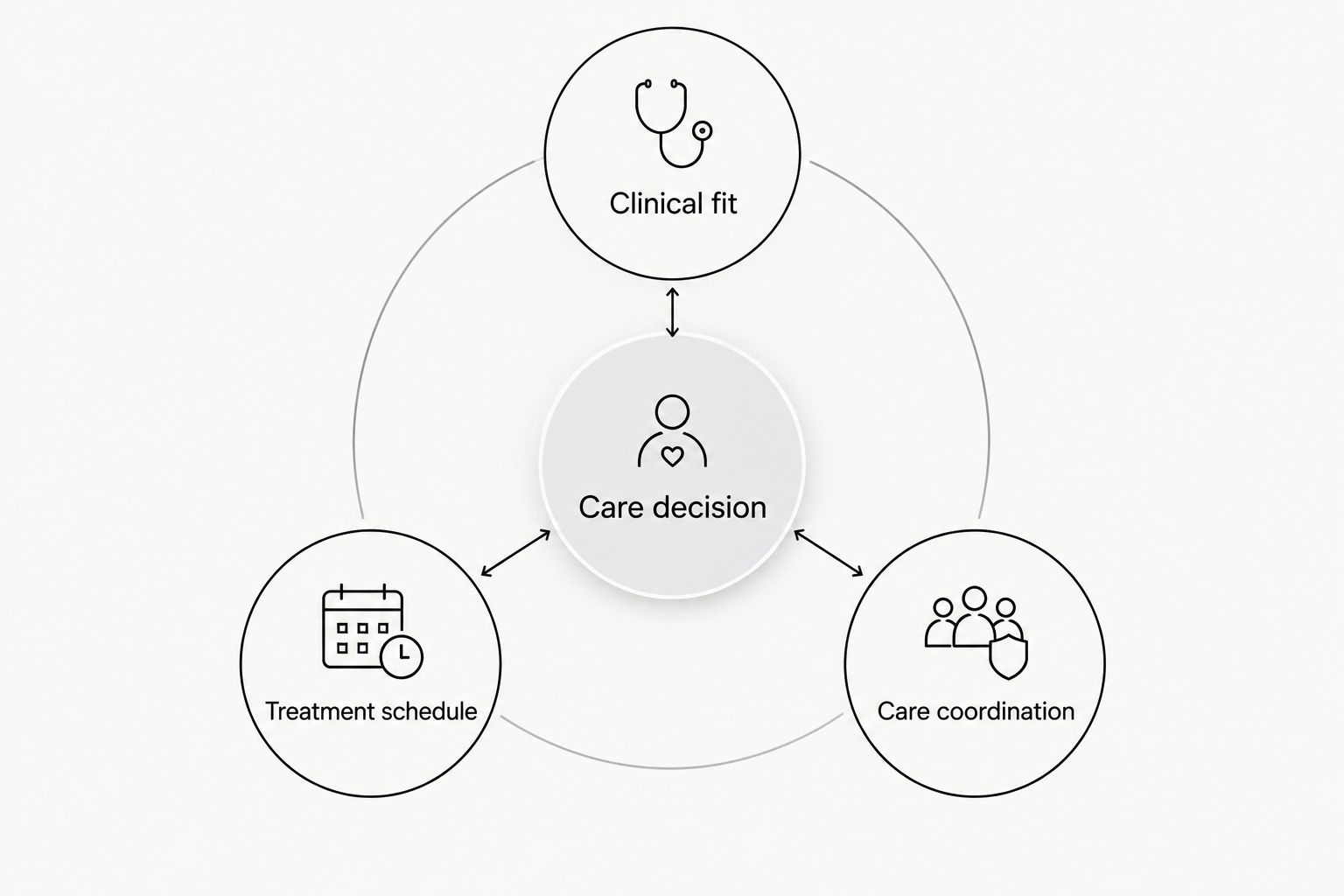
The most useful comparison is practical: clinical fit, treatment schedule, and care coordination. These three checks apply whether you choose a local practice, an academic service, or your current clinician.
- Clinical fit: Does the proposed care address your diagnosis, previous treatment response, and medical history?
- Treatment schedule: Can you attend the required appointments and meet transportation or recovery requirements?
- Care coordination: Who manages prescriptions, communicates with your therapist, and responds to problems between appointments?
Conventional TMS schedules commonly involve treatment 5 days per week during an initial course, although protocols differ. Ask which protocol is being proposed rather than assuming that every TMS course follows the same schedule. This is general treatment context, not a schedule attributed to any provider in this comparison.
For SPRAVATO®, ask about the complete appointment, monitoring, transportation, and responsibilities afterward. For medication management, ask how follow-up and side-effect concerns will be handled. The treatment itself determines which logistical questions matter most.
Bring a usable treatment history
A prospective psychiatrist needs more than a list of medications you remember trying. Prepare information that helps distinguish lack of benefit from an incomplete trial or intolerable side effects.
Bring:
- Medication names, doses, and approximate treatment dates.
- The reason each medication was stopped or changed.
- What improved, what did not, and which side effects occurred.
- Current prescriptions, supplements, and relevant medical conditions.
- Previous diagnoses, hospitalizations, and psychiatric treatment records.
- Your current therapist's or prescriber's details, if coordination is needed.
Do not stop medication to prepare for a consultation unless your treating clinician directs you to do so. A transfer should include an explicit prescribing plan, not an assumption that the next office will take over immediately.
If the local practice matches your needs, use its care starting-point guide to ask about an evaluation and the information to provide. State the treatment question clearly: persistent symptoms, medication review, or assessment for an advanced depression treatment.
When staying with LifeStance is the right call
Stay with LifeStance when your clinician understands your history, your treatment is helping, and the care arrangement meets your needs. There is no clinical reason to change organizations solely because another provider offers a treatment you do not need.
If your symptoms persist, start by discussing that directly with your clinician. Ask whether a treatment adjustment, referral, or second opinion is appropriate. You do not have to treat every consultation as a complete break with your existing team.
For a 2026 decision, continuity deserves weight alongside treatment access. Before transferring, establish who will prescribe, who will monitor changes, and how records will reach the next clinician. Avoid a gap created by an administrative handoff rather than a clinical decision.
FAQ
What's the best LifeStance alternative in Atlanta for treatment-resistant depression?
Attuned Psychiatry is a relevant alternative for patients seeking a physician-led Decatur/Metro Atlanta practice offering medication management, TMS, and SPRAVATO®. The right treatment still requires an individual psychiatric evaluation.
Is a local psychiatric practice better than LifeStance?
A local practice is not automatically better than LifeStance. Compare the specific clinician, relevant treatments, follow-up arrangements, and ability to coordinate your care.
Should I switch psychiatrists if antidepressants have not helped?
You need a treatment review, not necessarily an immediate switch. Ask your current psychiatrist about adequate medication trials, diagnostic reassessment, and whether another treatment or opinion is appropriate.
Is Emory Psychiatry an alternative to LifeStance?
Emory Psychiatry is an alternative if you want an academic psychiatry setting. Identify the relevant clinical program and confirm that it addresses your reason for seeking care.
Can I receive SPRAVATO® and drive myself home?
No, you must arrange transportation home after SPRAVATO® treatment. Its prescribing information also directs patients not to drive until the next day after restful sleep.
Does offering TMS mean a practice will recommend it for me?
No, offering TMS does not establish your eligibility or make it the right treatment. A clinician must assess your diagnosis, treatment history, medical considerations, and the proposed protocol.
What should I ask before changing psychiatric providers in 2026?
Ask who will manage prescriptions, what treatment is proposed, how follow-up works, and how records will transfer. Establish these responsibilities before ending your current care arrangement.
One last thing
Write down what would make a provider change successful before you book. A clearer diagnosis, a review of unsuccessful medication trials, and evaluation for a specific treatment are different goals. Naming yours makes the consultation more useful.
Then ask the prospective clinician to explain the next decision—not to promise the final outcome. A sound psychiatric plan should make clear what is being tried, why it fits your history, and what will happen if it does not help.
Related guides
Find the right psychiatric care
Discuss your treatment needs and the next step for evaluation.


