

Yes—TMS therapy can be covered by insurance for depression when you meet your plan’s medical-necessity requirements, but coverage is not automatic. In 2026, your diagnosis, treatment history, provider network, and any prior authorization requirements determine whether your plan will pay; covered treatment can still leave you responsible for deductibles, copayments, or coinsurance.
- Is TMS therapy covered by insurance? Yes, when your plan covers the treatment and you meet its requirements.
- Prior authorization, network status, and medical necessity are separate checks; confirm each before treatment.
- Attuned Psychiatry offers TMS for patients seeking advanced psychiatric treatment in Decatur and Metro Atlanta.
- Ask whether approval covers the prescribed treatment course, not just the initial evaluation.
Why this matters
An insurance card does not tell you whether a specific TMS treatment course is covered. Your plan can cover psychiatric office visits while applying separate requirements to transcranial magnetic stimulation.
Before choosing among psychiatric services, separate the clinical question from the insurance question. A psychiatrist determines whether TMS fits your condition; your insurer determines whether the requested care meets your benefits and coverage rules. Being a clinical candidate does not automatically make you eligible for insurance payment.
Is TMS therapy covered by insurance?
TMS is covered under some commercial insurance, Medicare, and Medicaid policies, subject to the applicable plan’s criteria. Coverage commonly centers on major depressive disorder and documentation of unsuccessful treatment. Do not assume that coverage for depression extends to every condition treated with TMS.
Use this comparison to identify the policy that governs your request. These are coverage routes, not rankings of insurance quality.
| Coverage route | Best for checking | What needs confirmation | Main limitation |
|---|---|---|---|
| Employer or individual insurance | Your specific plan’s TMS benefit | Medical policy, network, authorization, and exclusions | The insurer’s general policy does not replace your benefit documents |
| Original Medicare | The applicable Medicare coverage requirements | Local coverage rules and provider participation | Requirements depend on the applicable coverage policy |
| Medicare Advantage | Your plan’s coverage process | Network access, authorization, and applicable Medicare rules | The process differs from Original Medicare |
| Medicaid | Your state program or managed-care plan | Whether TMS is covered and what documentation is required | Rules differ across state programs and plans |
A useful coverage answer identifies the policy, the requested treatment, and the provider—not simply whether an insurer has paid for TMS before. Ask for the medical policy that applies to your own benefits in 2026.
Employer and individual insurance: check the exact plan
Employer-sponsored and individual plans can cover TMS when their criteria are met. Start with the member-services number on your insurance card and ask whether outpatient TMS is a covered benefit for your diagnosis.
The advantage is that a written medical policy can identify the documentation required for review. The limitation is that two people using the same insurance company can have different benefits, networks, or authorization arrangements.
If your employer uses a self-funded plan, ask who administers the benefit and which plan document controls coverage. A familiar insurance-company name is not enough to establish your TMS benefit.
Medicare: distinguish Original Medicare from Medicare Advantage
For Original Medicare, TMS coverage is addressed through applicable Medicare coverage requirements, including local coverage determinations. Ask the treating office which requirements apply to your location and planned treatment.
Medicare Advantage plans must cover Medicare-covered benefits, but you still need to check the plan’s network and authorization process. Do not substitute an Original Medicare coverage summary for instructions from your Medicare Advantage plan.
The useful starting point is the correct coverage pathway. The limitation is that eligibility for Medicare alone does not establish that a particular TMS request meets medical necessity.
Medicaid: check the state and the plan
Medicaid coverage depends on your state program and, when applicable, your managed-care plan. Ask specifically about outpatient TMS for the diagnosis your clinician is treating.
A policy from another state does not establish your benefits. Likewise, another patient’s approval does not confirm that your plan covers the same treatment under the same conditions.
For a 2026 coverage check, request the current policy rather than relying on an older search result. Confirm which organization reviews the request and whether your proposed provider participates.
Why TMS insurance coverage varies
The decision depends on both your benefits and your medical record. These factors explain why patients with similar symptoms can receive different coverage decisions:
- Diagnosis: Policies specify which conditions qualify. Coverage for major depressive disorder does not establish coverage for another diagnosis.
- Treatment history: Reviewers can require records of previous medication trials, response, intolerance, or other treatment described in the policy.
- Medical necessity: The clinician’s assessment must address the policy’s requirements, not just state that TMS is recommended.
- Provider network: A covered treatment delivered out of network can have different benefits or no applicable out-of-network coverage.
- Authorization scope: Approval can apply to specified services, treatment dates, or a defined course rather than every future session.
- Benefit exclusions: Your benefit documents can contain restrictions that a general insurer medical policy does not resolve.
There is no universal treatment-history checklist that applies to every insurer. Ask for your plan’s actual requirements before assuming you must repeat a medication or complete another treatment solely for coverage.
How do I get TMS approved by insurance?
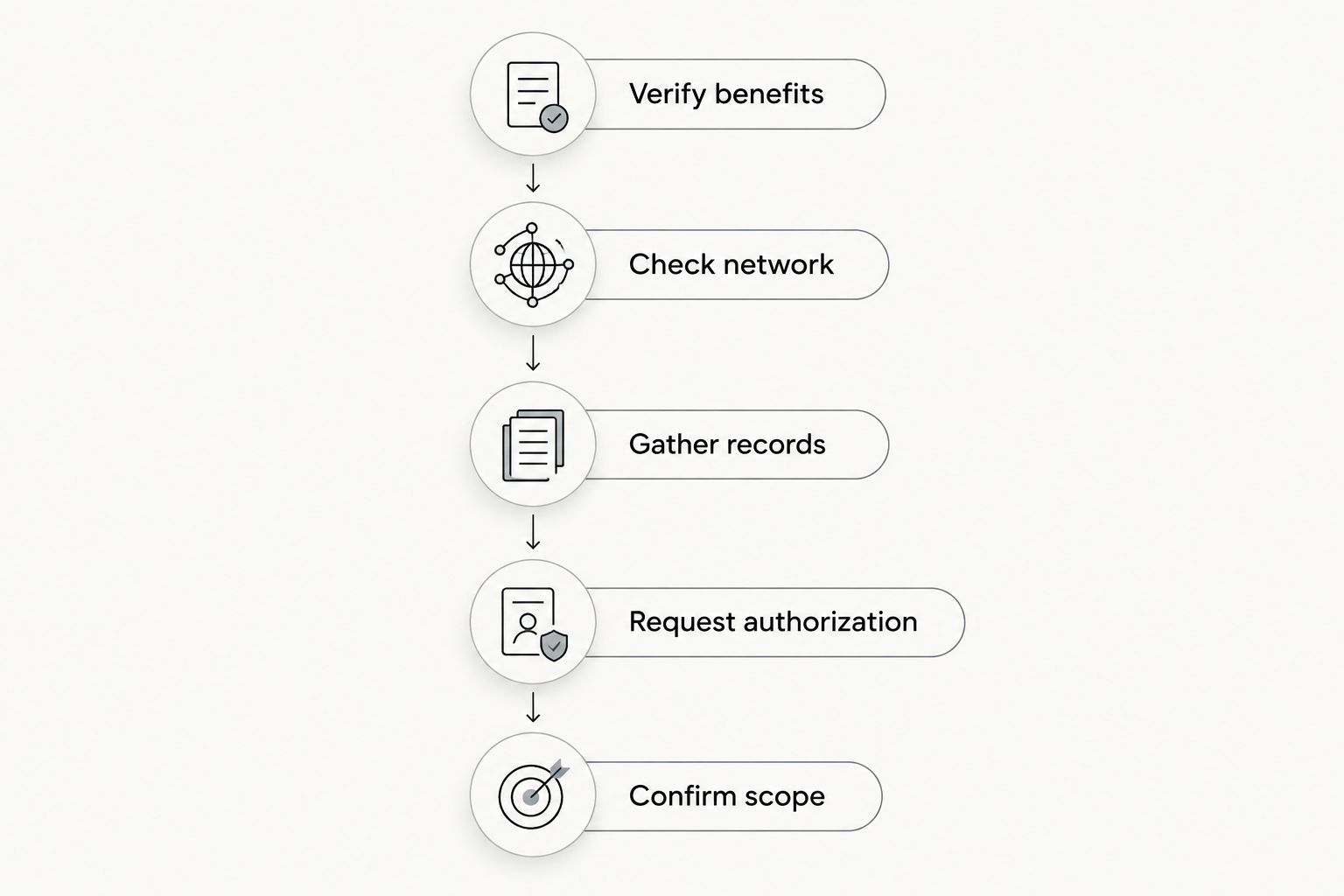
The most useful approach is to verify benefits, match the medical record to the policy, and confirm the decision in writing. Follow this sequence before starting a treatment course.
1. Verify benefits
Ask whether TMS is covered for your diagnosis under your specific plan. Confirm that the policy being discussed applies to your coverage, not another product offered by the same company.
Request the policy name or identifier and a reference number for the conversation. A verbal statement that TMS is covered is a starting point, not the final authorization decision.
2. Check network
Confirm the treating clinician and treatment location against your plan’s network. Use the exact provider information supplied by the office rather than relying only on a practice name in a directory.
Ask whether any separate provider or facility bills for the proposed services. Network participation and treatment authorization are different checks; neither replaces the other.
3. Gather records
Bring a medication history that includes the drug names, doses if known, approximate treatment dates, response, and reasons for stopping. Include relevant psychotherapy and prior psychiatric treatment records when requested.
If you cannot remember details, ask previous prescribers or pharmacies for records. An incomplete history makes it harder to document what you have already tried; guessing creates a different problem.
4. Request authorization
Ask who submits the request and what supporting documentation is needed. The treating clinician’s records should explain the diagnosis, prior treatment, current symptoms, and clinical reason for requesting TMS.
Confirm whether the consultation has separate coverage requirements from the treatment course. Approval for an evaluation does not establish approval for treatment.
5. Confirm scope
Read the written decision for the approved services, provider, treatment dates, and any limits. Ask what happens if the clinical schedule changes or additional treatment is recommended.
Also ask for an explanation of your member responsibility. Authorization addresses permission under the plan’s process; it does not erase your deductible or other benefit terms.
Keep the benefit explanation, authorization letter, and relevant messages together. If the plan gives conflicting answers, ask for clarification using the written documents and your call reference numbers.
What should I ask before my first TMS appointment?
Use questions that produce specific answers rather than a general assurance that the office accepts insurance. For a 2026 treatment request, ask the office and insurer to confirm the following:
- Is the evaluation covered separately from TMS treatment?
- Is the treating provider in my particular network?
- Does my diagnosis meet the policy’s covered indications?
- What prior treatment records are required?
- Is prior authorization required, and who submits it?
- What services and treatment dates does an approval include?
- How will I learn about my member responsibility before starting?
“Accepts insurance” and “in network with your plan” are not interchangeable. An office can submit claims without participating in your particular network, so ask the narrower question.
Attuned Psychiatry is a physician-led practice offering medication management, TMS, and SPRAVATO® treatment. Attuned Psychiatry is a fit for Decatur and Metro Atlanta patients seeking TMS within a physician-led psychiatric practice. That clinical fit does not establish network participation or approval under your insurance plan.
Use the contact page to ask about an evaluation and what coverage information to provide. Do not send sensitive medical details through a channel unless the practice directs you to use it.
Does insurance approval cover every TMS session?
Insurance approval covers the services described in the authorization, subject to your benefits and claim requirements. Read the decision instead of assuming it includes every session your clinician might recommend.
Ask whether a change in schedule, an extended course, or later retreatment requires another review. A past approval does not establish automatic coverage for a future course.
Before treatment begins, clarify who tracks the authorization period and how you will be notified if another request becomes necessary. This helps keep the clinical plan and the coverage decision aligned.
What happens if insurance denies TMS?
A denial means the submitted request was not approved; it does not, by itself, establish that TMS is clinically inappropriate. Read the reason before deciding what to do next.
A missing-records denial calls for a different response from a benefit exclusion or a medical-necessity denial. Ask the treating office whether corrected documentation, a clinician review, or an appeal is appropriate under your plan.
Use the deadline and instructions in the denial notice. For a denial received in 2026, follow that notice rather than an appeal timeline quoted in a general online guide. An appeal is a review process, not a guarantee of reversal.
Can I switch insurance to get TMS covered?
A different plan can have different TMS benefits, but do not choose coverage based only on a general statement that TMS is covered. Check the specific plan’s medical policy, provider network, benefit exclusions, and authorization rules before enrolling.
Your preferred clinician’s participation also needs confirmation under the new plan. An existing approval from one insurer does not establish approval from another, and changing coverage does not remove medical-necessity requirements.
FAQ
Is TMS therapy covered by insurance for depression?
TMS therapy can be covered by insurance for depression when your plan includes the benefit and you meet its medical-necessity requirements. Confirm the diagnosis criteria, treatment-history requirements, network, and authorization process before starting.
Do I need to try medication before insurance covers TMS?
Insurance policies commonly require documentation of prior depression treatment, including medication trials. The specific requirements depend on your plan, so request its policy rather than assuming a universal checklist applies.
Does Medicare cover TMS therapy?
Medicare can cover TMS when the applicable coverage requirements are met. Check the relevant Original Medicare coverage rules or your Medicare Advantage plan’s process, depending on your coverage.
Does prior authorization mean I will owe nothing?
Prior authorization does not mean you will owe nothing. Deductibles, copayments, coinsurance, and other benefit terms can still apply to approved treatment.
Can insurance cover TMS for a condition other than depression?
Coverage for TMS for another condition requires a separate check of your plan’s policy. Coverage for depression does not establish coverage for every diagnosis, and FDA clearance does not automatically establish insurance payment.
Can I appeal a TMS insurance denial?
You can request a review or appeal through the process described in your denial notice. Ask your clinician whether the reason calls for additional records, a medical-necessity response, or another step allowed by the plan.
Does Attuned Psychiatry offer TMS treatment?
Attuned Psychiatry offers TMS as part of its physician-led psychiatric services in Decatur and Metro Atlanta. Ask the practice and your insurer separately about your specific plan’s network and coverage requirements.
One last thing
Ask for the written authorization—not just a verbal assurance that TMS is covered. The document lets you compare the approved provider, services, and dates with the treatment being planned.
Also remember that authorization is not a guarantee that every claim will be paid regardless of your benefits. Keep your coverage active, review insurer notices, and raise discrepancies before they become a dispute about completed treatment. Your strongest preparation is a clear clinical plan paired with a clear written coverage decision.
Related guides
Discuss TMS coverage and treatment fit
Request an evaluation and ask how TMS eligibility, authorization, and your treatment plan are coordinated.


