

Yes, SPRAVATO is covered by many insurance plans, but coverage depends on your diagnosis, plan rules, treatment setting, and authorization requirements. In 2026, approval for the medication does not automatically confirm coverage for every part of the treatment visit, so verify both the drug benefit and the supervised care before starting.
- Is SPRAVATO covered by insurance? Often, but your plan must confirm eligibility, prior authorization, and treatment-site requirements.
- SPRAVATO coverage and out-of-pocket responsibility are separate questions; approval does not mean every service is paid in full.
- Attuned Psychiatry offers SPRAVATO treatment for patients with treatment-resistant depression in Decatur/Metro Atlanta.
- Confirm medication coverage, supervised-visit coverage, network status, and authorization dates before scheduling treatment.
Why this matters
SPRAVATO treatment involves more than a prescription. You receive esketamine nasal spray under direct supervision in a certified healthcare setting, followed by monitoring. That creates separate questions about medication benefits, professional services, and where your insurer permits treatment.
For patients exploring psychiatric services, the practical goal is a written explanation of what the plan covers—not simply a verbal statement that SPRAVATO is a covered drug. Check the medication, the visit, and the treatment location together.
Is SPRAVATO covered by insurance?
Many commercial insurance plans cover SPRAVATO when their medical-necessity requirements are met. Medicare and Medicaid coverage also depends on the applicable benefit, plan, state rules, and treatment setting. Your insurer’s current policy determines the requirements for your specific enrollment.
The table below identifies what to verify. It does not establish that any particular insurer or practice participates in your plan.
| Coverage type | Best starting point | What to verify | Main limitation |
|---|---|---|---|
| Commercial insurance | Your insurer’s member services and clinical coverage policy | Prior authorization, network participation, medication benefit, and visit coverage | A listed medication can still require clinical approval |
| Original Medicare | Medicare coverage information and the treating practice’s billing team | How the drug and supervised services are billed in that setting | Coverage and patient responsibility depend on the applicable services and benefits |
| Medicare Advantage | Your specific plan’s member services | Authorization, network rules, referrals, and billing requirements | Original Medicare information alone does not confirm the plan’s administrative requirements |
| Medicaid | Your state program or Medicaid managed-care plan | State-specific criteria, participating providers, and authorization | Rules are not interchangeable across states or plans |
A covered benefit is not the same as an approved course of treatment. Ask whether the insurer has approved your clinical request, your treating location, and the services associated with each visit.
For a 2026 benefits check, use the coverage policy that applies to your current plan year. A previous employer’s approval or another patient’s experience does not establish your benefits.
What has to happen before insurance approves SPRAVATO?
Prior authorization is the insurer’s review of whether the requested treatment meets its requirements. The treating clinician supplies clinical information; the insurer makes the coverage decision. An appointment confirmation is not evidence that this review is complete.
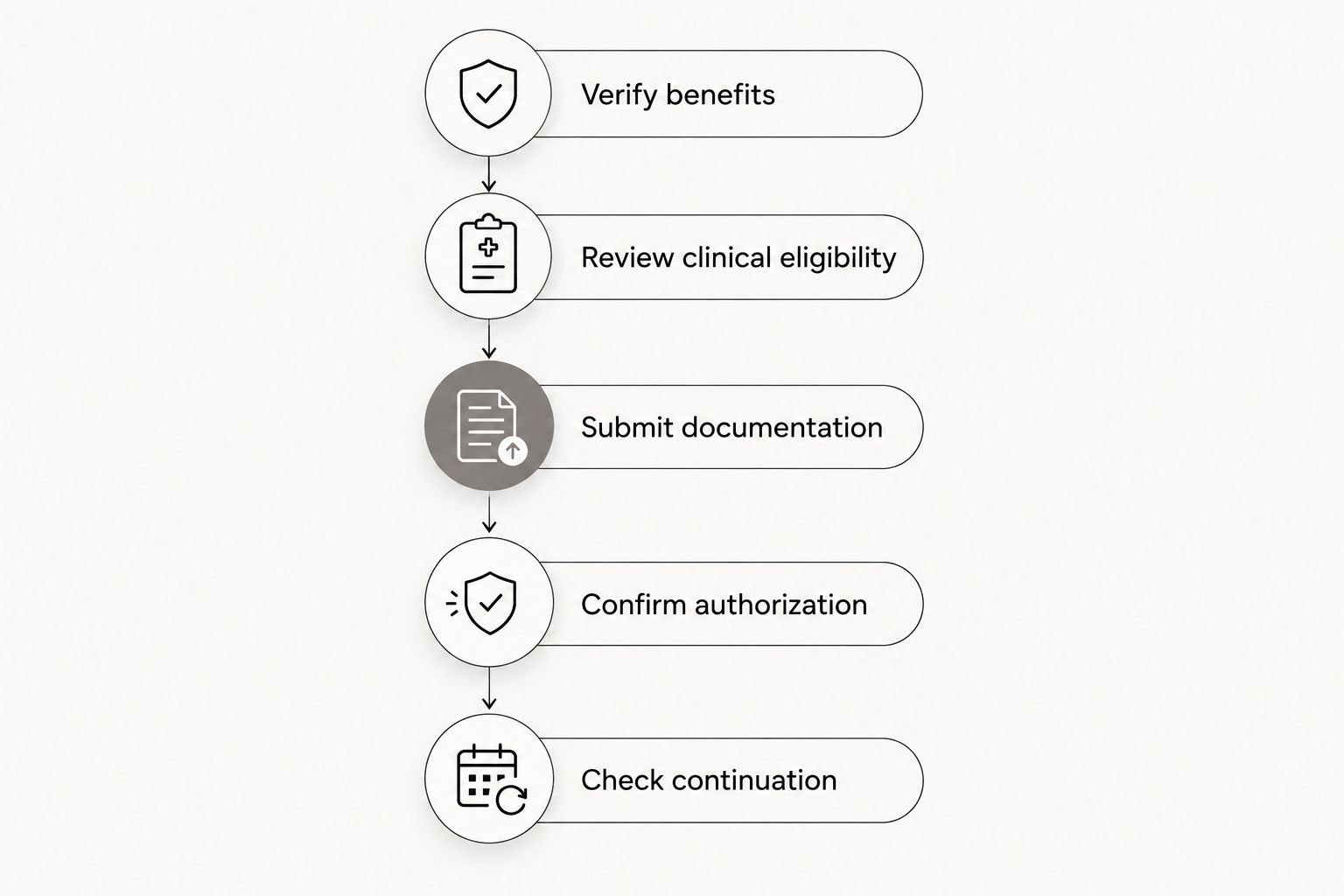
- Verify benefits. Confirm that your enrollment is active and ask which benefit handles the medication and associated services.
- Review clinical eligibility. Your clinician evaluates the diagnosis, treatment history, safety considerations, and whether SPRAVATO is appropriate.
- Submit documentation. The practice sends the information required by your plan, which can include prior medication trials and current symptoms.
- Confirm authorization. Check the approved location, services, visit limits, and effective dates before treatment starts.
- Check continuation. Ask what documentation and additional approval will be needed if treatment continues.
Keep a copy of the approval notice and the insurer’s reference number. If the authorization describes a different location or service than the planned treatment, ask for clarification before the visit rather than assuming the difference is harmless.
Does treatment-resistant depression qualify for coverage?
Treatment-resistant depression is a common reason insurers evaluate SPRAVATO requests. Clinicians commonly use the term when depression has not responded adequately to at least two antidepressant trials, but an insurer can define the required treatment history more specifically.
Do not assume that taking two medications at any point automatically satisfies your policy. The reviewer can require details about dose, duration, response, side effects, and whether the trials relate to the current depressive episode.
Bring a medication history that includes:
- Medication names and the doses you remember.
- Approximate start and stop dates.
- Whether each medication helped, partly helped, or did not help.
- Side effects or other reasons treatment stopped.
- The names of clinicians or pharmacies that hold older records.
FDA prescribing information identifies SPRAVATO as an adult treatment; it is not approved for pediatric patients under 18 years of age. FDA-approved uses and insurance coverage criteria are different documents, however, and neither replaces an individual psychiatric assessment.
Do not stop or change medication to try to satisfy an insurance requirement. Ask the prescribing clinician to document what actually happened during previous treatment.
Why SPRAVATO coverage varies
Your 2026 insurance decision depends on the policy and the request submitted under it. These factors explain why another patient’s approval does not predict yours:
- Diagnosis and indication. The insurer evaluates the condition being treated against its coverage policy. A depression diagnosis alone does not establish eligibility for every treatment.
- Prior treatment documentation. Missing records can leave the reviewer unable to confirm the required medication history, even when treatment occurred.
- Network participation. A clinician’s participation in an insurer’s network does not by itself establish coverage for every location or service.
- Benefit and billing requirements. Ask how the medication, administration, and monitoring are handled under your plan rather than assuming they share one approval.
- Treatment setting. SPRAVATO requires a certified healthcare setting under its safety program. Certification does not establish insurance network participation.
- Continuation criteria. An initial approval does not promise indefinite coverage. Your plan can require updated clinical documentation for further treatment.
The useful question is not just whether your insurer covers SPRAVATO. Ask whether your specific plan covers the requested treatment at the proposed location under the submitted clinical circumstances.
What does insurance approval leave for you to manage?
Insurance authorization addresses coverage, not every practical requirement of care. You still need to understand your financial responsibility, transportation, time away from work, and the clinic’s treatment instructions.
FDA prescribing information requires monitoring for at least 2 hours after administration, with discharge based on clinical assessment. That is a minimum monitoring period—not a promise that your entire appointment will last exactly that long.
You must not drive or operate machinery until the next day after a restful sleep. Arrange transportation home in advance and ask the practice what arrangements it requires.
For treatment-resistant depression, the prescribing information describes twice-weekly treatment during the initial 4 weeks. Your clinician determines the appropriate regimen, and your insurer’s authorization must be checked against the planned course. Do not infer the approved number of visits from the general dosing schedule.
Before beginning, request an explanation of:
- Your deductible, copayment, or coinsurance responsibilities.
- Which services are included in the estimate.
- Whether separate clinicians or entities submit claims.
- What happens if authorization expires during the planned course.
- Which transportation and scheduling arrangements you need.
An estimate is not a guarantee of final claim payment. Resolve unclear coverage language before treatment starts, not after a claim is denied.
What should you do if SPRAVATO authorization is denied?
Start with the denial notice. It should explain the reason for the decision and the available review process; a request for missing records needs a different response from a plan exclusion or a clinical-criteria denial.
Ask the treating practice to compare the stated reason with the submitted records. A corrected submission can address an administrative error, while a medical-necessity appeal needs clinical reasoning and supporting documentation. Approval is not guaranteed after either step.
Keep these questions focused:
- What exact policy requirement was not met?
- Was the request denied, or is the insurer waiting for more information?
- Were the diagnosis and prior medication history submitted accurately?
- Is a clinician-to-clinician review available?
- What appeal instructions and deadlines appear in the notice?
Do not assume that paying for a visit yourself will produce later reimbursement. Confirm the insurer’s rules before making that decision, and discuss other clinically appropriate care with your psychiatrist while the coverage issue is being addressed.
Does SPRAVATO coverage mean it is the right treatment for me?
No. Insurance approval is a payment decision, not a medical recommendation or a guarantee of improvement. SPRAVATO requires assessment of potential benefits, medical history, current medications, and risks such as sedation, dissociation, respiratory depression, and increased blood pressure.
Attuned Psychiatry is best suited to Decatur/Metro Atlanta patients seeking physician-led care for treatment-resistant depression. The practice offers medication management, TMS, and SPRAVATO; treatment selection still requires an individual evaluation, and insurance participation must be verified separately.
A useful consultation should connect your treatment history with your clinical needs. Ask how response will be assessed, what side effects require attention, and what the next step is if the selected treatment does not help.
Discuss your treatment history
Request an evaluation for treatment-resistant depression and ask how to begin coverage verification.
Can insurance approve SPRAVATO but deny the treatment visit?
Yes, medication coverage does not automatically establish payment for every associated service. Ask the insurer to verify the drug, supervised administration, monitoring, and treatment location as applicable to the practice’s billing arrangement.
Get clarification when the authorization and the planned services do not match. A general statement that the drug is covered is not enough to resolve that mismatch.
Do I need new approval if my insurance changes?
Do not assume an existing authorization transfers to a new plan. For a 2026 insurance change, contact the new insurer and the treating practice before the new coverage takes effect whenever possible.
A new plan can have different documentation, network, and authorization requirements. Ask your clinician how to manage treatment planning while the new coverage is reviewed.
Can I receive SPRAVATO at home if insurance covers it?
No. SPRAVATO is administered under direct supervision in a certified healthcare setting through the SPRAVATO REMS safety program; insurance approval does not remove that requirement.
FDA prescribing information and the REMS program establish the supervised-treatment framework. Your insurer’s policy determines coverage within that framework, not permission to use the medication at home.
FAQ
Is SPRAVATO covered by insurance in 2026?
Many insurance plans cover SPRAVATO in 2026 when their clinical and administrative requirements are met. Confirm your specific plan’s authorization, network, medication, and supervised-visit requirements before treatment.
Does Medicare cover SPRAVATO treatment?
Medicare can cover SPRAVATO treatment when applicable coverage requirements are met. Verify how the medication and supervised services are billed, and check your specific plan if you have Medicare Advantage.
Does Medicaid cover SPRAVATO?
Medicaid coverage depends on your state program and, where applicable, your managed-care plan. Ask about clinical criteria, participating treatment locations, and prior authorization.
How much will I owe if insurance approves SPRAVATO?
Your responsibility depends on your plan benefits and how the covered services are billed. Request an estimate that addresses the medication, supervised care, deductible, and applicable cost sharing.
How long do I have to stay after a SPRAVATO dose?
SPRAVATO requires monitoring for at least 2 hours after administration, followed by a clinical assessment before discharge. Arrange transportation home and do not drive until the next day after a restful sleep.
What should I bring to a SPRAVATO insurance evaluation?
Bring your insurance information and a history of prior depression treatments, including medication names, doses, dates, responses, and side effects. Older records can help your clinician document the treatment history required by your plan.
Does Attuned Psychiatry offer SPRAVATO treatment?
Attuned Psychiatry offers SPRAVATO treatment for patients with treatment-resistant depression in Decatur/Metro Atlanta. An individual evaluation determines clinical suitability; coverage and network participation require separate verification.
One last thing
Ask when the authorization ends before asking when treatment begins. An approval can have limits that matter during the course of care, and an authorization letter is more useful when you understand its dates, services, and location requirements.
For treatment planning in 2026, keep the insurer’s approval and the practice’s instructions together. Bring unresolved questions to Attuned Psychiatry before your first treatment appointment so the clinical plan and coverage review address the same proposed care.


