

No—esketamine and ketamine are related, but they are not the same medication or interchangeable treatments. Esketamine contains one molecular form of ketamine; conventional ketamine contains two, and their approved uses, formulations, and treatment requirements differ. For a depression treatment decision in 2026, the distinction is between the exact medications and protocols—not simply a nasal spray and an infusion.
- Is esketamine the same as ketamine? No: esketamine contains one molecular form; conventional ketamine contains two.
- SPRAVATO is FDA-approved for treatment-resistant depression in adults; ketamine is not FDA-approved for depression.
- SPRAVATO requires supervised administration and at least two hours of monitoring; neither treatment is automatically the better choice.
Is esketamine the same thing as ketamine?
Esketamine is the S-enantiomer of ketamine, not another name for the full ketamine mixture. Enantiomers are molecules arranged as mirror images. Conventional ketamine, also called racemic ketamine, contains both S-ketamine and R-ketamine.
That chemical relationship does not make prescriptions interchangeable. The formulation, route, dose, evidence, and safety protocol all matter when you compare psychiatric treatment services.
| Question | SPRAVATO esketamine nasal spray | Ketamine used for depression |
|---|---|---|
| What does it contain? | The S-enantiomer of ketamine | Usually racemic ketamine, containing S- and R-enantiomers |
| Is it FDA-approved for depression? | Yes, for specified adult indications | No; depression treatment is off-label |
| How is it administered? | Nasal spray under healthcare supervision | Route varies; intravenous infusion is one approach |
| Best for | Adults whose clinical evaluation supports an approved esketamine indication | Patients whose clinician recommends an off-label approach after reviewing alternatives |
| Main advantage | A depression-specific FDA-approved product with a required safety program | An alternative route and treatment approach when clinically appropriate |
| Main limitation | Required supervised visits, monitoring, and transportation planning | No FDA-approved ketamine dosing or treatment schedule for depression; protocols vary |
The FDA distinction concerns a specific product and indication. It does not establish that SPRAVATO works better than every ketamine protocol, or that off-label treatment has no supporting evidence.
Why this matters
You need to know exactly what a clinic means when it advertises ketamine treatment. SPRAVATO, intravenous ketamine, and compounded nasal ketamine are not equivalent labels for the same prescription.
In 2026, ask for the medication name, route, indication, and monitoring plan before comparing treatment programs. A shared relationship to ketamine does not establish equivalent benefits, risks, or follow-up care.
The useful question is not whether the names sound alike. It is whether the proposed treatment fits your diagnosis, treatment history, and medical risks. Bring a record of previous medications, doses, treatment lengths, benefits, and side effects to that discussion.
Esketamine: the medication in SPRAVATO
SPRAVATO is the FDA-approved esketamine nasal spray used for specified depression indications in adults. For treatment-resistant depression, its prescribing information permits use alone or with an oral antidepressant. Eligibility still requires a clinical assessment; unsuccessful medication treatment does not automatically make every patient a candidate.
A separate indication covers depressive symptoms in adults with major depressive disorder and acute suicidal ideation or behavior, together with an oral antidepressant. The prescribing information states that effectiveness in preventing suicide or reducing suicidal ideation or behavior has not been demonstrated. Treatment does not replace hospitalization when hospitalization is clinically warranted.
SPRAVATO is self-administered under direct healthcare supervision in a certified healthcare setting. It is not dispensed for unsupervised home use. Each nasal spray device contains 28 mg of esketamine, but that device strength is not a recommendation for your treatment dose.
The advantage is a defined, depression-specific regulatory framework. The limitation is the practical commitment: supervised appointments, post-dose observation, and a plan to get home without driving.
Ketamine: a related drug used off-label for depression
Ketamine injection is FDA-approved as an anesthetic, not as a depression treatment. A clinician prescribing it for depression is using it off-label. Off-label prescribing is permitted in medical practice, but the clinician must explain the rationale, evidence, alternatives, and risks.
Intravenous ketamine has published clinical evidence for antidepressant effects. That does not mean every ketamine formulation or delivery model has the same evidence. An infusion protocol cannot establish the effectiveness or safety of a compounded product taken by another route.
The potential advantage is access to a different treatment approach when a clinician considers it appropriate. The limitation is that there is no single FDA-approved ketamine regimen for depression, so administration and follow-up protocols differ.
Ask who evaluates you, who supervises administration, what monitoring occurs, and who manages your ongoing psychiatric care. A treatment session is only one part of a depression care plan.
Why esketamine and ketamine treatment differ
Several factors explain why these related medications lead to different clinical decisions. Review each factor rather than treating the medication name as a shortcut for quality.
- Molecular composition: Esketamine contains the S-enantiomer; racemic ketamine contains both S- and R-enantiomers. Their doses are not interchangeable.
- Administration route: Nasal administration and intravenous infusion deliver medication differently. Milligram amounts cannot be compared as though they represent equivalent exposure.
- Approved indication: SPRAVATO has specific adult depression indications. Ketamine's depression use is off-label.
- Safety requirements: SPRAVATO has a required restricted-distribution program. Ketamine depression protocols require separate scrutiny of the provider's monitoring and emergency procedures.
- Clinical history: Diagnosis, previous treatment response, blood pressure, substance use history, and other medications affect the treatment assessment.
- Continuing care: Symptom review, side-effect assessment, and decisions about continued treatment remain necessary beyond the initial appointment.
How should you compare the treatment plans?
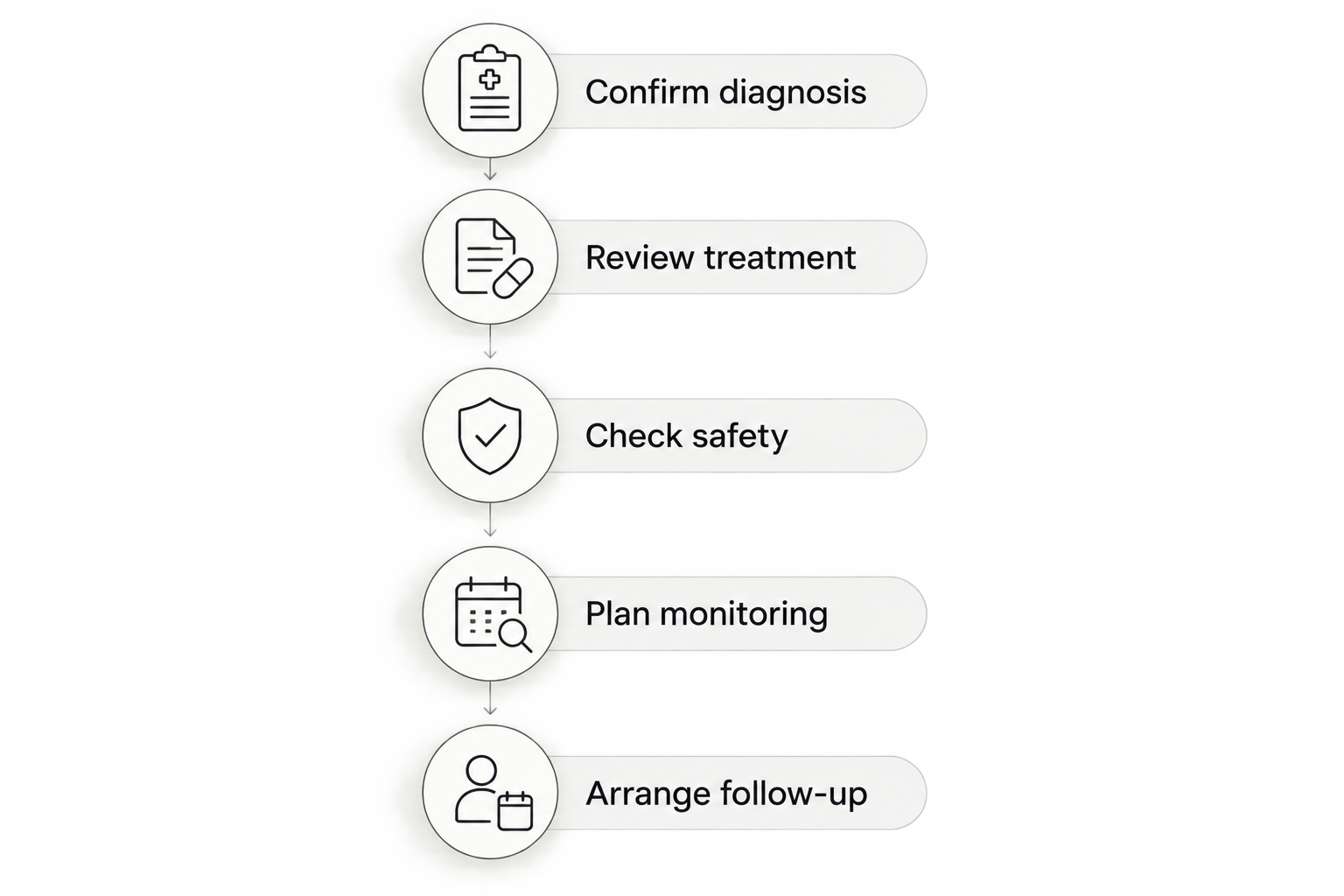
Start with an evaluation rather than a preferred medication. In 2026, a useful consultation should connect the proposed treatment to your history and explain what happens if symptoms improve, persist, or worsen.
- Confirm diagnosis. Ask whether another condition, a medical problem, or substance use changes the assessment. A history of mania or hypomania matters when evaluating depressive symptoms.
- Review treatment. Bring medication names and describe how consistently you took them, what changed, and why you stopped. An incomplete trial and an adequate trial without benefit are different clinical situations.
- Check safety. Review blood pressure, cardiovascular and cerebrovascular history, pregnancy considerations, substance use, and prescription or nonprescription drugs.
- Plan monitoring. Ask what staff will assess before, during, and after treatment, including how they respond to concerning symptoms.
- Arrange follow-up. Establish who reviews progress, manages other medications, and decides whether continuing treatment makes sense.
These steps help you compare clinical plans rather than promotional descriptions. Keep the answers with your medication history so your treating professionals can work from the same information.
What safety differences should you understand?
Both medications require attention to sedation, dissociation, blood pressure changes, and misuse risk. Dissociation can include feeling detached from your surroundings or yourself. A noticeable altered state is not proof that depression treatment is working.
SPRAVATO carries boxed warnings for sedation, dissociation, respiratory depression, abuse and misuse, and suicidal thoughts and behaviors. Its Risk Evaluation and Mitigation Strategy, or REMS, requires administration in a certified setting and observation after dosing.
The SPRAVATO prescribing information requires monitoring for at least 2 hours after administration, followed by an assessment of clinical stability. That is a minimum observation period, not a promise that you will be ready to leave at a fixed time.
You must not drive or operate machinery until the next day after a restful sleep. Arrange transportation home. For ketamine treatment, obtain the specific restrictions from the treating clinician rather than assuming the SPRAVATO instructions cover a different medication or protocol.
For safety decisions in 2026, use the current FDA-approved SPRAVATO prescribing information and Medication Guide. For compounded ketamine, the FDA's safety communications address risks including sedation, dissociation, psychiatric events, blood pressure increases, respiratory depression, and misuse.
Is esketamine better than ketamine for depression?
Neither medication is the universal winner. SPRAVATO has FDA approval for specified depression indications and a required administration framework; ketamine treatment for depression is off-label and requires evaluation of the particular protocol.
Do not treat regulatory approval as a head-to-head effectiveness result. Ask your psychiatrist why the recommended option fits your prior treatment response, medical history, and ability to attend supervised care.
Can you switch from ketamine to esketamine?
There is no direct milligram-for-milligram substitution between ketamine and esketamine. A switch requires a new prescribing decision that accounts for the formulation, route, previous response, adverse effects, and timing of treatment.
Bring records from the previous prescriber. Do not copy a previous schedule or change treatment on your own because both medications share part of the same name.
Is compounded nasal ketamine the same as SPRAVATO?
Compounded nasal ketamine is not SPRAVATO. Sharing a nasal route does not make products equivalent in ingredients, concentration, delivery, regulatory review, or required supervision.
Compounded drugs are not FDA-approved. Ask exactly what is prescribed and why; do not assume a compounded nasal spray has the same evidence or safeguards as the approved esketamine product.
Where does a local psychiatric evaluation fit?
Attuned Psychiatry is best suited to Decatur/Metro Atlanta patients seeking physician-led evaluation for treatment-resistant depression. The practice offers medication management, TMS, and SPRAVATO treatment. Offering these services does not establish which treatment is right for you before an assessment.
Attuned Psychiatry provides a setting to discuss your treatment history and these options. For esketamine treatment, the monitoring and transportation requirements remain practical limitations to consider alongside potential benefit. No assessment guarantees eligibility or a particular outcome.
Discuss your depression treatment options
Request an evaluation of your treatment history and whether SPRAVATO fits your care needs.
FAQ
Is esketamine the same as ketamine?
No. Esketamine is the S-enantiomer of ketamine, while conventional racemic ketamine contains both S- and R-enantiomers. They are related but are not interchangeable prescriptions.
Is SPRAVATO approved for adults with treatment-resistant depression?
Yes. SPRAVATO is FDA-approved for treatment-resistant depression in adults, meaning patients aged 18 years and older. Its prescribing information permits use alone or with an oral antidepressant for that indication.
How long do you have to stay after SPRAVATO treatment?
SPRAVATO requires at least 2 hours of monitoring after administration. A healthcare professional must then assess whether you are clinically stable before you leave.
Can I drive myself home after esketamine treatment?
No. Arrange transportation home after SPRAVATO treatment, and do not drive or operate machinery until the next day after a restful sleep.
Does feeling dissociated mean the treatment is working?
No. Dissociation is a possible treatment effect, not proof of antidepressant benefit. Progress should be assessed through depressive symptoms, functioning, and safety over time.
Can SPRAVATO replace emergency care for suicidal thoughts?
No. SPRAVATO does not replace emergency assessment or hospitalization when needed, and it has not been demonstrated to prevent suicide. If you are in immediate danger or cannot stay safe, call emergency services or go to the nearest emergency department.
Does Attuned Psychiatry offer SPRAVATO?
Yes. Attuned Psychiatry offers SPRAVATO, medication management, and TMS in Decatur/Metro Atlanta. A clinical evaluation determines whether a treatment fits your diagnosis, history, and safety needs.
One last thing
The same route does not mean the same treatment—and a different route does not establish better treatment. Before starting care in 2026, ask the prescriber to write down the exact medication, why it fits your diagnosis, the monitoring plan, and how progress will be assessed.
Keep that explanation with your treatment records. It gives you a clearer basis for informed consent than the word ketamine alone.


