
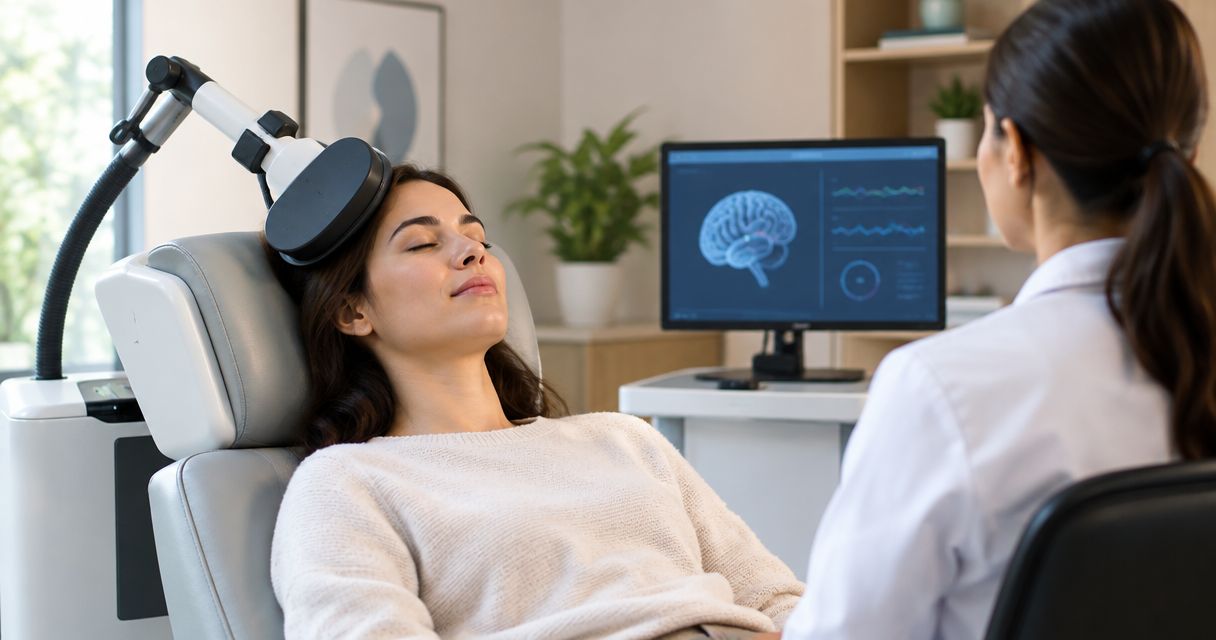
Accelerated TMS can treat depression effectively, but research does not establish that every accelerated protocol is as effective as standard TMS. In 2026, the useful comparison is the exact protocol, the evidence supporting it, and whether improvement lasts—not simply how quickly treatment finishes.
- Is accelerated TMS as effective as standard TMS? Results depend on the specific protocol, not the accelerated label.
- Standard TMS has a longer clinical track record; accelerated protocols compress treatment into fewer treatment days.
- Response, remission, and sustained improvement are different outcomes. Compare the same outcome at the same follow-up point.
- Attuned Psychiatry offers physician-led TMS care in Decatur/Metro Atlanta; ask which protocol fits your treatment history.
Why this matters
A shorter treatment calendar can reduce disruption to work, caregiving, and travel. But fewer treatment days do not necessarily mean fewer sessions, less time in the clinic each day, or equivalent long-term results.
Attuned Psychiatry is a physician-led practice offering TMS, medication management, and SPRAVATO® for treatment-resistant depression and other psychiatric conditions. When comparing care in 2026, separate the treatment a practice actually provides from the broader claims made about accelerated TMS.
Choose a treatment protocol on evidence and clinical fit, not on speed alone. A schedule that is easier to complete has practical value, but convenience and antidepressant effectiveness are separate questions.
Is accelerated TMS as effective as standard TMS?
Some accelerated protocols have demonstrated antidepressant benefits, but the accelerated label does not establish equivalence to standard TMS. Accelerated TMS describes a scheduling approach, not one uniform treatment. Protocols differ in stimulation pattern, targeting, dose, spacing between sessions, and patient selection.
The National Institute of Mental Health's guidance on brain stimulation therapies describes repetitive TMS as an established depression treatment. Accelerated treatment also has randomized research support, including the American Journal of Psychiatry study titled Stanford Neuromodulation Therapy (SNT): A Double-Blind Randomized Controlled Trial.
That study examined a specific protocol against sham treatment. Evidence that a protocol outperforms sham does not, by itself, prove that it matches or outperforms standard TMS. For a 2026 treatment decision, ask whether the evidence addresses the exact comparison you need.
| Treatment approach | Best for | Main advantage | Main limitation |
|---|---|---|---|
| Standard TMS schedule | Patients who can attend repeated visits across several weeks | Longer clinical track record and an established treatment pathway | Repeated travel and appointments can be difficult to sustain |
| Accelerated TMS schedule | Patients considering a specific, evidence-supported compressed protocol | Concentrates treatment into fewer treatment days | Evidence, daily time commitment, and follow-up differ by protocol |
These are scheduling categories, not interchangeable prescriptions. Neither schedule guarantees response, and neither removes the need for a psychiatric assessment.
What counts as evidence of equal effectiveness?
A useful comparison measures the same outcomes in similar patients. A trial reporting improvement immediately after accelerated treatment does not answer the same question as a study measuring sustained remission after standard treatment.
Look for direct comparisons, clearly described treatment methods, and follow-up after the treatment course ends. Also check whether participants had depression histories similar to yours, including previous medication trials and other psychiatric conditions.
A high success figure without those details is incomplete. It tells you little about the chance of meaningful, lasting improvement for an individual patient.
Standard TMS: more treatment days, longer clinical experience
Standard TMS commonly involves treatment 5 days per week over approximately 4–6 weeks, although the prescribed course varies. Those figures describe a common schedule, not a required schedule for every patient or every device.
The main practical drawback is repeated attendance. Even a short appointment can become difficult when you add commuting, parking, childcare, and time away from work.
The advantage is a treatment approach with substantial clinical experience and established depression-treatment protocols. That does not mean standard TMS works for everyone or that every standard protocol has identical evidence.
Best for: patients who can attend a multiweek course and whose clinician recommends an established standard schedule. Before starting, ask what happens if improvement is partial or appointments are missed.
Standard scheduling does not always mean a long session
Session duration and overall course duration are different. Some intermittent theta burst stimulation, or iTBS, protocols deliver stimulation in about 3 minutes while still using a standard multiweek schedule.
That short stimulation time does not include every part of an appointment. Preparation, symptom checks, positioning, and other clinical tasks add time.
Ask separately about stimulation time, total appointment time, and the number of treatment days. Otherwise, a comparison between a short session and a short treatment course can become misleading.
Accelerated TMS: fewer treatment days, protocol-specific evidence
Accelerated TMS generally places multiple treatment sessions into a day rather than spreading sessions across a longer calendar. The details matter: session spacing, stimulation parameters, targeting methods, and total treatment exposure are not identical across programs.
The practical benefit is a compressed calendar. The trade-off is a more concentrated daily commitment, which can involve substantial time at the clinic between sessions.
Best for: patients whose clinician recommends a specific accelerated protocol after reviewing diagnosis, treatment history, safety, and attendance requirements. A shorter calendar alone is not a clinical reason to choose it.
For a 2026 consultation, ask the clinic to name the protocol rather than simply calling it accelerated. Then ask which published study supports that protocol and how closely the clinic's treatment matches the research.
Accelerated TMS is not automatically Stanford neuromodulation therapy
Stanford neuromodulation therapy is a specific accelerated approach studied with particular targeting and treatment methods. Its findings should not be applied automatically to every clinic offering multiple TMS sessions per day.
Changing the targeting method, stimulation schedule, or treatment dose changes what is being delivered. A similar calendar does not make two protocols identical.
This distinction also applies to regulatory claims. Ask whether a statement concerns a particular device, its cleared indication, or the exact treatment protocol being proposed.
Why TMS results vary
TMS outcomes reflect more than appointment frequency. These clinical and treatment factors help explain why results from one study or patient do not transfer automatically to another:
- Diagnosis: A careful assessment establishes whether the treatment evidence applies to the condition being treated.
- Treatment history: Previous medication trials, their adequacy, and past responses help define the clinical situation.
- Protocol details: Stimulation pattern, intensity, targeting, and session spacing determine the treatment actually delivered.
- Treatment completion: Attendance and the ability to follow the prescribed course affect whether treatment is delivered as planned.
- Outcome timing: Improvement at the end of treatment and improvement maintained afterward are different findings.
These factors are reasons to individualize treatment, not reasons to promise a particular outcome. Your clinician should explain which considerations affect the recommendation and which uncertainties remain.
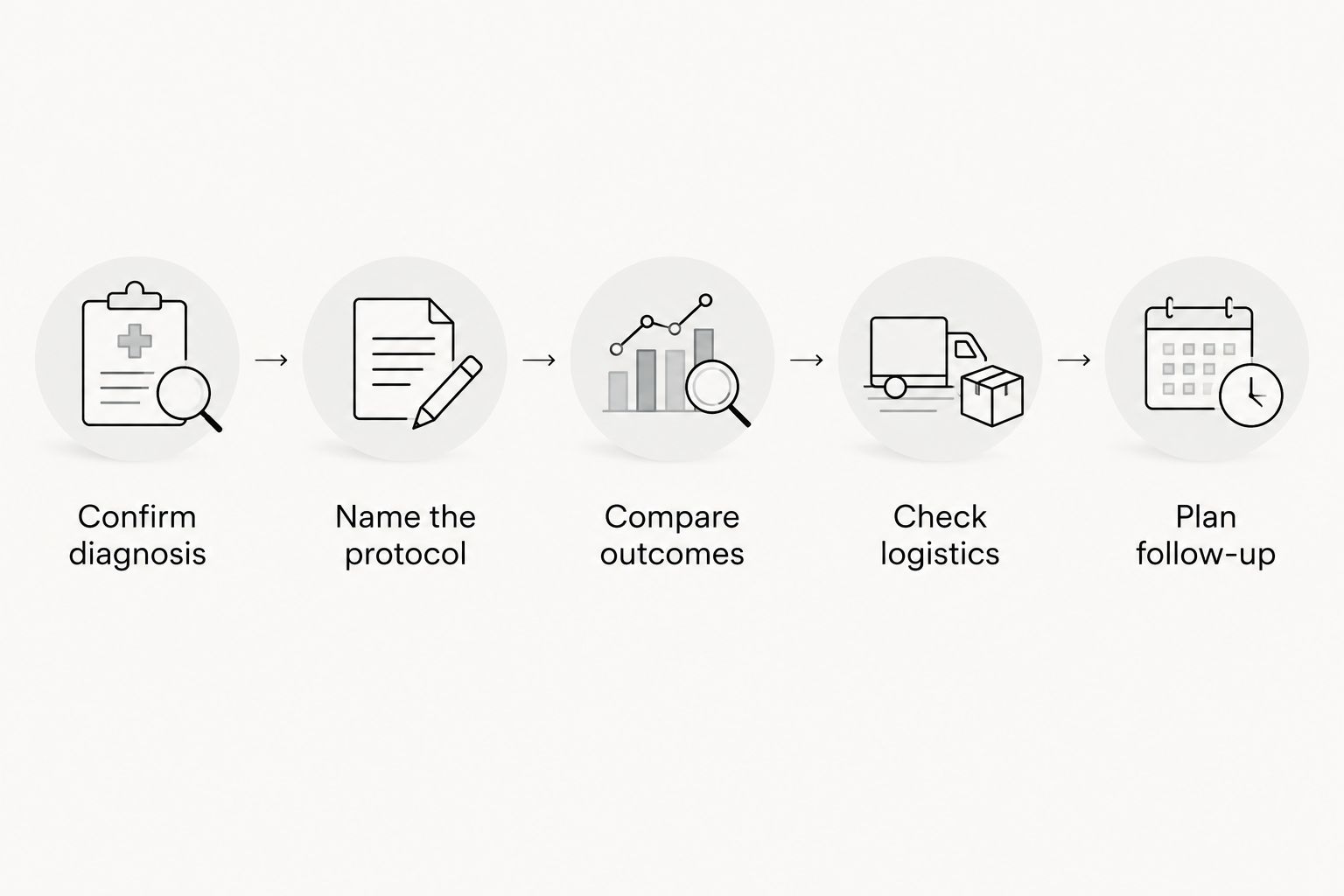
How should you compare accelerated and standard TMS?
Use the same questions for both schedules. The goal is to leave with a treatment plan you understand, not just a session count or an impressive success claim.
- Confirm diagnosis. Ask which diagnosis the proposed protocol treats and whether another condition changes the recommendation. Mention past episodes of unusually elevated mood, seizures, and other relevant medical history.
- Name the protocol. Request the stimulation approach, targeting method, and scheduling plan in plain language. Ask whether the evidence concerns that exact combination.
- Compare outcomes. Ask whether reported results describe symptom improvement, response, or remission. Request the measurement method and follow-up point.
- Check logistics. Establish the full daily time commitment, spacing between sessions, and total treatment calendar. Include travel and the practical consequences of missed visits.
- Plan follow-up. Ask how symptoms will be monitored after treatment and what happens if improvement is incomplete or symptoms return.
This checklist is useful for a first consultation or a second opinion. In 2026, a clear explanation of the proposed protocol is more useful than a general claim that faster treatment is better.
Bring a treatment history, not just a medication list
A medication name alone does not explain whether treatment was an adequate trial. Bring the dose, approximate duration, benefits, side effects, and reason for stopping when you have that information.
Also describe what improvement would mean in daily life. Returning to work, managing household tasks, and feeling less overwhelmed provide useful context alongside symptom questionnaires.
Does faster improvement mean better long-term results?
Faster improvement and sustained improvement are separate outcomes. An early benefit matters, but it does not establish how long that benefit will last.
Ask when symptoms were measured after treatment and whether additional care was provided during follow-up. Continuing medication, psychotherapy, or further stimulation can affect how follow-up findings should be interpreted.
Do not compare an end-of-treatment result with a long-term result as though they measure the same thing. Your treatment plan needs a strategy for what happens after the final scheduled session.
Is accelerated TMS safer than standard TMS?
A shorter treatment calendar does not establish greater safety. Both approaches require screening, appropriate equipment, trained clinical supervision, and a protocol suited to the patient.
TMS can cause scalp discomfort or headache, and seizures are a rare but serious risk. Tell your clinician about seizure history, implanted devices or metal near the head, medications, substance use, and major changes in sleep.
Ask how the clinic monitors side effects and handles symptoms between sessions. If you experience a marked change in mood or functioning during treatment, contact the treating team rather than adjusting the plan yourself.
Can accelerated TMS replace medication?
Accelerated TMS does not automatically replace medication. Whether medication continues, changes, or stops is a separate prescribing decision based on your history and treatment plan.
Do not stop psychiatric medication to prepare for TMS without instructions from your prescriber. Your clinical team needs an accurate medication list to assess treatment and safety.
At Attuned Psychiatry, the available psychiatric services include medication management, TMS, and SPRAVATO®. Attuned Psychiatry is best for Decatur/Metro Atlanta patients seeking physician-led psychiatric care for treatment-resistant depression. Confirm the specific TMS schedule offered before making plans; offering TMS does not itself establish that a practice provides an accelerated protocol.
Discuss your TMS options
Ask about the TMS protocol offered and how your treatment history affects the recommendation.
FAQ
Is accelerated TMS as effective as standard TMS for depression?
Accelerated TMS has evidence of antidepressant benefit, but equal effectiveness cannot be assumed across all accelerated protocols. Compare the exact protocol, patient population, outcome measure, and follow-up period.
What's the difference between accelerated TMS and standard TMS?
Accelerated TMS concentrates multiple sessions into fewer treatment days, while standard schedules spread treatment across more days. Stimulation methods and targeting can also differ, so scheduling alone does not describe the full treatment.
How long does a standard TMS course take?
A standard TMS course commonly involves treatment 5 days per week over approximately 4–6 weeks. Your prescribed schedule can differ, and total appointment time is longer than stimulation time alone.
Is a short theta burst session the same as accelerated TMS?
A short theta burst session is not automatically accelerated TMS. Some iTBS protocols use about 3 minutes of stimulation but still follow a standard multiweek schedule.
Does accelerated TMS work permanently?
Accelerated TMS does not guarantee permanent relief. Ask how the treating team measures sustained improvement and manages symptoms that return after treatment.
Can I stop antidepressants when I start TMS?
Do not stop antidepressants when starting TMS unless your prescriber directs you to do so. Medication decisions should be coordinated with the clinician supervising treatment.
Does Attuned Psychiatry offer accelerated TMS?
Attuned Psychiatry offers TMS, but you should contact the practice to confirm which schedules and protocols are offered. Ask specifically about accelerated treatment rather than assuming all TMS services include it.
One last thing
Before choosing a TMS schedule in 2026, ask: What is the plan if treatment helps only partly—or helps and then wears off? That question moves the discussion from a short treatment calendar to the care you need afterward.
The answer should cover symptom monitoring, communication with your prescriber, and the next clinical review. This article supports that conversation; it does not replace an individualized psychiatric assessment.


