
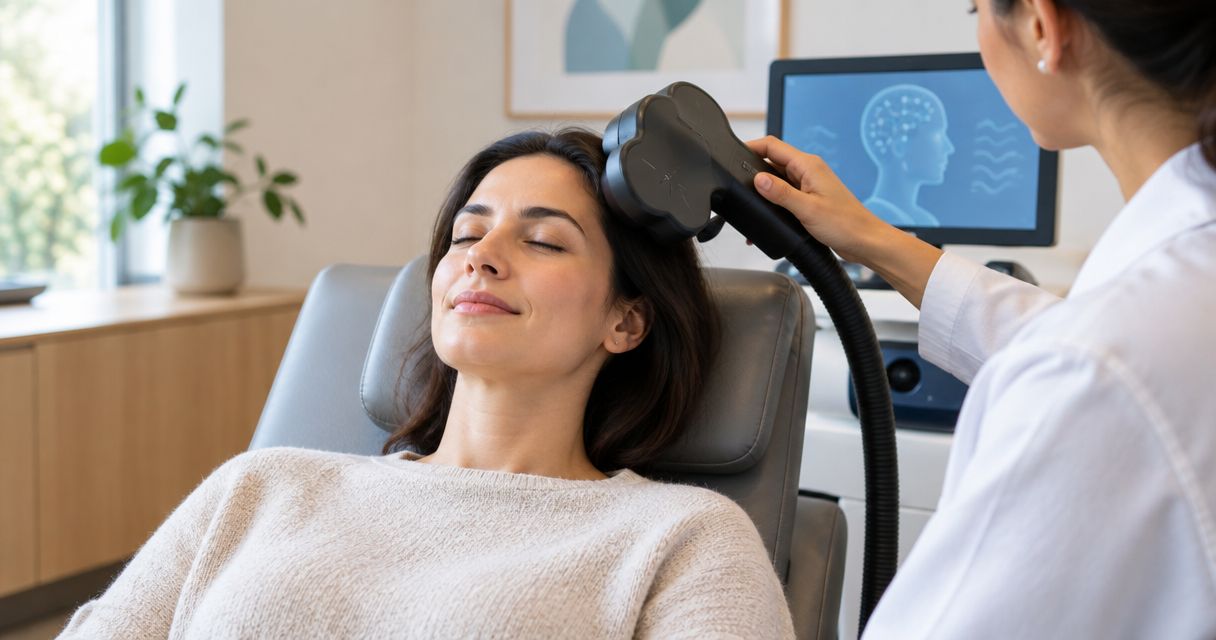
TMS usually starts helping over several weeks, not immediately after the first session. You might notice changes in sleep, energy, or daily functioning before your mood improves, but there is no guaranteed day when relief begins. A slow start does not automatically mean treatment has failed, and completing a course does not guarantee a response.
- How soon does TMS start working? Expect improvement over weeks rather than immediate relief after a session.
- NIMH describes a conventional TMS course as treatment five days weekly for four to six weeks.
- Track mood and daily functioning together; an early change in one symptom does not establish recovery.
- Attuned Psychiatry offers physician-led TMS evaluation for patients in Decatur/Metro Atlanta.
Why this matters
When depression has not responded to treatment, another wait can feel difficult to tolerate. Knowing what to watch for helps you distinguish a gradual response from a treatment plan that needs reassessment.
For your 2026 treatment planning, separate three questions: when improvement might begin, how long the prescribed course lasts, and when your clinician will review the result. These are different milestones. You can discuss them during an evaluation of psychiatric services, rather than treating the final appointment as the only meaningful checkpoint.
How soon will I feel better after starting TMS?
Expect a gradual assessment over weeks, not a pass-or-fail test after each session. Mayo Clinic’s patient guidance explains that symptom relief can take a few weeks. The National Institute of Mental Health’s Brain Stimulation Therapies guidance describes conventional repetitive TMS treatment as occurring 5 days a week for 4–6 weeks.
Those figures describe a conventional schedule, not a promise about when you will feel better. Your prescribed protocol determines your actual schedule, and different TMS protocols should not be treated as interchangeable.
| Point in treatment | What to watch for | What it does not establish |
|---|---|---|
| Early sessions | Tolerability and any changes in symptoms or functioning | Whether the full course will work |
| Over the following weeks | A sustained trend in mood, interest, energy, or daily activities | That every symptom must improve together |
| At the planned review | Symptom scores, your experience, and remaining difficulties | That improvement automatically means treatment should stop |
| After the acute course | Whether benefits persist and what follow-up is needed | That everyone needs the same maintenance plan |
A conventional 4–6-week course is therefore a planning reference, not a deadline for recovery. Ask your clinician which schedule applies to you and when a lack of improvement should trigger a discussion.
What can early improvement actually feel like?
An early response does not have to feel like happiness. You might find it easier to get out of bed, start a task, follow a conversation, or return a message that previously felt overwhelming.
These changes matter because depression affects functioning as well as mood. They still need context: better sleep alone does not prove that depression has responded, and a productive afternoon does not establish a sustained change.
Useful observations include:
- Mood: Are low mood, hopelessness, or emotional heaviness becoming less persistent?
- Interest: Are you reconnecting with activities rather than only completing obligations?
- Energy: Is starting an ordinary task becoming less difficult?
- Function: Are work, household responsibilities, or personal care becoming more manageable?
- Consistency: Does improvement continue across different days and situations?
Choose examples that reflect your own depression. If your main difficulty is being unable to prepare a meal, that can be a more useful marker than asking whether you feel completely different.
Why the TMS response timeline varies
There is no single TMS response date that applies to every patient. The clinical picture and the treatment being delivered both matter, so another person’s experience cannot set your deadline.
- The prescribed protocol: Conventional and accelerated schedules organize treatment differently. Compare timelines only after confirming which protocol is being discussed.
- The symptoms being followed: Sleep, motivation, interest, and mood are different outcomes. Improvement in one does not necessarily mean improvement in all of them.
- Treatment attendance: Missed appointments change how the delivered course compares with the prescribed schedule. Tell the team about attendance barriers early.
- Other treatments: Medication changes and psychotherapy belong in the same clinical picture. Your clinician needs to know about changes rather than interpreting symptoms in isolation.
- The diagnosis and accompanying conditions: Persistent symptoms warrant a review of the broader assessment, not simply an assumption that more sessions are always the answer.
Do not label yourself a nonresponder by comparing your progress with someone else’s calendar. Ask whether you have received enough of your prescribed treatment for your clinician to interpret the result.
How to track whether TMS is helping
Use a short, repeatable record instead of relying only on how you feel immediately after treatment. A weekly review can make patterns easier to discuss without turning every appointment into an examination you have to pass.
For a treatment course beginning in 2026, choose a few meaningful markers before treatment starts. Keep the same markers throughout the course so that your comparisons remain useful.
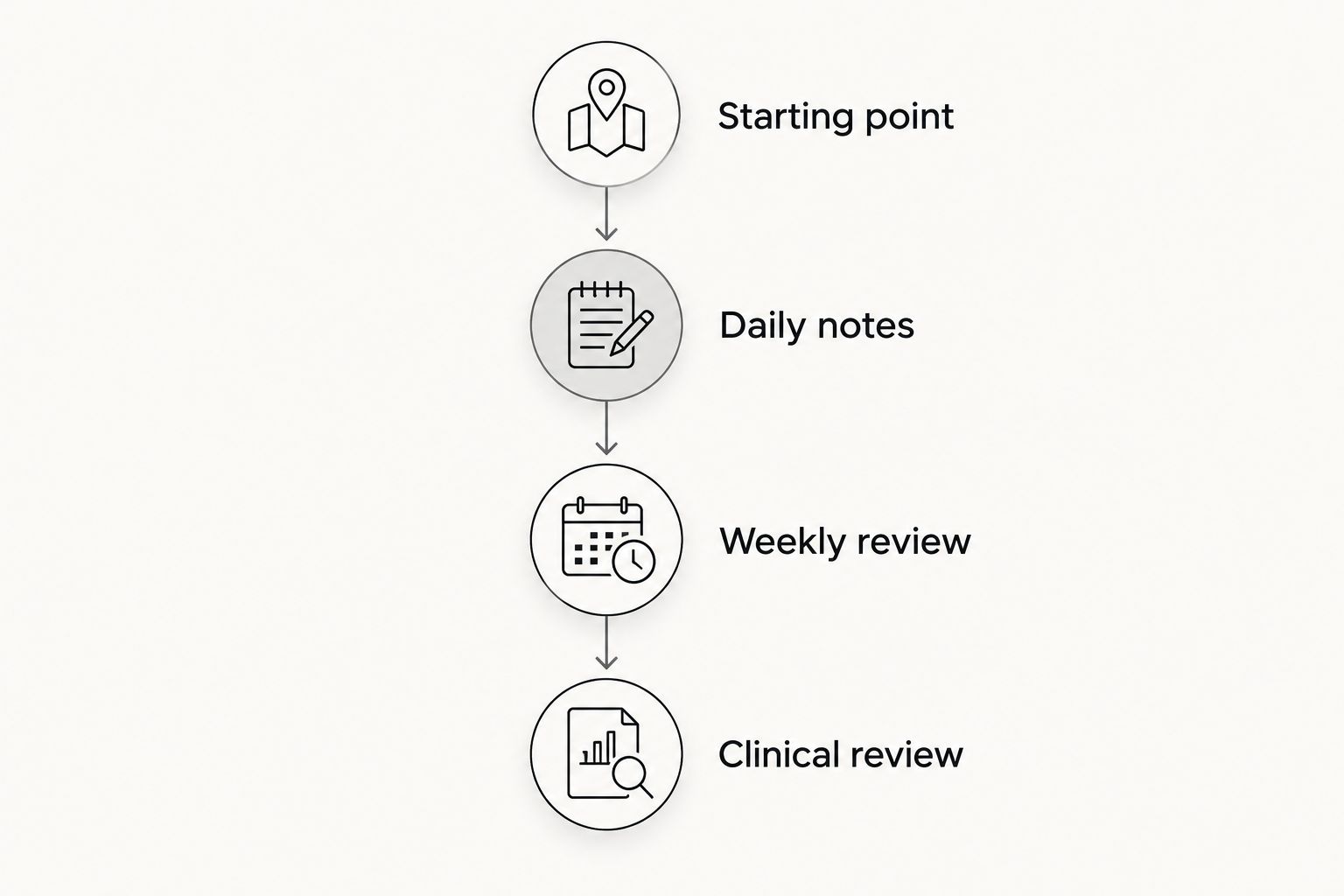
- Starting point: Describe what depression currently prevents you from doing. Include symptoms and ordinary activities, not just a general rating of how bad things feel.
- Daily notes: Record a brief observation about mood, sleep, energy, or a meaningful activity. Keep it short enough that you can continue when motivation is low.
- Weekly review: Compare the pattern across 1 week rather than giving one unusually good or bad day all the weight.
- Clinical review: Bring your notes to the treating team. Discuss them alongside any standardized symptom questionnaires the practice uses.
A symptom score is useful, but it is not the whole decision. Tell your clinician if the score improves while you still cannot function, or if functioning improves before you notice a clear mood change.
What if I do not feel better early in treatment?
An early lack of improvement is a reason to communicate, not to stop treatment on your own. Explain whether symptoms are unchanged, worsening, or changing in ways you did not expect.
Ask your clinician where you are in the prescribed course and what the next review will assess. The useful question is not simply whether TMS works in general; it is whether your current treatment is producing enough benefit to justify the next step.
A review can address:
- Whether appointments have followed the prescribed schedule.
- Whether side effects are interfering with treatment.
- Whether medications or other treatments have changed.
- Whether the original diagnosis and accompanying conditions need another look.
- What alternatives should be discussed if the response remains insufficient.
Avoid interpreting persistence as a requirement to tolerate anything. New or worsening symptoms deserve attention during treatment, not only after the course ends.
Is feeling different after a session the same as improvement?
Feeling different immediately after TMS does not establish an antidepressant response. Treatment-related scalp discomfort or headache is different from a sustained reduction in depression symptoms.
Tell the treatment team about discomfort, especially if it makes you reluctant to attend. Also report pronounced agitation, substantially reduced need for sleep, or unusually elevated mood promptly; these should not be assumed to mean that treatment is working well.
For your 2026 care plan, ask who handles concerns between appointments and what instructions apply outside office hours. Knowing that process beforehand is more useful than trying to decide alone whether a new symptom matters.
What should I ask before starting TMS?
Attuned Psychiatry is best suited to Decatur/Metro Atlanta patients seeking physician-led evaluation for TMS and other depression treatments. The practice offers medication management, TMS, and SPRAVATO®; an evaluation should determine which treatment fits your circumstances rather than assuming TMS is the next step for everyone.
TMS offers a noninvasive treatment option for depression, but it requires a prescribed course of appointments and does not help every patient. Those trade-offs belong in the decision alongside your treatment history, medical history, and goals.
Bring these questions to your evaluation:
- Which TMS protocol are you recommending, and why?
- When will we formally review my response?
- What changes should I report between appointments?
- How will my current medications be managed?
- What happens if symptoms improve only partly?
- What will we discuss if treatment does not help?
Ask Attuned Psychiatry to distinguish the expected treatment schedule from the expected response timeline. That conversation gives you a clearer basis for deciding whether the appointment commitment fits your needs.
Discuss your depression treatment options
Request a physician-led evaluation for depression care in Decatur/Metro Atlanta.
Can TMS work before the course is finished?
TMS can produce improvement before the prescribed course ends, but early relief is not a reason to change the schedule yourself. Tell your clinician what has improved and what remains difficult.
The decision about completing treatment or arranging follow-up should account for the durability and extent of your response. Feeling better and having a completed treatment plan are not the same thing.
Does no improvement halfway through mean TMS has failed?
No improvement halfway through does not, by itself, establish that TMS has failed. Your clinician needs to consider the protocol, treatment delivered, symptom trend, and overall clinical picture.
Ask for a defined review point rather than an open-ended instruction to wait. You should understand what the team is monitoring and how it will decide whether to continue or reconsider treatment.
Will I need more treatment after TMS helps?
Improvement after TMS does not eliminate the need for a follow-up plan. Your clinician should discuss ongoing depression care, monitoring for returning symptoms, and whether additional treatment is appropriate.
For a course completed in 2026, leave with clear instructions about whom to contact if symptoms return. Do not assume that every patient needs maintenance TMS or that no further care will be necessary.
FAQ
How soon does TMS start working for depression?
TMS generally starts helping over several weeks rather than immediately after a session. Some patients notice changes earlier than others, and some do not respond; your clinician should assess the trend across the prescribed course.
How long is a typical TMS course?
NIMH describes conventional repetitive TMS as treatment 5 days a week for 4–6 weeks. Other protocols use different schedules, so confirm which schedule your clinician is prescribing.
What are the first signs that TMS is working?
Early signs can include improvements in mood, interest, energy, sleep, or daily functioning. No single change proves a response, so discuss whether the improvement is sustained and meaningful.
Is it normal to have a bad day during TMS?
A bad day alone does not establish that TMS has stopped helping or will not work. Look at the broader pattern, and report worsening symptoms rather than dismissing them as an expected fluctuation.
Should I stop antidepressants when I start TMS?
Do not stop or change prescribed antidepressants without instructions from your prescriber. Your TMS clinician needs an accurate medication list and updates about medication changes during treatment.
What if my depression gets worse while I wait for TMS to work?
Contact your treating clinician promptly if depression worsens during TMS. If you have suicidal thoughts or are in emotional crisis in the United States, call or text 988; call 911 or go to an emergency department for immediate danger.
Does Attuned Psychiatry provide TMS in Metro Atlanta?
Attuned Psychiatry offers TMS as part of its physician-led psychiatric practice in Decatur/Metro Atlanta. An evaluation is needed to determine whether TMS fits your treatment history and current condition.
One last thing
You do not need to feel better immediately after an appointment for treatment to deserve a careful assessment. Bring one concrete example of something depression has made difficult, then revisit that same example throughout treatment.
That turns a vague question about feeling different into a useful discussion about recovery. This article provides general education; your treating clinician should set your schedule, assess your response, and guide treatment changes.


