

SPRAVATO can begin reducing depressive symptoms within 24 hours in some patients, but improvement is usually assessed across the first 4 weeks of treatment rather than after a single dose. Feeling sleepy, dizzy, or disconnected during a session is a side effect—not proof that the antidepressant treatment is working.
- How soon does SPRAVATO start working? Some patients improve within 24 hours; the first 4 weeks help establish response.
- SPRAVATO’s temporary dissociation and sedation do not measure its antidepressant benefit.
- Attuned Psychiatry offers physician-led psychiatric care for patients considering treatment-resistant depression options.
- SPRAVATO requires supervised treatment and at least 2 hours of monitoring after each dose.
How soon does SPRAVATO start working?
Some patients notice improvement within 24 hours, but an early change does not establish a lasting response. Your prescriber assesses whether symptoms improve across the initial treatment course, including the first 4 weeks. A session that feels uneventful does not, by itself, establish treatment failure.
SPRAVATO is prescription esketamine nasal spray administered under healthcare supervision. For patients seeking treatment-resistant depression care in Decatur or Metro Atlanta, Attuned Psychiatry offers physician-led psychiatric evaluation, medication management, TMS, and SPRAVATO.
| Time or experience | What it tells you | What it does not tell you |
|---|---|---|
| Within 24 hours | Early symptom improvement is possible | That everyone will respond immediately |
| During the first 4 weeks | Repeated assessments help establish antidepressant response | That each session must produce a noticeable lift |
| During a treatment session | Dizziness, sedation, or dissociation can occur | That a stronger sensation means better treatment |
| After an initial response | Your prescriber can assess continued treatment needs | That further care is unnecessary |
The evidence behind these timelines comes from the SPRAVATO U.S. Prescribing Information, particularly its Clinical Studies and Dosage and Administration sections. Those sections distinguish early symptom assessments from the broader evaluation of treatment benefit.
Why this matters
Depression makes waiting difficult. When you start a treatment described as fast-acting, it is easy to interpret every sensation—or the absence of one—as a verdict.
That is the wrong measure. Track depressive symptoms and daily functioning, not how intense the treatment session feels. Getting out of bed, completing a necessary task, or engaging in a conversation can provide more useful information than whether you felt detached during dosing.
For treatment decisions in 2026, rapid onset and reliable recovery remain different questions. Your care plan needs to address both: whether symptoms begin improving and whether that improvement continues between appointments.
Early improvement: within 24 hours for some patients
SPRAVATO clinical studies have assessed depressive symptoms as early as 24 hours after treatment. Some studies demonstrated improvement at that assessment, but a study result describes a group—not a deadline for an individual patient.
Early improvement can involve a reduction in the intensity of depressive symptoms. It does not necessarily mean that motivation, concentration, sleep, and enjoyment all recover together.
Avoid treating the next morning as a pass-or-fail test. Instead, describe what changed, what stayed the same, and whether the change lasted. A brief improvement still belongs in the discussion, even when it does not carry through to your next visit.
The limitation is equally important: a fast effect does not guarantee a sustained effect. Continue the prescribed plan unless your treating clinician changes it, and report worsening symptoms promptly rather than waiting for a scheduled review.
Initial response assessment: the first 4 weeks
For treatment-resistant depression, the prescribing information describes an initial phase with twice-weekly treatment during the first 4 weeks. It directs clinicians to evaluate therapeutic benefit at the end of that phase when deciding whether treatment should continue.
That schedule gives your prescriber repeated opportunities to review symptoms, tolerability, and safety. It is not a promise that everyone will feel better by the final appointment.
A useful review separates several questions:
- Symptoms: Is the depression less severe, less persistent, or less disruptive?
- Function: Are ordinary activities becoming more manageable?
- Consistency: Does improvement last between treatment sessions?
- Tolerability: Are adverse effects acceptable and resolving as expected?
- Safety: Have suicidal thoughts, agitation, or other concerning symptoms changed?
Do not adjust the dose or appointment frequency yourself. If there is little improvement, your prescriber needs to reassess the treatment plan rather than assume that more of the same will necessarily help.
In 2026, the practical checkpoint remains the same: review documented benefit alongside treatment burden and adverse effects. An appointment attended is not the same as a response achieved.
Session effects: not an antidepressant response test
Dissociation can feel like detachment from your surroundings or yourself. Sedation means reduced alertness or sleepiness. Both are recognized SPRAVATO risks, and neither is a target you should try to achieve.
A strong session experience does not prove that depression is improving. Likewise, a less dramatic experience does not establish that treatment has stopped working.
SPRAVATO carries serious safety warnings, including sedation, dissociation, respiratory depression, and abuse and misuse. Its restricted treatment program requires administration in a certified healthcare setting and monitoring after treatment.
Expect at least 2 hours of observation after each dose. Leaving depends on a healthcare professional’s assessment of clinical stability, not simply on the clock reaching the minimum observation period.
Do not drive or operate machinery until the next day after a restful sleep. Arrange transportation before treatment; feeling alert enough to leave the clinic does not mean you are cleared to drive home.
Why the time to improvement varies
There is no reliable personal countdown to a SPRAVATO response. Your clinician interprets the timeline in the context of your diagnosis, treatment history, symptoms, and ability to tolerate treatment.
- The condition being treated: Treatment-resistant depression and depressive symptoms associated with an acute suicidal crisis involve different clinical questions and evidence.
- The symptom being measured: Mood, interest, sleep, concentration, and daily functioning are distinct parts of an assessment.
- The treatment phase: An early symptom change and the response assessed after the initial course answer different questions.
- The treatment plan: Dose and frequency follow prescribing guidance and clinical assessment; they are not self-directed ways to speed improvement.
- Adverse effects: Safety and tolerability influence whether treatment can continue as planned.
- Other medications and conditions: Your prescriber reviews the full clinical picture when judging benefit, risks, and next steps.
These factors guide interpretation; they do not supply a formula that predicts your response date. Be cautious of any claim that a particular session number guarantees relief.
How should I track whether SPRAVATO is working?
Use a short, repeatable record rather than a detailed diary you cannot maintain. The goal is to give your prescriber a clear picture of symptoms between appointments, not to grade yourself on recovery.
- Set a baseline. Before treatment, describe your main depressive symptoms and the activities they interfere with. Include symptoms that are difficult to discuss, especially thoughts of death or self-harm.
- Track symptoms. Use the same questions or clinician-provided symptom scale over time. Record changes in mood, interest, energy, sleep, and concentration without assuming they must improve together.
- Track function. Note concrete activities, such as preparing food, showering, answering messages, or attending work. Choose examples that reflect your own baseline.
- Review together. Bring the record to your treating clinician. Separate temporary session effects from changes that continue after treatment day.
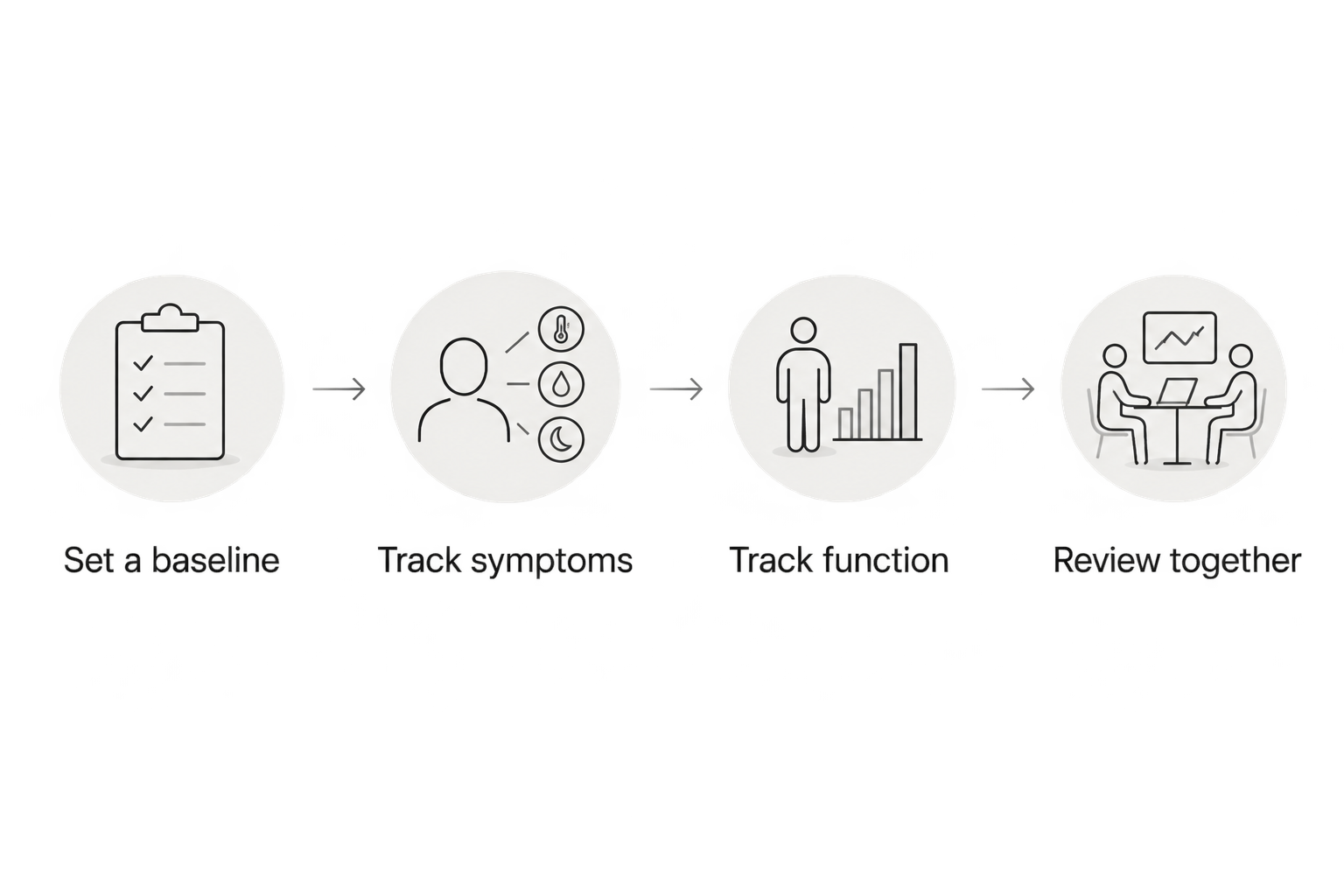
For your 2026 treatment record, consistency matters more than elaborate detail. A brief note using the same categories is easier to compare than a long description written only on unusually good or bad days.
Ask whether your clinician wants you to complete a standardized depression questionnaire. Symptom scales support the conversation, but they do not replace discussion of safety, functioning, and your experience.
What if I feel nothing after my first SPRAVATO treatment?
Within 24 hours, some patients notice improvement, but no noticeable change after the first session does not establish treatment failure. Tell your prescriber what you experienced and continue only according to the agreed treatment plan.
Be specific about what “nothing” means. No dizziness, no emotional lift, and no improvement in depression are different observations; your clinician needs to know which one you mean.
Do not seek a stronger dissociative experience as a way to make treatment work. The treatment goal is relief from depression with acceptable safety and tolerability.
How long should I try SPRAVATO before reviewing the plan?
The first 4 weeks are the initial treatment phase used to evaluate benefit for treatment-resistant depression. Your clinician should also assess safety and symptoms throughout treatment rather than postpone every decision until that checkpoint.
A review does not automatically mean continuing or stopping. It means discussing the symptom record, adverse effects, functioning, and whether the next phase is clinically appropriate.
Does feeling better mean I can stop other depression treatment?
The first 4 weeks help establish response, but improvement is not a reason to stop prescribed medication or other care on your own. SPRAVATO treatment decisions and changes to other medications require your prescriber’s guidance.
Tell the treating team about every prescription, nonprescription medicine, and substance you use. A complete medication review matters for sedation, interactions, and the interpretation of symptoms.
When should you seek help instead of waiting?
Do not wait for SPRAVATO to start working if you cannot stay safe. In the United States, call or text 988 for the Suicide & Crisis Lifeline. Call 911 or go to the nearest emergency department for immediate danger or a medical emergency.
SPRAVATO has not been shown to prevent suicide or reduce suicidal ideation or behavior. Improvement after a dose does not remove the need for hospitalization when hospitalization is clinically warranted, according to its prescribing information.
Tell treatment staff immediately about breathing difficulty, severe sedation, chest pain, or other urgent symptoms during a session. Between sessions, follow the treating team’s instructions for urgent concerns; an online appointment request is not emergency care.
Discussing SPRAVATO with a psychiatric practice
Attuned Psychiatry is best suited to patients seeking physician-led evaluation of treatment-resistant depression treatment options. Its stated services include medication management, TMS, and SPRAVATO; those options require an individualized assessment rather than a choice based only on speed.
Review the practice’s psychiatric services with your treatment history in mind. Bring the names of previous medications, what happened during each trial, and any adverse effects you remember.
SPRAVATO offers the possibility of early symptom relief, but it also requires supervised visits, observation, transportation planning, and ongoing assessment. An evaluation at Attuned Psychiatry should establish clinical fit, not presume that SPRAVATO is the right next treatment.
Discuss your depression treatment options
Request an evaluation to discuss treatment history, symptoms, and whether SPRAVATO fits your care needs.
FAQ
Can SPRAVATO work the next day?
Some patients experience improvement within 24 hours, but a next-day response is not guaranteed. Your prescriber evaluates whether improvement continues across the treatment course.
Is it normal not to feel better after the first SPRAVATO session?
A lack of noticeable improvement after the first session does not establish treatment failure. Report your symptoms and session effects separately so your prescriber can interpret them.
How long is the initial SPRAVATO treatment course?
For treatment-resistant depression, the initial phase is twice-weekly treatment for the first 4 weeks. Your clinician evaluates benefit and determines whether continued treatment is appropriate.
Does dissociation mean SPRAVATO is working?
Dissociation is a recognized adverse effect, not proof of antidepressant response. Track changes in depression and functioning rather than the intensity of the treatment experience.
How long do I have to stay after SPRAVATO?
You need at least 2 hours of monitoring after each dose. A healthcare professional must determine that you are clinically stable before you leave.
Can I drive home after a SPRAVATO appointment?
No, you should not drive home after SPRAVATO. Do not drive or operate machinery until the next day after a restful sleep, and arrange transportation beforehand.
Does SPRAVATO prevent suicide?
SPRAVATO has not been shown to prevent suicide or reduce suicidal ideation or behavior. Call or text 988 in the United States for crisis support, or call 911 for immediate danger.
One last thing
Before starting treatment in 2026, write down what meaningful improvement would look like in your ordinary life. Choose an observable activity—not an expectation that every difficult feeling will disappear.
Bring that example back to each review. The question is not whether you felt the medication; it is whether your depression is improving safely and meaningfully. This article provides general education, not an individual treatment recommendation.


