

TMS therapy without insurance has no single standard total; your self-pay bill depends on the prescribed treatment plan and the clinic’s fees. For your 2026 budget, request a written full-course estimate that separates treatment sessions from evaluation, mapping, and follow-up charges if those services are billed separately.
- How much does TMS therapy cost without insurance? Get a written full-course estimate, not just a session fee.
- Attuned Psychiatry offers physician-led TMS care in Decatur/Metro Atlanta; request an individualized self-pay estimate.
- Compare treatment sessions, evaluation, mapping, and follow-up on the same basis.
- Ask how changes to your treatment plan affect your financial responsibility.
Why this matters
A session fee is not a treatment-course estimate. Before you commit to TMS, you need to understand both the planned clinical care and what you would owe for that care. Comparing isolated fees leaves you without a usable budget.
Attuned Psychiatry’s psychiatric services include medication management, TMS, and SPRAVATO® treatment. A clinical evaluation addresses which treatment fits your condition; a written financial estimate addresses whether the proposed plan fits your budget. Keep those decisions connected, but do not treat them as the same question.
How much does TMS therapy cost without insurance?
The useful answer is the total self-pay estimate for your proposed course, with included services and exclusions clearly identified. Ask the clinic to explain what is already determined, what depends on your evaluation, and what would trigger a revised estimate.
For a 2026 comparison, use the same checklist with every provider. Otherwise, an estimate that includes evaluation and treatment can appear more expensive than one that lists treatment alone, even when the underlying services differ.
| Part of the estimate | What to ask | Why it matters |
|---|---|---|
| Initial evaluation | Is the evaluation included or billed separately? | You need to know your obligation before treatment begins. |
| Treatment planning and mapping | Are these included in the proposed course? | A session fee alone does not establish what planning services it covers. |
| Treatment sessions | What prescribed schedule does the estimate cover? | The total needs to match the actual treatment plan. |
| Clinical follow-up | Which appointments are included? | Follow-up and treatment-session billing need to be distinguished. |
| Changes or interruptions | What happens financially if the plan changes? | A written policy helps you understand your remaining responsibility. |
| Care after the course | Is later treatment outside this estimate? | Future care should not be confused with the current course. |
Do not assume that any listed item carries a separate charge. The purpose of the breakdown is to establish what the clinic includes, not to predict its billing practices.
A single-session quote
Best for: understanding the fee for an individual appointment. A session quote gives you a useful unit for comparison, but it does not tell you the full financial commitment unless you also know the prescribed course and all other charges.
Ask whether the quoted appointment is representative of every treatment visit. Also ask whether planning, reassessment, or follow-up appointments use a different billing arrangement.
A full-course estimate
Best for: planning your total self-pay budget. A course estimate is more useful when it identifies the planned treatment, included services, payment terms, and conditions that would change the total.
Its limitation is that clinical care can change after reassessment. A written estimate should explain how the clinic communicates changes rather than imply that a financial document fixes your medical plan.
How to get a usable TMS estimate in 2026
You do not need to know which treatment protocol to request before contacting a practice. Start by asking how the evaluation and financial-estimate process works, then use the following sequence to clarify your commitment.
1. Explain that you are asking about self-pay care
State that you need an estimate without insurance reimbursement. Ask whether the clinic uses the same financial process for an uninsured patient and a patient who has insurance but chooses not to submit a claim.
If you have coverage but are considering self-pay, distinguish that decision from an insurance denial. The clinic needs to understand which situation applies before discussing your financial responsibility.
2. Separate evaluation from treatment
Ask what you would owe for the initial evaluation and what that appointment determines. Then ask whether a treatment estimate is available before evaluation or only after the clinician recommends a plan.
An evaluation is not a promise that TMS will be recommended. Clarify the evaluation charge independently so you understand your obligation even if you do not proceed with treatment.
3. Request the proposed course in writing
Ask the clinician to describe the recommended schedule and the financial team to identify the services covered by the estimate. Those descriptions should refer to the same treatment plan.
Avoid building your budget around a session count found in an advertisement or another patient’s experience. Your estimate needs to reflect the care proposed for you, not a generic example.
4. Identify inclusions and exclusions
Ask specifically about evaluation, mapping, treatment sessions, reassessment, and follow-up. Have the clinic mark each as included, separately billed, or outside the proposed course.
This step prevents ambiguous language from carrying too much weight. A phrase such as full course is useful only when the estimate explains what that course contains.
5. Clarify changes and interruptions
Ask what happens if treatment pauses, the schedule changes, or the clinician recommends stopping. If payment is collected in advance, request the applicable cancellation and refund terms before paying.
Do not assume that unused appointments are refundable or transferable. Equally, do not assume they are nonrefundable; the written agreement should answer that question.
6. Confirm payment timing
Ask when payment is due and whether the clinic offers any payment arrangements. If an outside financing company is involved, read that agreement separately from the clinical treatment documents.
A smaller installment does not establish a smaller total obligation. Review the full repayment terms, including any interest or fees, before deciding whether an arrangement fits your budget.
7. Keep the estimate with your treatment documents
Save the dated estimate, its stated validity period, and the financial policies you receive. Ask for an updated document if the proposed care changes before treatment starts.
For a 2026 decision, compare current written estimates rather than screenshots or undated search results. A clear record also gives you a specific reference when you need a billing question answered.
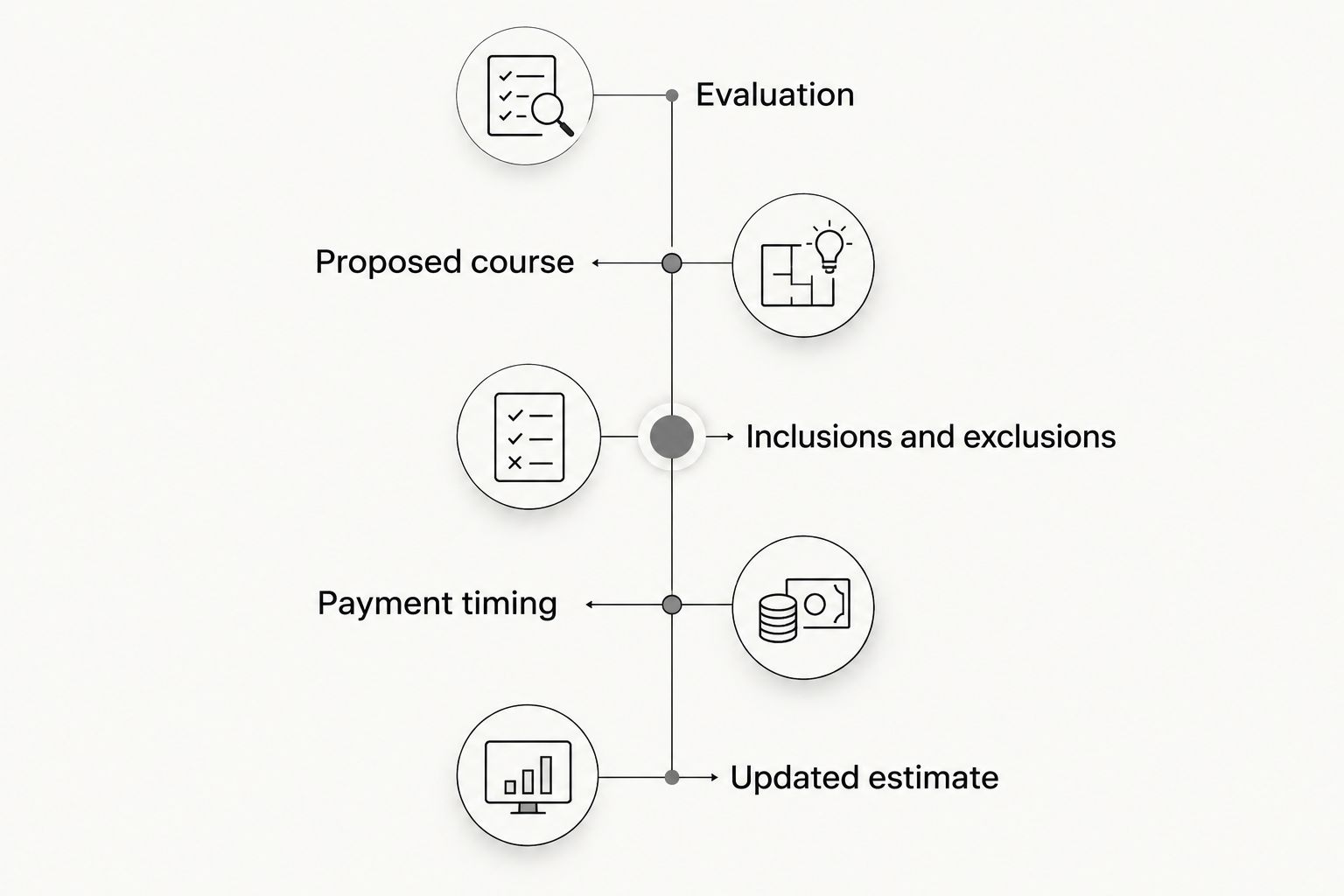
Why your TMS estimate varies
A TMS estimate needs to account for the proposed care and the clinic’s billing terms. Use these factors as questions to resolve, not as assumptions about what a particular practice charges.
- The prescribed course. Ask which treatment visits the estimate covers and how a revised clinical plan would affect your responsibility. A fee without a defined scope is not enough for budgeting.
- Included clinical services. Establish whether evaluation, planning, mapping, reassessment, and follow-up sit inside or outside the quoted course. The labels alone do not establish how a clinic bills them.
- Payment structure. Clarify whether you would pay by appointment, in advance, or under another arrangement. Payment timing and total responsibility are separate details.
- Interruption terms. Review the financial consequences of missed appointments, a pause, or early discontinuation. Ask for the actual policy rather than relying on a verbal summary.
- Care beyond the initial plan. Ask whether later reassessment or additional treatment would require a new estimate. Keep possible future care separate from your current commitment.
Your practical budget also includes transportation and time away from work or caregiving. Those are personal expenses, not clinic charges, but they still affect whether you can follow the proposed schedule. Map the appointments against your actual obligations before agreeing to treatment.
Is a TMS package better than paying per session?
Neither billing format is automatically better. Compare the same clinical scope, then compare the financial terms. A package label does not establish value, and a per-session arrangement does not establish flexibility.
| Billing format | Best for | Potential benefit | Limitation to check |
|---|---|---|---|
| Per-session billing | Reviewing charges appointment by appointment | Makes each treatment charge visible | Does not establish the full-course obligation by itself |
| Course-based billing | Reviewing the proposed course as a whole | Can make the included scope easier to review | Requires clear terms for changes, interruptions, and unused visits |
These are comparison formats, not a statement that a particular clinic offers both. Ask which arrangement applies and request the complete terms before choosing based on presentation alone.
Can you get an estimate before starting TMS?
You can request an estimate before committing to treatment; ask whether the clinic needs an evaluation before it can define the course. An initial estimate and a personalized treatment estimate serve different purposes, so establish which document you are receiving.
For your 2026 planning, ask when the estimate expires and whether it includes all reasonably anticipated services in the proposed course. If any part remains undecided, request an explanation of what determines it and when you will receive an updated estimate.
Does paying without insurance mean TMS is right for you?
No. Paying without insurance changes the financial arrangement, not the need for clinical assessment. Your symptoms, treatment history, and medical circumstances still need to guide the recommendation.
Attuned Psychiatry is an option for Decatur/Metro Atlanta patients seeking physician-led TMS care. The practice also offers medication management and SPRAVATO®, but the appropriate treatment requires an individualized assessment. Offering a treatment does not mean every patient is a candidate or that any outcome is guaranteed.
Use the contact page to ask how to arrange an evaluation and request self-pay information. Keep your questions specific: what the evaluation involves, when a personalized estimate becomes available, and which financial policies you can review before proceeding.
FAQ
How much does TMS therapy cost without insurance in 2026?
TMS therapy without insurance requires a clinic-specific, individualized estimate; there is no single standard total. Request a written breakdown of the proposed course, included services, and any separate charges before committing.
Does a TMS session fee include the initial evaluation?
A TMS session fee does not establish whether the initial evaluation is included. Ask the clinic to identify evaluation and treatment charges separately in writing.
Can I ask about TMS without committing to treatment?
You can ask about the evaluation process and financial terms before deciding to proceed. Confirm whether an evaluation itself carries a charge and what you would owe if TMS is not recommended.
Is paying per session better than paying for a TMS course?
Neither payment format is automatically better. Compare the same treatment scope, total financial responsibility, payment timing, and interruption terms.
What happens financially if I stop TMS early?
Your financial responsibility depends on the agreement you accept. Request the written cancellation, refund, and unused-appointment policies before making an advance payment.
Can I use self-pay TMS if I have insurance?
Ask the clinic how it handles patients who have insurance but want to pay directly. Confirm the billing arrangement before treatment and do not assume later reimbursement is available.
Does Attuned Psychiatry offer TMS in Metro Atlanta?
Attuned Psychiatry offers TMS as part of its physician-led psychiatric practice in Decatur/Metro Atlanta. Ask about an individualized evaluation and the self-pay estimate process.
What should I bring to a TMS evaluation?
Ask the practice which records it needs before your appointment. Prepare your treatment history and current medication information so the clinician can assess the proposed care.
One last thing
Ask for the financial consequences of a changed plan, not just the total for an unchanged one. That question tests whether an estimate is useful when real clinical decisions arise.
Before accepting a 2026 estimate, you should be able to explain what it covers, when payment is due, and what happens if treatment changes. If any answer remains unclear, resolve it before paying rather than trying to reconstruct the agreement afterward.
Related guides
Discuss TMS costs and coverage
Request an evaluation and ask how coverage verification and your proposed TMS plan are coordinated.


