

For conventional TMS for depression, plan on 30 sessions over 6 weeks, usually scheduled 5 days a week; some treatment plans reach 36 sessions when taper visits are included. In 2026, the number you need depends on the prescribed protocol and your response—not just the appointment count. Maintenance treatment, if recommended later, is separate from the initial course.
- How many TMS sessions do you need? Conventional depression treatment often involves 30 sessions, with some courses reaching 36.
- TMS usually requires weekday appointments; treatment response and the prescribed protocol determine the final schedule.
- Early improvement does not mean you should stop the remaining sessions without discussing the plan with your psychiatrist.
- Attuned Psychiatry offers physician-led TMS care for patients with treatment-resistant depression in Decatur/Metro Atlanta.
Why this matters
The session count tells you more about the practical commitment than the time spent in the treatment chair. You need room in your schedule for repeated appointments, travel, and clinical reviews—not just an occasional visit.
Before arranging work or family responsibilities, confirm whether your proposed course includes taper visits. You can review the practice’s psychiatric services, but your individual treatment schedule requires a clinical assessment. A typical course is a planning estimate, not a promise that a particular number of sessions will resolve depression.
How many TMS sessions do you need for depression?
A conventional depression course commonly includes 30 acute treatment sessions, delivered 5 days a week for 6 weeks. Some plans add taper visits, bringing the total to 36 sessions. Other protocols use different schedules, so the total must match the treatment being prescribed.
The National Institute of Mental Health’s Brain Stimulation Therapies patient guidance describes repetitive TMS treatment as typically occurring 5 times a week for 4–6 weeks. That broader description explains why you will encounter different session totals. For 2026 planning, ask which protocol applies to you rather than treating every published schedule as interchangeable.
| Treatment phase or approach | Typical scheduling pattern | Who it is for | Benefit and limitation |
|---|---|---|---|
| Conventional acute TMS | Often 30 sessions across 6 weeks | Patients prescribed a conventional initial depression course | Provides a structured treatment course; requires repeated weekday attendance |
| Taper visits | Some plans reach 36 total sessions after tapering | Patients whose prescribed course includes a gradual reduction in visit frequency | Spaces appointments farther apart; adds visits beyond the acute phase |
| Maintenance treatment | Individualized after the initial course | Selected patients who need an ongoing treatment strategy | Addresses continuing care needs; has no universal schedule |
| Accelerated treatment | Multiple sessions within a day under a specific protocol | Patients assessed as suitable for that protocol | Compresses the calendar; is not interchangeable with a conventional schedule |
These are different treatment arrangements, not a ranking of effectiveness. The best schedule is the one supported by your diagnosis, the specific protocol, and your psychiatrist’s assessment. A shorter calendar does not automatically mean fewer total treatments or a better fit.
Conventional TMS: 30 sessions over 6 weeks
Conventional TMS usually means attending treatment on weekdays across several weeks. A schedule of 5 sessions per week for 6 weeks adds up to 30 sessions. Each appointment is part of the prescribed course, even when your symptoms fluctuate between visits.
Repeated treatment matters because TMS is delivered as a course rather than a single intervention. Your clinician tracks whether depressive symptoms and daily functioning change as treatment progresses. An isolated good day or difficult day does not establish the final outcome.
The practical advantage is predictability: you know that treatment occupies a recurring part of your week. The drawback is the attendance commitment. If you are planning a conventional course in 2026, discuss upcoming travel, work changes, and caregiving responsibilities before treatment begins.
Ask how long your appointment will take from arrival to departure. The stimulation time and the total appointment time are not necessarily the same, and treatment duration differs by protocol. Do not use another patient’s appointment length to estimate your own.
Courses with taper visits: up to 36 total sessions
Some conventional plans include taper visits after the more frequent acute phase, bringing the course to 36 sessions. Tapering means appointments become less frequent rather than ending immediately after the weekday schedule. It is not the same as indefinite maintenance treatment.
Ask whether the total you have been given already includes tapering. A plan described as 30 sessions and a plan described as 36 sessions can refer to different portions of a similar overall treatment course. That distinction affects your calendar and your expectations about the final appointment.
Tapering is not a rule you should apply yourself. Your treating clinician determines whether it belongs in your plan and how the appointments are spaced. Do not add, remove, or spread out sessions without discussing the change with your treatment team.
Why the number of TMS sessions varies
Your session count is a clinical decision, not a target you must reach regardless of what happens during treatment. The main factors are:
- Treatment protocol. Conventional and accelerated schedules distribute sessions differently. Confirm the exact approach before comparing appointment totals.
- Symptom response. Changes in depression severity and everyday functioning help your psychiatrist assess whether the course is helping.
- Treatment tolerance. Scalp discomfort, headache, or other concerns require review. Adjustments depend on the issue and the prescribed treatment.
- Attendance interruptions. Missed appointments change the calendar and require scheduling guidance; they do not automatically mean starting over.
- Continuing care needs. Tapering, maintenance, or a later repeat course answers a different question from the initial acute treatment plan.
The same number of sessions does not guarantee the same outcome for different patients. Your treatment history, current symptoms, and safety assessment belong in the discussion, alongside the schedule itself.
What happens before your session count is finalized?
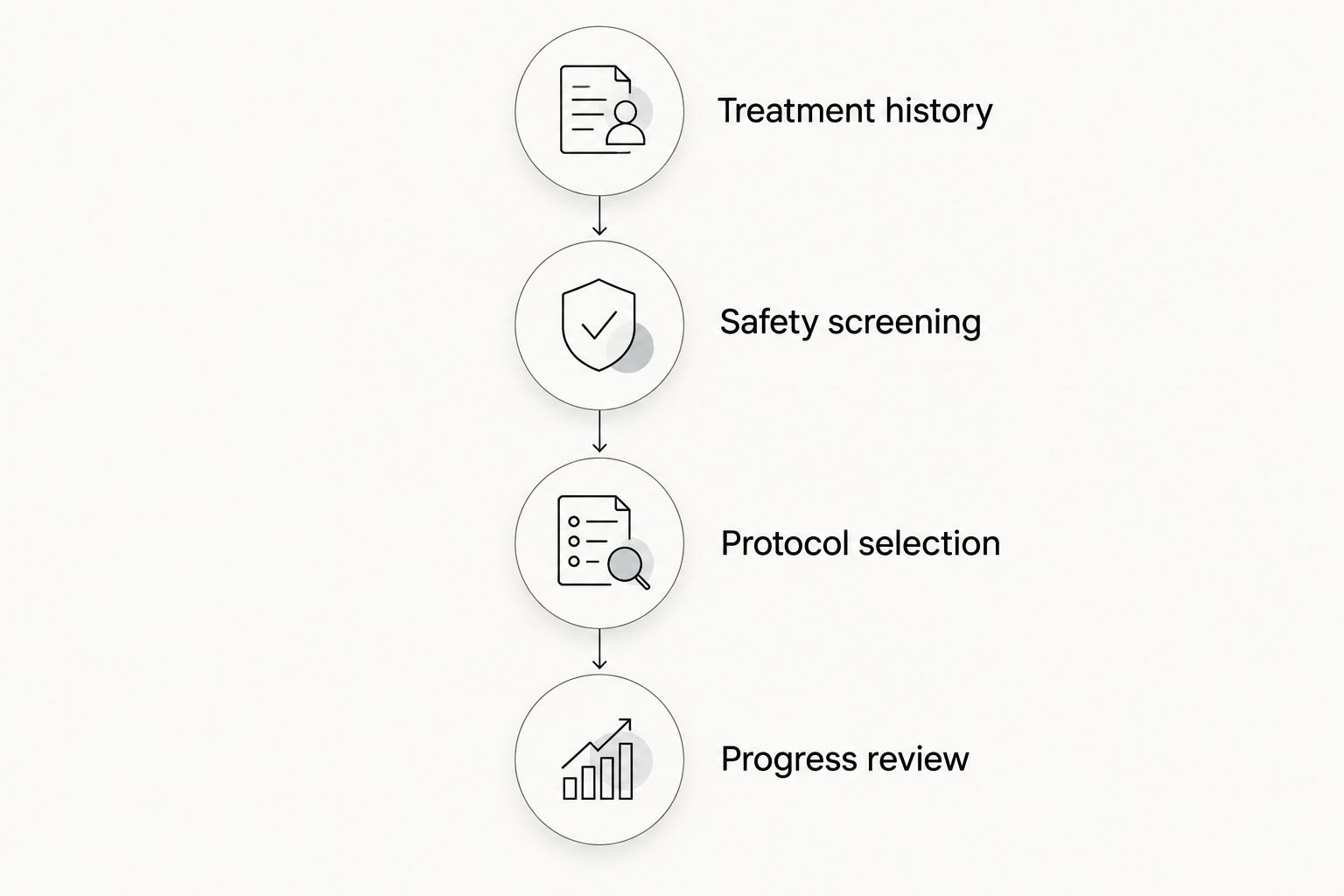
A useful evaluation connects the proposed treatment course to your actual history. Bring a medication list and any records that show which depression treatments you have tried, how long you took them, and what happened. Include side effects and reasons for stopping—not just medication names.
- Treatment history: Review prior treatment, current symptoms, and the reason TMS is being considered.
- Safety screening: Discuss implanted devices, metal near the head, seizure history, medications, and other relevant medical issues.
- Protocol selection: Confirm the treatment approach, expected appointment frequency, and whether tapering is included.
- Progress review: Agree on how symptoms, functioning, side effects, and attendance will be assessed during treatment.
The sequence prevents a common planning mistake: choosing a convenient session total before confirming that the treatment is appropriate. Suitability comes before scheduling. An appointment calendar cannot replace a psychiatric evaluation.
How will you know whether TMS is helping?
Track symptoms and functioning rather than judging treatment only by the session number. Your clinician can use standardized depression questionnaires alongside a discussion of sleep, concentration, interest, energy, and daily responsibilities. These measures make the review more specific than asking whether you feel better overall.
Look for changes you can describe plainly. Getting out of bed more consistently, returning to a task, or finding activities less difficult are useful observations to report. They do not replace formal assessment, and a change in one symptom does not establish remission.
Report worsening depression, marked agitation, or an unusually elevated mood promptly. Do not wait for a scheduled progress review when something feels significantly wrong. TMS treatment still requires ongoing psychiatric care and attention to safety.
Can you stop TMS once you start feeling better?
A 30-session plan should not be shortened simply because you notice early improvement. Tell your psychiatrist what has changed and ask whether the prescribed course should stay the same. Feeling better is information for the treatment review, not an instruction to cancel appointments.
The opposite situation also deserves discussion: reaching the middle of treatment without a clear benefit does not tell you, by itself, what the final outcome will be. Ask how your current symptoms compare with baseline and what findings would lead the clinician to reassess the plan.
Do not stop or change psychiatric medication on your own during TMS. Medication changes and new side effects belong in the same conversation as treatment progress, because your clinician needs an accurate picture of your care.
Does missing a TMS session mean starting over?
Missing a session in a 30-session course does not automatically mean restarting the entire course. Contact the clinic and ask how the interruption affects your schedule. The length and reason for the gap matter, so avoid trying to make up appointments yourself.
If repeated attendance is becoming difficult, raise the problem early. A workable plan needs to account for transportation, work, illness, and caregiving. For a course beginning in 2026, review known conflicts before the first treatment rather than waiting until appointments are missed.
What if depression returns after TMS?
Completing 30 or 36 sessions does not guarantee that depression will never return. If symptoms recur, your psychiatrist reassesses the symptoms, previous response, current treatment, and possible next steps. A repeat course and maintenance treatment are distinct decisions—not automatic extensions of the first course.
Ongoing care can include medication management, psychotherapy, or another clinically appropriate treatment. TMS does not replace the need to monitor depression after the acute course ends. Before finishing, ask whom to contact if symptoms begin to return.
Questions to settle before you schedule treatment
Get the treatment plan in clear language before committing to repeated visits. You should understand what is planned, what remains individualized, and when the clinician will review progress.
- Does the proposed total include both acute treatment and taper visits?
- How often will you attend, and what is the expected appointment length?
- How will the team measure improvement and review side effects?
- What should you do if you miss an appointment or become ill?
- What follow-up is planned after the initial course?
Attuned Psychiatry is a fit for patients seeking physician-led TMS evaluation for treatment-resistant depression in Decatur/Metro Atlanta. The practice also offers medication management and SPRAVATO® treatment. The appropriate choice depends on an individual assessment; this article cannot determine your eligibility, protocol, or session count.
Discuss your depression treatment plan
Ask about TMS evaluation, the proposed session schedule, and follow-up care.
FAQ
How many TMS sessions do you need for depression in 2026?
Conventional TMS for depression often involves 30 sessions over 6 weeks, with some plans reaching 36 sessions when taper visits are included. Your prescribed protocol and clinical response determine the individual plan.
Do you have to attend TMS every weekday?
Conventional TMS is commonly scheduled 5 days a week during the acute course. Other protocols use different schedules, so confirm the approach your psychiatrist is prescribing.
Is TMS guaranteed to work after 30 sessions?
No, 30 TMS sessions do not guarantee improvement or remission. Your clinician assesses symptoms and functioning throughout treatment and discusses next steps based on your response.
Can you finish TMS sooner if you feel better?
Do not shorten your prescribed TMS course without discussing it with your psychiatrist. Early improvement should be documented and reviewed rather than used to cancel remaining appointments yourself.
Are taper sessions the same as maintenance TMS?
Taper sessions and maintenance TMS are different. Tapering reduces appointment frequency after an acute course, while maintenance refers to an individualized ongoing treatment strategy.
Can you drive after a TMS appointment?
Standard TMS does not require sedation, and patients can generally drive afterward. Follow your clinician’s instructions if symptoms, side effects, or another medication affect your ability to drive safely.
Does Attuned Psychiatry offer TMS for treatment-resistant depression?
Attuned Psychiatry offers TMS for patients with treatment-resistant depression in Decatur/Metro Atlanta. A physician-led assessment determines whether TMS is appropriate and what treatment schedule to recommend.
One last thing
Ask for a written schedule that separates acute sessions, taper visits, and follow-up. That distinction is more useful than a session total alone: it shows what you are committing to and when the treatment plan will be reviewed.
For your 2026 treatment planning, keep the central rule simple: prepare for a course of care, not a guaranteed result at a particular appointment. If depression includes thoughts of suicide or you feel unable to stay safe, call or text 988 in the United States; call 911 for an immediate emergency.


