

For treatment-resistant depression, the standard SPRAVATO® schedule starts with 12 treatment visits over the first 8 weeks: twice weekly for 4 weeks, then weekly for 4 weeks. In 2026, there is no fixed lifetime treatment count; continued treatment depends on your response, and each appointment includes at least 2 hours of monitoring after the dose.
- How many SPRAVATO treatments do you need? The standard treatment-resistant depression schedule starts with 12 visits over 8 weeks.
- Maintenance treatment begins after the initial phases, with frequency based on your response and clinical assessment.
- Each SPRAVATO appointment requires at least 2 hours of monitoring; arrange transportation home.
- Attuned Psychiatry offers physician-led treatment-resistant depression care in Decatur/Metro Atlanta, including SPRAVATO.
Why this matters
Plan for a treatment schedule, not a fixed course with a guaranteed finish date. The initial visits establish whether SPRAVATO helps and whether you tolerate it. Later appointments focus on maintaining benefit at an appropriate frequency.
The calendar also affects your work, transportation, and other commitments. Attuned Psychiatry includes SPRAVATO among its psychiatric services, alongside medication management and TMS. An evaluation determines whether SPRAVATO fits your diagnosis and treatment history; a visit count alone cannot answer that question.
How many SPRAVATO treatments do you need?
For adults with treatment-resistant depression, the FDA-approved prescribing information gives the following schedule. The first checkpoint comes at the end of the induction phase, when your clinician evaluates the evidence of benefit before deciding whether to continue.
Standard treatment-resistant depression schedule in 2026
| Treatment phase | Timing | Scheduled frequency | Visits during that phase | Best for |
|---|---|---|---|---|
| Induction | Weeks 1–4 | Twice weekly | 8 visits | Establishing initial benefit and tolerability |
| Early maintenance | Weeks 5–8 | Once weekly | 4 visits | Continuing treatment when clinically appropriate |
| Ongoing maintenance | Week 9 onward | Once weekly or every 2 weeks | No fixed total | Maintaining response at an individualized frequency |
These phases are parts of one treatment plan, not competing packages. The advantage of the schedule is that it includes reassessment rather than committing you to indefinite treatment from the start. The limitation is practical: you cannot know your final number of visits before your response is assessed.
Twelve visits describes the standard first 8 weeks, not a promise that treatment ends then. Do not change your appointment frequency without discussing it with your prescriber.
Induction: 8 visits over 4 weeks
The induction phase uses twice-weekly treatment for the first 4 weeks. This gives your clinician a defined period to assess symptom changes, side effects, and whether continuing treatment makes sense.
Before starting, describe what depression is preventing you from doing. Getting out of bed, preparing meals, concentrating, and participating in relationships give the clinical discussion more substance than simply asking whether you feel better.
Your clinician can use symptom assessments alongside your account of daily functioning. Report both improvement and problems after treatment, including sedation, dissociation, nausea, or other effects that interfere with your day.
The end of induction is a decision point, not an automatic renewal. The prescribing information calls for evaluating evidence of therapeutic benefit after this phase to determine the need for continued treatment. An incomplete response requires discussion; it does not establish, by itself, which next step is appropriate.
Early maintenance: 4 visits over 4 weeks
For treatment-resistant depression, the next scheduled phase is once-weekly treatment during weeks 5–8. That adds 4 visits to the initial 8, producing the standard total of 12 visits through week 8.
The benefit is fewer appointments than during induction while treatment continues. The limitation is that weekly attendance still requires transportation and protected time away from other responsibilities.
Keep reporting what happens between appointments, not just how you feel immediately afterward. A useful account includes whether improvements last, whether symptoms return before the next visit, and whether daily tasks are becoming easier.
Do not interpret a move to weekly treatment as proof that depression has resolved. It is the scheduled next phase, with continued clinical assessment. Your clinician still needs to evaluate both benefit and tolerability.
Ongoing maintenance: weekly or every 2 weeks
From week 9 onward, the treatment-resistant depression schedule allows once-weekly treatment or treatment every 2 weeks. The prescribing information directs clinicians to individualize frequency to the least frequent dosing that maintains remission or response.
Maintenance has no universal final visit number. Your clinician uses your symptom course and treatment response to decide whether the current interval remains appropriate.
Less frequent appointments reduce the scheduling burden, but a longer interval is not automatically the right choice. Tell your treatment team if symptoms return or functioning declines between sessions rather than waiting for a routine review.
A maintenance discussion should also cover how your progress will be reviewed and what happens if symptoms worsen. An ongoing plan needs clear reassessment points, even when it does not have a predetermined end date.
Why your SPRAVATO treatment count varies
In 2026, the standard schedule provides the starting framework; your clinical course determines what follows. These factors shape the decision:
- Treatment indication: The treatment-resistant depression schedule differs from the schedule for depressive symptoms in adults with major depressive disorder and acute suicidal ideation or behavior.
- Evidence of benefit: Your prescriber evaluates whether symptoms and functioning improve enough to support continued treatment.
- Tolerability: Side effects and safety findings affect whether treatment remains appropriate.
- Maintenance response: How well improvement holds between appointments informs the ongoing interval.
- Interruptions: Missed sessions require instructions from your treatment team, especially if symptoms worsen during a gap.
- Ongoing assessment: Changes in your condition or overall treatment plan require clinical review rather than an automatic continuation.
These are reasons to individualize care, not reasons to predict a longer course before treatment begins. Ask your prescriber which findings would support continuing, spacing out, changing, or stopping treatment.
How do you decide whether to continue treatment?
A useful review connects your appointment schedule to specific clinical decisions. Before each major transition, make sure you understand what your clinician is assessing and what the next step means.
- Confirm the indication. Ask which diagnosis and treatment indication the proposed schedule addresses. Do not assume every SPRAVATO treatment plan follows the treatment-resistant depression calendar.
- Track the response. Describe changes in symptoms and daily functioning, including what has not improved. Bring observations from the days between appointments.
- Review tolerability. Report side effects and safety concerns, even when treatment also appears helpful. Benefit and tolerability both belong in the decision.
- Set the interval. Ask why the next appointment frequency fits your current response and when that decision will be reviewed.
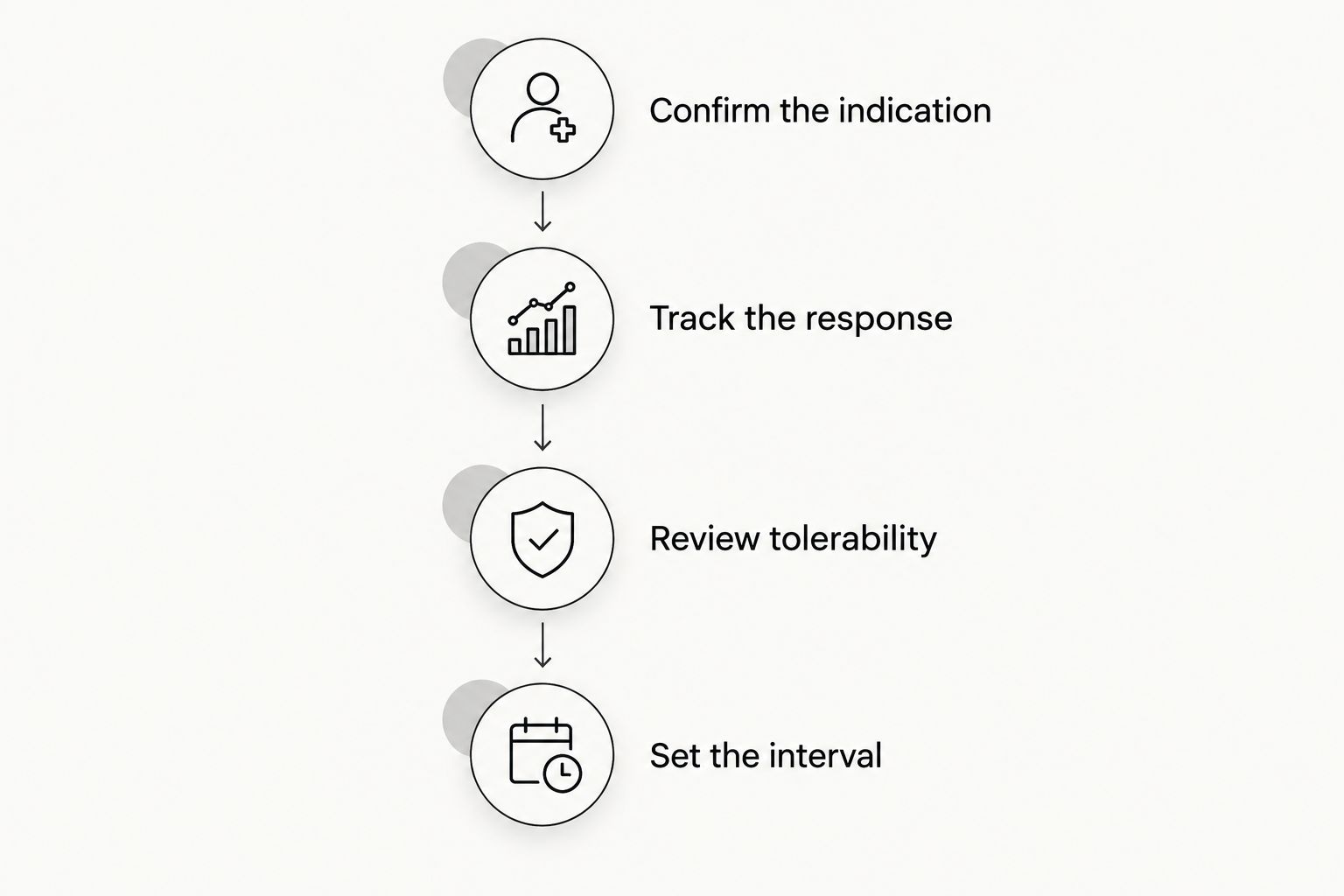
Bring the same concerns to each review so changes are easier to discuss. If your goal is returning to work or managing household tasks, tell your clinician whether those abilities have changed—not just whether the treatment day felt different.
What does each SPRAVATO appointment require?
A treatment visit includes more than administering the nasal spray. SPRAVATO is given under healthcare supervision in a certified healthcare setting, with monitoring afterward because of risks including sedation, dissociation, and respiratory depression.
Monitoring lasts at least 2 hours after administration. Your healthcare professional assesses whether you are clinically stable and ready to leave; reaching the minimum observation time does not guarantee discharge at that moment.
Arrange transportation home. The prescribing information instructs patients not to drive, operate machinery, or perform activities requiring complete mental alertness until the next day after a restful sleep.
That restriction matters when planning recurring visits. Do not build your calendar around driving yourself home or returning immediately to safety-sensitive work. Ask the clinic how arrival, treatment, monitoring, and discharge fit together so you can protect enough time without assuming that the observation minimum equals the entire appointment.
Is the schedule different for acute suicidal symptoms?
Yes. For depressive symptoms in adults with major depressive disorder and acute suicidal ideation or behavior, the labeled schedule is twice weekly for 4 weeks, used with an oral antidepressant. That is a different indication from the treatment-resistant depression maintenance pathway.
For this indication, treatment beyond 4 weeks has not been systematically evaluated. Your clinician assesses the need for continued treatment after the initial course; do not extend the treatment-resistant depression maintenance table to this situation on your own.
SPRAVATO has not been shown to prevent suicide or reduce suicidal ideation or behavior, and it does not replace hospitalization when clinically warranted. If you are in immediate danger or cannot keep yourself safe, call 911 or go to the nearest emergency department rather than waiting for an appointment.
Can I stop SPRAVATO after the first 8 treatments?
Eight treatments complete the standard 4-week induction phase for treatment-resistant depression; they do not establish an automatic stopping point. Your clinician evaluates the evidence of benefit at that checkpoint before recommending whether to continue.
Ask for a direct explanation of the decision. You should understand what improved, what remains unresolved, and why the proposed next step fits your situation.
Will I need SPRAVATO forever?
Twelve initial visits do not establish a lifelong commitment. Ongoing maintenance is individualized, and the prescribing information does not assign every patient a fixed lifetime course.
Discuss continued need, appointment frequency, and any proposed discontinuation with your prescriber. Feeling better is important information, but it is not a reason to cancel future treatment without a plan.
What happens if I miss a SPRAVATO treatment?
A missed treatment requires instructions from your treatment team, not a self-directed catch-up dose. The appropriate next step depends on the interruption and your symptoms.
Contact the clinic promptly, particularly if depression worsens during the gap. Do not assume that missing an appointment means restarting the entire course or simply moving to a less frequent schedule.
What should you ask before booking treatment?
Before starting SPRAVATO in 2026, ask for an explanation of the clinical plan as well as the appointment calendar. A clear discussion should cover:
- Which indication is being treated and why SPRAVATO is being considered.
- What records and previous treatment details the clinician needs.
- How benefit and side effects will be assessed after induction.
- What transportation and post-treatment restrictions you need to arrange.
- Who to contact about missed appointments, worsening symptoms, or side effects.
Attuned Psychiatry serves Decatur/Metro Atlanta patients seeking physician-led care for treatment-resistant depression. You can review information about the practice and schedule an evaluation to discuss whether its treatment options fit your needs. An evaluation is not a guarantee that SPRAVATO will be recommended.
Discuss your depression treatment plan
Request an evaluation to discuss your treatment history and whether SPRAVATO is appropriate.
FAQ
How many SPRAVATO treatments do you need at the beginning?
For treatment-resistant depression, the standard initial schedule is 12 visits over 8 weeks. That consists of twice-weekly treatment for 4 weeks, followed by weekly treatment for 4 weeks, when continued treatment is clinically appropriate.
How often do you get SPRAVATO after the first month?
For treatment-resistant depression, the standard schedule is once weekly during weeks 5–8. From week 9 onward, treatment is once weekly or every 2 weeks, individualized to maintain remission or response.
How long does a SPRAVATO appointment take?
SPRAVATO requires at least 2 hours of monitoring after administration. The full appointment also includes preparation, administration, and a clinical assessment before discharge.
Can I drive home after SPRAVATO?
No, you should arrange transportation home after SPRAVATO. Do not drive or perform activities requiring complete mental alertness until the next day after a restful sleep.
Does everyone need maintenance SPRAVATO?
Continued SPRAVATO treatment depends on clinical benefit and assessment, not a universal requirement. For treatment-resistant depression, your clinician evaluates evidence of benefit after induction before deciding whether to continue.
What if SPRAVATO is not helping after induction?
Your clinician should reassess the evidence of benefit after the 4-week induction phase. Discuss symptom changes, functioning, and side effects before deciding whether continued treatment is appropriate.
Where can I discuss SPRAVATO treatment in Decatur or Metro Atlanta?
Attuned Psychiatry offers SPRAVATO as part of its physician-led psychiatric care in Decatur/Metro Atlanta. An evaluation determines whether the treatment fits your diagnosis, history, and clinical needs.
One last thing
Count treatment visits, not nasal spray devices. A prescribed SPRAVATO dose can require multiple devices during the same appointment; those devices do not represent separate treatment sessions. When planning time away from work or arranging rides, use the visit schedule.
Clinical reference for this 2026 guide: FDA-approved SPRAVATO prescribing information and Medication Guide, covering dosing, monitoring, driving restrictions, and limitations of use. This information supports a discussion with your prescriber; it does not replace an individualized treatment plan.


