
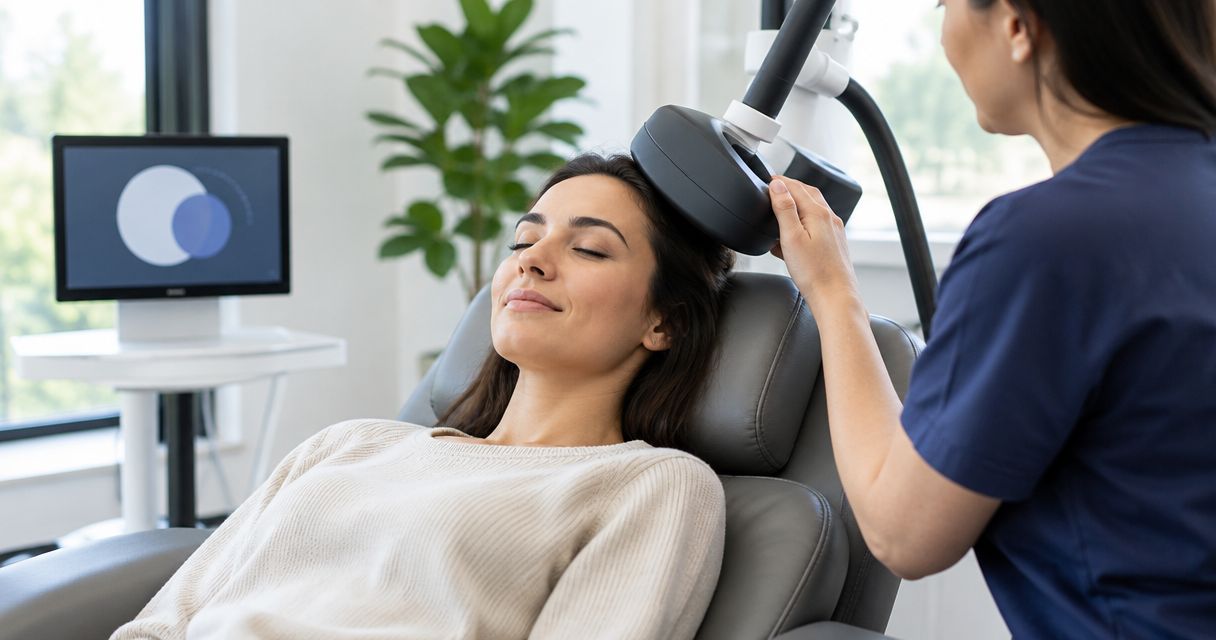
A TMS session involves 37.5 minutes of stimulation with the conventional protocol studied in the THREE-D trial, versus 3 minutes with intermittent theta-burst stimulation (iTBS). Your full appointment also includes positioning, equipment setup, and symptom checks, so stimulation time is not your total visit time. For your 2026 schedule, confirm the prescribed protocol and the clinic’s arrival-to-departure estimate before arranging work or transportation.
- How long does a TMS session last? The THREE-D trial compared 37.5-minute conventional rTMS with 3-minute iTBS stimulation.
- Shorter stimulation does not mean a shorter treatment course or an appropriate protocol for every patient.
- Attuned Psychiatry provides physician-led psychiatric care, including TMS, in Decatur/Metro Atlanta.
- Ask for total appointment time, first-visit length, and the prescribed treatment schedule before planning your calendar.
Why this matters
You need the appointment length, not just the device’s treatment timer. A brief stimulation protocol still requires the team to position the coil, review relevant changes, and check your comfort.
Attuned Psychiatry offers physician-led TMS care for patients in Decatur/Metro Atlanta. When discussing treatment, separate the clinical question—whether TMS fits your condition—from the scheduling question: whether you can attend the prescribed visits.
For treatment planning in 2026, ask the clinic to distinguish stimulation time, appointment time, and the length of the entire course. Those are different commitments, and a short answer about one does not answer the others.
How long does a TMS session last?
The clearest comparison comes from Blumberger and colleagues’ 2018 THREE-D trial in The Lancet. In adults with treatment-resistant depression, the study compared conventional repetitive transcranial magnetic stimulation, or rTMS, delivered over 37.5 minutes with iTBS delivered over 3 minutes.
Those figures describe the study’s stimulation protocols. They do not establish the appointment length for every TMS device, prescription, or clinic.
| Protocol | Stimulation time in THREE-D | Best for | Main advantage | Main limitation |
|---|---|---|---|---|
| Conventional rTMS | 37.5 minutes | Patients whose clinician selects the conventional protocol | An established approach studied for depression | Longer stimulation time than the iTBS protocol compared in the trial |
| iTBS | 3 minutes | Patients whose clinician determines iTBS is appropriate | Substantially shorter stimulation in the studied protocol | Short treatment time does not establish individual suitability or guarantee improvement |
The trial found iTBS noninferior to the conventional protocol for reducing depressive symptoms under its study conditions. That finding supports iTBS as a clinical option; it does not mean that every short TMS protocol is interchangeable with every longer one.
Choose the prescribed treatment on clinical grounds, then plan around its actual appointment length. A device’s shortest advertised setting is not enough information to make that decision.
Conventional rTMS: 37.5 minutes in the THREE-D trial
The conventional rTMS protocol in THREE-D delivered stimulation over 37.5 minutes. Treatment includes periods of stimulation separated by pauses, rather than one uninterrupted magnetic pulse.
You remain awake during standard outpatient TMS. A coil rests against your head while the device delivers magnetic pulses to a selected brain region; routine treatment does not require general anesthesia.
The benefit of this timing figure is specificity: it describes an identifiable protocol from a published clinical comparison. Its limitation is equally important: 37.5 minutes is not a universal duration for all conventional TMS sessions.
Your clinician should identify the protocol being prescribed and explain its expected stimulation time. Do not assume that another patient’s appointment length applies to your treatment, even if both appointments are described as TMS for depression.
Ask whether the time you are given includes the chair setup and any check-in with staff. That distinction matters when you are deciding whether an appointment fits between other commitments.
iTBS: 3 minutes in the THREE-D trial
The iTBS protocol in THREE-D delivered stimulation over 3 minutes. It uses a different pattern of magnetic pulses from the conventional rTMS protocol studied alongside it.
Its practical advantage is the shorter stimulation period. Its limitation is that a 3-minute protocol is not a promise of a 3-minute visit, and shorter treatment does not guarantee a particular result.
If you are comparing TMS options in 2026, ask whether iTBS is clinically appropriate for you and available within your proposed treatment plan. Do not assume a practice offers a particular protocol simply because it offers TMS.
The prescription still depends on your diagnosis, treatment history, safety screening, and clinician’s assessment. Convenience belongs in that conversation, but it does not replace it.
Also distinguish a short session from an accelerated course. A brief stimulation period describes how treatment is delivered during a session; an accelerated schedule changes how sessions are arranged across the day or treatment course.
Why TMS appointment length varies
The published stimulation time is only part of your calendar commitment. These factors explain why the time in the clinic differs from the time the device is delivering treatment:
- Protocol: The prescribed pulse pattern and settings determine the stimulation period. Conventional rTMS and iTBS do not use the same timing.
- Initial mapping: Before treatment begins, the team identifies treatment parameters, including your motor threshold. This makes the initial appointment different from a routine session.
- Positioning: Staff must place the coil at the intended treatment location and confirm a suitable position before stimulation starts.
- Clinical review: Changes in symptoms, medication, sleep, or health need discussion because they can affect treatment planning and safety.
- Comfort adjustments: Scalp discomfort or difficulty tolerating stimulation needs attention rather than pressure to finish quickly.
These factors are reasons to ask for a visit estimate, not reasons to expect an unexplained delay every day. Ask the clinic which parts occur at every session and which belong mainly to the initial visit or a reassessment.
What happens during a routine TMS appointment?
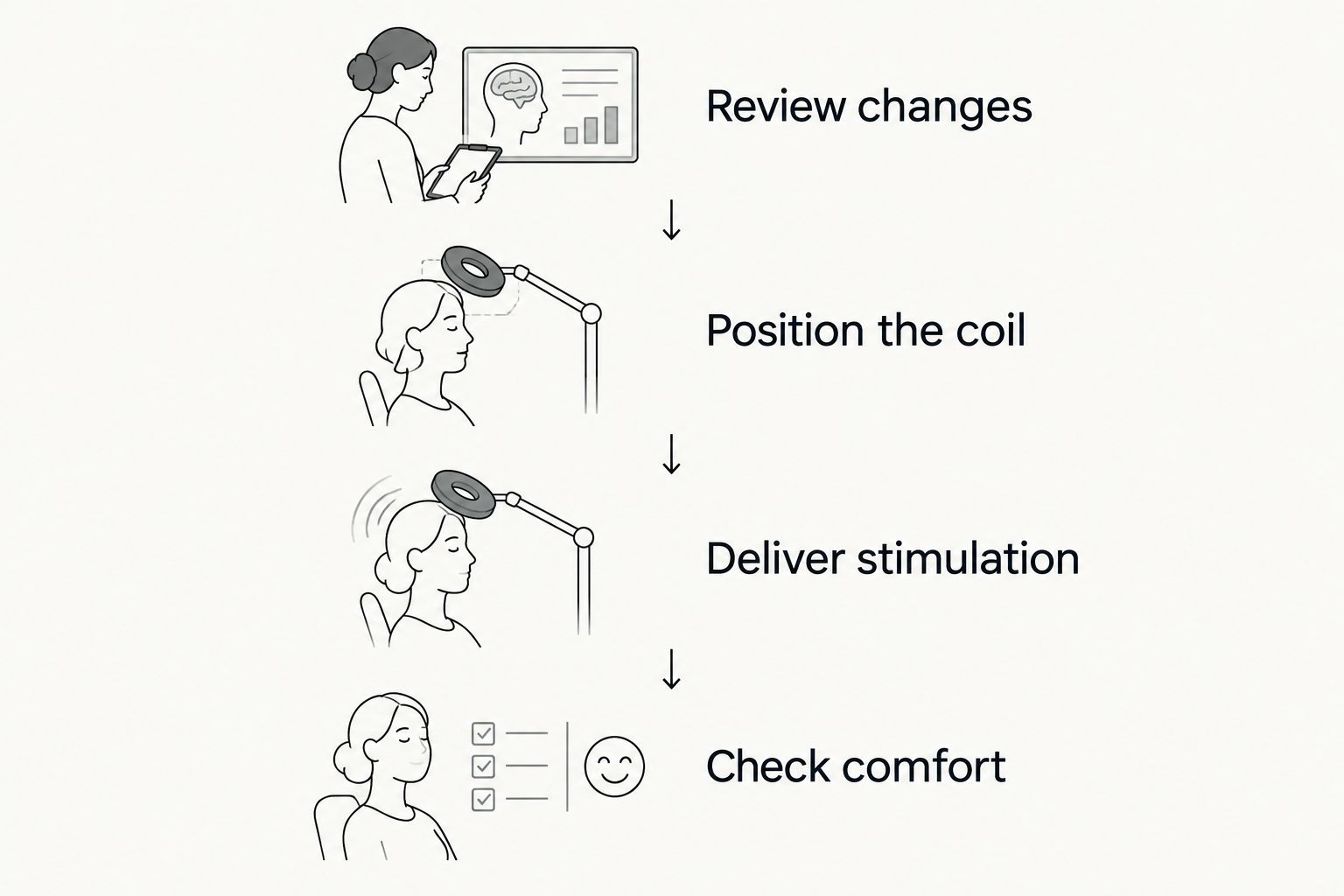
A routine appointment follows a repeatable process, although the details depend on the prescription. Knowing the steps helps you understand why the stimulation timer and the appointment calendar are not identical.
- Review changes. Tell the team about relevant changes in symptoms, medications, sleep, or health. Report concerns before treatment starts rather than waiting until the visit ends.
- Position the coil. Staff position you and the treatment coil according to your prescribed treatment location. Consistent positioning is part of delivering the planned treatment.
- Deliver stimulation. The device delivers the prescribed pulse sequence while you remain awake. Use the hearing protection provided and follow the team’s instructions.
- Check comfort. Tell staff about pain, headache, or other symptoms. Before leaving, clarify anything that affects your next appointment or your ability to resume activities.
The initial visit adds assessment and setup that are not identical to a routine treatment session. Request a separate estimate for the first appointment, rather than using the ongoing-session estimate for both.
How long does the full TMS treatment course take?
The National Institute of Mental Health describes a typical conventional rTMS course as treatment 5 days per week for 4–6 weeks. That is a general description of an acute course, not a prescription for every patient or every protocol.
For your 2026 calendar, the repeated visits can matter more than the duration of a single stimulation period. Travel, parking, check-in, and the return trip remain part of your personal time commitment even when stimulation is brief.
A treatment course also differs from a response timeline. Finishing a session does not establish whether treatment is working; your clinician evaluates symptom changes across the course and adjusts the plan when appropriate.
Ask how progress will be measured and when you will review it together. Do not shorten, combine, or stop sessions on your own because a different schedule appears more convenient.
What should you ask before scheduling TMS?
Bring specific questions rather than asking only whether treatment is “quick.” The answers should let you plan your calendar without confusing a general description with your individual prescription.
- Which protocol are you recommending? Ask for its name and stimulation time, not simply the device’s shortest possible treatment setting.
- How long is the first visit? Confirm whether assessment, mapping, and treatment happen during the same appointment or separate appointments.
- How much time should I reserve for routine visits? Request an arrival-to-departure estimate rather than the stimulation time alone.
- What is my prescribed schedule? Clarify the expected visit frequency, course length, and process for missed appointments.
- What should I report before treatment? Ask about medication changes, sleep disruption, new health concerns, and implanted devices or metal near the head.
- What happens if treatment is uncomfortable? Know how to alert the team and how tolerability concerns are assessed.
Attuned Psychiatry’s TMS care sits within a physician-led psychiatric practice that also offers medication management and SPRAVATO® treatment. That identifies the practice’s services; it does not determine which treatment or TMS protocol is right for you.
Use the scheduling page to arrange an appointment and discuss the clinical assessment and time commitment.
Can I return to work after a TMS session?
Standard TMS does not require general anesthesia, so it does not involve recovery from anesthesia after each routine session. Many patients continue ordinary activities after treatment, but your symptoms, side effects, and clinician’s instructions determine what is appropriate for you.
Headache and scalp discomfort are recognized TMS side effects. Tell the treatment team if either interferes with concentration or daily activities, and follow individualized advice about driving or returning to work.
For a first appointment, avoid planning around the shortest possible departure time. Establish how you tolerate treatment before assuming every visit will fit into a tightly packed break.
Does a shorter TMS session work as well?
The 3-minute iTBS protocol was noninferior to the 37.5-minute conventional rTMS protocol in the THREE-D trial’s adult treatment-resistant depression population. That is a finding about specified protocols and study conditions, not a guarantee for an individual patient.
Longer stimulation is not automatically better, and shorter stimulation is not automatically appropriate. Ask your clinician why the selected protocol fits your treatment history and how response will be evaluated.
The useful comparison is clinical suitability plus treatment burden—not minutes alone. A schedule you can attend matters, but it must still deliver the treatment your clinician prescribes.
FAQ
How long does a TMS session last from start to finish?
Total TMS appointment length includes setup and clinical checks as well as stimulation. The THREE-D trial compared 37.5-minute conventional rTMS with 3-minute iTBS stimulation; ask your clinic for the full arrival-to-departure estimate.
Is the first TMS appointment longer than later appointments?
The first TMS appointment includes assessment or setup steps that differ from routine sessions, including determining treatment parameters. Request a first-visit estimate separately from the estimate for ongoing treatment.
Is a 3-minute TMS treatment real?
A 3-minute iTBS stimulation protocol was studied in the THREE-D trial for adults with treatment-resistant depression. That duration refers to stimulation, not the entire clinic appointment or treatment course.
How many days a week do you get TMS?
The National Institute of Mental Health describes typical conventional rTMS treatment as 5 days per week for 4–6 weeks. Your clinician determines the schedule for your prescribed protocol.
Do I need someone to drive me home after TMS?
Routine TMS does not require general anesthesia, but driving advice depends on your health, symptoms, and treatment plan. Ask your clinician before the first visit rather than assuming your transportation needs.
Does a longer TMS session mean better results?
A longer TMS session does not automatically mean better results. In THREE-D, the specified 3-minute iTBS protocol was noninferior to the specified 37.5-minute conventional rTMS protocol for the studied population.
Can I schedule TMS during my lunch break?
TMS fits a lunch break only if the full appointment and travel fit your available time. Confirm routine visit length and consider how treatment affects you before making a recurring work commitment.
One last thing
The number most useful for your calendar is not the shortest treatment setting—it is your expected time from arrival to departure. Ask for that estimate separately from stimulation time, then confirm how the first visit differs.
Before starting TMS in 2026, have Attuned Psychiatry explain the proposed protocol, appointment length, and course schedule together. Those answers turn a general timing question into a workable treatment plan.
Related guides
Discuss your TMS appointment schedule
Request an evaluation and ask about the proposed protocol, appointment length, and course schedule.


