

SPRAVATO’s immediate effects, such as dizziness or feeling disconnected, usually resolve on the treatment day; depression relief follows a different timeline and often requires continued treatment. There is no fixed number of days that one dose controls depression for every patient. Your response, treatment schedule, and symptoms between visits determine how long the benefit lasts—not how long you feel the medication after a session.
- How long do SPRAVATO effects last? Same-day side effects and antidepressant benefits follow different timelines.
- SPRAVATO requires monitoring for at least 2 hours after each dose, even when you feel ready sooner.
- Maintenance treatment depends on your response; feeling better does not establish that treatment is finished.
- Attuned Psychiatry offers physician-led SPRAVATO treatment for patients with treatment-resistant depression in Decatur/Metro Atlanta.
Why this matters
Feeling less dizzy does not mean the antidepressant benefit has ended. Feeling disconnected does not prove the treatment is working, either. These are different effects, and confusing them makes it harder to judge progress.
For patients considering care at Attuned Psychiatry, the useful question is whether depression improves between appointments and whether the treatment remains tolerable. This 2026 guide separates the visit-day experience from the longer treatment plan, using the FDA-approved SPRAVATO prescribing information and Medication Guide as the clinical reference.
How long do SPRAVATO’s effects last?
SPRAVATO has no single duration that describes both its side effects and its antidepressant benefit. The FDA-approved treatment schedule uses repeated doses, with frequency adjusted according to response rather than a universal expiration time for each dose.
| What you mean by effects | Expected timeline | What that means for you |
|---|---|---|
| Dizziness, sedation, or feeling disconnected | Usually resolve on the treatment day, but recovery varies | You still need monitoring and clearance before leaving |
| Required observation | At least 2 hours after each treatment | The minimum observation period is not a guarantee that you are ready to leave |
| Depression relief | Onset and persistence vary between patients | Judge benefit through symptoms and functioning between visits |
| Ongoing symptom control | Assessed across initial and maintenance treatment | Your prescriber adjusts frequency according to response |
| Driving restriction | Until the next day after a restful sleep | Feeling normal before then does not remove the restriction |
Some patients experience improvement early in treatment. Others need repeated sessions before a meaningful change becomes clear, and some do not respond. An early improvement also does not establish how long the benefit will persist.
Ask your prescriber to distinguish three questions: Are the immediate effects resolving safely? Is depression improving? Is that improvement holding between appointments? Each question requires a different assessment.
Immediate effects: at least 2 hours of monitoring
SPRAVATO is administered under supervision in a certified healthcare setting. The FDA prescribing information requires monitoring for at least 2 hours after administration because of risks that include sedation, dissociation, and respiratory depression.
Dissociation can feel like detachment from your body, surroundings, or sense of time. Dizziness, nausea, sleepiness, and changes in blood pressure can also occur. Tell the treatment team what you feel rather than deciding on your own that an unfamiliar symptom is expected.
The observation period is a safety requirement, not a countdown to automatic discharge. A healthcare professional assesses whether you are clinically stable before you leave; some patients need longer observation.
For your 2026 appointment planning, arrange transportation home before treatment. Do not drive, operate machinery, or do other activities requiring full alertness until the next day after a restful sleep, even if the noticeable effects have ended.
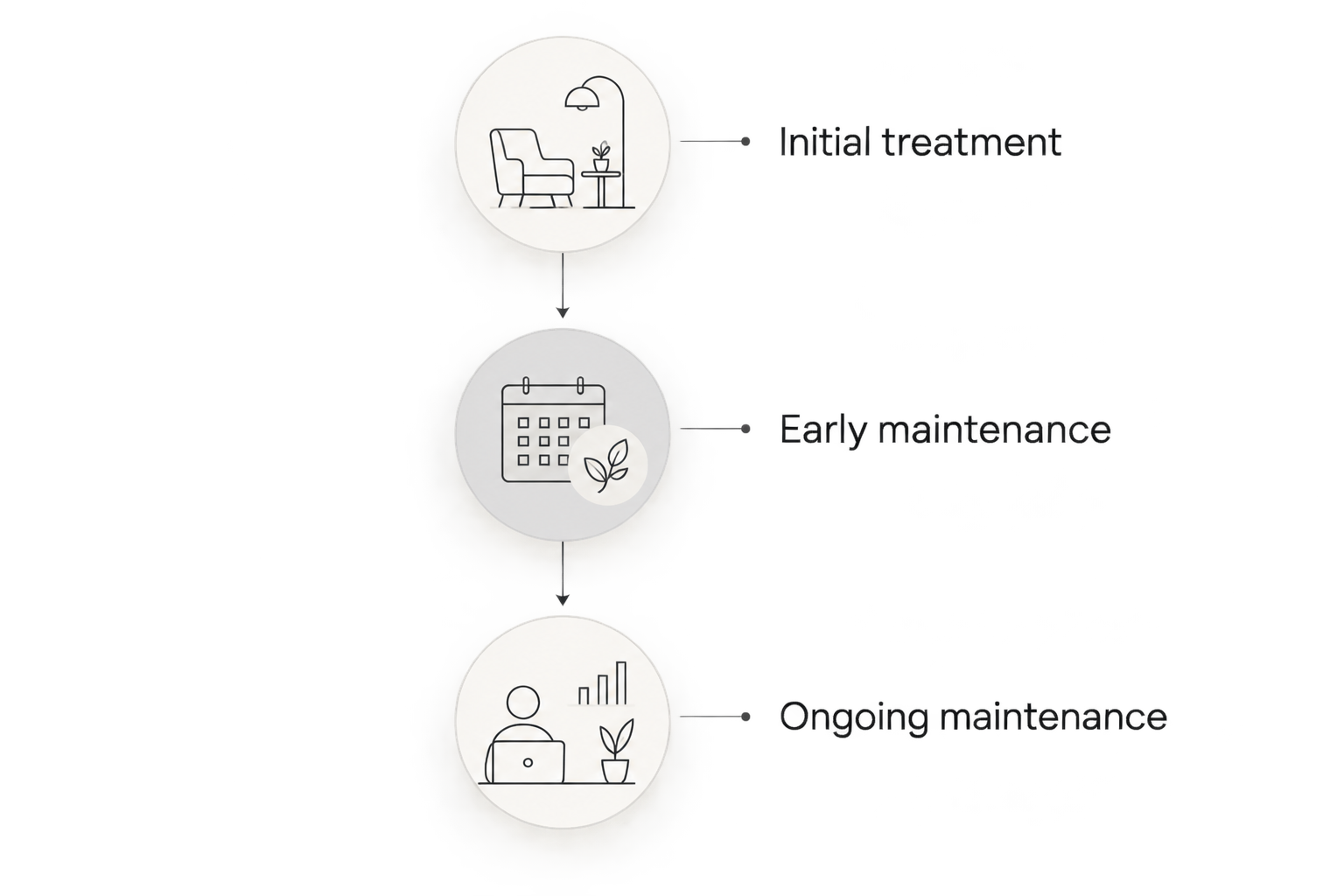
Initial treatment: twice weekly for 4 weeks
For adults receiving SPRAVATO for treatment-resistant depression, the FDA-labeled initial schedule is twice weekly during weeks 1–4. Repeated appointments allow your prescriber to assess both benefit and tolerability.
The advantage of this phase is structured assessment rather than relying on a single experience. The limitation is the practical burden: treatment involves supervised administration, observation, and transportation arrangements at each visit.
At the end of the initial phase, your clinician evaluates evidence of benefit to determine whether continued treatment makes sense. Do not treat the first session as a pass-or-fail test. A dramatic sensation during treatment is not the same as a sustained improvement in depression.
Keep track of changes that matter outside the treatment room: getting out of bed, completing daily tasks, concentrating, or reconnecting with people. Share worsening symptoms as well as improvements so the assessment reflects your actual experience.
Early maintenance: once weekly during weeks 5–8
The FDA-labeled treatment-resistant depression schedule moves to once weekly during weeks 5–8. This phase continues treatment while the clinician evaluates whether improvement persists between visits.
Fewer appointments reduce the visit burden compared with the initial phase. They do not mean that depression is permanently resolved or that treatment can stop without a plan.
If symptoms return before your next appointment, describe when the change begins and how it affects daily life. A brief difficult period and a sustained return of depressive symptoms require clinical interpretation, not an automatic assumption that the medication has stopped working.
Do not change other psychiatric medicines to compensate without instructions. Your prescriber needs an accurate account of the full treatment plan to judge what is happening.
Ongoing maintenance: weekly or every 2 weeks from week 9
From week 9 onward, the FDA-labeled schedule for treatment-resistant depression is weekly or every 2 weeks. The prescribing information directs clinicians to individualize treatment to the least frequent dosing that maintains remission or response.
The benefit of a less frequent schedule is fewer treatment visits. The trade-off is that the interval must still provide adequate symptom control; a longer gap is not automatically the better plan.
| Treatment phase | FDA-labeled frequency for treatment-resistant depression | Main decision |
|---|---|---|
| Initial treatment | Twice weekly during weeks 1–4 | Is there evidence of benefit, and is treatment tolerable? |
| Early maintenance | Once weekly during weeks 5–8 | Does improvement persist between visits? |
| Ongoing maintenance | Weekly or every 2 weeks from week 9 | What is the least frequent schedule that maintains response? |
These are treatment phases, not promises about how long an individual dose lasts. In 2026, your personal schedule still requires a prescribing decision based on symptoms, safety, and response.
Why the duration of SPRAVATO benefit varies
The standard schedule provides a framework. It does not predict the exact day your symptoms will improve or return. Your clinician considers several factors when interpreting the pattern:
- Treatment phase: A response during initial treatment does not establish the maintenance interval you will need later.
- Degree of improvement: Partial improvement and remission are different outcomes. Your clinician assesses what has changed and what symptoms remain.
- Symptoms between visits: Sustained improvement matters more than a brief change immediately after administration.
- Tolerability and safety: Side effects and clinical assessments influence whether and how treatment continues.
- Treatment interruptions: A missed appointment needs individualized instructions, particularly if depressive symptoms worsen.
Your report matters, but you do not need to diagnose the pattern yourself. Describe what happened, when it started, and how long it continued. That gives your prescriber something more useful than simply saying the treatment wore off.
How can you tell whether the benefit is lasting?
Assess the time between appointments, not just the hours after administration. A useful record distinguishes depressive symptoms from treatment-day effects and connects changes to ordinary activities.
- Record your baseline. Write down the symptoms that most interfere with your life before treatment begins or before a schedule change.
- Separate visit-day symptoms. Note dizziness, nausea, sleepiness, or disconnection separately from depression symptoms.
- Describe daily function. Record whether you can start tasks, concentrate, maintain routines, and engage with others more easily.
- Mark changes between visits. Tell your clinician whether improvement stays steady or symptoms return as the next appointment approaches.
- Review the pattern together. Bring the record to follow-up rather than changing the schedule yourself.
A symptom scale used by your clinician can add consistency to this discussion. It does not replace reporting side effects, suicidal thoughts, or changes that a questionnaire does not capture.
Judge SPRAVATO by sustained symptom improvement, not by the intensity of the treatment-day sensation. Feeling little dissociation does not by itself show that treatment failed, and strong dissociation does not prove that it succeeded.
Does SPRAVATO last longer than the treatment appointment?
The required observation lasts at least 2 hours, but that period does not define how long antidepressant benefit lasts. The appointment addresses administration and immediate safety; follow-up assesses depression relief between sessions.
Keep those timelines separate when discussing results. Tell your clinician both when the noticeable treatment effects end and whether your depression changes afterward.
What if depression returns before the next session?
The maintenance schedule is weekly or every 2 weeks from week 9, but returning symptoms require a clinical review rather than a self-directed schedule change. Contact your prescriber and explain the timing, severity, and effect on daily functioning.
Do not wait for the next routine appointment if symptoms become dangerous. If you have suicidal thoughts or feel unsafe, seek immediate help; call or text 988 in the United States, or call 911 for an immediate emergency.
Does feeling better mean you can stop SPRAVATO?
The initial phase lasts 4 weeks, but completing it does not establish that you should stop. Continued treatment depends on the benefit, risks, and clinical plan.
Discuss stopping before making a change. Ask how symptoms will be monitored, whom to contact if depression returns, and what the next treatment step would be.
When should you discuss a treatment review?
Request a review when improvement is unclear, side effects interfere with daily life, symptoms return between appointments, or transportation and observation requirements make attendance difficult. Those are treatment decisions, not details you need to manage alone.
Best for local evaluation: Attuned Psychiatry is an option for adults in Decatur/Metro Atlanta seeking physician-led care for treatment-resistant depression. Its psychiatric services include medication management, TMS, and SPRAVATO treatment. An evaluation determines which approach fits your clinical history; the practice’s available treatments do not establish your eligibility or guarantee a response.
For a 2026 consultation, bring your medication history, previous treatment responses, relevant medical conditions, and questions about visit logistics. Ask how the clinician will define meaningful benefit and when continuation will be reviewed.
Discuss your depression treatment options
Review your treatment history and ask whether supervised SPRAVATO treatment fits your needs.
FAQ
How long do SPRAVATO effects last after one dose?
There is no fixed duration of antidepressant benefit after one SPRAVATO dose. Immediate effects such as dizziness or dissociation usually resolve on the treatment day, while depression response is assessed across repeated treatment and the intervals between visits.
How long do I have to stay after SPRAVATO treatment?
SPRAVATO requires monitoring for at least 2 hours after each dose. A healthcare professional determines whether you are clinically stable to leave, and observation can last longer.
Can I drive home if I feel normal after SPRAVATO?
No. Do not drive until the next day after a restful sleep, even if you feel normal before then; arrange transportation home before treatment.
How often do you need SPRAVATO for treatment-resistant depression?
The FDA-labeled schedule is twice weekly during weeks 1–4, once weekly during weeks 5–8, and weekly or every 2 weeks from week 9. Your prescriber individualizes ongoing frequency according to response and tolerability.
Does feeling disconnected mean SPRAVATO is working?
Feeling disconnected does not prove that SPRAVATO is improving depression. Dissociation is a treatment effect that requires monitoring; antidepressant benefit is assessed through symptoms and functioning over time.
What should I do if I miss a SPRAVATO appointment?
Contact your treatment team for instructions rather than changing the schedule yourself. Tell the team whether depression symptoms have worsened, because symptoms and the treatment phase affect the next step.
Can SPRAVATO prevent suicide?
SPRAVATO has not been shown to prevent suicide or reduce suicidal thoughts or behavior. Its use does not replace hospitalization when clinically necessary; seek immediate help if you feel unsafe.
One last thing
The most useful question for your next 2026 visit is not simply how long you felt the medication. Ask: What evidence shows that my depression is improving between treatments? That keeps the discussion focused on the outcome you need rather than the sensation of receiving treatment.
When discussing SPRAVATO treatment with Attuned Psychiatry, bring a short record of symptoms and daily functioning. A clear account of the days between visits helps your clinician assess whether the current plan is doing enough.


