

Esketamine treatment for corporate executives is a supervised prescription treatment for eligible adults with depression, with the aim of reducing symptoms while protecting safety and functioning. This 2026 guide explains eligibility, treatment-day restrictions, and work planning; Attuned Psychiatry offers physician-led psychiatric care in Decatur/Metro Atlanta.
- Esketamine treatment for corporate executives requires a clinical evaluation, monitored visits, and protected recovery time—not a productivity shortcut.
- Attuned Psychiatry offers medication management, TMS, and SPRAVATO® for patients with treatment-resistant depression in Decatur/Metro Atlanta.
- SPRAVATO requires at least 2 hours of monitoring; driving waits until the next day after restful sleep.
- Choose depression treatment around your diagnosis, prior treatment response, medical risks, and ability to attend appointments.
Why esketamine treatment matters for corporate executives
An executive role does not change the medical criteria for esketamine. It changes the practical questions you need answered: who handles urgent decisions during appointments, how you get home, and what happens when treatment overlaps with travel.
The right treatment plan protects recovery time instead of squeezing treatment between obligations. A board meeting, client dinner, or flight does not shorten the monitoring requirement or make driving safe afterward.
For treatment planning in 2026, distinguish treatment-resistant depression from stress, burnout, or an isolated difficult week. A psychiatric assessment should review your symptoms, previous treatment, sleep, substance use, and possible alternative diagnoses before selecting a treatment.
Attuned Psychiatry is best suited to Decatur/Metro Atlanta patients seeking physician-led evaluation and treatment for treatment-resistant depression. Its stated services include medication management, TMS, and SPRAVATO; those options support a discussion about treatment fit rather than a predetermined choice.
The prescribing facts below come from the FDA-approved SPRAVATO prescribing information and the SPRAVATO Risk Evaluation and Mitigation Strategy, or REMS. Confirm the current instructions with your prescriber before treatment.
How to plan treatment around an executive role
Start by organizing your history and calendar yourself. Then use the psychiatric evaluation to decide whether esketamine belongs in your care plan; administrative preparation cannot establish medical eligibility.
The sequence is straightforward: record history, review eligibility, compare treatments, plan recovery, protect privacy, and track progress. Each step answers a different question, from whether treatment fits your diagnosis to whether you can attend safely.
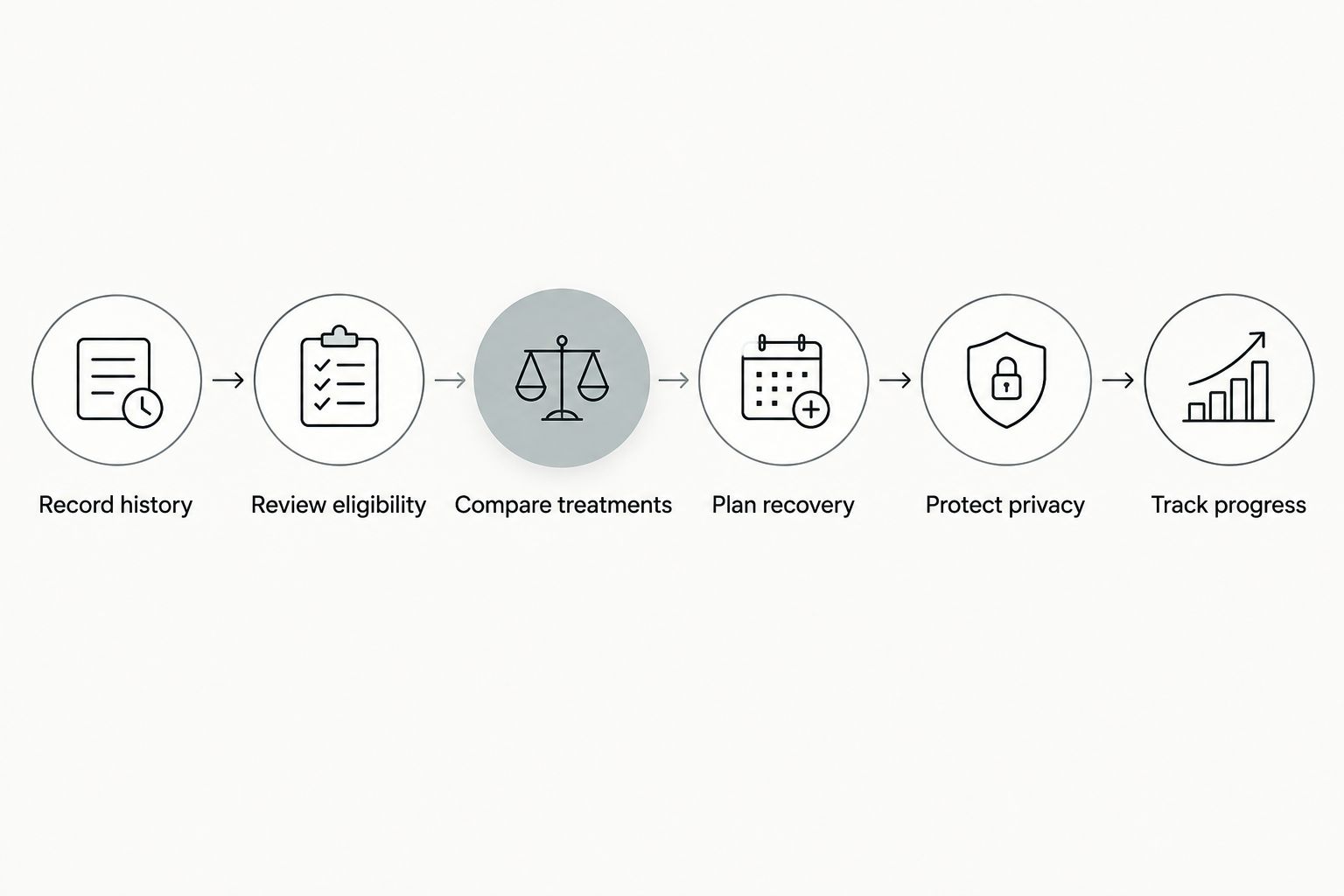
Record history
Before your appointment, create a treatment summary using your own records, pharmacy history, and previous clinicians’ notes. A medication name alone does not establish whether a treatment was adequate; the prescriber needs the dose, duration, adherence, response, and reason it ended.
Describe function as well as mood. Explain whether depression affects concentration, decision-making, sleep, relationships, or your ability to complete ordinary responsibilities—not just whether you are still attending meetings.
Avoid treating continued employment as evidence that symptoms are mild. Your evaluation needs an accurate account of what daily functioning requires and where it is breaking down.
- List current prescriptions, nonprescription medicines, supplements, and allergies.
- Record previous antidepressants, doses, approximate treatment dates, benefits, and adverse effects.
- Describe psychotherapy, prior procedures, hospitalizations, and relevant medical conditions.
- Note alcohol, cannabis, sedative, stimulant, and other substance use honestly.
- Bring specific examples of impaired functioning without including confidential company information.
Review eligibility
Ask a psychiatrist to assess diagnosis and treatment resistance before discussing calendar convenience. Treatment-resistant depression generally refers to depression that has not responded adequately to at least 2 antidepressant treatments given at an adequate dose and duration; the full history still determines the next step.
Under FDA-approved labeling applicable in 2026, SPRAVATO can treat adult treatment-resistant depression alone or with an oral antidepressant. A separate indication covers depressive symptoms in adults with major depressive disorder and acute suicidal ideation or behavior, used with an oral antidepressant. That indication does not establish prevention of suicide or remove the need for hospitalization when clinically warranted.
SPRAVATO has important risks, including sedation, dissociation, respiratory depression, and abuse or misuse. Blood-pressure increases also matter. Screening includes cardiovascular and cerebrovascular history; certain vascular conditions and a history of intracerebral hemorrhage are contraindications.
Do not stop an antidepressant or other prescription to prepare for an evaluation unless your prescriber directs you to do so. Medication changes need an individualized plan.
- Ask which diagnosis and treatment indication apply to you.
- Review blood pressure, cardiovascular history, pregnancy considerations, and other medical risks.
- Discuss prior mania, psychosis, substance-use problems, and medication interactions.
- Ask how the clinic assesses readiness before each treatment session.
- Establish an urgent-care plan for worsening depression or suicidal thoughts.
Compare treatments
Use a written list of questions to compare medication management, TMS, and esketamine. Ask what makes each option appropriate for your clinical history, what monitoring it requires, and how the prescriber will decide whether it is helping.
Attuned Psychiatry’s psychiatric services include medication management, TMS, and SPRAVATO. A clinical consultation can connect those options to your history; the availability of a treatment does not establish that you qualify for it.
SPRAVATO is intranasal esketamine administered under supervision in a certified healthcare setting. It is not a take-home nasal spray. Do not treat intravenous ketamine and SPRAVATO as interchangeable: they differ in formulation, administration, and FDA approval status for depression.
Ask about benefits and burdens together. A treatment that looks convenient on paper still needs a clear clinical rationale and a workable attendance plan.
- Ask why each option fits or does not fit your diagnosis and previous response.
- Compare treatment-day restrictions, monitoring, and follow-up requirements.
- Discuss expected benefits without requesting a guaranteed response date.
- Ask how psychotherapy and existing prescriptions fit into the plan.
- Review financial responsibilities directly with the practice and insurer before committing.
Plan recovery
Build your 2026 calendar around the actual restrictions, not just the administration time. FDA-approved SPRAVATO instructions require monitoring for at least 2 hours after administration, with discharge based on the clinician’s assessment; your visit can extend beyond that minimum.
You must not drive, operate machinery, or perform activities requiring complete mental alertness until the next day after a restful sleep. Arrange transportation home before treatment. Do not assume a ride home makes a demanding evening work session appropriate.
For treatment-resistant depression, labeled induction treatment is twice weekly during weeks 1–4, followed by a schedule adjusted under clinical supervision. This creates a recurring scheduling commitment rather than a single appointment to work around.
Ask for preparation instructions in writing. The prescribing information advises avoiding food for at least 2 hours and liquids for at least 30 minutes before administration because nausea and vomiting can occur; follow your clinic’s specific instructions.
- Arrange transportation home and identify a backup plan.
- Block treatment, monitoring, travel, and recovery time on your calendar.
- Delegate urgent decisions and avoid safety-critical work after treatment.
- Discuss business travel before booking flights that conflict with sessions.
- Confirm instructions for food, fluids, nasal medicines, and other prescriptions.
Protect privacy
Start with practical boundaries: decide who needs to know your availability, who covers your responsibilities, and what you want to disclose. A calendar entry can describe a medical appointment without naming the diagnosis or treatment.
For privacy planning in 2026, distinguish medical confidentiality from workplace benefits administration. HIPAA protects information held by covered healthcare entities, but it does not mean every employment-related record is governed by HIPAA or that insurance paperwork is invisible to everyone involved.
Ask the practice how reminders, billing communications, forms, and authorized contacts work. Do not assume an executive title creates a separate confidentiality arrangement, private entrance, or special scheduling service.
You do not need to give colleagues a treatment narrative to create reliable coverage. Focus on availability and responsibilities, while discussing documentation requirements with the appropriate workplace or benefits contact.
- Choose a personal email address and phone number for clinical communications.
- Ask who can access appointment reminders and shared calendars.
- Decide whether to authorize a family member or another support person.
- Discuss leave or accommodation paperwork without disclosing more than necessary.
- Review insurer communications and benefits questions with the relevant administrator.
Track progress
Use a simple written log between visits. Track symptoms, sleep, side effects, attendance, and daily functioning; let your clinician choose a validated depression measure and interpret changes alongside the clinical interview.
Separate symptom improvement from a temporary feeling during or after administration. Dissociation is an adverse effect, not a target outcome or proof that depression treatment is working.
Agree on review points before starting. Ask what would prompt continuation, a schedule adjustment, a different treatment, or urgent reassessment. Improvement does not make self-directed medication changes safe.
If you are seeking care locally, contact the practice to discuss an evaluation. Bring your treatment summary and questions rather than assuming that a request for esketamine guarantees a prescription.
- Record mood, sleep, concentration, and day-to-day functioning consistently.
- Document adverse effects and when they occur.
- Tell the prescriber about missed appointments or medication changes.
- Agree on how and when treatment benefit will be reviewed.
- Report worsening symptoms promptly instead of waiting for a scheduled assessment.
Compare depression treatment options
For a 2026 treatment decision, compare clinical fit and practical burden together. The “best for” descriptions below identify discussion points, not individual treatment recommendations; a psychiatrist must assess suitability.
| Option | Best for | Main advantage | Key limitation |
|---|---|---|---|
| Medication management | Patients needing a review of prescriptions, response, and adverse effects | Allows individualized medication selection and adjustment | Benefits and adverse effects require follow-up; another medication change is not automatically the right next step |
| TMS | Patients discussing a noninvasive stimulation treatment for depression | Does not require taking an additional systemic medication for the stimulation itself | Requires attendance for a treatment course; eligibility and device-specific precautions need review |
| SPRAVATO | Eligible adults with treatment-resistant depression considering supervised esketamine | Provides an FDA-approved intranasal esketamine option with structured monitoring | Requires certified-setting administration, post-dose observation, transportation planning, and driving restrictions |
No option wins solely because you have a demanding job. Choose the treatment with an appropriate clinical rationale and an attendance plan you can follow safely. Ask about alternatives if the proposed schedule is unworkable rather than shortening recovery time yourself.
Common mistakes corporate executives make
These are planning errors to avoid—not assumptions about every executive seeking care. Each one can undermine an otherwise appropriate treatment plan.
- Using performance as the only outcome. Meeting a revenue target does not establish recovery. Include sleep, relationships, mood, and daily functioning in treatment reviews.
- Scheduling high-stakes decisions after treatment. A short virtual meeting still requires attention and judgment. Protect the recovery period instead of changing the meeting format.
- Withholding substance use or medication details. Concern about reputation must not replace accurate disclosure to your prescriber. Alcohol, sedatives, and other medicines can affect treatment safety.
- Booking travel before confirming the treatment schedule. Discuss conflicts before committing to trips. Do not independently compress, skip, or move sessions.
- Choosing a clinic based on convenience alone. Ask about clinical assessment, required monitoring, adverse-effect management, and follow-up—not just appointment times.
FAQ
Is esketamine treatment for corporate executives different from standard treatment?
No. An executive role does not change medical eligibility, dosing decisions, or required monitoring. Work planning should accommodate the treatment restrictions, not reduce them.
Can I work immediately after a SPRAVATO appointment?
Do not schedule work requiring complete mental alertness after SPRAVATO until the next day after a restful sleep. Arrange coverage for important decisions and follow your clinician’s discharge instructions.
How long does a SPRAVATO appointment take?
SPRAVATO requires at least 2 hours of monitoring after administration, and the clinician determines when you are ready to leave. Preparation and assessment add time, so ask the practice how much time to reserve.
Do I have to keep taking an oral antidepressant with SPRAVATO?
For adult treatment-resistant depression, FDA-approved labeling in 2026 allows SPRAVATO alone or with an oral antidepressant. The separate indication for depressive symptoms with acute suicidal ideation or behavior requires an oral antidepressant; your prescriber determines your regimen.
Is SPRAVATO the same as intravenous ketamine?
No. SPRAVATO is an FDA-approved intranasal esketamine product administered under supervision through a restricted program. Intravenous ketamine is a different formulation and route, and its use for depression is off-label.
Will my employer know I am receiving esketamine treatment?
Receiving treatment does not automatically notify your employer. Review insurance communications, shared calendars, leave documentation, and any authorizations you sign rather than assuming complete workplace invisibility.
What should I do if depression becomes an emergency?
Call 911 or go to the nearest emergency department if you are in immediate danger or cannot stay safe. In the United States, call or text 988 for suicide and crisis support; do not wait for an esketamine consultation.
One last thing
Your ability to make room for treatment is part of the treatment decision. If you cannot reliably arrange transportation, attend monitoring, or protect recovery time, tell your psychiatrist before starting—not after the first scheduling conflict.
For your 2026 evaluation, bring a draft calendar alongside your medication history. That practical document helps turn a medically appropriate recommendation into a plan you can actually follow.
Related guides
Discuss esketamine treatment options
Request an evaluation to review your treatment history and whether SPRAVATO fits your care needs.


