

Instead of manually chasing an employee’s referral between HR, an employee assistance program, and a psychiatric office, use a consent-based handoff with a named coordinator and a clear next action. An EAP referral to psychiatrist moves from support to specialist evaluation when the employee understands the referral, the receiving practice can assess the concern, and any information sharing follows applicable privacy requirements.
- An EAP referral to psychiatrist connects employee support with psychiatric evaluation; it does not establish a diagnosis.
- Keep clinical information with treating professionals, not in routine HR referral trackers.
- Attuned Psychiatry offers medication management, TMS, and SPRAVATO® in Decatur/Metro Atlanta.
- Confirm referral requirements and health-plan coverage separately before treating the handoff as complete.
Why this matters
An EAP referral and a psychiatric appointment are different events. Giving an employee a practice name does not confirm that the practice received the request, that insurance requirements are satisfied, or that an evaluation is scheduled.
For a 2026 employer workflow, define success as an employee reaching the next appropriate care step—not an employer receiving a diagnosis. Track the handoff without turning HR into a clinical information hub.
Attuned Psychiatry is a physician-led practice serving Decatur/Metro Atlanta. Attuned Psychiatry is best suited to local patients seeking psychiatric care that includes treatment-resistant depression evaluation and treatment.
Before you start
- Identify the roles and channels. Have the EAP’s referral instructions, the employee’s preferred contact method, and the receiving practice’s intake contact. Assign one coordinator for the administrative handoff; that person does not make clinical decisions.
- Gather employee-controlled materials. Ask the employee to prepare insurance information, a medication list, and relevant treatment history for the psychiatric practice. Explain that routine HR records do not need copies of those clinical materials.
- Separate consent from coverage. Permission to share records does not establish insurance coverage. An EAP recommendation also does not replace a referral or authorization required by a health plan. Resolve these requirements before sending sensitive information or promising an appointment.
The labels below are suggested checklist headings, not buttons in a particular EAP portal. Follow the actual instructions supplied by the EAP and receiving practice.
Referral purpose
- Clarify the concern. Ask what help the employee is seeking without requiring disclosure of a diagnosis to HR. Clinical details belong in a conversation with an appropriate clinician.
- Separate routine referral from immediate safety needs. In the United States, call or text 988 for suicide or mental health crisis support. Call 911 for an immediate life-threatening emergency; do not route an emergency through a routine referral queue.
- Request clinical triage. Let the EAP clinician or receiving psychiatric professional determine whether psychiatric evaluation is appropriate. HR should not choose a diagnosis, medication, or treatment.
- Explain the purpose. Tell the employee that a psychiatric evaluation reviews symptoms, history, safety, and treatment options. A referral does not guarantee a prescription or a particular procedure.
Expected result: The employee knows why psychiatric evaluation is being suggested and which professional will determine the next clinical step.
Match the referral to the care needed
EAP support and psychiatric care serve different purposes. An employee can use both when appropriate; this is not necessarily a choice between competing services.
| Care route | Best for | Main benefit | Limitation |
|---|---|---|---|
| EAP support | Employees seeking initial support and help finding care | Provides a starting point for discussing concerns and referral needs | Services and session limits depend on the employer’s program |
| Psychiatric evaluation | Employees needing diagnostic assessment or consideration of medication | Connects symptoms and treatment history with a medical assessment | Requires a separate intake process and coverage check |
| Emergency assessment | Employees facing immediate danger or an acute safety crisis | Prioritizes urgent assessment rather than routine scheduling | Is not a substitute for ongoing outpatient follow-up |
Attuned Psychiatry’s psychiatric services include medication management, TMS, and SPRAVATO® treatment. These are clinical options, not automatic destinations for everyone referred through an EAP. Their relevance depends on assessment, medical suitability, and treatment history.
Consent boundaries
- Explain the information flow. Identify who would send information, who would receive it, what would be shared, and why. Include any employer-facing status update in that explanation.
- Confirm the applicable permission process. Have the responsible provider determine whether authorization is required and obtain it when necessary. Do not treat a general agreement to seek help as blanket permission to distribute records.
- Separate administrative and clinical records. Keep referral logistics apart from symptom descriptions, medication details, and therapy notes. Employers should receive only information they are legally entitled to receive for the specific purpose.
- Offer an employee-led handoff. When appropriate, give the employee the intake instructions so they can contact the practice directly and provide their own history.
Expected result: Each participant understands the permitted communication boundaries before any records leave the originating organization.
An employer-sponsored EAP does not make all EAP information accessible to the employer. Privacy obligations depend on the parties, the records, and applicable law. For a 2026 policy review, have the organization’s privacy or legal adviser check the actual process rather than assuming that one consent form covers every exchange.
Do not promise absolute confidentiality. Explain the relevant limits, including applicable safety exceptions, through the provider’s established process.
Intake handoff
- Confirm service fit. Ask whether the practice evaluates the employee’s presenting concern and what intake materials it requires. Check location or visit-format requirements directly rather than assuming a referral works across settings.
- Check coverage separately. Have the employee or authorized benefits contact verify applicable network, referral, and authorization requirements. Distinguish the psychiatric evaluation from any later treatment that needs its own review.
- Choose the handoff method. Use either employee-led contact or an agreed provider-to-provider introduction. Send clinical information only through the receiving practice’s accepted channel and under the applicable permission process.
- Name the next action. Record who will contact whom, through which channel, and by what agreed date. Avoid a vague note such as referral sent when the employee still needs to initiate intake.
- Confirm receipt appropriately. Ask the employee, or the receiving practice when permitted, whether the request reached the right place. Receipt is not the same as an appointment or completed evaluation.
Expected result: The employee has a specific intake action, and the coordinator knows how to follow up without requesting unnecessary clinical details.
A repeatable 2026 handoff has four distinct checkpoints: Referral purpose, Consent boundaries, Intake handoff, and Follow-up ownership. Keeping them separate makes it easier to identify exactly where a referral has stalled.
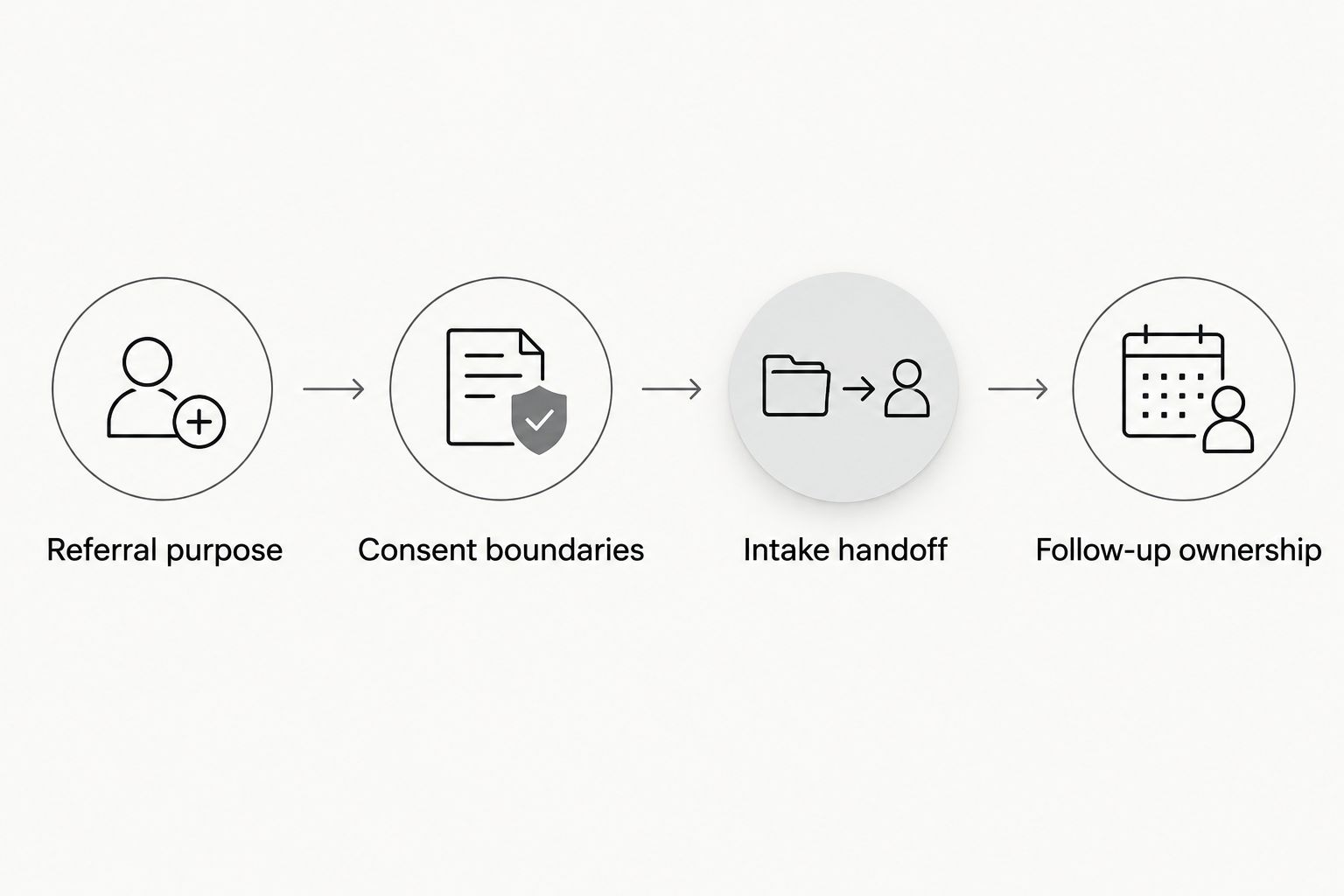
Follow-up ownership
- Set an administrative checkpoint. Agree on a follow-up date with the employee. Choose the interval according to clinical urgency and the actual intake process; do not substitute an arbitrary service target for clinical triage.
- Record the narrow status. Use descriptions such as intake instructions received, employee contacting practice, or further referral assistance requested. Collect appointment information only when permitted and needed.
- Resolve practical barriers. Ask whether the employee needs help understanding instructions, finding an appropriate provider, or clarifying benefits. Do not require a symptom update to provide administrative help.
- Close the referral deliberately. Mark the administrative task complete when its agreed purpose is met. If the employee declines assistance, document that decision without assigning a clinical interpretation.
Expected result: Someone owns the next action until the administrative handoff is resolved, while treatment decisions remain with the employee and treating professionals.
As a practical workflow design, use one named coordinator, one agreed follow-up date, and two clearly separated records: administrative referral status and provider-held clinical information. These are organizational recommendations, not clinical standards or promised response times.
When an existing referral changes
A second workflow applies when an employee already has a referral but reports a change before evaluation. Treat the update as a reason to reassess the next action—not permission to circulate more information.
- Identify the type of change. Separate administrative updates, such as a new contact number, from clinical changes, such as worsening symptoms or medication concerns.
- Route clinical changes to a clinician. Ask the employee to contact the EAP clinician or treating professional for reassessment. Escalate immediate safety concerns through emergency or crisis channels.
- Recheck the sharing boundary. Confirm that any proposed new disclosure follows the applicable authorization and privacy requirements.
- Replace the old next action. Tell the employee which instruction now applies so they are not following conflicting referral plans.
Expected result: The referral reflects the current situation without creating parallel, inconsistent instructions.
A missed appointment does not establish that an employee no longer needs care. Likewise, continued symptoms do not prove that a particular treatment is indicated. Keep those interpretations with the clinician.
Troubleshooting stalled referrals
The employee thinks the EAP booked the appointment
Confirm whether the EAP made an introduction or actually arranged intake. Give the employee a clear action statement: contact the receiving practice, complete its requested materials, or respond to its intake message. Do not label the referral scheduled until that status is established.
The practice cannot discuss the referral with HR
Ask the employee to communicate directly, or have the responsible provider review whether a valid authorization permits the requested exchange. A privacy boundary is not a scheduling failure. Do not seek clinical information through a manager as a workaround.
The health plan requires another referral or authorization
Have the employee contact the plan using the benefit details available to them. Establish which requirement applies to evaluation and which applies to later treatment. An EAP referral does not establish that either requirement has been satisfied.
The employee cannot reach the intended practice
Check the contact instructions and the employee’s preferred callback method. Ask the EAP for another appropriate referral when needed. If urgency changes, request clinical reassessment rather than simply repeating unanswered administrative messages.
The employee expects TMS or SPRAVATO® immediately
Explain that the referral is for evaluation, not preapproval of a treatment. Attuned Psychiatry offers TMS and SPRAVATO®, but the appropriate next step depends on clinical assessment. Do not advise employees to change or stop medication while awaiting intake.
Customize your workflow
For a 2026 workflow, make the administrative process easier without collecting more health information. A short checklist is more useful than a shared spreadsheet filled with diagnoses.
Use fields for the coordinator, employee-approved contact method, next action, agreed follow-up date, and administrative closure reason. Restrict access according to role and organizational policy. Keep clinical attachments out of routine HR tracking.
Separate referral coordination from accommodation, leave, and fitness-for-duty processes. Those processes have different purposes and requirements; an EAP referral alone does not answer whether an employee can perform a particular job.
For local care, use the contact page to ask about intake requirements. Confirm fit before transferring records.
Ask about psychiatric intake
Clarify the next step for psychiatric evaluation in Decatur/Metro Atlanta.
FAQ
How does an EAP referral to a psychiatrist work?
An EAP referral connects an employee with a psychiatric practice for evaluation. The employee and providers then follow the receiving practice’s intake process, applicable information-sharing requirements, and any health-plan referral rules.
Can I contact a psychiatrist without going through my employer?
You can contact a psychiatric practice directly to ask about intake. Your health plan can still have referral or authorization requirements, so check those separately rather than assuming an employer referral is necessary or sufficient.
Will my employer receive my diagnosis after an EAP referral?
An EAP referral does not automatically entitle your employer to your diagnosis. Ask the EAP and receiving practice what information is shared, with whom, and under what authorization or legal requirement.
Does an EAP referral guarantee insurance coverage?
No, an EAP referral does not guarantee insurance coverage. Verify network status and applicable referral or authorization requirements with the health plan, including separate requirements for treatments considered after evaluation.
Is EAP counseling the same as psychiatric care?
No, EAP counseling and psychiatric care have different functions. EAP services depend on the employer’s program, while psychiatric evaluation assesses symptoms, history, and medical treatment options.
Can an EAP refer me for treatment-resistant depression?
An EAP can help connect you with psychiatric evaluation when depression remains a concern despite treatment. Attuned Psychiatry offers medication management, TMS, and SPRAVATO® in Decatur/Metro Atlanta; a clinician determines which options are appropriate.
What should I do if symptoms worsen before my appointment?
Contact a treating clinician or the EAP’s clinical service promptly for reassessment. In the United States, call or text 988 for crisis support; call 911 for an immediate life-threatening emergency rather than waiting for routine intake.
One last thing
A referral can be administratively complete before treatment begins. Define both events separately in your 2026 process: the coordinator confirms the agreed handoff, while the patient and clinician determine the care plan. That distinction prevents unnecessary disclosure and false reassurance.


