
TMS therapy can hurt, but the usual sensation is tapping or knocking against your scalp, sometimes with brief discomfort or a headache afterward. You stay awake, and standard depression treatment does not require anesthesia. This 2026 guide explains what treatment feels like, which symptoms need attention, and how your clinician can address discomfort without asking you to push through pain.
- Does TMS therapy hurt? Scalp discomfort and headaches can occur; tell your clinician rather than enduring pain silently.
- TMS discomfort happens around the treatment site; persistent or severe symptoms need clinical assessment.
- Attuned Psychiatry offers physician-led TMS care for patients with treatment-resistant depression in Decatur/Metro Atlanta.
- Ask about coil positioning, treatment intensity, hearing protection, and a plan for managing headaches before treatment begins.
Does TMS therapy hurt?
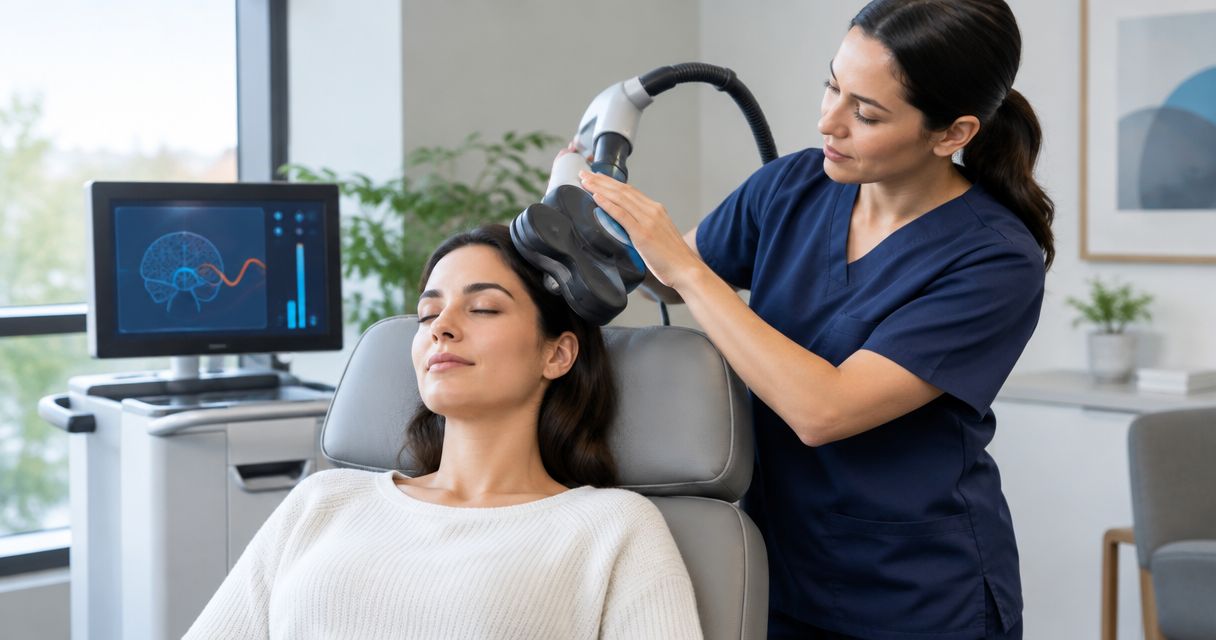
TMS can cause scalp pain or a headache, but significant pain is not something you should simply tolerate. During treatment, a magnetic coil rests against your head and delivers pulses. You hear clicking and feel tapping near the coil; some people also notice nearby facial muscles twitching.
The distinction between an expected sensation and a symptom needing attention matters more than choosing a single pain score. Describe what you feel, where it happens, and whether it continues between pulses or after the session.
| Sensation or symptom | What it means for you | What to do |
|---|---|---|
| Rhythmic tapping or knocking | An expected sensation while the coil delivers pulses | Tell the clinician whether it feels tolerable |
| Local scalp tenderness | A recognized treatment side effect | Ask for an assessment of positioning and comfort |
| Brief facial twitching | Stimulation can activate nearby muscles | Mention it, especially if it hurts |
| Headache during or after treatment | A recognized side effect that needs a management plan | Report its severity, duration, and recurrence |
| Severe, unusual, or persistent pain | Not a symptom to dismiss as routine | Ask the clinician to assess it promptly |
If you are considering treatment locally, review the psychiatric services and discuss your pain concerns before starting a course. A consultation should address both treatment suitability and what happens if a session becomes uncomfortable.
Why this matters
Fear of pain can make it difficult to evaluate a treatment you otherwise want to consider. The useful question is not whether someone else found TMS painless; it is whether you understand the sensations, the risks, and your options when something hurts.
For a treatment decision in 2026, separate comfort from effectiveness. A comfortable session does not prove that treatment will work, and a painful session does not prove that stimulation is reaching the right target. Your clinician assesses treatment settings and your clinical response separately.
What does a TMS session feel like?
You sit awake while the clinician positions the coil against your scalp. When stimulation starts, you hear a series of clicks and feel repeated tapping at the treatment site. The pattern includes stimulation and pauses, depending on the protocol.
The tapping can feel firm rather than gentle. Some people describe pressure, a snapping sensation, or a brief pulling feeling around the forehead; others find the sound more bothersome than the scalp sensation. Your description helps the clinician distinguish local discomfort from headache, jaw tension, or another problem.
During the first appointment
The setup includes identifying an appropriate stimulation intensity using your motor threshold, a measure of how your motor system responds to stimulation. This assessment commonly involves observing a small hand or finger movement. It is not a test of how much pain you can withstand.
Tell the clinician if you feel anxious, have a headache already, or have a history of migraines. Mention hearing problems and any medication changes as well. These details belong in the assessment rather than being saved until discomfort becomes difficult to manage.
During later appointments
Scalp discomfort often becomes less troublesome as treatment continues, but improvement is not guaranteed for every patient. Report your own experience at each visit instead of assuming that you should have adjusted by a particular appointment.
A new headache pattern deserves attention even if earlier sessions were comfortable. Explain whether the discomfort starts during stimulation, appears afterward, or remains until the next day. That timeline gives your clinician more useful information than saying only that treatment hurts.
How long does TMS discomfort last?
Scalp sensations tied to the pulses occur during stimulation. Tenderness or headache can continue afterward, so distinguish the time spent in the treatment chair from the time a symptom lasts. Ask your clinician what they expect for your protocol and when to call about symptoms after leaving.
Traditional repetitive TMS sessions for depression often take about 20–40 minutes, although other protocols have different treatment times. A commonly used schedule involves 5 days a week, with an initial course lasting 4 weeks to 6 weeks. Your prescribed schedule can differ; these figures are not an appointment schedule or protocol promised by this practice.
When planning treatment in 2026, ask for the actual stimulation time, the total appointment length, and the expected course length. These are separate questions. A shorter session does not by itself establish that treatment will be more comfortable or more effective for you.
Why TMS discomfort varies
TMS does not feel identical for every patient or every session. The National Institute of Mental Health identifies scalp discomfort and headache among recognized side effects of repetitive TMS; your individual experience still needs assessment.
The main factors to discuss are:
- Treatment intensity: Stimulation strength affects the sensation, but prescribed intensity also serves a clinical purpose. Ask about changes rather than requesting an arbitrary lower setting.
- Coil position: The coil's contact and position can affect local scalp or muscle discomfort. Your clinician must preserve the intended treatment target while assessing comfort.
- Headache history: Migraines, existing headaches, and scalp sensitivity are relevant to symptom assessment and planning.
- Muscle activation: Nearby muscle contractions can produce pulling or twitching that feels different from the scalp tapping itself.
- Treatment protocol: Pulse patterns, pauses, and stimulation duration differ across protocols. Ask what your prescribed approach involves.
- Your response over time: Early discomfort can ease, remain troublesome, or change. Report the pattern rather than relying on someone else's experience.
None of these factors makes pain your fault. The goal is a clinically appropriate treatment you can tolerate, not a contest in endurance.
What should you do if TMS hurts?
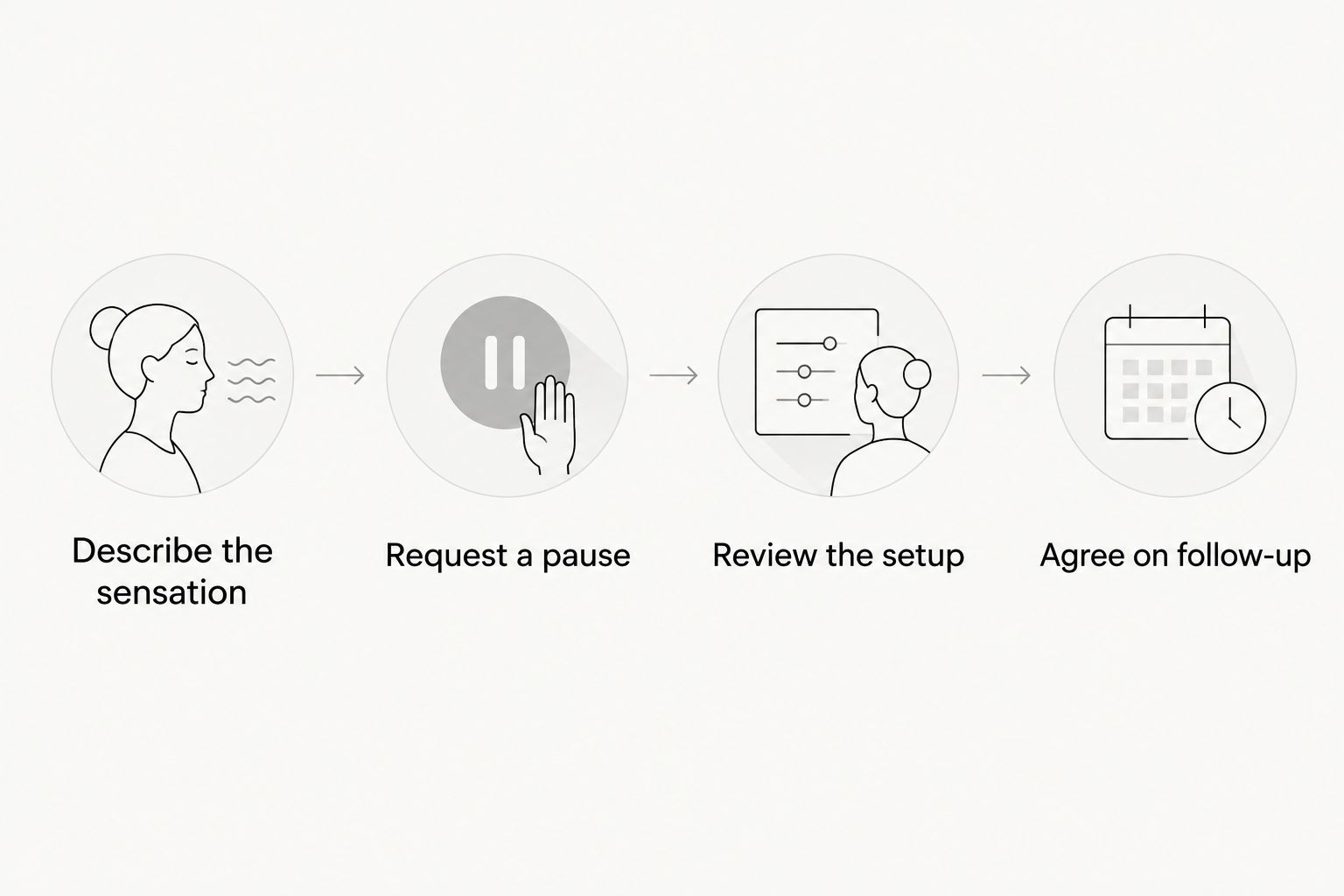
Speak up during the session, not just at the end of the treatment course. Your clinician needs to know whether you feel pressure, sharp pain, burning, muscle pulling, or headache. Those descriptions are not interchangeable.
- Describe the sensation. Point to the location and explain whether it occurs only with the pulses or continues during pauses. Say clearly if it feels severe or different from previous sessions.
- Request a pause. Ask the clinician to stop briefly and assess the symptom. Do not shift your head or move the equipment yourself.
- Review the setup. The clinician can assess positioning, muscle activation, and treatment settings while maintaining the prescribed treatment plan.
- Agree on follow-up. Before leaving, establish what to do if symptoms persist, worsen, or return after the appointment.
This sequence keeps the decision clinical: identify the problem, assess it, and make a plan. It does not assume that every uncomfortable sensation requires stopping treatment altogether.
Ask before taking a pain reliever specifically for TMS discomfort. Your clinician should consider your medical history, other medications, and the pattern of your headaches. Do not change prescribed psychiatric medication or take extra doses to get through a session without discussing it.
What can make appointments easier to tolerate?
Start with a clear comfort plan rather than an assumption that treatment should be painless. Ask how you should signal discomfort, whether you can request a pause, and who to contact about symptoms afterward. Knowing the process reduces uncertainty without promising a particular experience.
Use the hearing protection provided or directed by the treatment team. TMS produces loud clicking, and hearing protection is part of treatment safety—not an optional response only when the sound feels unpleasant. Tell the clinician if the protection does not fit or if you develop ringing or a hearing change.
Keep your team informed about medication changes and changes in sleep, alcohol use, or other substance use. These details matter to safety screening as well as appointment planning. Follow the instructions for your prescribed treatment rather than advice from another patient's protocol.
For your 2026 consultation, bring a short description of any migraines, chronic headaches, or previous sensitivity to medical procedures. You do not need perfect medical terminology. A clear account of what happened and how long it lasted is more useful.
Is TMS pain a sign that treatment is working?
Pain is not a measure of whether TMS is treating depression. Treatment intensity is prescribed using clinical assessment, not by trying to create the strongest sensation you can tolerate. Report discomfort even if you worry that an adjustment will undermine treatment.
Response is assessed through changes in depressive symptoms, daily functioning, and clinical follow-up. Keep those observations separate from a record of headaches or scalp discomfort. Both matter, but they answer different questions.
Is TMS the same as electroconvulsive therapy?
TMS is not electroconvulsive therapy, or ECT. Standard TMS for depression uses magnetic stimulation while you remain awake; ECT uses electrical stimulation under anesthesia to induce a controlled seizure. The National Institute of Mental Health describes them as distinct brain-stimulation treatments.
This distinction explains why TMS does not involve the anesthesia preparation and recovery associated with ECT. It does not mean TMS is risk-free or that ECT is inappropriate. Treatment selection requires a psychiatric assessment, not a decision based only on which procedure sounds less intimidating.
When should symptoms prompt urgent attention?
Ask your treatment team for clear instructions about headache, scalp pain, hearing changes, and symptoms that develop outside office hours. Severe or worsening symptoms require assessment rather than an assumption that they are a normal adjustment to treatment.
Seizures are a rare but recognized serious risk of TMS. Safety screening includes seizure history, relevant medical conditions, medications, and implanted metal or electronic devices. Give complete answers even when a condition seems unrelated to your depression.
A sudden severe headache, seizure, fainting, or new neurological symptoms needs urgent medical attention. Call 911 for a medical emergency. If you are in a mental health crisis or having thoughts of suicide, call or text 988; use emergency services when there is immediate danger.
Who should discuss TMS with Attuned Psychiatry?
Attuned Psychiatry is best suited to Decatur/Metro Atlanta patients seeking physician-led care for treatment-resistant depression. The practice offers medication management, TMS, and SPRAVATO® treatment. A psychiatric assessment should determine which treatment, if any, fits your diagnosis and history.
TMS avoids anesthesia during standard depression treatment, but it still involves appointments, possible discomfort, and safety screening. It also does not guarantee symptom improvement. Discuss those limitations alongside the reasons your clinician recommends considering it.
Discuss your TMS concerns
Ask about treatment suitability, expected sensations, and a plan for managing discomfort.
FAQ
Does TMS therapy hurt during the first session?
TMS can cause scalp discomfort during the first session, including tapping, pulling, or local muscle twitching. Tell your clinician when a sensation hurts so they can assess positioning and treatment settings.
Will I get a headache after TMS?
Headache is a recognized TMS side effect, but it does not happen to everyone. Report headaches that are severe, persistent, changing, or different from your usual pattern.
Can I ask to stop if TMS hurts?
Yes, you can ask the clinician to pause treatment and assess your discomfort. Describe the location and type of pain rather than moving the coil or changing your position yourself.
Do I need anesthesia for TMS?
Standard TMS treatment for depression does not require anesthesia. You remain awake and can tell the clinician how the stimulation feels.
Does more painful TMS work better?
More painful TMS does not establish a better antidepressant response. Your clinician assesses prescribed stimulation settings and symptom improvement separately from discomfort.
Can I take a pain reliever before TMS?
Ask your clinician before taking a pain reliever specifically for TMS discomfort. The appropriate plan depends on your medical history, current medications, and headache symptoms.
Can I discuss fear of TMS pain with Attuned Psychiatry?
Yes, discuss fear of pain when seeking TMS care at Attuned Psychiatry. Ask what sensations to expect, how discomfort is assessed, and what symptoms need follow-up after an appointment.
One last thing
Before starting TMS in 2026, ask this question: What will we do if I find the stimulation painful? A useful answer should cover how to signal discomfort, how the clinician will assess it, and when symptoms need follow-up. You do not need to promise that you can tolerate treatment before learning how discomfort will be managed.


