

Yes. Esketamine for treatment resistant depression is an FDA-approved option for adults in 2026, available as SPRAVATO® nasal spray either alone or with an oral antidepressant. It does not work for everyone, and treatment requires administration at a certified healthcare setting with observation for at least 2 hours after each dose.
- The FDA approves esketamine for treatment resistant depression in adults; SPRAVATO® can be used alone or with oral antidepressants.
- Treatment-resistant depression generally means inadequate improvement after at least two adequate antidepressant trials.
- SPRAVATO® requires supervised nasal administration and at least 2 hours of observation after each treatment.
- Esketamine is not a take-home treatment or a substitute for emergency psychiatric care.
Why this matters
An antidepressant that has not helped is a reason to reassess treatment, not proof that every treatment will fail. Esketamine gives clinicians another option, but choosing it requires a review of your diagnosis, previous medications, medical history, and ability to attend monitored appointments.
Attuned Psychiatry is best for Decatur/Metro Atlanta patients seeking physician-led evaluation of treatment-resistant depression. The practice offers medication management, TMS, and SPRAVATO®; the right choice depends on your clinical assessment rather than a preference for one treatment in advance.
Can esketamine treat treatment-resistant depression?
Yes. SPRAVATO® is approved for adult treatment-resistant depression, including use without an oral antidepressant. Its FDA-approved prescribing information distinguishes this indication from its separate use for depressive symptoms in adults with major depressive disorder and acute suicidal ideation or behavior.
For U.S. treatment decisions in 2026, the FDA-approved SPRAVATO® prescribing information provides the reference for eligibility, dosing, monitoring, and safety restrictions.
| Treatment approach | Best for | Main advantage | Main limitation |
|---|---|---|---|
| SPRAVATO® for treatment-resistant depression | Adults whose depression has not improved adequately with prior antidepressant treatment and who meet clinical criteria | An approved option that works through a different mechanism from conventional antidepressants | Requires certified-site treatment, observation, and transportation planning |
| Oral antidepressant treatment | Patients whose history and symptoms support starting, adjusting, or continuing medication | Does not require an observed treatment visit for each dose | Previous nonresponse and medication side effects can limit usefulness |
This is not a ranking of stronger and weaker treatments. An oral medication adjustment can remain appropriate, while esketamine introduces its own safety requirements and appointment burden. Your psychiatrist should explain why the proposed approach fits your history.
Who qualifies for esketamine treatment?
Treatment-resistant depression generally refers to depression that has not improved adequately after at least two antidepressant trials given at an adequate dose for an adequate duration. The number alone does not establish eligibility. A clinician must review what you took, how consistently you took it, how long you took it, and what changed.
An evaluation should also establish whether major depressive disorder is the correct diagnosis. A history of mania or hypomania, substance use, sleep problems, and relevant medical conditions can change the treatment plan.
Bring information about:
- Previous medications: Names, doses, treatment duration, benefits, and reasons for stopping.
- Current symptoms: Mood, interest, energy, sleep, concentration, and daily functioning.
- Medical history: Blood pressure problems, vascular conditions, pregnancy, and other relevant concerns.
- Current substances: Prescription medicines, over-the-counter products, alcohol, and other substances.
- Treatment logistics: Transportation and your ability to attend monitored appointments.
In 2026, being interested in SPRAVATO® is a reason to request an assessment, not evidence that you qualify. Clinical suitability and insurance coverage are separate questions; approval by an insurer does not replace a medical evaluation.
What benefits can you realistically expect?
Esketamine can reduce depressive symptoms in some adults with treatment-resistant depression. Improvement is possible; remission is not guaranteed. A response means symptoms have improved, while remission means symptoms have fallen below the threshold used to define an active depressive episode.
Some patients notice changes early in treatment. Others need repeated treatment before the clinician can judge whether continuing makes sense. An early change does not establish that improvement will last, and a difficult first session does not by itself establish treatment failure.
Agree on what improvement would look like before starting. That discussion should include symptoms and practical changes, such as getting out of bed, returning to activities, or managing daily responsibilities. Repeated assessment helps separate a meaningful antidepressant response from short-lived changes during a treatment session.
What are the main risks and limitations?
SPRAVATO® carries boxed warnings for sedation, dissociation, respiratory depression, abuse and misuse, and suicidal thoughts and behaviors. These warnings explain why supervised treatment and post-dose observation are required.
Dissociation can include feeling detached from your body or surroundings. Other adverse effects include dizziness, nausea, sleepiness, and temporary increases in blood pressure. Tell the treatment team about symptoms rather than assuming every uncomfortable effect is expected or harmless.
Important restrictions include:
- Vascular conditions: SPRAVATO® is contraindicated in aneurysmal vascular disease, arteriovenous malformation, and a history of intracerebral hemorrhage.
- Blood pressure: Clinicians must assess whether a blood pressure increase would pose a serious risk.
- Other sedating substances: Alcohol, opioids, benzodiazepines, and other central nervous system depressants require review because sedation can increase.
- Pregnancy: Discuss pregnancy or pregnancy plans before treatment; the prescribing information warns of potential fetal harm.
- Substance-use history: A history of misuse requires careful assessment and monitoring rather than an assumption that treatment is automatically appropriate.
Do not stop or change prescribed medication on your own to prepare for esketamine. Your treatment team should give you instructions based on your actual medication list.
Why esketamine treatment plans vary
Esketamine treatment is not identical for every patient. The prescribing information establishes a framework, but the decision to start, continue, adjust frequency, or stop depends on clinical assessment.
The main drivers are:
- Previous treatment response: Which antidepressants helped, failed, or caused unacceptable effects.
- Current diagnosis: Whether the symptoms fit major depressive disorder or require a different treatment approach.
- Medical safety: Blood pressure, vascular history, breathing concerns, and other relevant conditions.
- Medication interactions: Current medicines and substances that affect sedation or blood pressure.
- Observed benefit and tolerability: Whether symptoms improve enough to justify continued treatment and its burdens.
Attuned Psychiatry offers psychiatric services that include medication management, TMS, and SPRAVATO®. An evaluation should connect the recommended treatment to your history and explain its disadvantages as clearly as its potential benefits.
What happens during an esketamine appointment?
For adults with treatment-resistant depression, the labeled initial schedule generally involves treatment twice weekly during the first 4 weeks. Your clinician evaluates the evidence of benefit at the end of that phase before deciding whether continued treatment is appropriate.
A monitored visit follows a safety-focused sequence:
- Check blood pressure. The team assesses blood pressure before dosing and reviews whether it is appropriate to proceed. Report new symptoms, medication changes, and substance use.
- Use nasal spray. You administer the prescribed nasal spray under direct healthcare supervision. SPRAVATO® is not dispensed for unsupervised use at home.
- Stay for observation. Monitoring lasts at least 2 hours and includes assessment for sedation, dissociation, respiratory effects, and blood pressure changes. You leave only after the clinician determines that you are clinically stable.
- Leave with transportation. Arrange a ride home. Do not drive or operate machinery until the next day after a restful sleep.
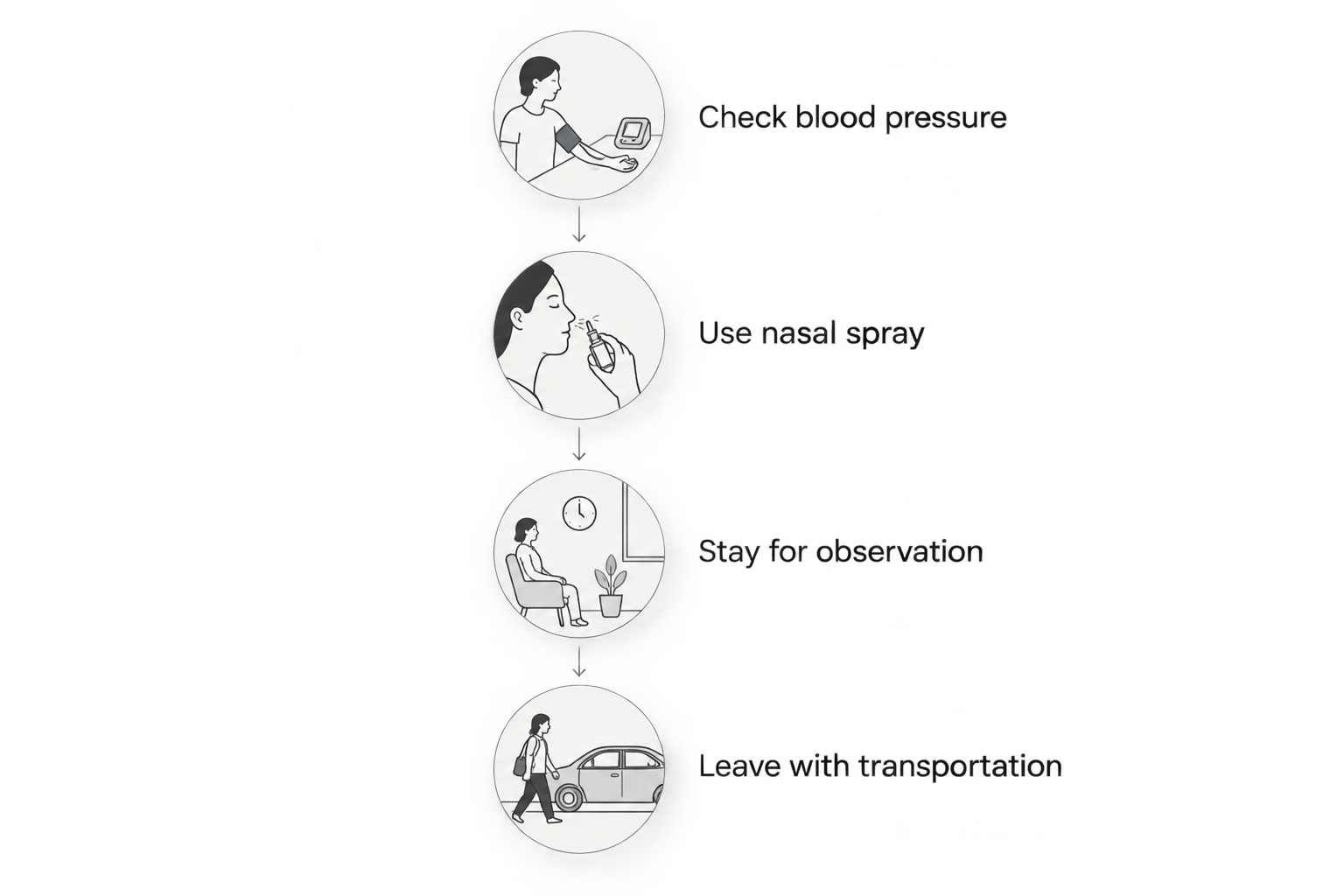
The observation requirement is a minimum, not a promised discharge time. In 2026, plan around the entire appointment and transportation needs rather than treating SPRAVATO® like a brief prescription pickup.
How is esketamine different from ketamine?
Esketamine is one component of ketamine, but the terms are not interchangeable. SPRAVATO® is an FDA-approved esketamine nasal spray with specific indications and a restricted distribution and monitoring program.
| Option | Best for | Regulatory distinction | Important limitation |
|---|---|---|---|
| SPRAVATO® nasal spray | Eligible adults seeking an FDA-approved esketamine treatment for treatment-resistant depression | FDA-approved for specified depression indications | Requires supervised treatment through the SPRAVATO® REMS program |
| Ketamine used for depression | Patients whose clinicians determine that off-label treatment is appropriate | Ketamine is not FDA-approved to treat psychiatric disorders | Routes, protocols, and clinical oversight require separate scrutiny |
Do not assume a compounded nasal spray, an intravenous ketamine infusion, and SPRAVATO® have the same evidence or monitoring requirements. Ask for the exact medication, route, indication, and safety plan before agreeing to treatment.
Can you take esketamine without an antidepressant?
SPRAVATO® can be used alone for adult treatment-resistant depression. It can also be used with an oral antidepressant. The choice requires a review of your prior response, side effects, and current treatment plan.
The separate indication for depressive symptoms in adults with major depressive disorder and acute suicidal ideation or behavior requires an oral antidepressant. Do not transfer the rules from one indication to the other or discontinue medication without instructions.
Does esketamine replace emergency care?
SPRAVATO® does not replace emergency assessment or hospitalization when needed. Its effectiveness in preventing suicide or reducing suicidal ideation or behavior has not been established, even though it has a separate indication involving depressive symptoms in a specific acute-risk population.
If you are in immediate danger or cannot stay safe, call 911 or go to the nearest emergency department. In the United States, call or text 988 for the Suicide & Crisis Lifeline. Do not wait for an outpatient treatment consultation during a crisis.
What should you ask before starting treatment?
Ask the clinician to explain the evidence that your depression is treatment-resistant, why esketamine fits your situation, and how benefit will be assessed. You should also understand what would lead the team to pause or stop treatment.
For a local evaluation, ask Attuned Psychiatry how its physician-led assessment addresses your prior medications, medical risks, and practical treatment needs. Confirm appointment arrangements directly rather than assuming every psychiatric visit includes esketamine treatment.
Request a psychiatric evaluation
Discuss previous treatments, current symptoms, and whether a SPRAVATO® assessment fits your needs.
FAQ
Can esketamine help when antidepressants have not worked?
Yes, SPRAVATO® is FDA-approved for adults with treatment-resistant depression. A clinician must review whether previous antidepressant trials were adequate and whether treatment is safe for you.
How many antidepressants do I need to try before esketamine?
Treatment-resistant depression generally involves inadequate improvement after at least two adequate antidepressant trials. Medication names alone are not enough; dose, duration, adherence, and response matter.
How long do I have to stay after SPRAVATO® treatment?
You must remain under observation for at least 2 hours after SPRAVATO® treatment. Discharge also requires a clinician to determine that you are clinically stable.
Can I drive myself home after esketamine?
No, you should arrange transportation home after esketamine treatment. Do not drive or operate machinery until the next day after a restful sleep.
Can I use SPRAVATO® nasal spray at home?
No, SPRAVATO® must be administered under direct supervision in a certified healthcare setting. It is not a take-home prescription.
Is esketamine guaranteed to put depression into remission?
No, esketamine does not guarantee remission. Continued treatment should depend on documented benefit, tolerability, and an ongoing review of risks.
Is SPRAVATO® the same as ketamine treatment?
No, SPRAVATO® is an FDA-approved esketamine nasal spray, while ketamine is not FDA-approved for psychiatric disorders. Different formulations and routes should not be treated as interchangeable.
One last thing
Write down your medication history before requesting an esketamine assessment. Include doses, treatment duration, benefits, and reasons you stopped—not just the medication names. This helps the clinician distinguish an unsuccessful adequate trial from treatment that ended before its effect could be assessed.
For anyone considering treatment in 2026, the useful question is not simply whether esketamine works. It is whether your diagnosis, prior treatment, safety profile, and ability to attend supervised sessions support using it now.


