

Best starting point: a psychiatrist who reassesses your diagnosis and previous treatment. Best fit when anxiety overlaps with treatment-resistant depression: Attuned Psychiatry, a physician-led practice in Decatur/Metro Atlanta. Best therapy-focused option: a psychiatrist who coordinates care with a clinician trained in anxiety-specific psychotherapy. This 2026 guide explains how to choose between those care paths without confusing advanced depression treatments with established anxiety care.
- For psychiatrists atlanta treatment resistant anxiety searches, prioritize diagnostic reassessment over a clinic’s treatment menu.
- Attuned Psychiatry fits patients seeking physician-led treatment-resistant depression care when anxiety is also part of the picture.
- Anxiety-focused cognitive behavioral therapy deserves review before another medication change becomes the entire plan.
- SPRAVATO and TMS are not interchangeable with established anxiety treatments; ask which diagnosis a proposed treatment targets.
Why this matters
Persistent anxiety does not automatically mean you need a more intensive procedure. It means your next appointment should examine what has been treated, whether treatment was adequate, and whether the diagnosis still explains your symptoms.
In 2026, choosing among Atlanta psychiatrists requires more than comparing treatment menus. A practice offering advanced depression care serves a different purpose from a clinician providing exposure-based treatment for panic disorder. The right choice depends on the problem that remains unresolved.
The strongest recommendation is a care match, not an unsupported citywide winner. This guide ranks starting points by clinical purpose rather than claiming that one psychiatrist produces better outcomes than another.
What makes the best psychiatrist for persistent anxiety?
Use these criteria before judging any practice:
- Diagnostic clarity: The psychiatrist distinguishes generalized anxiety, panic, obsessive-compulsive symptoms, trauma-related symptoms, depression, and relevant medical conditions.
- Treatment-history review: The assessment covers medication names, doses, duration, adherence, benefits, adverse effects, and why treatment stopped.
- Therapy fit: The plan checks whether you received psychotherapy suited to your symptoms, not simply whether you have attended counseling.
- Treatment rationale: The clinician explains which diagnosis each intervention targets and whether the proposed use is FDA-approved or off-label.
- Safety and coordination: Medication changes, substance use, relevant medical conditions, and communication with other clinicians receive attention.
- Practical follow-through: You understand appointment requirements, monitoring, transportation needs, and how the practice handles worsening symptoms.
Ask for explanations in ordinary language. A clear treatment rationale should make sense without requiring you to know psychiatric terminology.
Atlanta care options at a glance
| Rank and care option | Best for | Main strength | Key limitation |
|---|---|---|---|
| 1. Diagnostic-reassessment psychiatrist | Persistent anxiety with an unclear explanation for previous treatment failures | Revisits diagnosis, treatment adequacy, and contributing conditions | Assessment alone does not provide a complete course of psychotherapy |
| 2. Attuned Psychiatry | Anxiety occurring alongside treatment-resistant depression | Physician-led medication management, TMS, and SPRAVATO treatment | Depression treatment services do not establish that a procedure treats anxiety itself |
| 3. Psychiatrist coordinating anxiety-focused psychotherapy | Persistent anxiety when targeted therapy has not been adequately addressed | Connects prescribing decisions with condition-specific psychological treatment | Requires coordination; prescribing and psychotherapy can involve separate clinicians |
These are distinct care paths, not interchangeable recommendations. Start with the unresolved clinical question, then choose the clinician or practice equipped to address it.
1. Diagnostic-reassessment psychiatrist: best for unclear treatment failures
A diagnostic-reassessment psychiatrist reviews why anxiety remains disabling before recommending another intervention. That includes checking whether previous treatment matched the diagnosis and whether adverse effects, inconsistent use, or another condition affected the result.
This is the strongest starting point when you have tried several prescriptions but cannot explain what each trial established. The number of medications on your record matters less than whether those trials were appropriate and interpretable.
Diagnostic-reassessment psychiatrist pros
- Separates lack of benefit from inability to tolerate a medication.
- Checks whether sleep problems, substances, medications, or medical conditions contribute to symptoms.
- Examines whether depression, panic, obsessive-compulsive symptoms, or trauma require a different treatment approach.
- Creates a clearer basis for deciding what to continue, change, or stop under supervision.
Diagnostic-reassessment psychiatrist cons
- Reviewing a complicated history takes attention and preparation.
- A diagnostic consultation does not replace ongoing treatment.
- The psychiatrist’s therapy expertise and coordination arrangements still need checking.
Best for: You have an unclear diagnosis, conflicting explanations, or repeated treatment changes without a documented rationale.
For your 2026 consultation, bring a medication timeline and previous evaluations when available. Include what improved, what worsened, and what you stopped because of side effects. Do not change or discontinue medication simply to prepare for the appointment.
Verdict: Hold decisions about advanced procedures until the diagnostic review explains what needs treating.
2. Attuned Psychiatry: best for anxiety alongside resistant depression
Attuned Psychiatry is a physician-led psychiatric practice in Decatur/Metro Atlanta offering medication management, TMS, and SPRAVATO® treatment. Its stated focus includes treatment-resistant depression and other psychiatric conditions.
Attuned Psychiatry is a fit for Metro Atlanta patients seeking physician-led treatment-resistant depression care when anxiety is also present. That recommendation concerns the overlap with depression, not a claim that its advanced treatments are established treatments for anxiety alone.
Depression-focused psychiatric care pros
- Provides a relevant starting point when persistent depression is a central concern.
- Offers medication management and advanced depression treatment options within the practice’s stated services.
- Makes it possible to discuss which symptoms a proposed depression treatment is intended to address.
Depression-focused psychiatric care cons
- An anxiety-only presentation requires its own assessment rather than an assumption of suitability for depression procedures.
- TMS and SPRAVATO involve different eligibility, safety, and visit requirements.
- A depression treatment plan does not replace indicated anxiety-focused psychotherapy.
Best for: Depression remains a substantial problem alongside anxiety, and you need a psychiatric assessment of treatment-resistant depression options.
Review the practice’s psychiatric services with a specific question in mind: is the proposed treatment targeting depression, anxiety, or both? Ask the clinician to distinguish an expected benefit from an uncertain one.
Verdict: Hold an anxiety-only recommendation for advanced depression treatment until a clinician establishes the diagnosis and treatment rationale.
3. Coordinated psychiatric care: best for an unaddressed therapy gap
A psychiatrist who coordinates anxiety-focused psychotherapy connects medication decisions with the psychological treatment your symptoms require. Cognitive behavioral therapy includes different methods; the relevant approach depends on the diagnosis.
Exposure-based work is particularly relevant to conditions involving fear and avoidance. Exposure and response prevention is a specific treatment for obsessive-compulsive disorder, not a generic label for all anxiety therapy.
Coordinated psychiatric care pros
- Addresses avoidance and related behaviors that medication management alone does not directly retrain.
- Gives the prescriber and therapist a shared treatment target.
- Helps distinguish an incomplete therapy course from a therapy approach that did not fit the condition.
- Supports treatment decisions based on both symptoms and daily functioning.
Coordinated psychiatric care cons
- Prescribing and psychotherapy can require separate appointments.
- Coordination requires your consent and clear communication arrangements.
- Exposure-based treatment involves approaching feared situations or sensations within a clinician-guided plan.
Best for: Your care has centered on medication changes, but you have not received psychotherapy matched to your anxiety symptoms.
Ask what treatment the therapist actually provides. Supportive conversations and structured anxiety-focused treatment serve different purposes; neither label alone establishes that your previous care addressed the current problem.
Verdict: Skip treating another prescription as a substitute for indicated, condition-specific psychotherapy.
What treatment-resistant anxiety means in 2026
Treatment-resistant anxiety does not have one universally applied definition across every anxiety disorder. Your clinician needs to identify the specific condition and establish what adequate treatment has already occurred.
Treatment-resistant depression is commonly described as depression that has not responded adequately to at least 2 antidepressant trials given at adequate doses and durations. That depression framework should not be transferred automatically to every anxiety presentation.
Symptom questionnaires help track severity but do not establish the diagnosis by themselves. For example, the GAD-7 has a total score range of 0–21 points; the score is one part of an assessment, not proof that a particular medication or procedure is appropriate.
Bring concrete examples of impairment. Explain whether symptoms prevent driving, interrupt sleep, keep you from work, or lead you to avoid ordinary activities. Those details help define treatment goals beyond a questionnaire score.
TMS and SPRAVATO: separate the treatment from the target
For 2026 decisions, distinguish a treatment’s established indication from the symptoms you hope it will relieve. FDA prescribing information and device-specific labeling are the appropriate references for indications and safety requirements.
SPRAVATO is not FDA-approved as a treatment for anxiety disorders. It has depression indications and requires administration under supervision through its restricted safety program. Patients require monitoring for at least 2 hours after administration; driving is restricted until the next day after a restful sleep.
TMS uses magnetic stimulation, but FDA clearance depends on the device and treatment indication. Some devices have clearance for depression or obsessive-compulsive disorder; that does not make every TMS protocol an established treatment for every anxiety disorder.
When anxiety and depression occur together, ask whether improvement in anxiety is an intended treatment target, a possible accompanying benefit, or an uncertain outcome. Those are different claims. Your consent discussion should preserve the distinction.
How to prepare for the appointment
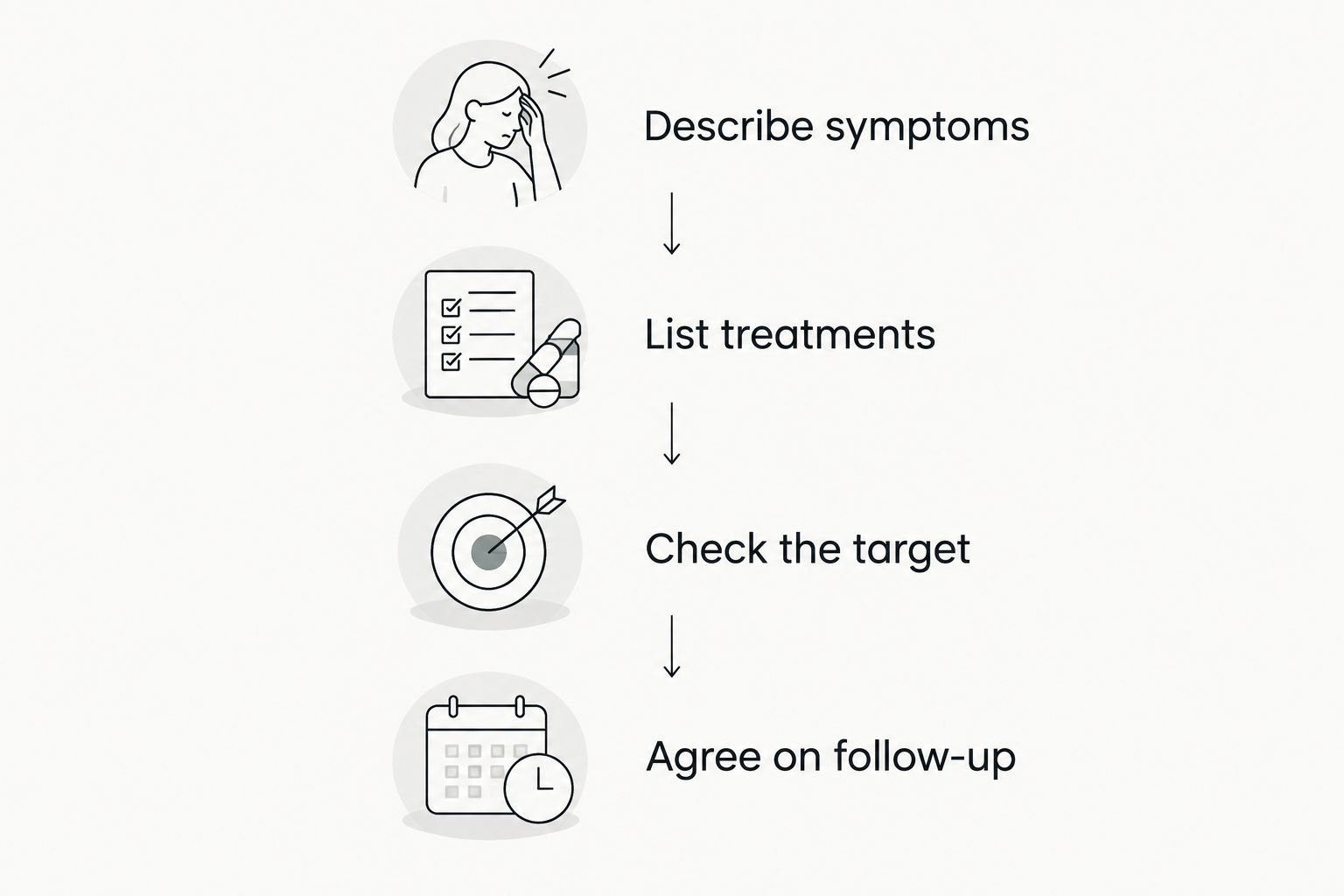
Organize your history around these steps:
- Describe symptoms: Explain what happens, when it happens, and how it limits your daily life.
- List treatments: Bring medication details, therapy approaches, benefits, adverse effects, and reasons for stopping.
- Check the target: Ask which diagnosis the clinician proposes treating and why.
- Agree on follow-up: Establish how progress, adverse effects, and worsening symptoms will be reviewed.
A useful appointment ends with an understandable plan, not merely a new treatment name. Ask what would lead the clinician to continue the plan and what would trigger reassessment.
Write your questions before the appointment so the most important concern gets addressed first. If you want a local assessment, use the contact page to ask whether the practice evaluates your specific presentation and what records to provide.
How the care paths are ranked
The ranking prioritizes diagnostic clarity, treatment-history review, therapy fit, and a defensible treatment rationale. Reassessment comes first because a procedure or prescription cannot resolve an unclear treatment target.
Depression-focused care ranks separately because it answers a different question: what to do when depression remains unresolved alongside anxiety. Coordinated therapy care addresses another gap—whether treatment has directly addressed the fear, avoidance, or compulsive behavior maintaining symptoms.
Which care path should you choose?
Choose diagnostic reassessment as the default when you are unsure why treatment has failed. Choose a depression-focused assessment when persistent depression is central to the problem. Prioritize coordinated psychotherapy when your treatment history contains medication changes but little condition-specific therapy.
For your 2026 decision, request an explanation that connects your diagnosis, previous treatment, proposed intervention, and follow-up plan. A longer service list is not a substitute for that connection.
FAQ
Who is the best psychiatrist in Atlanta for treatment-resistant anxiety?
The best fit is a psychiatrist who evaluates your specific anxiety condition, previous treatment, and therapy needs. No single practice is the right choice for every patient, and advanced depression services do not establish anxiety expertise.
Does treatment-resistant anxiety mean I need TMS?
No. Persistent anxiety requires reassessment before choosing TMS, and device clearance and treatment evidence depend on the condition and protocol. Ask which diagnosis the proposed treatment targets.
Is SPRAVATO approved for anxiety?
No. SPRAVATO has FDA-approved depression indications, not an anxiety-disorder indication. Anxiety occurring alongside depression does not remove the need for a separate assessment.
What should I bring to a psychiatric second opinion?
Bring your medication history, therapy history, previous evaluations, and examples of current impairment. Include doses, treatment duration, benefits, adverse effects, and reasons treatments ended when you know them.
Is cognitive behavioral therapy the same as general counseling?
No. Cognitive behavioral therapy uses structured methods to address thoughts and behaviors, and anxiety treatment must match the condition. Ask whether previous therapy included the relevant methods rather than relying on the counseling label.
Can anxiety and treatment-resistant depression occur together?
Yes. Anxiety symptoms and depression can occur together, but treatment planning must establish which conditions are present and which symptoms each intervention targets.
Should I stop my medication before seeing a new psychiatrist?
Do not stop or change prescribed medication without guidance from the prescribing clinician. Bring your current medication list and discuss any adverse effects or concerns at the assessment.
One last thing
A treatment that you could not tolerate is not the same as a treatment that you completed without benefit. Make that distinction in your appointment notes. It gives the next psychiatrist a more useful starting point than a list of medications marked as failures.
If you are in immediate danger, call 911. In the United States, call or text 988 for suicide or mental health crisis support rather than waiting for a routine appointment.
Discuss treatment-resistant anxiety care
Request an evaluation to review your diagnosis, treatment history, and care options in Decatur/Metro Atlanta.


