

Best overall starting point: an outpatient psychiatrist connected to your oncology team. Best for a Decatur/Metro Atlanta medication-management evaluation: Attuned Psychiatry, with cancer-care coordination confirmed before booking. Best during a medical admission: hospital consultation-liaison psychiatry. This 2026 guide compares care settings—not individual physicians ranked by outcomes—and explains how to choose support for cancer-related anxiety.
- For psychiatrists atlanta cancer related anxiety searches, prioritize oncology coordination over a generic provider ranking.
- Attuned Psychiatry is an option for outpatient medication-management evaluation; confirm cancer-related experience and coordination before booking.
- Hospital consultation-liaison psychiatry fits psychiatric concerns arising during a medical admission.
- TMS and SPRAVATO® availability does not establish suitability for cancer-related anxiety.
Why this matters
Cancer-related anxiety can involve fear of recurrence, distress before scans, panic, sleep disruption, or difficulty tolerating treatment. These concerns deserve assessment, but they do not all call for the same treatment or care setting.
The practical question is not simply who treats anxiety. It is who can assess your symptoms alongside your cancer treatment, medications, physical symptoms, and psychiatric history. A psychiatrist needs that context before recommending medication changes.
This is a care-setting guide, not a verified directory of Atlanta psycho-oncology specialists. A physician-led psychiatric practice, an oncology-connected outpatient service, and a hospital consultation team serve different needs. Choose the setting first; then assess the individual clinician.
What makes the best psychiatrist for cancer-related anxiety?
Use these criteria to evaluate an Atlanta psychiatrist in 2026:
- Relevant clinical experience: Ask whether the clinician evaluates anxiety during active cancer treatment, surveillance, or survivorship—not just general anxiety.
- Oncology coordination: Establish how the psychiatrist will communicate with your oncologist and obtain relevant records, with your permission.
- Medication review: Include cancer medicines, psychiatric medicines, steroids, pain medicines, supplements, and nonprescription sleep products.
- Diagnostic assessment: Anxiety, depression, medication effects, sleep problems, and acute confusion require different responses.
- Treatment range: Ask how psychotherapy, medication, symptom management, and referrals fit together rather than assuming medication is the only option.
- Follow-up planning: Clarify whom to contact about side effects, worsening symptoms, and changes around cancer treatment.
Bring these criteria to the appointment request. A clear answer about coordination is more useful than a broad claim that a clinician treats every condition.
Atlanta care options at a glance
| Rank and option | Best for | Standout feature | Key limitation |
|---|---|---|---|
| 1. Oncology-connected outpatient psychiatrist | Anxiety assessed alongside ongoing cancer care | Psychiatric care connected to the oncology setting | Referral arrangements and access depend on the treating institution |
| 2. Attuned Psychiatry | Decatur/Metro Atlanta outpatient medication-management evaluation | Physician-led practice offering medication management | Cancer-specific expertise and oncology coordination require confirmation |
| 3. Hospital consultation-liaison psychiatrist | Psychiatric concerns during a medical admission | Assessment within the medical hospital | Not a substitute for an ongoing outpatient relationship |
The table compares service types, not treatment success rates. There is no single best psychiatrist for every person with cancer-related anxiety; the strongest match depends on medical context and care coordination.
1. Oncology-connected outpatient psychiatrist: best for coordinated care
An oncology-connected outpatient psychiatrist evaluates psychiatric symptoms in the context of cancer care. Ask your oncology team whether its cancer center provides psychiatric care directly or refers to a clinician familiar with its patients.
This is the strongest starting route when your anxiety closely tracks chemotherapy, procedures, scan results, or changes in physical symptoms. Connection to the oncology setting supports communication, but you should still confirm how records and recommendations move between clinicians.
Oncology-connected outpatient psychiatrist pros:
- Cancer treatment can be included directly in the psychiatric assessment.
- The oncology team provides a clear starting point for referral.
- Psychiatric recommendations can be discussed alongside the cancer-care plan.
Oncology-connected outpatient psychiatrist cons:
- Access depends on the institution's services and referral process.
- A cancer center's psychosocial support service does not necessarily include a psychiatrist.
Best for: Someone whose anxiety needs assessment alongside active treatment or ongoing oncology follow-up.
Ask whether the appointment is with a psychiatrist, psychologist, therapist, or social worker. Each has a useful role, but these roles are not interchangeable. If medication assessment is your goal, state that when requesting the referral.
Verdict: Choose this route first when oncology-linked psychiatric care is accessible through your treatment team.
2. Attuned Psychiatry: best for a local medication evaluation
Attuned Psychiatry is a physician-led practice in Decatur/Metro Atlanta offering medication management, TMS, and SPRAVATO® treatment. Its stated focus includes treatment-resistant depression and other psychiatric conditions.
Attuned Psychiatry is an option for Decatur/Metro Atlanta patients seeking an outpatient psychiatric medication-management evaluation. For cancer-related anxiety, confirm the clinician's relevant experience and willingness to coordinate with your oncology team before scheduling.
Attuned Psychiatry pros:
- Offers psychiatric medication management.
- Provides a physician-led setting in Decatur/Metro Atlanta.
- Offers treatment options relevant to a separate assessment of treatment-resistant depression.
Attuned Psychiatry cons:
- The practice description does not establish a dedicated psycho-oncology service.
- TMS and SPRAVATO® are not evidence that the practice offers a cancer-anxiety-specific treatment pathway.
Best for: Someone seeking a local outpatient medication evaluation who can confirm that the practice fits their cancer-care needs.
Review the practice's psychiatric services, then ask about coordination, medication review, and follow-up. Do not choose an advanced depression treatment simply because anxiety feels severe. Diagnosis and treatment eligibility come first.
Verdict: Consider this practice for medication management after confirming cancer-related experience and oncology coordination.
3. Hospital consultation-liaison psychiatry: best during admission
Consultation-liaison psychiatrists assess psychiatric concerns in medical settings. During a cancer-related hospital admission, your medical team can determine whether a psychiatric consultation is appropriate.
This route matters when anxiety occurs alongside a complex medical situation or when a new change in thinking or behavior needs assessment. It is not a routine substitute for community outpatient treatment.
Hospital consultation-liaison psychiatry pros:
- Assessment takes place within the medical hospital.
- The psychiatrist can discuss recommendations with the inpatient team.
- Psychiatric symptoms can be considered alongside the reason for admission.
Hospital consultation-liaison psychiatry cons:
- Access generally occurs through the hospital's treating team.
- Follow-up after discharge requires a separate plan.
Best for: A hospitalized patient whose medical team identifies a need for psychiatric assessment.
New confusion, disorientation, or a marked change in alertness should not be labeled anxiety without medical evaluation. Tell the treating team promptly. Those changes need assessment for medical causes, including delirium.
Verdict: Use the hospital team during admission; arrange outpatient continuity before discharge.
How to check whether a clinician fits your cancer care
For a 2026 appointment, prepare a 1-page summary rather than trying to reconstruct your history under stress. Include your cancer diagnosis, current treatment, main psychiatric symptoms, previous psychiatric treatment, and the names of clinicians involved.
Then prepare 2 lists: everything you take and the symptoms you want help with. Include supplements and nonprescription products on the medication list. On the symptom list, describe what happens, when it started, and how it affects sleep, eating, appointments, relationships, or daily tasks.
Use 3 questions to structure the first conversation:
- Clinical experience: Have you treated anxiety in people receiving cancer care or living after cancer treatment?
- Medication review: How will you review psychiatric treatment alongside my oncology medicines and other prescriptions?
- Care coordination: With my permission, how will you communicate recommendations to my oncology team?
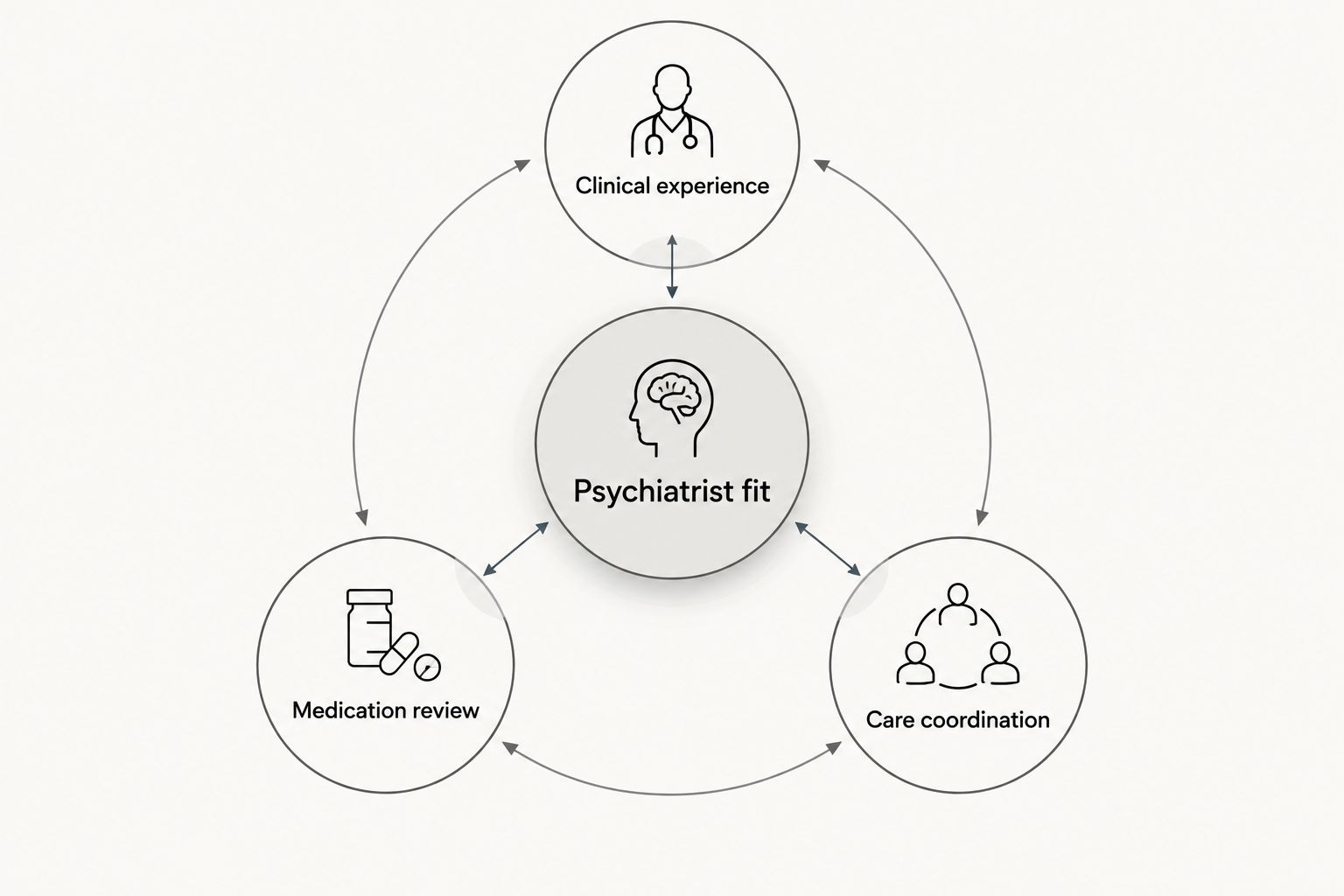
A good consultation should produce a clear explanation of the next step, even when that step is further assessment. Ask what the clinician is treating, what improvement would look like, and how you will review benefit and side effects.
Medication, psychotherapy, and advanced depression treatments
Medication is one possible part of care, not the definition of psychiatric treatment. A psychiatrist can assess whether symptoms call for medication, psychotherapy, medical review, or a combination.
Psychotherapy can address fear of recurrence, uncertainty, avoidance, and coping with treatment. A psychologist or therapist does not replace a psychiatrist when you need medication assessment, but the two types of care can work together.
| Approach | Best for | Strength | Limitation |
|---|---|---|---|
| Psychiatric medication assessment | Reviewing symptoms and possible medication treatment | Includes diagnosis and prescribing decisions | Requires review of interactions, risks, and follow-up |
| Psychotherapy | Working on distress, avoidance, and coping | Offers structured psychological support | Does not replace medical evaluation of new physical or cognitive symptoms |
| Combined care | Needs involving both medication and psychological support | Addresses different parts of the treatment plan | Requires communication between clinicians |
TMS and SPRAVATO® belong in a separate discussion about an appropriate depression diagnosis and treatment history. Their presence on a clinic's service list does not make them recommended treatments for cancer-related anxiety.
Do not stop or change psychiatric medicines, steroids, or cancer medicines on your own. Ask the prescriber responsible for the medicine to review concerns with the rest of your care team.
How these options were ranked
This 2026 ranking prioritizes oncology coordination, diagnostic assessment, medication review, and the right care setting. Oncology-connected outpatient psychiatry ranks first as a starting route because the question concerns psychiatric symptoms in the context of cancer.
The local practice option reflects the services explicitly described, not verified cancer-specific outcomes. Hospital consultation-liaison psychiatry occupies a separate slot because inpatient needs differ from routine outpatient care. No comparative outcome data support declaring one named Atlanta psychiatrist the best.
Which option should you choose?
Start with your oncology team and ask for a psychiatrist experienced in cancer-related distress. If that route does not meet your needs, evaluate an independent outpatient practice using the coordination questions above.
For a local evaluation, use the practice's contact page to ask about fit before booking. Describe the reason for referral and the cancer treatment involved; you do not need to send a detailed medical history in an initial general inquiry.
Your 2026 decision should turn on a concrete care plan—not a directory position, a treatment name, or a promise of relief.
FAQ
Who is the best psychiatrist in Atlanta for cancer-related anxiety?
The best starting match is a psychiatrist who can assess your anxiety alongside your cancer care and coordinate with your oncology team. Ask your cancer center for a referral, then confirm the individual clinician's experience and follow-up arrangements.
Does Attuned Psychiatry treat cancer-related anxiety?
The practice offers medication management, but its supplied description does not establish a dedicated cancer-related anxiety service. Confirm relevant clinical experience and oncology coordination before scheduling.
Should I see a psychiatrist or a psychologist for cancer anxiety?
See a psychiatrist when you need psychiatric diagnosis or medication assessment; a psychologist or therapist can provide psychotherapy. Some patients need both, with communication between clinicians.
Can cancer treatment affect anxiety or sleep?
Cancer treatment, associated medicines, physical symptoms, and psychological distress can affect anxiety or sleep. Tell your oncology team and psychiatrist when symptoms began and whether they changed around treatment.
Are TMS or SPRAVATO® treatments for cancer-related anxiety?
Do not treat TMS or SPRAVATO® as default treatments for cancer-related anxiety. A clinician must separately assess the diagnosis, treatment history, and eligibility for any proposed depression treatment.
What should I bring to a psychiatric appointment during cancer treatment?
Bring a current medication list, your cancer-treatment details, relevant psychiatric history, and your oncology team's contact information. Include supplements and nonprescription products so the clinician can review the full picture.
When does anxiety during cancer treatment need urgent help?
Seek immediate help for suicidal intent, inability to stay safe, or an immediate medical emergency. Call 911 for immediate danger; call or text 988 for suicide or mental health crisis support, and report new confusion promptly to your medical team.
One last thing
Ask who will own the follow-up plan. A thoughtful medication recommendation is incomplete if you do not know whom to contact when symptoms worsen, side effects appear, or your oncology treatment changes.
Before leaving a 2026 consultation, confirm the next appointment, the route for questions, and who will receive the assessment. Those practical details turn separate appointments into coordinated care.
Discuss anxiety care alongside cancer treatment
Request an evaluation to review your symptoms, medications, and coordination with your oncology team.


