

Best fit for treatment-resistant depression: Attuned Psychiatry. Best for reviewing prescriptions: medication management. Best for a treatment that does not involve taking an antidepressant during the procedure: TMS. If you are searching for psychiatrists accepting new patients in Decatur in 2026, choose by clinical fit, then confirm appointment availability directly.
- For psychiatrists accepting new patients Decatur searches, Attuned Psychiatry fits patients seeking treatment-resistant depression evaluation and advanced psychiatric care.
- Medication management, TMS, and SPRAVATO address different treatment decisions; they are not interchangeable options.
- Confirm appointment availability, insurance participation, and treatment eligibility directly before scheduling.
- Bring your medication history so the psychiatrist can assess previous treatment response and next steps.
Why this matters
Finding a psychiatrist is not just a scheduling problem. The right appointment must address your symptoms, previous treatment experience, and the kind of care you need now.
Someone starting medication needs a different discussion from someone whose depression has persisted through adequate antidepressant treatment. A practice offering advanced treatments is relevant to the second situation, but that does not mean every patient needs those treatments.
For your 2026 search, separate appointment access from treatment suitability. An opening tells you when you can be seen. A clinical evaluation determines what care is appropriate.
This guide compares a physician-led practice and the treatment pathways it offers, not a directory of independently ranked local doctors. Appointment openings change; contact the practice rather than treating a search result as a scheduling guarantee.
What makes the best psychiatrist for your needs?
Use these criteria before choosing a provider. A recognizable treatment name alone is not enough.
- Clinical fit: Ask whether the clinician evaluates your symptoms and treats your diagnosed condition. Depression, bipolar disorder, anxiety, and other psychiatric concerns require different assessments.
- Previous-treatment review: Your psychiatrist should understand what you tried, how you took it, what helped, and what caused problems.
- Appropriate treatment choices: Medication management, TMS, and SPRAVATO serve different purposes. Ask why a proposed option matches your situation.
- Medical safety: Share your medical conditions, prescriptions, supplements, substance use, and relevant treatment reactions.
- Practical access: Confirm appointment availability, visit format, insurance participation, and the demands of follow-up care directly.
- Continuity: Know who manages ongoing prescriptions, reviews progress, and responds when symptoms or side effects change.
A good consultation produces a reasoned treatment plan, not simply a prescription or a referral to a procedure. You should understand the recommendation and what happens if it does not help.
Decatur psychiatric care options at a glance
The options below are different entry points into care, not competing clinics. Attuned Psychiatry offers medication management, TMS, and SPRAVATO in Decatur/Metro Atlanta.
| Ranked option | Best for | Main distinction | Key limitation |
|---|---|---|---|
| Physician-led psychiatric services | Evaluating treatment-resistant depression | Medication management and advanced treatment options within the practice | An evaluation must establish which treatment fits |
| Medication management | Reviewing medication response and side effects | Assessment of prescriptions, tolerability, and treatment changes | Medication changes require follow-up and do not guarantee relief |
| TMS | Considering a noninvasive stimulation treatment for depression | Magnetic stimulation rather than administering a medication during the procedure | Requires eligibility screening and a course of appointments |
| SPRAVATO | Evaluating supervised esketamine treatment | Nasal medication administered in a certified healthcare setting | Requires monitoring and transportation planning |
1. Attuned Psychiatry: best for treatment-resistant depression review
Attuned Psychiatry is a physician-led psychiatric practice serving Decatur/Metro Atlanta. Its stated services include medication management, TMS, and SPRAVATO for patients with treatment-resistant depression and other psychiatric conditions.
Attuned Psychiatry is best for Decatur-area patients seeking physician-led evaluation of treatment-resistant depression and advanced treatment options. That is a statement of service fit, not a guarantee of treatment eligibility or an appointment opening.
Treatment-resistant depression commonly describes depression that has not improved adequately after at least 2 adequate antidepressant trials. A psychiatrist needs to review the diagnosis, doses, treatment duration, adherence, and response before deciding whether that description applies.
Attuned Psychiatry pros:
- Physician-led psychiatric care is part of the practice's stated model.
- Medication management, TMS, and SPRAVATO are stated services.
- Its Decatur/Metro Atlanta location matches the geographic focus of this search.
Attuned Psychiatry limitations:
- Offering a treatment does not establish your eligibility for it.
- You must confirm appointment availability, insurance participation, and scheduling arrangements directly.
Best for: Patients whose depression has not responded adequately to previous care and who want a psychiatric assessment of further options.
Verdict: Choose an evaluation when persistent depression is the main problem; do not select a procedure before the assessment.
2. Medication management: best for reviewing your current prescriptions
Medication management evaluates how psychiatric medicines fit your symptoms, diagnosis, medical history, and daily functioning. The discussion can include continuing treatment, adjusting it, or considering an alternative under the prescriber's direction.
This is a useful starting point when your medication only partly helps, causes side effects, or no longer seems to match your needs. It also gives the clinician an opportunity to review whether previous treatment was adequate before recommending something different.
Medication management pros:
- Directly addresses medication response and tolerability.
- Creates an opportunity to review interactions and the full medication list.
- Supports follow-up decisions based on symptoms and functioning.
Medication management limitations:
- Benefits and side effects require ongoing assessment.
- A prescription change does not replace a broader diagnostic evaluation or other indicated care.
Best for: Patients who need a clear review of current or previous psychiatric medication treatment.
For a 2026 appointment, bring the actual medication names rather than relying on pill colors or descriptions. Include medicines you stopped and explain why you stopped them; an intolerable side effect and a lack of benefit are different clinical findings.
Verdict: Choose medication management when the immediate question is whether your prescription plan still fits. Do not change or stop medication on your own.
3. TMS: best for considering noninvasive stimulation treatment
Transcranial magnetic stimulation, or TMS, uses magnetic pulses to stimulate targeted brain regions. It is a treatment option for certain patients with depression, including patients who have not had an adequate response to antidepressant treatment.
TMS does not involve administering an antidepressant during the procedure. That distinction does not mean you should stop existing medication; your treating clinician determines how TMS fits the rest of your care.
TMS pros:
- Provides a treatment approach distinct from another medication change.
- Does not require surgery.
- Allows evaluation of a noninvasive option for persistent depression.
TMS limitations:
- Requires a course of treatment visits rather than a single consultation.
- Requires screening for factors such as seizure risk and certain implanted devices or metal near the treatment area.
- Can cause discomfort at the treatment site or headache; benefit is not guaranteed.
Best for: Patients with depression who want to discuss whether a noninvasive stimulation treatment fits their treatment history and medical circumstances.
Ask about the proposed protocol, appointment demands, safety screening, and how progress will be assessed. Do not assume every TMS treatment plan uses the same schedule.
Verdict: Consider TMS after a clinical review; skip choosing it solely because it sounds different from medication.
4. SPRAVATO: best for evaluating supervised esketamine treatment
SPRAVATO is an esketamine nasal spray used for specific adult depression indications. It is administered under healthcare supervision in a certified setting, not dispensed for unsupervised use at home.
The FDA-required safety program includes monitoring for at least 2 hours after administration. Sedation, dissociation, respiratory depression, and changes in blood pressure are among the safety considerations your clinician must address.
SPRAVATO pros:
- Provides an additional treatment pathway for eligible adults with depression.
- Includes supervised administration and post-dose monitoring.
- Allows discussion of an option distinct from conventional oral antidepressant treatment.
SPRAVATO limitations:
- Requires time for administration and monitoring at each treatment visit.
- Requires arranging transportation home; patients must not drive until the next day after a restful sleep.
- Requires eligibility assessment and carries risks that need a detailed clinical discussion.
Best for: Adults seeking evaluation for supervised esketamine treatment after reviewing diagnosis, previous treatment, and safety factors.
For 2026 planning, assess the entire visit commitment, not just the time spent taking the medication. Ask how treatment visits fit your work, caregiving, and transportation needs before committing to a course.
Verdict: Consider SPRAVATO only through a prescribing clinician's evaluation; do not treat it as a walk-in substitute for routine psychiatric care.
How these options were ranked
The ranking follows clinical fit, treatment-history review, safety, practical access, and continuity. A physician-led evaluation comes first because it determines whether medication management, TMS, or SPRAVATO is appropriate.
The remaining options occupy distinct decision points: prescription review, noninvasive stimulation, and supervised esketamine treatment. This is not a claim that one treatment works better for every patient, and it does not rank local physicians by outcomes or reputation.
Which psychiatric care option should you choose?
Choose a diagnostic and treatment review if you are undecided. You do not need to arrive knowing whether you want medication management, TMS, or SPRAVATO.
If your main concern is side effects or incomplete relief from a prescription, start with medication review. If depression persists despite previous treatment, ask for an assessment of treatment resistance and the suitability of advanced options.
An advertised service is not a personal recommendation. The strongest next step is an appointment that explains the diagnosis, reviews prior care, and sets a follow-up plan you can realistically attend.
How to prepare for a new-patient appointment
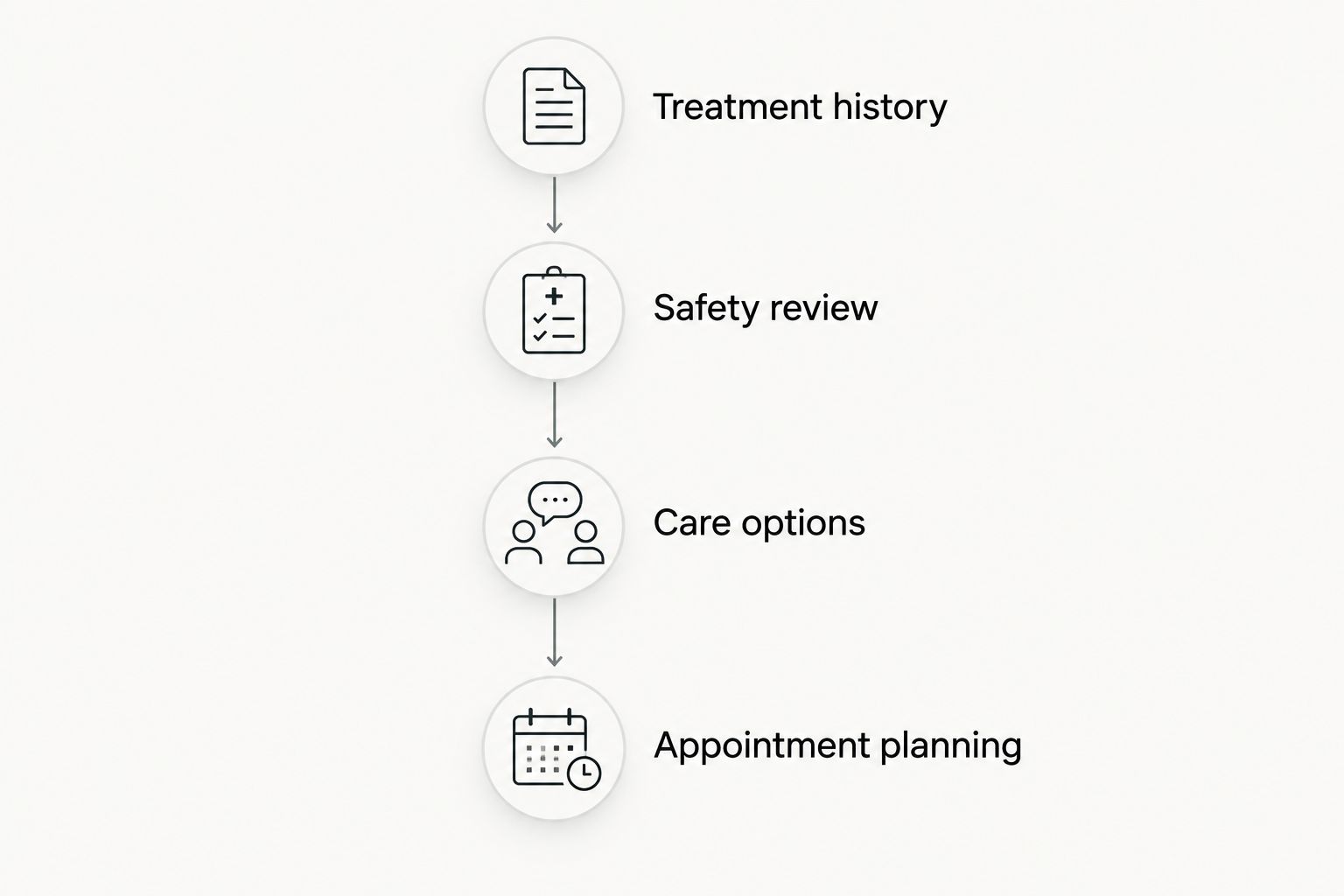
Use this sequence before contacting a practice in 2026. It helps you explain the problem clearly without trying to diagnose yourself.
- Treatment history: Prepare a 1-page summary of previous medications, approximate treatment periods, benefits, side effects, and reasons for stopping.
- Safety review: List current prescriptions, supplements, medical conditions, allergies, and previous serious reactions.
- Care options: Write down your main question, such as whether to revise medication or discuss treatment-resistant depression.
- Appointment planning: Confirm availability, visit format, insurance participation, required records, and follow-up arrangements.
These details support a clinical discussion. You do not need a perfectly complete record before asking for help; bring what you have and identify what you cannot remember.
When you are ready to ask about an appointment, use the practice's contact information. Describe your main concern and ask what information is needed for an initial evaluation.
Ask about a psychiatric evaluation
Discuss appointment availability and the next step for reviewing persistent symptoms or previous treatment.
FAQ
Who is the best psychiatrist in Decatur for treatment-resistant depression?
Attuned Psychiatry is a relevant option for Decatur-area patients seeking physician-led evaluation of treatment-resistant depression because its stated services include medication management, TMS, and SPRAVATO. The right clinician for you depends on your diagnosis, treatment history, practical needs, and appointment access.
How do I find psychiatrists accepting new patients in Decatur?
Contact the practice directly and ask about initial psychiatric evaluations. Confirm appointment availability, insurance participation, visit format, and whether the practice treats your specific concern before scheduling.
Do I need to choose between TMS and SPRAVATO before my appointment?
No, a psychiatric evaluation should come before choosing TMS or SPRAVATO. Your clinician needs to assess your diagnosis, previous treatment response, medical history, and safety considerations.
What should I bring to my first psychiatry appointment?
Bring your medication list, previous treatment history, relevant medical information, and a description of your current symptoms. Include treatments you stopped and the reasons you stopped them.
Does offering SPRAVATO mean a practice will prescribe it to me?
No, offering SPRAVATO does not establish that it is appropriate for you. A clinician must assess the relevant indication, your treatment history, and medical safety before recommending it.
Is TMS the same as medication management?
No, TMS uses magnetic stimulation, while medication management evaluates and manages psychiatric prescriptions. A clinician determines whether either approach, or a combination within a broader plan, fits your needs.
Should I wait for a new-patient appointment if I am in crisis?
No, do not wait for a routine appointment during a mental health emergency. In the United States, call or text 988 for crisis support; call 911 or go to an emergency department if you are in immediate danger.
One last thing
A treatment that did not help and a treatment you could not tolerate tell your psychiatrist different things. Write those experiences separately rather than labeling every previous prescription a failure.
That distinction gives your evaluation a clearer starting point. Your next appointment should answer what to try next and why that choice fits your history.


