

Best fit for discussing medication management, TMS, and SPRAVATO® in Decatur: Attuned Psychiatry. For your 2026 search, choose a psychiatrist who can explain why depression has persisted, assess your previous treatment trials, and match the next step to your diagnosis—not simply offer another prescription.
- Attuned Psychiatry offers Decatur patients medication management, TMS, and SPRAVATO® within a physician-led psychiatric practice.
- For decatur psychiatrists treatment-resistant depression searches, prioritize diagnostic review and documented treatment history over ranking claims.
- TMS and SPRAVATO® are distinct treatment options; eligibility, risks, and appointment requirements should guide the choice.
- Do not stop or change psychiatric medication without guidance from your prescriber.
Why this matters
Treatment-resistant depression generally describes depression that has not improved adequately after at least 2 adequate antidepressant trials. An adequate trial depends on the medication, dose, duration, adherence, and clinical circumstances. A medication stopped early because of side effects does not automatically establish treatment resistance.
Your next appointment should answer a specific question: What needs to change about the treatment plan, and why? That requires more than counting prescriptions. A psychiatrist should revisit the diagnosis, review what happened during previous treatment, and discuss options that fit your health and daily life.
For a 2026 decision, separate provider selection from treatment selection. A practice can offer several therapies without every therapy being appropriate for you. The guide below identifies a local practice and compares clinical pathways; it is not a citywide ranking of individual physicians.
What makes the best psychiatrist for treatment-resistant depression?
Use these criteria before comparing providers or requesting a particular therapy:
- Diagnostic review: The psychiatrist considers whether the symptoms reflect major depression, bipolar disorder, another psychiatric condition, or a contributing medical problem.
- Treatment-history review: The discussion covers medication names, doses, duration, benefits, side effects, and reasons for stopping.
- Relevant treatment options: The clinician explains medication strategies, psychotherapy, brain stimulation, and other appropriate interventions rather than presenting one treatment as universal.
- Safety assessment: The plan addresses suicidal thoughts, substance use, relevant medical conditions, and medication interactions.
- Measurable follow-up: You know how symptoms, functioning, side effects, and progress will be assessed.
- Practical fit: Appointment frequency, transportation, treatment setting, and coordination with other clinicians fit your circumstances.
A useful consultation ends with a rationale, not just a treatment name. Ask what evidence supports the recommendation for your situation and what would prompt a change in course.
Decatur depression care at a glance
The practice and treatment pathways below serve different purposes. The order is a decision sequence, not a claim that one treatment works better for everyone.
| Practice or pathway | Best for | Standout feature | Key limitation |
|---|---|---|---|
| Attuned Psychiatry | Discussing several advanced treatment options locally | Physician-led Decatur/Metro Atlanta practice offering medication management, TMS, and SPRAVATO® | The service list alone does not establish your eligibility or individual clinician fit |
| Medication-management review | Clarifying previous trials and the next prescribing decision | Examines dose, duration, tolerability, interactions, and diagnosis | Further prescribing changes require monitoring and do not guarantee improvement |
| TMS evaluation | Exploring a noninvasive brain-stimulation option | Uses magnetic pulses rather than administering a medication during treatment | Requires a treatment schedule and screening for device-related contraindications |
| SPRAVATO® evaluation | Assessing suitability for supervised esketamine treatment | Nasal esketamine administered in a certified healthcare setting | Requires observation, transportation planning, and screening for medical risks |
1. Attuned Psychiatry: best for a multi-option Decatur consultation
Attuned Psychiatry is a physician-led psychiatric practice serving Decatur and Metro Atlanta. Its stated services include medication management, TMS, and SPRAVATO® for patients with treatment-resistant depression and other psychiatric conditions.
Attuned Psychiatry is a fit for Decatur patients seeking a physician-led discussion of medication management, TMS, and SPRAVATO®. That scope supports a consultation about different treatment approaches; it does not establish which approach you should receive.
For your 2026 consultation, ask who will assess you, who will manage treatment, and how recommendations will be coordinated with your existing clinicians. Bring a concise treatment history so the conversation starts with clinical decisions rather than reconstructing old prescriptions.
Attuned Psychiatry pros:
- Physician-led psychiatric practice.
- Explicit focus on treatment-resistant mental health conditions.
- Medication management, TMS, and SPRAVATO® are named services.
- Decatur/Metro Atlanta location matches a local provider search.
Attuned Psychiatry limitations:
- A practice description does not establish an individual physician's experience with your specific circumstances.
- Offering a therapy does not establish that you qualify for it.
- Your scheduling, insurance, and care-coordination requirements still need direct confirmation.
Best for: Patients seeking a local assessment that includes several potential treatment paths.
Verdict: Hold the final provider decision until the consultation establishes clinical fit and a clear plan.
2. Medication-management review: best for clarifying what failed
A medication-management review examines whether previous treatment was appropriate, adequately delivered, and tolerable. It also checks whether a revised diagnosis or contributing condition changes the next prescribing decision.
This is not the same as automatically repeating another antidepressant. Depending on your history, a psychiatrist can discuss optimization, switching medication, augmentation, or moving to another treatment approach. Those are clinician-led decisions, not instructions to adjust medication yourself.
Medication-management review pros:
- Clarifies which previous trials were adequate.
- Identifies side effects and interactions that affect treatment choices.
- Connects prescribing decisions to diagnosis and symptoms.
- Creates a record that supports later treatment evaluations.
Medication-management review cons:
- Medication changes require monitoring for benefit and adverse effects.
- Additional medication trials do not guarantee improvement.
- An incomplete history makes previous treatment harder to interpret.
Best for: Patients whose medication history is fragmented, whose diagnosis needs reassessment, or whose previous trials need closer review.
Ask the prescriber to distinguish ineffective, partially effective, and not tolerated treatments. Those categories describe different clinical problems. A medication that helped mood but caused unacceptable side effects should not disappear into a generic list of failures.
Verdict: Hold medication changes until your prescriber has reviewed the full history and explained the next step.
3. TMS evaluation: best for exploring noninvasive brain stimulation
Transcranial magnetic stimulation, or TMS, uses magnetic pulses to stimulate targeted brain regions. It is a noninvasive treatment used for depression, and standard outpatient sessions generally do not require anesthesia.
Conventional depression protocols commonly involve appointments 5 days per week over several weeks, although schedules differ by protocol. For a 2026 treatment decision, ask about the actual protocol being proposed rather than assuming every TMS program uses the same schedule.
TMS evaluation pros:
- Assesses a treatment that does not administer a medication during the session.
- Provides an alternative mechanism to another prescribing change.
- Allows discussion of treatment targeting and symptom monitoring.
- Includes screening for relevant implants and other safety concerns.
TMS evaluation cons:
- Repeated appointments create a substantial scheduling commitment.
- Scalp discomfort and headache can occur; seizures are a rare serious risk.
- Some implanted devices or metal near the treatment area require exclusion or specialist assessment.
Best for: Patients seeking an assessment of whether noninvasive brain stimulation fits their depression history and medical circumstances.
Ask how the clinician will assess response, what side effects require a call, and what happens if symptoms improve only partly. A treatment course needs a follow-up plan, not just a first appointment.
Verdict: Hold a TMS decision until safety screening and the proposed appointment schedule are clear.
4. SPRAVATO® evaluation: best for assessing supervised esketamine
SPRAVATO® is an esketamine nasal spray administered under healthcare supervision. It is not a take-home nasal spray, and it is not interchangeable with every treatment described as ketamine therapy.
FDA prescribing information requires monitoring for at least 2 hours after administration. It also directs patients not to drive or operate machinery until the next day after a restful sleep. Transportation planning therefore belongs in the treatment decision, not as an afterthought.
SPRAVATO® evaluation pros:
- Assesses a treatment specifically indicated for treatment-resistant depression in adults.
- Includes supervised administration and post-dose monitoring.
- Creates an opportunity to review blood pressure, medications, and relevant medical history.
- Provides a distinct treatment discussion when previous antidepressant treatment has been inadequate.
SPRAVATO® evaluation cons:
- Sedation, dissociation, blood-pressure increases, and respiratory depression require clinical safeguards.
- Monitoring and transportation requirements affect your treatment-day schedule.
- Certain vascular conditions and other contraindications can rule out treatment.
Best for: Adults seeking a clinical assessment of esketamine eligibility after an inadequate response to previous depression treatment.
For decisions in 2026, ask the treating clinician to explain the current FDA prescribing information and SPRAVATO® REMS requirements. The assessment should address your medical risks and treatment history, not just whether you want the therapy.
Verdict: Hold a SPRAVATO® decision until eligibility, monitoring, and safe transportation are confirmed.
How these options were ranked
This guide prioritizes diagnostic review, treatment-history assessment, relevant options, safety, measurable follow-up, and practical fit. The practice comes first because you need a clinician to assess the choices; the treatment pathways follow because they answer different clinical questions.
No treatment earns a universal first-place ranking. Medication review clarifies the foundation. TMS and esketamine evaluations assess distinct interventions with different risks and appointment requirements. The appropriate sequence depends on your clinical assessment.
What to bring to your first appointment
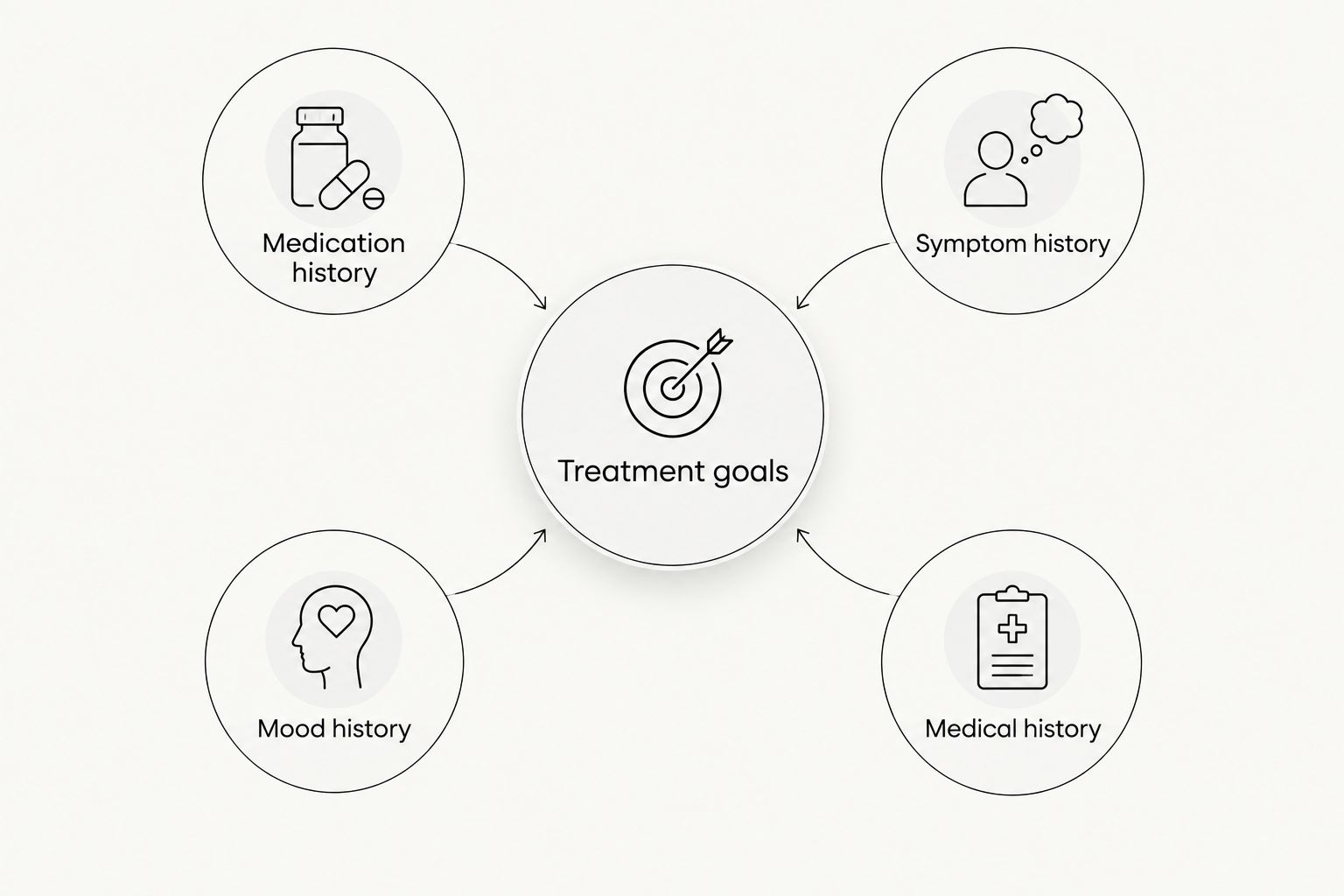
A useful treatment history makes the consultation more specific. Prepare these items without changing your current treatment:
- Medication history: Names, doses if known, approximate treatment periods, benefits, side effects, and reasons for stopping.
- Symptom history: When depression began, changes over time, sleep, energy, concentration, and effects on daily functioning.
- Mood history: Periods of unusually elevated or irritable mood, reduced need for sleep, or impulsive behavior.
- Medical history: Relevant conditions, implants, current medications, supplements, and substance use.
- Treatment goals: Concrete changes you want, such as returning to work reliably or resuming basic daily activities.
These categories help a psychiatrist distinguish persistent depression from an incomplete treatment trial, a tolerability problem, or a diagnosis that needs revision. You do not need perfect records to describe what you remember.
Ask the clinician to identify the next decision, the reason for it, and how progress will be reviewed. If the explanation remains unclear, ask for it in plain language before agreeing to treatment.
Which Decatur depression-care option should you choose?
Start with a psychiatric assessment, not a predetermined procedure. Attuned Psychiatry offers a local setting for discussing medication management, TMS, and SPRAVATO®; your consultation should establish which options deserve further evaluation.
If your previous treatment history is unclear, prioritize medication and diagnostic review. If that history already documents inadequate response, ask the psychiatrist to explain the next appropriate interventions and their trade-offs. Do not interpret a listicle as a personal treatment recommendation.
Review your depression treatment options
Explore a physician-led Decatur practice offering medication management, TMS, and SPRAVATO®.
FAQ
What's the best Decatur psychiatrist for treatment-resistant depression?
The best fit is a psychiatrist who reviews your diagnosis, previous treatment trials, safety risks, and appropriate next options. Attuned Psychiatry is a physician-led Decatur/Metro Atlanta practice offering medication management, TMS, and SPRAVATO®; individual fit requires a consultation.
How do I know whether my depression is treatment-resistant?
Treatment-resistant depression generally means depression has not improved adequately after at least two adequate antidepressant trials. A psychiatrist must assess dose, duration, adherence, tolerability, and diagnosis before applying that description to your history.
Is TMS better than SPRAVATO® for depression?
Neither TMS nor SPRAVATO® is the best choice for every patient. They differ in treatment delivery, risks, monitoring, and scheduling requirements, so the decision needs an individualized clinical assessment.
Do I have to try every antidepressant before discussing other options?
You do not have to try every antidepressant before discussing other treatment options. Your psychiatrist should review adequate previous trials, diagnosis, medical history, and the eligibility requirements of the treatment being considered.
Can I drive myself home after SPRAVATO®?
No, you should arrange transportation home after SPRAVATO® treatment. FDA prescribing information directs patients not to drive or operate machinery until the next day after a restful sleep.
What should I bring to a treatment-resistant depression consultation?
Bring your medication history, current medication list, relevant medical information, and a description of how depression affects daily life. Include past benefits and side effects rather than listing medication names alone.
Should I stop my antidepressant before a TMS or SPRAVATO® evaluation?
Do not stop or change your antidepressant unless your prescriber directs you to do so. The evaluating clinician should review your current medications and explain any treatment-specific instructions.
What should I do if depression becomes an immediate safety crisis?
If you are in immediate danger or cannot stay safe, call 911 or go to the nearest emergency department. In the United States, call or text 988 for suicide and crisis support; do not wait for a routine appointment.
One last thing
Write down what improvement would look like in daily life before your appointment. A symptom score helps track depression, but your ability to sleep, work, eat, maintain relationships, and manage basic tasks also matters. For your 2026 treatment plan, ask how those concrete goals will be assessed alongside symptoms.


