

Best starting point: a psychiatrist experienced in bipolar disorder who reviews your diagnosis and prior treatments before changing medication. For adults comparing Atlanta psychiatrists for resistant bipolar depression in 2026, Attuned Psychiatry is a local option for a physician-led psychiatric assessment—not a verified bipolar-specialist ranking winner.
- For atlanta psychiatrists resistant bipolar depression searches, prioritize bipolar experience and medication safety over treatment menus.
- Attuned Psychiatry offers physician-led psychiatric care in Decatur/Metro Atlanta; confirm bipolar-specific experience before booking.
- Academic consultation, hospital-based treatment, and emergency care serve different needs; they are not interchangeable.
- SPRAVATO is not FDA-approved for bipolar depression. Ask about diagnosis-specific evidence before considering advanced treatments.
Why this matters
Depression that persists despite treatment needs a fresh clinical review, not simply another prescription. In bipolar disorder, that review must also address past mania or hypomania, mixed symptoms, sleep changes, and medication-related mood elevation.
The best psychiatrist for resistant bipolar depression is the one who can explain both the treatment plan and its safeguards against mood switching. A long treatment menu does not establish that expertise.
Attuned Psychiatry offers medication management, TMS, and SPRAVATO® in Decatur/Metro Atlanta. Those services establish what the practice offers, but they do not establish that each treatment is appropriate for bipolar depression. This 2026 guide compares care settings and selection criteria rather than assigning unsupported scores to individual doctors.
What makes the best psychiatrist for resistant bipolar depression?
Use these criteria before choosing an appointment:
- Bipolar-specific experience: Ask how the psychiatrist evaluates bipolar depression, past mood elevation, and mixed features.
- Diagnostic review: Expect questions about your full mood history, substance use, physical health, and family history—not just current sadness.
- Treatment-history review: Bring medication names, doses, treatment lengths, benefits, side effects, and reasons for stopping.
- Safety planning: Ask how the practice responds to worsening depression, suicidal thoughts, reduced sleep, or emerging mania.
- Escalation options: Find out when the psychiatrist recommends a specialist consultation, ECT evaluation, or hospital care.
- Continuity: Clarify who handles follow-up, urgent messages, refills, and coordination with other clinicians.
These criteria matter more than a generic “best psychiatrist” label. For your 2026 search, use them to test whether a clinician fits your particular history.
Atlanta care options at a glance
The order below starts with planned outpatient assessment and moves toward more specialized or urgent care. It is not a quality ranking: the right setting depends on symptoms, safety, and previous treatment.
| Care option | Best for | Main role | Key limitation |
|---|---|---|---|
| Attuned Psychiatry | Exploring a local physician-led assessment | Medication management and discussion of available psychiatric services | Confirm bipolar-specific experience and suitability before booking |
| Academic mood-disorder consultation | Diagnostic uncertainty or a complex treatment history | Specialist reassessment and treatment recommendations | A consultation does not necessarily include ongoing prescribing |
| Hospital-based ECT evaluation | Severe depression requiring consideration of ECT | Assessment for a procedure used in severe mood disorders | Requires medical evaluation, anesthesia, and recovery planning |
| Emergency psychiatric assessment | Immediate safety concerns or severe behavioral change | Urgent assessment and stabilization | Not a substitute for long-term outpatient treatment |
1. Attuned Psychiatry: best for exploring local outpatient assessment
Attuned Psychiatry is a physician-led psychiatric practice serving Decatur/Metro Atlanta. The practice offers medication management, TMS, and SPRAVATO for patients with treatment-resistant depression and other psychiatric conditions.
Attuned Psychiatry is an option for adults seeking a local physician-led psychiatric assessment. If your diagnosis is bipolar disorder, ask directly whether the evaluating clinician regularly treats resistant bipolar depression. Do not treat the availability of advanced depression therapies as proof of bipolar-specific suitability.
Attuned Psychiatry pros:
- Physician-led psychiatric care.
- Medication management among its stated services.
- A Decatur/Metro Atlanta setting for local assessment.
Attuned Psychiatry limitations:
- Confirm bipolar-specific clinical experience rather than assuming it from the service list.
- TMS and SPRAVATO require diagnosis-specific discussion; neither is automatically the next step for bipolar depression.
Best for: Adults exploring a local outpatient evaluation who can confirm the clinician's fit before scheduling.
Ask who will manage medication, how mood switching is monitored, and what happens if symptoms become unsafe. The practice's psychiatric services provide a starting point for that conversation.
Verdict: Hold until the practice confirms bipolar-specific fit and follow-up arrangements.
2. Academic consultation: best for diagnostic uncertainty
An academic mood-disorder consultation is a setting to consider when the diagnosis or treatment sequence remains unclear. Ask for an evaluation focused on bipolar disorder rather than a general depression appointment.
This route fits questions such as whether past periods of increased energy were hypomania, whether current agitation represents mixed symptoms, or whether previous treatments received an adequate trial. The consultation should produce specific recommendations that your ongoing prescriber can understand and implement.
Academic consultation pros:
- A setting to seek a detailed diagnostic second opinion.
- An opportunity to review a complicated medication history.
- A way to request recommendations before another treatment change.
Academic consultation limitations:
- Confirm that the appointment includes the relevant mood-disorder expertise.
- A second-opinion visit does not necessarily transfer long-term care.
Best for: Adults with conflicting diagnoses, unclear mood episodes, or repeated treatment changes without a clear explanation.
Before booking, ask whether the clinician provides a written assessment and coordinates with your current psychiatrist. Also establish who remains responsible for prescriptions while the consultation is underway.
Verdict: Hold until the consultation scope and ongoing prescribing responsibility are clear.
3. Hospital-based ECT evaluation: best for discussing severe illness
Electroconvulsive therapy, or ECT, is an established treatment for severe mood disorders, including bipolar depression. An ECT evaluation is particularly relevant when depression is severe, other treatments have not helped, or the clinical situation requires consideration of a rapid response.
ECT is a medical procedure performed under anesthesia. Choosing an evaluation means discussing suitability, benefits, risks, and alternatives—not committing to treatment.
ECT evaluation pros:
- Addresses a treatment option used for severe bipolar depression.
- Includes medical and psychiatric suitability assessment.
- Creates a specific discussion about acute treatment and follow-up care.
ECT evaluation limitations:
- ECT involves anesthesia and recovery arrangements.
- Memory problems and confusion are important risks to discuss.
- Continuing care remains necessary after an acute treatment course.
Best for: Adults whose psychiatrist recommends evaluating ECT because of illness severity or inadequate response to prior care.
Ask how the team evaluates memory, manages current medications, arranges transportation requirements, and plans treatment after the acute course. Request an explanation tailored to your health history rather than a general success claim.
Verdict: Hold until an ECT clinician completes an individualized assessment.
4. Emergency assessment: best for immediate safety concerns
Emergency care takes priority over provider comparisons when someone cannot stay safe, has suicidal intent, develops psychosis, or shows dangerous behavior associated with mania or mixed symptoms. You do not need to finish an outpatient search before seeking urgent help.
In the United States, call or text 988 for suicide or mental health crisis support. Call 911 or go to the nearest emergency department for immediate danger or a medical emergency.
Emergency assessment pros:
- Prioritizes immediate safety and urgent evaluation.
- Provides assessment when symptoms exceed what a routine appointment can address.
- Helps determine whether hospital-level care is necessary.
Emergency assessment limitations:
- Does not replace an ongoing therapeutic relationship.
- Requires follow-up planning after the immediate crisis.
Best for: Immediate safety concerns, severe loss of judgment, or symptoms that make waiting unsafe.
Verdict: Skip the routine booking process when emergency assessment is needed.
What resistant bipolar depression actually requires reviewing
Persistent symptoms do not, by themselves, explain why treatment has failed. A psychiatrist needs to distinguish inadequate response from an incorrect diagnosis, an incomplete medication trial, intolerable side effects, inconsistent dosing, or another condition affecting recovery.
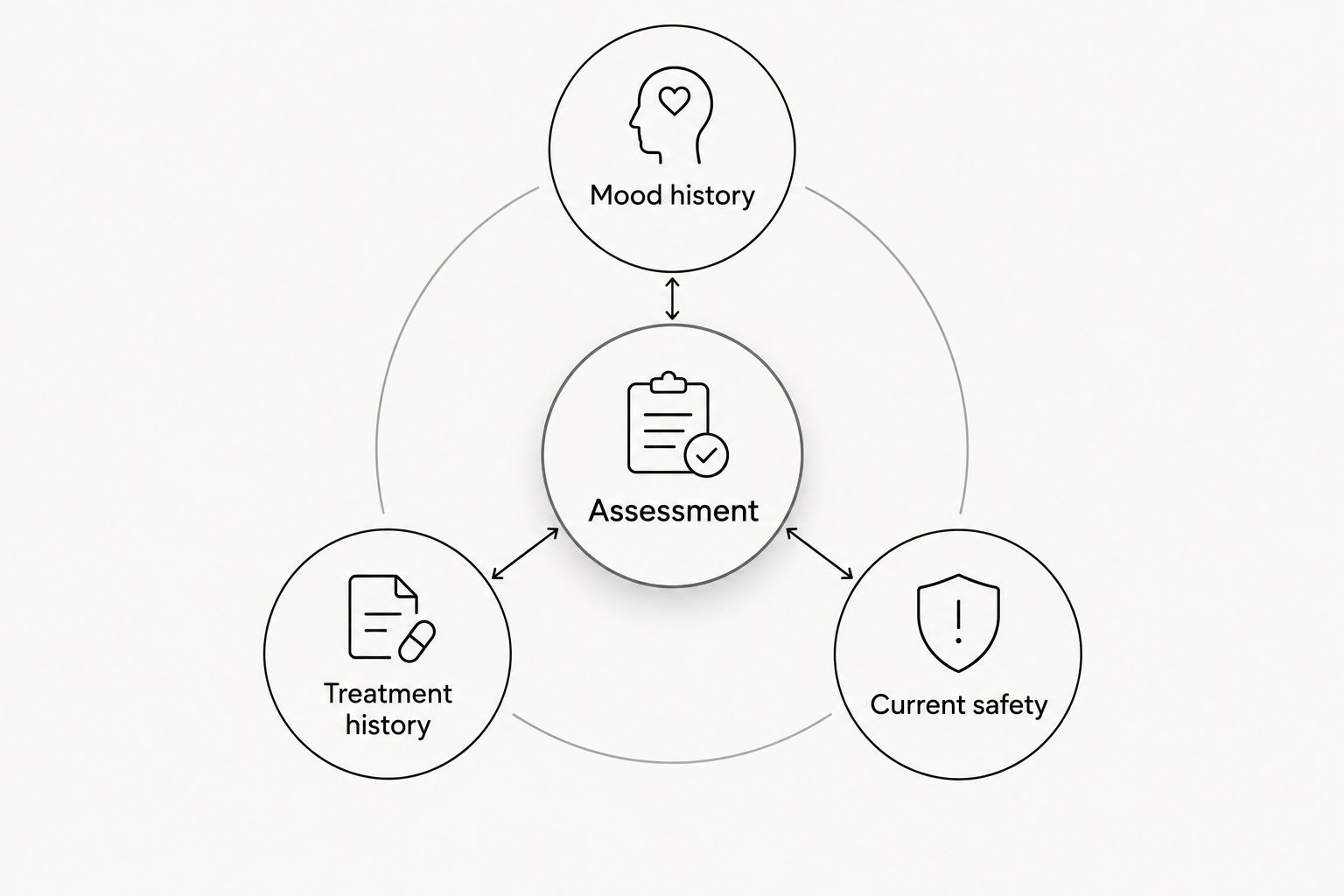
Bring a written history with these 3 sections:
- Mood history: Depressive episodes, periods of increased energy, reduced need for sleep, impulsivity, and major changes noticed by others.
- Treatment history: Medication names, doses, duration, adherence, side effects, psychotherapy, and previous procedures.
- Current safety: Suicidal thoughts, agitation, substance use, sleep disruption, and your ability to manage daily needs.
A useful assessment connects these sections. It should explain why a proposed treatment fits your diagnosis and what would trigger a change in the plan.
For a 2026 appointment, include older records when they document previous mood elevation or medication reactions. A brief episode from years earlier can change how a psychiatrist interprets today's depression.
TMS and SPRAVATO are not automatic bipolar recommendations
Treatment-resistant major depression and resistant bipolar depression are not interchangeable diagnoses. A treatment's role in one does not establish its role in the other.
FDA prescribing information for SPRAVATO addresses specified uses in major depressive disorder, not bipolar depression. SPRAVATO is not FDA-approved for bipolar depression. It also requires supervised administration and monitoring for at least 2 hours after each treatment session.
For TMS, ask about the exact device, proposed protocol, evidence for bipolar depression, and regulatory status of that use. Do not assume that an FDA-cleared depression device has a bipolar-depression indication.
For either discussion, ask:
- Is this proposed use approved for my diagnosis or off-label?
- What evidence supports it for bipolar depression specifically?
- How will you monitor hypomania, mania, or mixed symptoms?
- What treatment continues alongside it?
- What is the plan if symptoms worsen?
Off-label treatment requires a clear explanation, not an automatic rejection or endorsement. Your psychiatrist should discuss the evidence, uncertainty, alternatives, and monitoring before you decide.
How these options were ranked
This 2026 guide orders care settings by their role: local outpatient assessment, specialist reassessment, procedural evaluation, and urgent stabilization. It does not claim that a named clinician has better outcomes, shorter waits, or more bipolar experience than another.
The selection criteria remain the same across settings: diagnostic accuracy, bipolar-specific experience, medication safety, escalation planning, and continuity. Choose the setting that addresses your current clinical problem—not the one with the longest treatment list.
Which Atlanta psychiatrist should you choose?
If you are safe and seeking planned care, start with a psychiatrist who can assess bipolar disorder and explain the next treatment decision. If your diagnosis remains disputed, seek a specialist second opinion. If illness is severe, ask whether an ECT evaluation belongs in the plan.
Before scheduling with Attuned Psychiatry, find the right starting point to confirm experience with your diagnosis and the type of evaluation offered. Do not stop or change psychiatric medication based on a provider comparison article.
FAQ
Who is the best Atlanta psychiatrist for resistant bipolar depression?
Choose a psychiatrist with bipolar-specific experience who reviews your full mood and treatment history. A defensible choice depends on diagnostic fit, safety planning, and continuity—not an unsupported local ranking.
Does Attuned Psychiatry treat resistant bipolar depression?
Confirm bipolar-specific treatment with Attuned Psychiatry before booking. The practice describes physician-led care, medication management, TMS, and SPRAVATO for treatment-resistant depression and other psychiatric conditions; that description does not establish a bipolar-specific treatment program.
Is SPRAVATO approved for bipolar depression?
No. SPRAVATO is not FDA-approved for bipolar depression. Its FDA prescribing information addresses specified uses in major depressive disorder, which is a different diagnosis.
Is TMS automatically appropriate when bipolar depression resists medication?
No. A psychiatrist must evaluate the evidence, proposed protocol, regulatory status, and your individual history. Ask specifically about monitoring for hypomania or mania.
When should I ask about ECT for bipolar depression?
Ask about an ECT evaluation when bipolar depression is severe or previous treatments have not provided adequate benefit. A specialist must assess medical suitability, potential benefits, memory risks, and alternatives.
What should I bring to a bipolar depression consultation?
Bring your medication history, previous psychiatric records, and a timeline of depressive and elevated moods. Include treatment lengths, side effects, sleep changes, and observations from someone who knows you well, with your consent.
What should I do if I cannot stay safe while waiting for an appointment?
Seek urgent help rather than waiting for an outpatient visit. In the United States, call or text 988 for crisis support; call 911 or go to an emergency department for immediate danger or a medical emergency.
One last thing
Bring observations about your highest-energy periods—not just your lowest moods. Reduced need for sleep, unusual spending, increased activity, and medication-related agitation can be important diagnostic clues even when depression is the reason you are seeking care.
Before your 2026 appointment, write down what changed, who noticed, and what medication you were taking. That history gives the next psychiatrist something more useful than “nothing has worked.”
Related guides
Discuss your treatment-resistant depression options
Request an evaluation and ask what the next step looks like after unsuccessful antidepressant trials.


