

Best starting point for a physician-led treatment review: Attuned Psychiatry. Best fit for a compressed treatment schedule: an accelerated TMS program whose exact protocol and medical oversight you verify before enrolling. This 2026 guide compares care pathways for people searching for accelerated TMS programs in Atlanta—not unverified clinic rankings.
- For accelerated TMS programs in Atlanta, compare the exact protocol, medical screening, daily schedule, and follow-up.
- Attuned Psychiatry offers physician-led TMS evaluation in Decatur/Metro Atlanta; an accelerated schedule requires direct confirmation.
- Conventional TMS and SPRAVATO are different treatment pathways, not interchangeable versions of accelerated TMS.
- Choose treatment around clinical suitability and continuity of care, not the shortest advertised course.
Why this matters
Accelerated TMS compresses multiple stimulation sessions into a shorter treatment period than a conventional schedule. The word accelerated describes scheduling; it does not, by itself, identify the stimulation protocol, establish your eligibility, or guarantee a better outcome.
For your 2026 shortlist, separate three questions: Does the practice provide TMS? Does it provide an accelerated protocol? Is that protocol appropriate for your diagnosis and treatment history? A yes to the first question does not answer the others.
Attuned Psychiatry is a local option for physician-led TMS evaluation, not a confirmed accelerated TMS program. Its stated services include medication management, TMS, and SPRAVATO® for treatment-resistant depression and other psychiatric conditions.
The ranked options below organize your next decision. They are care pathways, not a claim that particular Atlanta clinics have been independently compared or that one treatment works best for everyone.
What makes the best accelerated TMS program?
Use these criteria before comparing schedules or making travel arrangements:
- A named protocol: Ask what treatment is delivered, how sessions are arranged, and what evidence supports that exact approach.
- Diagnostic screening: The evaluation should address your depression history, previous treatment, relevant medical conditions, and safety concerns.
- Clear medical responsibility: Know who determines eligibility, manages treatment changes, and handles problems during the course.
- A workable schedule: Obtain the full attendance requirements, including evaluation, treatment, reassessment, and follow-up.
- A plan after treatment: Ask how response is measured and what happens if symptoms persist or return.
- Evidence without inflated promises: Distinguish published research on a particular protocol from broad claims about TMS as a category.
A short schedule is useful only when the treatment itself fits your clinical needs. Do not treat convenience as evidence of effectiveness.
Atlanta TMS care pathways at a glance
| Ranked pathway | Best for | Standout feature | Key limitation |
|---|---|---|---|
| Attuned Psychiatry evaluation | Reviewing treatment-resistant depression with a local physician-led practice | Medication management, TMS, and SPRAVATO within its stated services | An accelerated TMS protocol is not established by the practice description |
| Verified accelerated TMS program | Considering multiple sessions within a compressed treatment period | Concentrated treatment scheduling | Protocols differ; the accelerated label alone is insufficient |
| Conventional TMS course | Considering treatment spread across repeated visits | A spaced outpatient treatment schedule | Frequent attendance can be difficult to sustain |
| SPRAVATO assessment | Evaluating a medication-based alternative for treatment-resistant depression | Supervised intranasal esketamine treatment | Requires monitoring and transportation planning; it is not TMS |
This table compares purposes and practical constraints. It does not rank clinical effectiveness or replace a psychiatric assessment.
1. Attuned Psychiatry: best for a local treatment review
Attuned Psychiatry is a physician-led psychiatric practice serving Decatur/Metro Atlanta. Its stated services include medication management, TMS, and SPRAVATO, making it relevant when you need to review treatment-resistant depression rather than select a schedule in isolation.
Start with your diagnosis, previous medication trials, response to psychotherapy, and current symptoms. Then ask which treatment pathway fits—and whether an accelerated TMS protocol is among the practice's current services.
Attuned Psychiatry pros:
- Physician-led psychiatric care is explicitly part of the practice description.
- Its stated scope includes TMS and medication management.
- SPRAVATO is another named treatment option for discussion.
Attuned Psychiatry limitations:
- The practice description does not establish an accelerated TMS schedule or named accelerated protocol.
- Individual eligibility, treatment logistics, and follow-up arrangements require clinical discussion.
Best for: Patients in Decatur/Metro Atlanta who need a physician-led review of treatment options after inadequate improvement.
Use the practice's services information to frame your questions, but obtain the proposed schedule directly before arranging work leave or transportation.
Verdict: Hold off on choosing an accelerated course until the practice confirms the protocol; start with a treatment evaluation.
2. Verified accelerated TMS: best for a compressed schedule
An accelerated TMS pathway delivers multiple sessions within a shorter treatment period. The important distinction is the actual protocol: session timing, stimulation approach, targeting method, and clinical supervision all matter.
Ask the provider to name the protocol in writing. A general explanation of TMS is not a substitute for evidence supporting the specific accelerated approach being proposed.
Accelerated TMS pros:
- Concentrates treatment into a shorter calendar period than a conventional course.
- Offers a scheduling approach worth discussing when repeated travel is difficult.
- Uses noninvasive brain stimulation rather than an intranasal medication.
Accelerated TMS limitations:
- Multiple sessions can create substantial demands within each treatment day.
- Evidence from one accelerated protocol does not automatically apply to another.
- Completing a compressed course does not eliminate the need for follow-up.
Best for: Patients whose evaluating clinician supports a specific accelerated protocol and who can accommodate the full daily commitment.
For a 2026 decision, ask what the provider means by accelerated. Also ask whether published results concern the same protocol and a patient population relevant to your condition.
Verdict: Hold until the provider supplies the protocol, eligibility assessment, and follow-up plan—not just a short schedule.
3. Conventional TMS: best for treatment spread across visits
Conventional TMS generally spreads treatment across repeated outpatient visits rather than concentrating multiple sessions into a compressed course. It remains a separate option to discuss when acceleration is unsuitable or unavailable through your chosen practice.
The National Institute of Mental Health's patient guidance, Brain Stimulation Therapies, describes typical repetitive TMS courses as occurring 5 days per week for 4–6 weeks. That is general educational guidance, not an individual prescription or an Atlanta practice's promised schedule.
Conventional TMS pros:
- Spreads treatment across separate visits instead of an intensive daily block.
- Provides repeated opportunities to discuss tolerability during the course.
- Offers a noninvasive treatment pathway without an intranasal drug.
Conventional TMS limitations:
- Frequent visits create commuting and scheduling demands.
- A longer calendar course requires sustained attendance.
- Clinical improvement is not guaranteed.
Best for: Patients whose clinician recommends a conventional protocol and whose routine supports repeated attendance.
Ask about the complete visit, not only stimulation time. Check-in, setup, clinical discussion, and travel all affect whether the course fits your life.
Verdict: Hold until the clinical recommendation and attendance plan align; do not dismiss conventional TMS solely because it takes longer.
4. SPRAVATO assessment: best for considering another treatment route
SPRAVATO is intranasal esketamine, not magnetic stimulation. It belongs in a treatment-resistant depression discussion because choosing care involves more than comparing faster and slower TMS schedules.
FDA prescribing information requires monitoring for at least 2 hours after each administration. Patients must also avoid driving until the next day after a restful sleep, so transportation planning is part of treatment—not an optional detail.
SPRAVATO assessment pros:
- Opens discussion of a medication-based route distinct from TMS.
- Includes supervised administration and post-dose monitoring.
- Helps patients compare treatment demands beyond the number of clinic visits.
SPRAVATO limitations:
- Monitoring extends the clinic commitment beyond administration itself.
- Driving restrictions require a transportation plan.
- Its risks and eligibility requirements differ from those of TMS.
Best for: Patients seeking a psychiatric assessment of whether esketamine is appropriate for their treatment-resistant depression.
Ask the clinician to explain why SPRAVATO, TMS, or another approach fits your history. A different mechanism does not make one treatment automatically preferable.
Verdict: Hold until a clinician reviews suitability, risks, monitoring, and transportation requirements.
How these pathways are ranked
The order prioritizes the decision you need to make: establish clinical suitability, investigate an accelerated protocol, compare conventional scheduling, and consider a different treatment route when appropriate. It is not an effectiveness leaderboard.
The criteria are protocol clarity, diagnostic screening, medical responsibility, scheduling practicality, follow-up, and evidence quality. No patient outcome rates or clinic performance scores are assigned.
What to ask before you commit
Use this sequence during your 2026 consultation. Keep the answers together so you can compare programs without relying on memory or promotional language.
Confirm diagnosis
Bring your medication history, including how long you took each treatment, the prescribed dose if known, side effects, and any benefit. Include psychotherapy, prior brain stimulation, and relevant medical history.
Treatment-resistant depression commonly refers to inadequate response to at least 2 adequate antidepressant trials. Your clinician still needs to assess whether those trials were adequate and whether another diagnosis changes the treatment plan.
Confirm protocol
Ask for the treatment's exact name and the reason it fits your history. Have the clinician distinguish evidence about the proposed protocol from evidence about TMS generally.
Confirm schedule
Request the expected treatment-day structure, attendance requirements, and reassessment plan. Ask how the practice handles a missed visit or a treatment interruption before committing to travel.
Confirm follow-up
Ask who reviews your progress, how improvement is measured, and what happens after the initial course. Discuss what to do if symptoms worsen during treatment or return afterward.
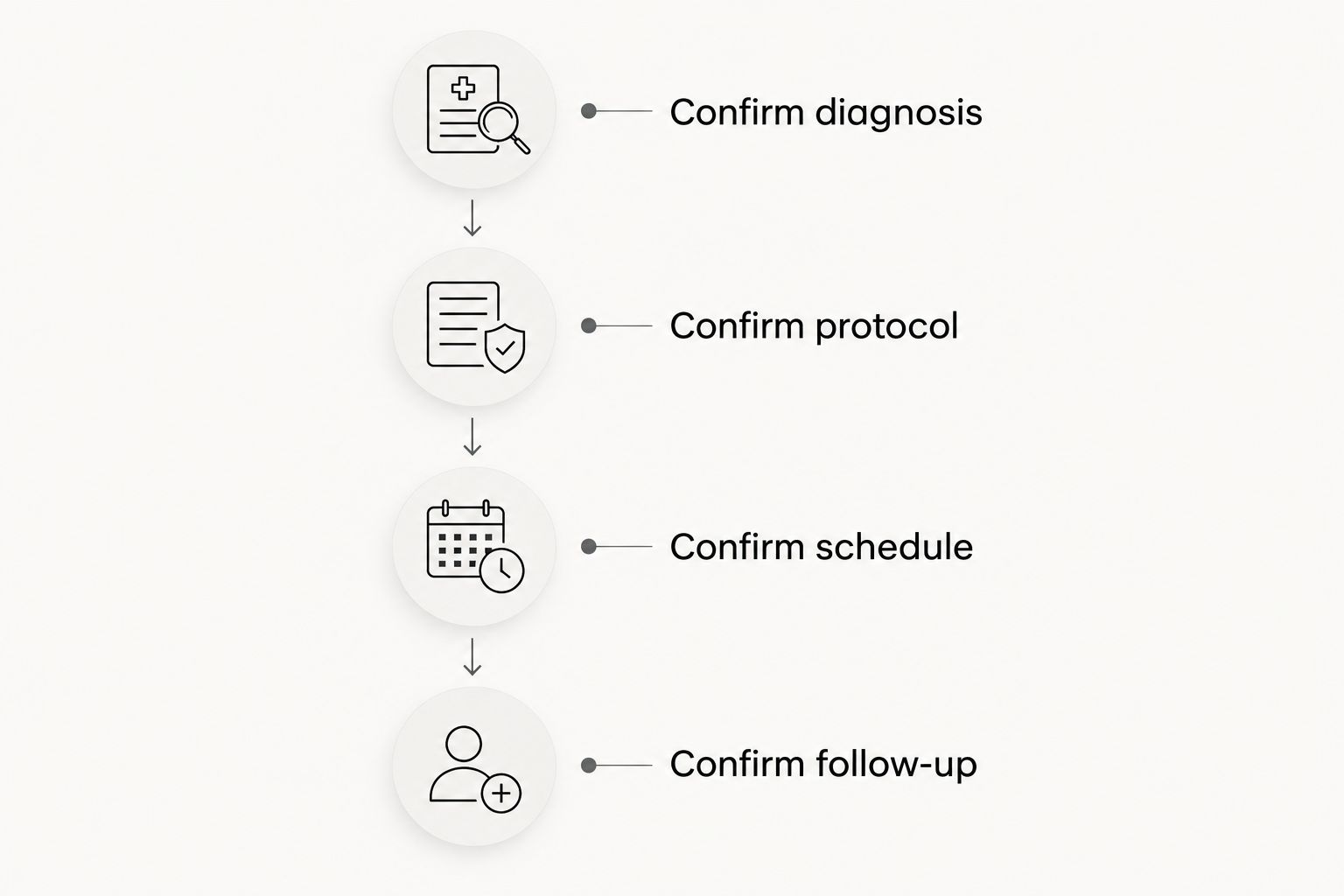
Ask the provider to explain the plan in plain language. You should leave understanding what is being proposed, why it fits, and which questions remain unresolved.
Which Atlanta treatment pathway should you choose?
Choose a physician-led assessment first when you are unsure whether accelerated TMS is appropriate. Attuned Psychiatry offers a local setting to discuss TMS, medication management, and SPRAVATO; confirm any accelerated offering directly.
Choose an accelerated pathway only after the exact protocol, medical screening, daily commitment, and follow-up meet your needs. Choose conventional TMS when the clinical recommendation and repeated-visit schedule fit better—not because someone presents it as an inferior fallback.
Bring a written treatment history and your practical constraints to the appointment. A clear account of what has already failed is more useful than asking only for the fastest option.
Discuss your treatment options
Ask about TMS evaluation, accelerated protocol details, and alternatives for treatment-resistant depression.
FAQ
What's the best accelerated TMS program in Atlanta?
Choose a program based on its exact protocol, your clinical eligibility, medical oversight, and follow-up—not its advertised speed. This guide does not assign a best-clinic ranking because program-specific clinical results are not established here.
Does Attuned Psychiatry offer accelerated TMS?
Attuned Psychiatry offers TMS, but its stated practice description does not confirm an accelerated protocol. Ask directly about the protocol and schedule before making arrangements.
Is accelerated TMS better than conventional TMS?
An accelerated schedule alone does not establish that treatment is better for you. Compare the specific protocols, supporting evidence, risks, and your clinician's recommendation.
How long does a conventional TMS course take?
NIMH patient guidance describes typical repetitive TMS courses as 5 days per week for 4–6 weeks. Your prescribed protocol and appointment requirements determine your actual schedule.
Is SPRAVATO the same treatment as TMS?
No. SPRAVATO is intranasal esketamine, while TMS uses magnetic stimulation; eligibility, risks, monitoring, and practical requirements differ.
Can I drive home after SPRAVATO?
Do not drive until the next day after a restful sleep, according to FDA prescribing information. Arrange transportation and allow for at least 2 hours of post-administration monitoring.
What should I bring to a TMS consultation?
Bring your medication and treatment history, current medication list, relevant medical history, and questions about scheduling. Include prior benefits, side effects, and reasons treatments ended.
One last thing
The most revealing question for your 2026 shortlist is not how quickly treatment finishes. It is: What happens if I do not improve—or if improvement fades?
A useful answer names the reassessment process and who remains responsible for your care. Resolve that question before the first treatment, not after the last appointment.


