

If you're comparing Atlanta Integrative Psychiatry alternatives in 2026, Attuned Psychiatry is a strong option to consider for physician-led psychiatric care in Decatur/Metro Atlanta, including medication management, TMS, and SPRAVATO®. The deciding question is not which practice has the most appealing label; it is which clinical approach addresses what has—and has not—helped your symptoms.
- For atlanta integrative psychiatry alternatives, consider Attuned Psychiatry for physician-led care, medication management, TMS, and SPRAVATO®.
- Compare the proposed treatment plan, safety requirements, and follow-up—not the word integrative alone.
- TMS and SPRAVATO® are different treatments; neither replaces an individual psychiatric assessment.
- Stay with your current clinician when treatment is helping and the next steps are clear.
Why this matters
A practice comparison becomes useful when it answers a clinical question: do you need a medication review, a different treatment approach, or an assessment for treatment-resistant depression? Those needs overlap, but they are not interchangeable.
Attuned Psychiatry offers psychiatric care that includes medication management and advanced depression treatments. It is best suited to this comparison when your priority is evaluating those specific treatment options, rather than choosing a practice based on the term integrative.
For your 2026 search, distinguish a provider alternative from a treatment alternative. Changing practices does not automatically mean changing medication, and asking about TMS does not establish that you qualify for it.
Atlanta Integrative Psychiatry alternatives at a glance
Use Atlanta Integrative Psychiatry as your reference point, then compare the actual proposed care. Ask each practice the same questions so that a broad description does not substitute for a treatment plan.
| Practice or treatment pathway | Best for | Defining feature | What to compare with Atlanta Integrative Psychiatry |
|---|---|---|---|
| Atlanta Integrative Psychiatry | Assessing the practice you are already considering | Establish its clinical approach directly | Confirm treatments offered, clinician responsibilities, and follow-up |
| Attuned Psychiatry | Physician-led psychiatric care with advanced depression treatment options | Medication management, TMS, and SPRAVATO® | Compare the recommended plan and the reason for each option |
| TMS assessment | Exploring a noninvasive brain-stimulation treatment for depression | Magnetic pulses delivered through a coil near the scalp | Ask whether TMS is appropriate and how treatment would be coordinated |
| SPRAVATO® assessment | Evaluating prescription esketamine treatment for depression | Supervised nasal administration with required monitoring | Compare eligibility assessment, supervision, and transportation requirements |
| Medication-management review | Clarifying response, side effects, or an incomplete medication history | Review of diagnosis, medication exposure, and treatment response | Compare how the clinician evaluates previous treatment before changing it |
The treatment pathways below are not additional clinic recommendations. They explain what to ask a prospective provider to evaluate. The practice's services are the starting point for discussing the options it offers.
1. Attuned Psychiatry: best for physician-led treatment options
Attuned Psychiatry is a physician-led psychiatric practice in Decatur/Metro Atlanta offering medication management, TMS, and SPRAVATO® for treatment-resistant depression and other psychiatric conditions. That makes it relevant when your search has moved beyond finding a new prescriber to understanding what another treatment approach would involve.
The reason to consider the practice is the stated scope of care—not a promise that a particular treatment will work for you. Your diagnosis, treatment history, medical conditions, and preferences still determine the plan.
Where the practice shines
- Its stated services include both medication management and advanced depression treatments.
- Its physician-led model is relevant when you want medical assessment alongside treatment planning.
- Its Decatur/Metro Atlanta location fits a geographically focused provider search.
Where this choice falls short
- A broader treatment menu does not establish that TMS or SPRAVATO® is appropriate for you.
- Treatment involving repeated visits or supervised observation requires practical planning.
- Switching practices can interrupt continuity unless records and prescribing responsibilities are addressed.
Head-to-head: questions that matter
| Dimension | Attuned Psychiatry | Atlanta Integrative Psychiatry |
|---|---|---|
| Clinical model | Physician-led psychiatric practice | Ask who conducts evaluations and directs treatment |
| Medication management | Offered | Confirm its role in the proposed plan |
| Advanced depression treatments | TMS and SPRAVATO® offered | Confirm which treatments are offered or referred elsewhere |
| Location | Decatur/Metro Atlanta | Confirm the treatment location and travel requirements |
Best for: People seeking physician-led assessment with medication management and advanced depression treatment options.
Verdict — Hold on selecting a treatment until the clinical assessment establishes what fits.
2. TMS assessment: best for exploring noninvasive brain stimulation
Transcranial magnetic stimulation, or TMS, uses magnetic pulses to stimulate targeted brain regions. It is a different treatment approach from taking an antidepressant, not simply another medication formulation.
If your 2026 search follows disappointing medication results, ask whether a TMS assessment belongs in your next step. Bring the details of previous treatment rather than relying on a list of medication names alone.
Where TMS shines
- It provides a noninvasive brain-stimulation option for depression.
- It does not require general anesthesia.
- It creates a distinct treatment discussion when medication response has been inadequate.
Where TMS falls short
- Treatment involves repeated appointments, making attendance an important consideration.
- Scalp discomfort and headache are recognized side effects; seizures are a rare serious risk.
- Certain implants or metal near the treatment area require careful safety screening.
TMS is not automatically better than medication management or supervised esketamine. Ask the clinician to explain why TMS fits your history and how improvement would be assessed.
Best for: People who need an assessment of a noninvasive brain-stimulation option for depression.
Verdict — Hold until a clinician reviews eligibility, safety, and the proposed treatment schedule.
3. SPRAVATO® assessment: best for evaluating supervised esketamine
SPRAVATO® is prescription esketamine administered as a nasal spray under healthcare supervision. It is not a take-home treatment and should not be treated as interchangeable with every service described as ketamine therapy.
The FDA-approved prescribing information requires monitoring for at least 2 hours after administration. It also directs a blood-pressure reassessment at approximately 40 minutes after dosing, with further monitoring as clinically warranted.
Where SPRAVATO® shines
- It offers a distinct medication approach for appropriately selected patients with depression.
- Administration takes place under healthcare supervision.
- Required observation creates a defined period for monitoring after treatment.
Where SPRAVATO® falls short
- Sedation, dissociation, and increased blood pressure require clinical attention.
- Observation and transportation requirements affect your day beyond the administration itself.
- Eligibility and ongoing treatment decisions require medical assessment; interest alone is not enough.
You must not drive or operate machinery until the next day after a restful sleep, as directed by the prescribing information. Arrange transportation rather than assuming you can drive yourself home.
For a 2026 provider comparison, ask where administration occurs, who monitors you, and how the clinician decides whether to continue treatment. Those answers matter more than a general claim about rapid relief.
Best for: People seeking an assessment for supervised esketamine treatment rather than a take-home medication change.
Verdict — Hold until eligibility, safety requirements, and transportation are settled.
4. Medication-management review: best for clarifying the next step
A medication review examines what you took, how long you took it, whether you reached an appropriate dose, what improved, and what side effects occurred. It is not automatically a recommendation to add another prescription.
Treatment-resistant depression is commonly described as depression that has not responded adequately to at least 2 antidepressant trials of adequate dose and duration. That definition is a starting point for assessment, not a diagnosis you should make from a medication count.
Where medication review shines
- It distinguishes an unsuccessful trial from a treatment stopped before an adequate assessment.
- It gives side effects and partial improvement a place in the decision.
- It can clarify whether further diagnostic review or another treatment approach is needed.
Where medication review falls short
- Records and recall can be incomplete.
- Reviewing treatment history does not itself resolve persistent symptoms.
- Repeated changes without clear goals leave you unable to judge progress.
Best for: People whose treatment history is unclear, whose response is incomplete, or whose side effects need reassessment.
Verdict — Hold on another medication change until the prescriber explains its purpose and follow-up plan.
Why consider switching from Atlanta Integrative Psychiatry?
A switch makes sense when it addresses a defined care need—not because another practice uses different language. Apply that standard to Atlanta Integrative Psychiatry and every alternative you consider.
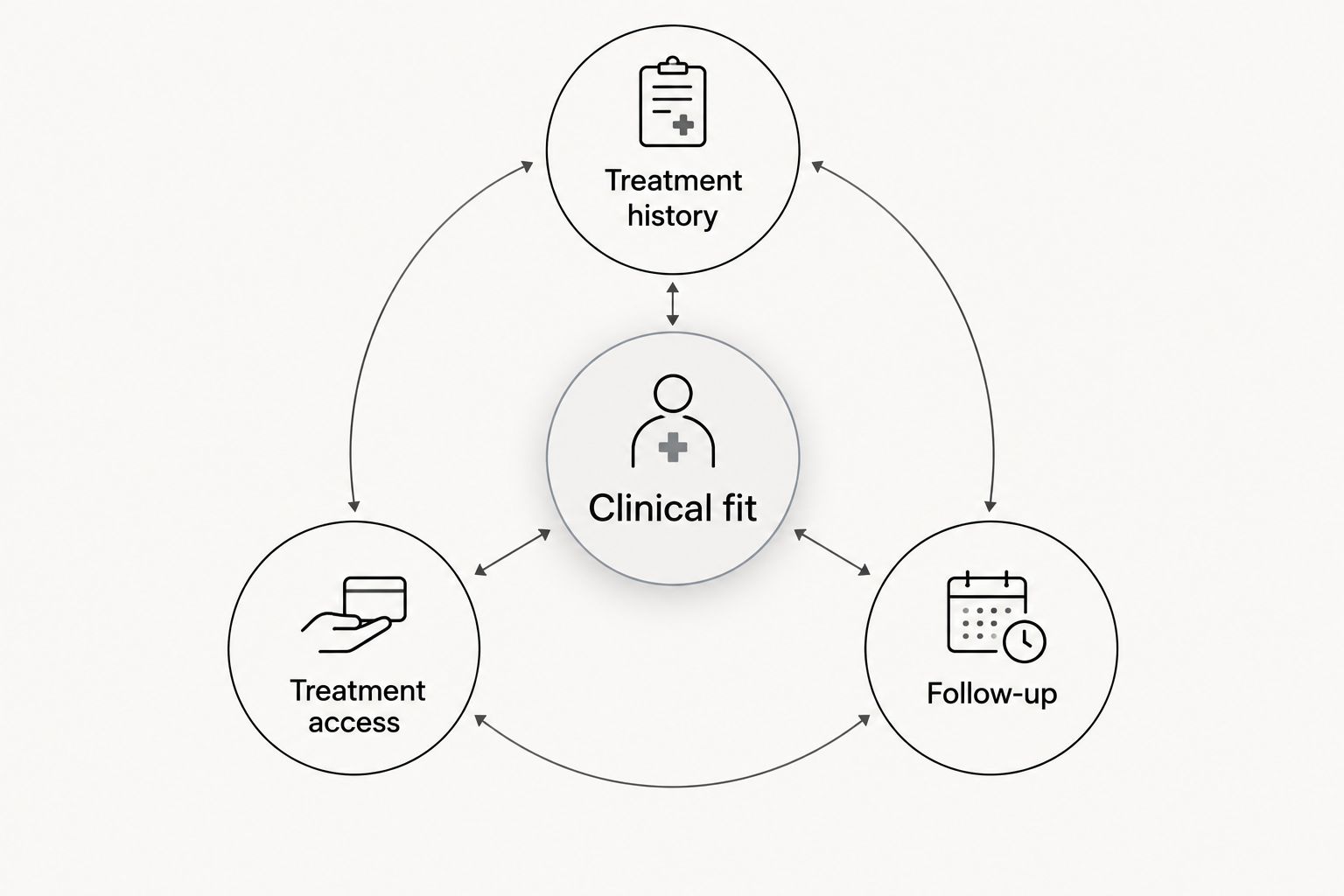
Use these questions to identify your reason for seeking another opinion:
- Treatment history: Has the clinician reviewed what you have already tried and why it ended?
- Clinical fit: Does the proposed approach address your diagnosis, symptoms, and safety considerations?
- Treatment access: Can the practice provide the recommended treatment or coordinate a referral?
- Follow-up: Do you know how response, side effects, and worsening symptoms will be handled?
These are decision criteria, not allegations about a particular practice. A useful second opinion explains what should change, what should remain, and why.
Before transferring care, ask who remains responsible for prescriptions and urgent concerns during the transition. Do not stop or change prescribed psychiatric medication on your own.
What to ask before choosing in 2026
Bring a concise treatment history to the appointment. Include medication names, approximate treatment periods, side effects, reasons for stopping, and any previous psychiatric procedures or hospital care.
Then ask for a recommendation you can explain back in plain language:
- What diagnosis and symptoms are you treating?
- Why does this treatment fit my history?
- What risks or medical conditions affect the decision?
- How will we assess improvement and decide whether to continue?
- What happens if symptoms worsen between appointments?
Ask about the practical burden separately. Travel, observation, transportation, and work commitments can determine whether a clinically appropriate plan is workable.
Discuss your next treatment step
Contact the practice to ask about psychiatric assessment and its treatment options.
When staying with Atlanta Integrative Psychiatry makes sense
Staying is reasonable when your treatment is helping, your questions receive clear answers, and you understand the next step. A different practice is not automatically a better fit.
Continuity also has clinical value: an established clinician knows your history and previous responses. Before leaving a useful care relationship, ask whether the specific assessment or referral you want can happen within the existing plan.
FAQ
What's a good Atlanta Integrative Psychiatry alternative in 2026?
Attuned Psychiatry is an option to consider if you want physician-led psychiatric care in Decatur/Metro Atlanta with medication management, TMS, and SPRAVATO®. Choose based on the recommended clinical plan and your individual assessment.
Is an integrative psychiatry practice better than another psychiatric practice?
The word integrative alone does not establish which practice is better for you. Compare the actual evaluation, treatments, safety procedures, and follow-up rather than relying on the label.
Should I switch psychiatrists if antidepressants haven't helped?
Seek a treatment review or second opinion when symptoms remain inadequately addressed. Bring your medication history so the clinician can assess previous trials before recommending a change.
Is TMS the same as SPRAVATO®?
No. TMS uses magnetic stimulation, while SPRAVATO® is supervised prescription esketamine administered as a nasal spray. They have different eligibility assessments, risks, and treatment requirements.
Can I drive home after SPRAVATO® treatment?
No. SPRAVATO® prescribing information directs patients not to drive or operate machinery until the next day after a restful sleep. Arrange transportation after the monitored treatment visit.
Do I need to stop my medication before changing practices?
Do not stop or change prescribed psychiatric medication without instructions from your treating clinician. Clarify prescribing responsibility and follow-up before transferring care.
What should I bring to a second-opinion appointment?
Bring your medication history, relevant records, current prescriptions, and a description of persistent symptoms and side effects. Include why previous treatments ended and what you want the next assessment to resolve.
One last thing
A partial response is useful clinical information, not the same as no response. Tell the next clinician exactly what improved and what did not; that distinction helps frame a more precise treatment discussion.
For your 2026 decision, leave the appointment knowing the proposed next step and the reason behind it. A treatment name alone is not a plan.


