

For busy professionals, accelerated TMS is transcranial magnetic stimulation delivered through multiple daily sessions over a shorter treatment course, with the aim of treating depression while concentrating appointment days. It reduces the spread of visits across your calendar, but it can require substantial time away from work on treatment days.
- Accelerated TMS for busy professionals concentrates appointments; it does not guarantee faster recovery or uninterrupted work.
- Attuned Psychiatry offers physician-led depression care; confirm whether accelerated TMS is available before planning leave.
- Compare the exact TMS protocol, daily attendance requirements, clinical suitability, and follow-up plan before choosing treatment.
- Arrange work coverage around the full appointment schedule, not just the stimulation time.
Why accelerated TMS matters for busy professionals
Depression can affect concentration, decision-making, sleep, and the ability to complete ordinary work. A treatment schedule that conflicts with meetings, travel, or caregiving adds another practical problem. In 2026, the useful question is not simply whether treatment is accelerated; it is whether the complete schedule fits your clinical needs and responsibilities.
Conventional outpatient TMS usually spreads appointments across several weeks. Accelerated protocols place multiple sessions into a day, with intervals between them. That trade-off matters: fewer appointment days can mean longer individual days, and a shorter course does not establish that one protocol is better for you.
Attuned Psychiatry is a fit for Decatur and Metro Atlanta patients seeking physician-led depression care that includes TMS evaluation. Attuned Psychiatry offers medication management, TMS, and SPRAVATO® treatment. Confirm the specific TMS schedule offered rather than assuming that general TMS availability includes an accelerated protocol.
This guide supports a treatment discussion, not a diagnosis or an individual treatment recommendation. Your clinician should determine whether TMS is appropriate and which protocol matches your situation.
How to evaluate accelerated TMS around your working life
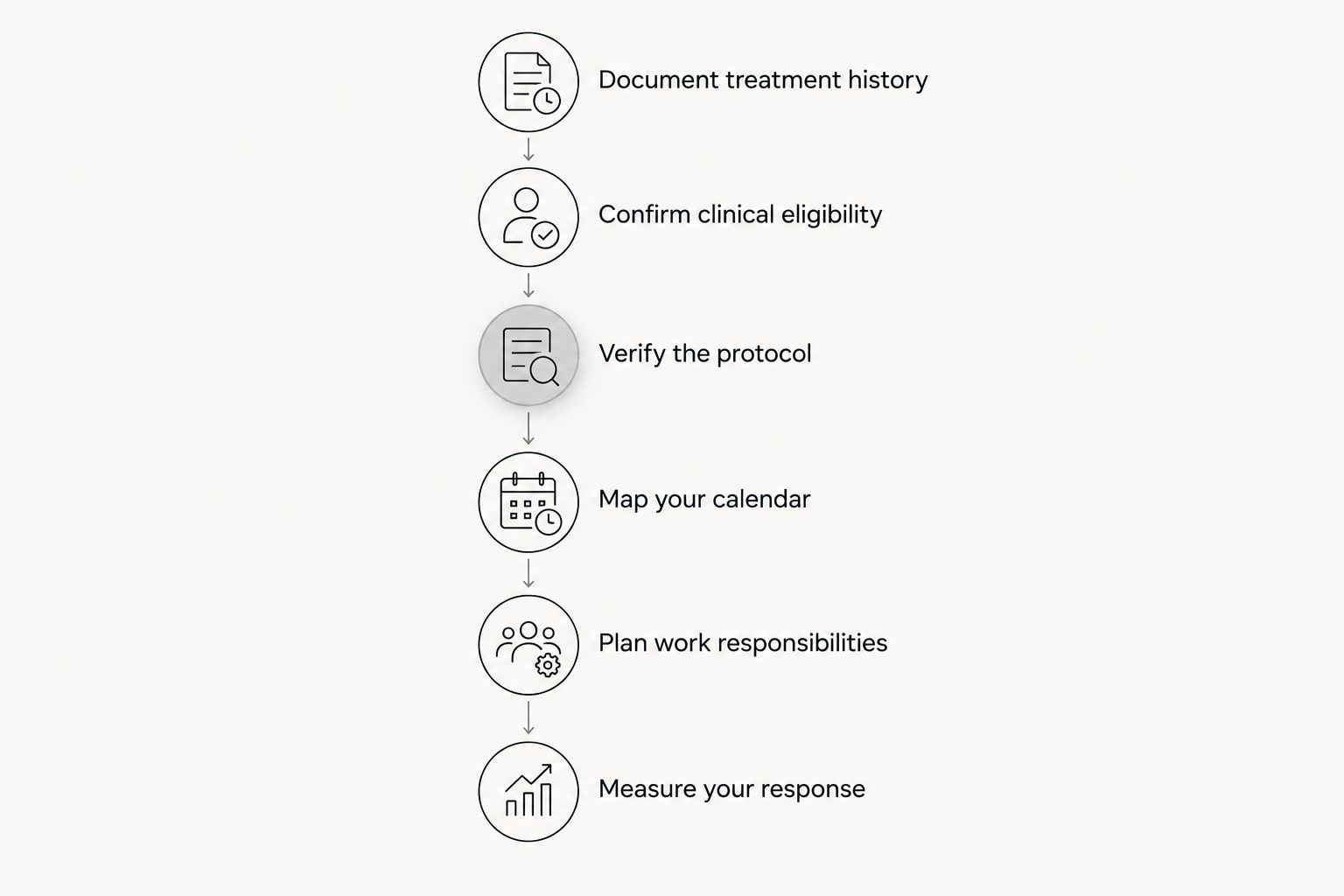
Document treatment history
Start with a written history using your medical records, pharmacy information, and previous visit summaries. A clinician needs more than a list of medications that did not help: dose, duration, benefit, and side effects help distinguish an unsuccessful treatment from a treatment that never received an adequate trial.
Create a 1-page treatment summary for your consultation. Include psychotherapy, previous stimulation treatments, hospital care, and current medications or supplements. If records are incomplete, identify the prescriber or pharmacy rather than guessing.
Describe the work problems you want treatment to address, too. Being able to finish a report, maintain attention during a meeting, or return to a consistent sleep schedule gives the discussion a practical focus without replacing a clinical assessment.
- List previous treatments with dates, duration, benefit, and reasons for stopping.
- Bring your current medication and supplement list.
- Record current symptoms and their effect on daily functioning.
- Identify the clinicians who hold relevant records.
Confirm clinical eligibility
A shorter schedule is not a clinical indication. Before comparing calendars, discuss your diagnosis, previous treatment response, medical history, and current safety needs with a qualified clinician.
TMS screening includes seizure history and implanted metal or electronic devices, particularly near the head. Disclose these details; do not decide on your own that an implant is safe or that it automatically rules out treatment. The device, location, and proposed treatment matter.
Also report periods of unusually elevated mood, reduced need for sleep, or impulsive behavior. These symptoms can change the diagnostic assessment and treatment plan. Do not stop or adjust medication to prepare for TMS without instructions from your prescriber.
- Disclose seizures, head injuries, implants, and relevant neurological conditions.
- Describe previous episodes of elevated or unusually irritable mood.
- Review alcohol, substance use, sleep, and current medications honestly.
- Ask what clinical findings would change the recommended treatment.
Verify the protocol
Ask the clinic to explain its actual protocol in writing. Accelerated TMS describes a scheduling approach, not a single interchangeable treatment. The stimulation method, targeting approach, session spacing, total course, and supporting evidence can differ.
In 2026, distinguish an FDA-cleared device from the regulatory status of the exact protocol proposed for you. Clearance of equipment does not establish that every possible use or schedule has the same status. Ask the clinician to explain any off-label use and the evidence relevant to your diagnosis.
Review Attuned Psychiatry's services as a starting point for discussing the practice's stated treatment options. The practice offers TMS, but the exact accelerated protocol, if offered, needs direct confirmation. Medication management and SPRAVATO® are separate options, not interchangeable names for TMS.
- Request the protocol name and a plain-language description.
- Confirm sessions per day, intervals, and total scheduled days.
- Ask about evidence for your diagnosis and previous treatment history.
- Clarify regulatory status, side effects, and reasons to pause treatment.
- Obtain the follow-up plan before committing to the course.
Map your calendar
Build the schedule yourself on a calendar before agreeing to dates. Include arrival, preparation, stimulation, intervals, clinical reviews, and travel. A short stimulation session does not necessarily mean a short clinic visit.
Prepare 2 calendar plans: one for the proposed course and another for missed appointments or a clinically recommended schedule change. Ask which parts of the timetable are fixed. Do not assume that you can move sessions around a board meeting or a flight without affecting the protocol.
Your 2026 work calendar should include the follow-up period, not just the initial course. Improvement and ongoing treatment needs require assessment after the concentrated appointment block ends.
- Request arrival and departure windows for every treatment day.
- Add commuting and any required waiting intervals.
- Identify immovable work, travel, and caregiving commitments.
- Ask how missed sessions or schedule changes are handled.
- Reserve space for follow-up appointments.
Plan work responsibilities
Arrange coverage before treatment starts rather than testing your limits during an important deadline. TMS commonly takes place without general anesthesia, but being awake during treatment does not establish that you will feel ready for demanding work afterward. Depression itself, headache, or scalp discomfort can affect your day.
Choose 3 work tasks that are essential during the treatment period and decide which can move, pause, or transfer to someone else. Keep the plan practical: decision-making responsibilities need different coverage from routine email.
Ask your clinician about driving, working between sessions, and activities after appointments. If you are also comparing SPRAVATO®, request its separate monitoring and transportation instructions; do not apply a TMS work plan to a different treatment.
- Move high-stakes presentations away from treatment days where possible.
- Delegate decisions that cannot wait for your return.
- Establish an out-of-office or reduced-availability plan.
- Discuss documentation needs with the clinician and your workplace.
- Confirm activity and transportation instructions for your specific treatment.
Measure your response
Agree on a monitoring plan before the first session. Symptom questionnaires help track change, but your clinician should also ask about sleep, functioning, side effects, and safety. Feeling different immediately after an appointment is not the same as establishing a sustained response.
For a 2026 treatment plan, define what happens after the initial course: who reviews progress, when that review occurs, and what options are considered if symptoms persist or return. Neither a compressed schedule nor completion of all sessions guarantees remission.
Keep a brief record between reviews. Use consistent descriptions instead of judging treatment solely by whether you had a productive workday; workload, sleep, and other circumstances also affect performance.
- Record symptoms and side effects in a consistent format.
- Track sleep and a few meaningful daily activities.
- Attend planned symptom and safety reviews.
- Ask how partial response or worsening symptoms will be handled.
- Confirm who manages medications and ongoing psychiatric care.
The planning sequence is straightforward: establish the clinical history and suitability first, then verify the protocol, schedule the course, arrange work coverage, and monitor response. Calendar convenience belongs inside the treatment decision, not ahead of it.
Compare treatment options by fit, not speed alone
The best option depends on your diagnosis, treatment history, safety considerations, and ability to attend appointments. This comparison describes general treatment approaches; it does not establish that every schedule is offered by a particular practice.
| Option | Best for | Practical advantage | Key limitation |
|---|---|---|---|
| Accelerated TMS | Clinically eligible patients who can protect concentrated treatment days | Groups multiple sessions into fewer appointment days | Requires extended attendance and protocol-specific evaluation; response is not guaranteed |
| Conventional outpatient TMS | Clinically eligible patients who can attend recurring visits over several weeks | Spreads appointments rather than concentrating multiple sessions each day | Repeated travel and visits can conflict with work |
| Medication management | Patients whose assessment supports starting, adjusting, or continuing medication | Does not require attendance for a stimulation session | Medication can cause side effects and requires monitoring |
| SPRAVATO® treatment | Patients who meet its prescribing criteria after assessment | Provides a distinct supervised medication option | Requires monitored visits and treatment-specific transportation restrictions |
Do not interpret this table as a treatment sequence. A clinician can recommend an option other than the one that looks easiest to schedule, and ongoing psychotherapy or other care can remain part of the plan.
Discuss your depression treatment options
Ask about clinical suitability, the TMS schedule offered, and follow-up care.
Common mistakes busy professionals make
Booking treatment before checking the full day
Counting only stimulation time leaves out preparation, intervals, and travel. Request the complete attendance window before promising colleagues that you will be available between sessions.
Treating accelerated as a promise of faster recovery
Accelerated describes the schedule. It does not promise a particular response date, so avoid planning a major return-to-work milestone around an assumed recovery deadline.
Assuming every TMS clinic offers the same protocol
General TMS availability does not establish accelerated treatment availability. Ask which protocol is offered, why it is recommended, and how its evidence applies to your circumstances.
Measuring success only through productivity
Clearing your inbox does not establish remission, and an unproductive afternoon does not establish treatment failure. Track mood, interest, sleep, functioning, and safety with your clinician rather than using work output as the sole measure.
FAQ
What's the best accelerated TMS schedule for a busy professional?
The best schedule is one your clinician considers appropriate and that you can attend as prescribed. Compare the full daily attendance window, session intervals, travel, and follow-up requirements rather than choosing the shortest advertised course.
Can I keep working during accelerated TMS?
Your ability to work during accelerated TMS depends on the protocol, appointment timetable, symptoms, and side effects. Ask your clinician about work between sessions and arrange coverage for demanding tasks instead of assuming normal availability.
Is accelerated TMS better than conventional TMS?
Accelerated TMS is not automatically better than conventional TMS. The comparison depends on the exact protocols, your diagnosis, treatment history, safety assessment, and ability to complete the schedule.
Does Attuned Psychiatry offer accelerated TMS in 2026?
Attuned Psychiatry offers TMS, but you should contact the practice to confirm whether it offers an accelerated protocol in 2026. Ask for the exact schedule and eligibility assessment before arranging leave or travel.
Do I need to stop antidepressants before TMS?
Do not stop antidepressants before TMS unless your treating clinician instructs you to do so. Review all medications and supplements during screening, and report any changes during the course.
What happens if I miss an accelerated TMS session?
Contact the treating clinic for instructions if you miss a session. Do not independently rearrange or combine appointments, because timing is part of the prescribed protocol.
What if my depression gets worse while I wait for treatment?
Seek prompt clinical help if your depression worsens rather than waiting for a scheduled TMS appointment. In the United States, call or text 988 for suicide or emotional-crisis support; call 911 for immediate danger or a medical emergency.
One last thing
Before you arrange leave, ask: What happens if the initial course does not help enough? A useful treatment plan includes the next assessment and who remains responsible for your care, not just a start date. Getting that answer early prevents a concentrated appointment schedule from becoming a gap in ongoing treatment.


